
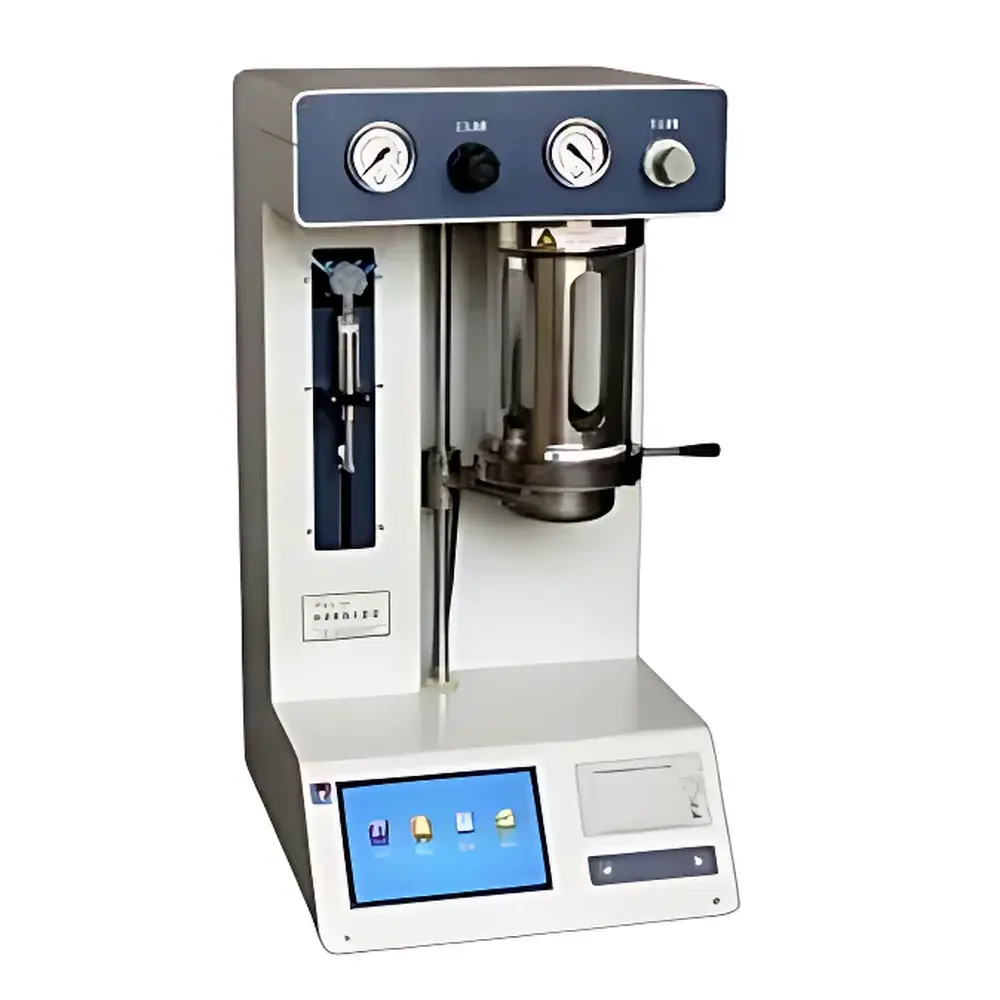
TUNE VOLT TW-2058AKL Optical Blockage Particle Counter for Engine Fuel Oil and Hydraulic Fluid Contamination Analysis
| Brand | TUNE VOLT |
|---|---|
| Model | TW-2058AKL |
| Principle | Light Obscuration (Optical Blockage) |
| Particle Size Range | 0.8 µm to 500 µm |
| Detection Channels | 8 user-configurable channels |
| Resolution | <10% |
| Repeatability | RSD <2% |
| Viscosity Limit | up to 350 mm²/s (cSt) |
| Sample Volume | 0.2–1000 mL |
| Sampling Accuracy | ±1% |
| Flow Rate | 5–80 mL/min |
| Vacuum Pressure | up to 0.08 MPa |
| Positive Pressure | up to 0.8 MPa |
| Coincidence Limit | 10,000 particles/mL |
| Power Supply | AC 220 V ±10%, 50 Hz ±10% |
| Dimensions | 400 × 340 × 660 mm |
| Weight | 23.5 kg |
Overview
The TUNE VOLT TW-2058AKL is a precision optical blockage (light obscuration) particle counter engineered for quantitative contamination analysis of engine fuel oils, hydraulic fluids, turbine oils, insulating oils, and phosphate ester-based anti-wear fluids. It operates on the principle of single-particle light extinction: as particles suspended in a liquid sample pass through a focused laser beam, they attenuate the transmitted light proportionally to their cross-sectional area. This analog signal is converted into digital pulse counts and amplitude distributions, enabling high-fidelity size-resolved particle concentration measurement per unit volume (e.g., particles/mL). Designed specifically for petroleum and aerospace maintenance laboratories, the instrument complies with core international standards including ISO 4406 (fluid cleanliness coding), ISO 11171 (calibration standard for liquid-borne particle counters), NAS 1638 (U.S. aerospace fluid cleanliness classification), GJB 420B (Chinese military standard for aviation hydraulic fluid), DL/T 432 (Chinese power industry standard), and GB/T 18854 (national standard for automatic particle counters). Its architecture supports both routine field-level screening and GLP-compliant laboratory reporting.
Key Features
- Optical detection system based on a stable semiconductor laser source with optimized beam collimation and photodiode signal conditioning for low-noise, high-dynamic-range particle sizing.
- Eight independently configurable detection channels, allowing simultaneous reporting across standardized bin boundaries (e.g., ≥4 µm(c), ≥6 µm(c), ≥14 µm(c), ≥21 µm(c), ≥38 µm(c)) per ISO 4406 or custom thresholds per customer-defined specifications.
- Integrated dual-pressure fluid handling system combining positive pressure (up to 0.8 MPa) and vacuum aspiration (down to –0.08 MPa), enabling effective degassing of viscous or volatile samples and consistent flow control across viscosity ranges up to 350 mm²/s (cSt).
- Precision syringe pump sampling mechanism with programmable volume selection (0.2–1000 mL) and calibrated flow rates (5–80 mL/min), ensuring volumetric accuracy better than ±1% and repeatability with RSD <2% under controlled temperature conditions.
- Onboard air filtration module with HEPA-grade particulate removal, minimizing ambient contamination during analysis and supporting cleanroom-compatible operation without external laminar flow hoods.
- Embedded calibration library supporting traceable alignment to ISO 11171 reference materials, with preloaded correction curves for GJB 420B, NAS 1638, ISO 4406, and GOST 17216 — all accessible via intuitive touchscreen interface.
- Full-featured embedded operating system with Chinese/English bilingual UI, real-time histogram display, automated ISO code assignment, and built-in thermal printer for immediate hardcopy reporting.
Sample Compatibility & Compliance
The TW-2058AKL accommodates a broad spectrum of petroleum-derived and synthetic lubricants, including but not limited to: mineral-based engine oils (SAE 0W–60), aviation turbine fuels (Jet A-1, JP-8), fire-resistant hydraulic fluids (e.g., Skydrol LD-4), transformer insulating oils (IEC 60296), and steam turbine oils (ISO L-TGA). Its design meets mechanical and electrical safety requirements per IEC 61010-1 and electromagnetic compatibility (EMC) criteria per IEC 61326-1. All reported particle counts are traceable to NIST-traceable calibration suspensions when used with certified reference materials. The instrument supports audit-ready data integrity protocols, including time-stamped event logs, operator ID tagging, and immutable result storage — features aligned with FDA 21 CFR Part 11 readiness when integrated with validated LIMS platforms.
Software & Data Management
Data acquisition and reporting are managed via an embedded ARM-based controller running a deterministic real-time OS. Raw pulse data, channel histograms, and calculated cleanliness codes are stored internally (≥10,000 test records) with timestamp, operator ID, and method configuration metadata. Export options include CSV, PDF, and XML formats via USB host port or RS-232 serial interface. Optional PC software provides advanced statistical trending (e.g., SPC charts, historical deviation analysis), multi-instrument fleet monitoring, and customizable report templates compliant with internal QA documentation requirements. Audit trails record all parameter changes, calibration events, and result modifications — supporting ISO/IEC 17025 and GMP-aligned quality systems.
Applications
- Condition monitoring of aircraft hydraulic systems prior to flight-line servicing (per GJB 420B Class 5–8 verification)
- Acceptance testing of new turbine oil batches in power generation facilities (DL/T 432 compliance)
- Root-cause analysis of servo-valve failures in industrial hydraulics through sub-10 µm particle profiling
- Verification of filter performance efficiency in fuel polishing skids (ISO 4572 methodology)
- Baseline contamination assessment during commissioning of marine diesel engine lubrication circuits
- Regulatory reporting for refinery off-spec product release decisions (NAS 1638 Class 4–7 thresholds)
FAQ
What particle size standards does the TW-2058AKL support out-of-the-box?
The instrument includes native calibration curves for ISO 4406, NAS 1638, GJB 420B, and GOST 17216. Custom bin configurations can be defined via the setup menu to align with proprietary or emerging industry specifications.
Can the instrument analyze opaque or highly colored oils?
Yes — the optical blockage method is less sensitive to fluid coloration than light scattering techniques; however, samples exceeding 350 mm²/s (cSt) viscosity require pre-heating or dilution per ASTM D7619 guidelines to ensure laminar flow and avoid coincidence error.
Is third-party calibration certification available?
TUNE VOLT offers optional accredited calibration services through CNAS-certified metrology laboratories, delivering traceable certificates with uncertainty budgets per ISO/IEC 17025.
Does the system meet regulatory requirements for electronic records?
While the base firmware provides full audit trail functionality, formal 21 CFR Part 11 compliance requires deployment within a validated IT environment with electronic signatures, role-based access controls, and periodic backup validation — achievable via integration with enterprise LIMS or ELN systems.





