
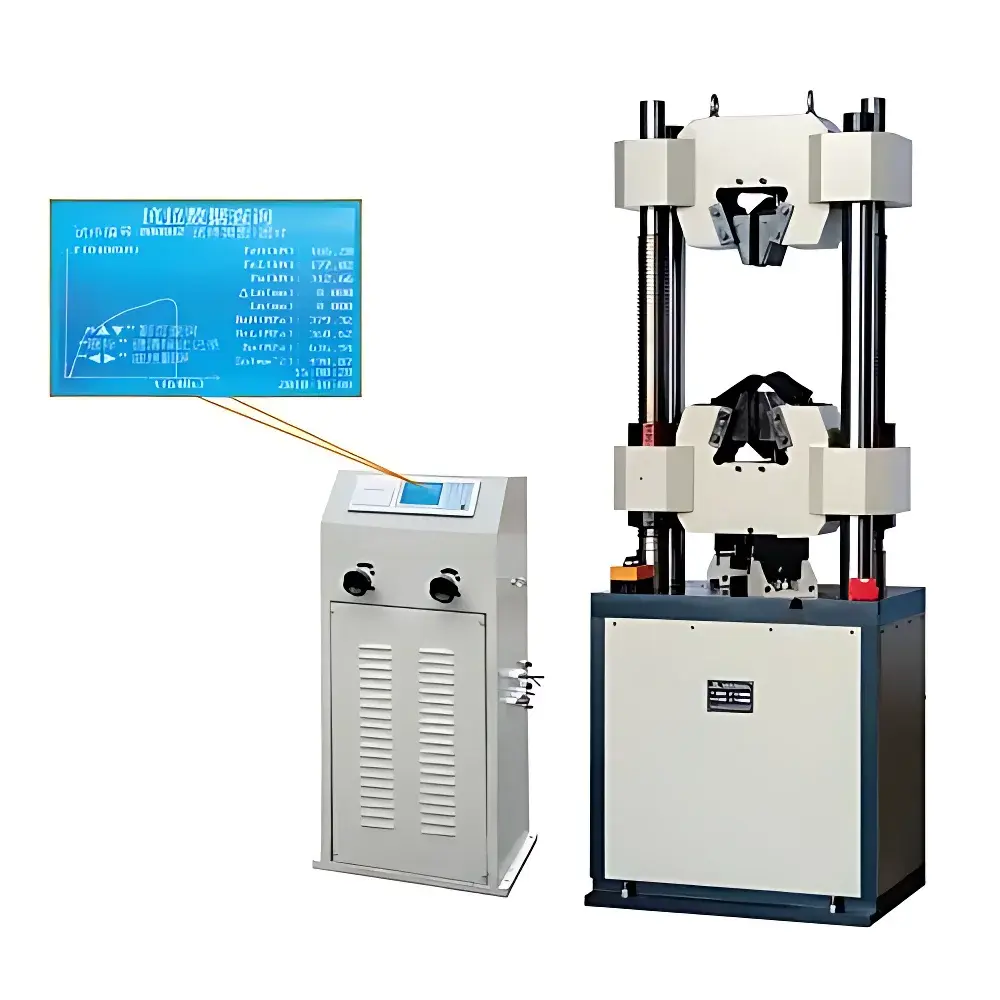
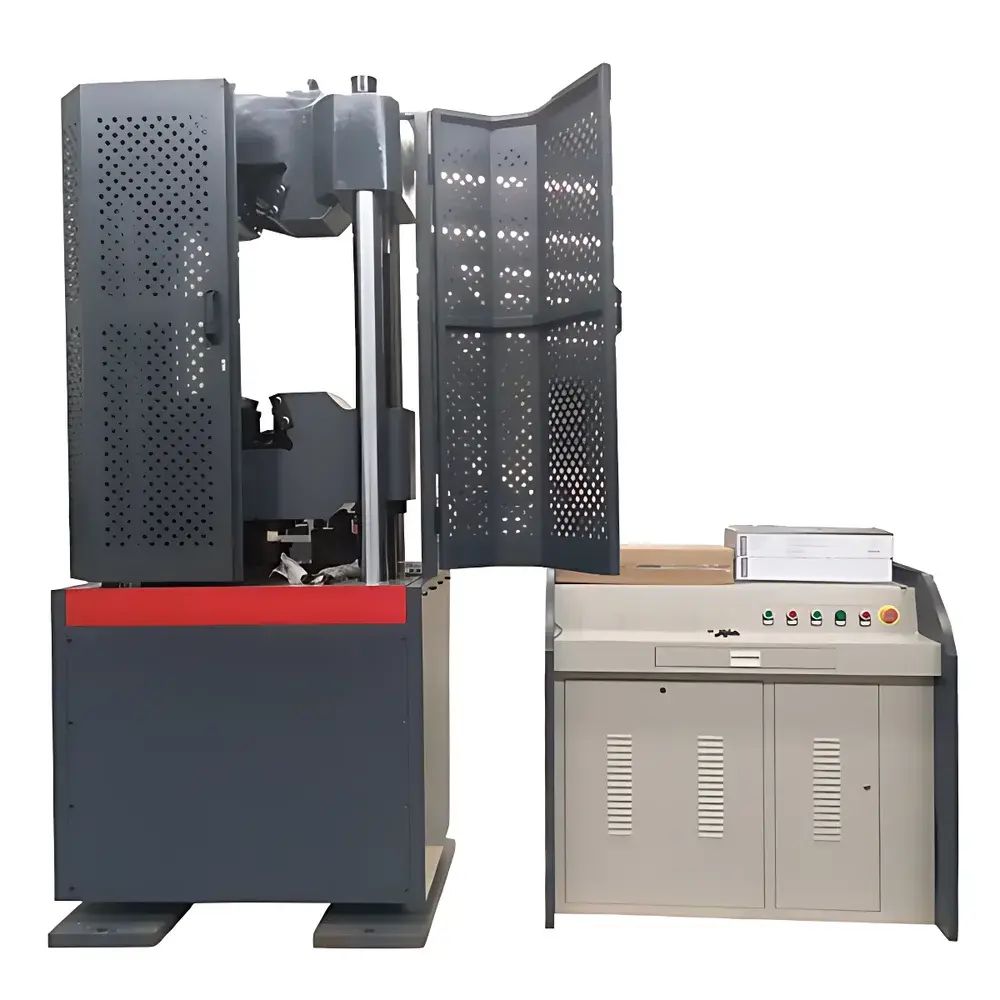
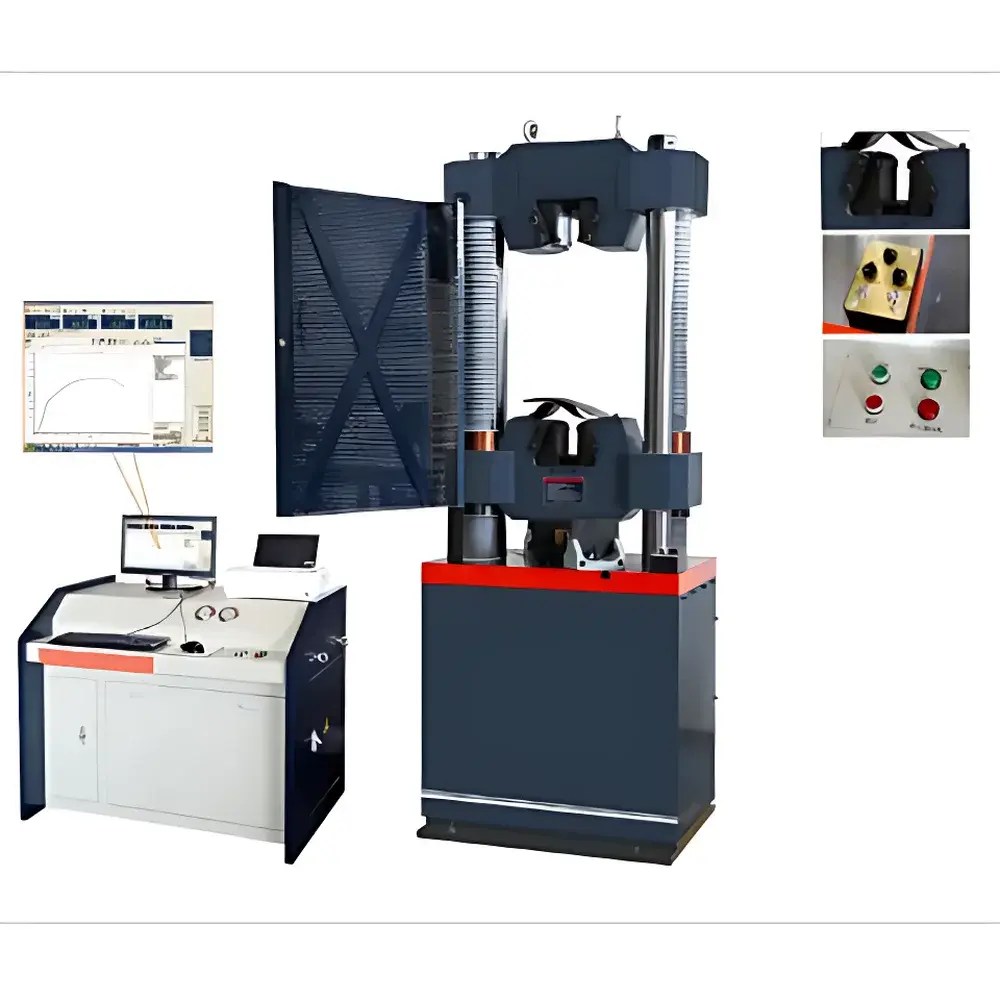
Tuofeng WE-100B Digital Display Hydraulic Universal Testing Machine
| Brand | Tuofeng |
|---|---|
| Origin | Shanghai, China |
| Manufacturer Type | Direct Manufacturer |
| Model | WE-100B |
| Instrument Type | Hydraulic Universal Testing Machine |
| Max Test Load | 100 kN |
| Force Measurement Range | 2–100% FS |
| Force Accuracy | ≤ ±1% of reading |
| Force Resolution | 0.01 kN |
| Max Tensile Space | 550 mm |
| Max Compressive Space | 450 mm |
| Piston Stroke | 150 mm |
| Round Specimen Clamping Range | Φ6–Φ26 mm |
| Flat Specimen Thickness Capacity | 0–15 mm |
| Flat Specimen Max Width | 70 mm |
| Compression Platen Diameter | φ160 mm |
| Bend Span (Two-Point) | 450 mm |
| Bend Roller Width | 120 mm |
| Bend Roller Diameter | Φ30 mm |
| Max Piston Speed | 50 mm/min |
| Clamping Method | Manual |
| Host Dimensions (W×D×H) | 720×580×1950 mm |
| Control Console Dimensions (W×D×H) | 1000×700×1400 mm |
Overview
The Tuofeng WE-100B Digital Display Hydraulic Universal Testing Machine is a statically loaded, oil-pressure-driven mechanical testing system engineered for precision force measurement and controlled displacement in tensile, compressive, and flexural testing of metallic and non-metallic materials. Based on the classical hydraulic servo principle—where a high-stability gear pump supplies pressurized oil to a vertically oriented lower-placed actuator cylinder—the machine delivers repeatable load application across its full 100 kN capacity. Its low-profile, oil-cylinder-down architecture minimizes overall height (1950 mm) and enhances portability and field deployment suitability, particularly for construction site laboratories, prefabrication QA/QC units, and civil engineering material verification workflows. The system complies with fundamental mechanical testing standards including ASTM E4 (Standard Practices for Force Verification of Testing Machines), ISO 7500-1 (Metallic Materials – Calibration of Force-Testing Machines), and GB/T 228.1 (Chinese national standard equivalent to ISO 6892-1 for tensile testing of metals).
Key Features
- Hydraulic actuation with dual-path oil circuit control: independent supply and return lines managed via manually operated send-oil and return-oil valves, enabling stable quasi-static loading without electronic servo feedback.
- Lower-cylinder design ensures compact vertical footprint and improved center-of-gravity stability during high-force compression tests on concrete cylinders or cement mortar specimens.
- Digitally calibrated load cell integrated into the load train provides real-time force readout with ≤ ±1% indication error and 0.01 kN resolution, traceable to national metrological standards.
- Liquid crystal display (LCD) console shows real-time force–time curves, peak load capture, yield point detection (for materials exhibiting distinct yield behavior), and direct calculation of ultimate tensile strength (UTS) and yield strength (Rp0.2 or ReH) upon input of specimen cross-sectional area.
- Motor-driven crosshead adjustment via chain-and-screw transmission allows precise positioning of test space for both tensile (up to 550 mm) and compression/flexure (up to 450 mm) configurations.
- Dual mechanical safety interlocks: overload protection (automatic pump shutoff at >103% FS) and upper piston travel limit switch prevent hardware damage and operator risk.
- Manual wedge-type clamping mechanism ensures consistent grip pressure across round (Φ6–Φ26 mm) and flat (0–15 mm thick × 70 mm wide) specimens without slippage under dynamic load ramping.
Sample Compatibility & Compliance
The WE-100B accommodates a broad spectrum of standardized and non-standard specimens per international and regional material testing protocols. Metallic samples conforming to ASTM E8/E8M (tension), ASTM E9 (compression), and ASTM E290 (flexure) are fully supported using supplied fixtures. Non-metallic applications include compressive strength evaluation of concrete cubes (ASTM C39/C39M), cement paste prisms (ASTM C109), and ceramic tiles (ISO 10545-3). With optional shear fixtures, it supports ASTM D732 (plastic shear) and ISO 3597 (composite interlaminar shear). All test data outputs—including force values, time stamps, and user-entered identifiers—are stored locally and printable via built-in thermal printer, satisfying basic GLP documentation requirements. While not natively 21 CFR Part 11 compliant, audit-ready records can be exported manually for inclusion in regulated quality systems.
Software & Data Management
This model operates via embedded firmware with no external PC dependency. All control logic, signal conditioning, and display rendering occur within the dedicated LCD console. Users enter specimen ID, cross-sectional dimensions, and test type via membrane keypad; the system computes and displays Rm (UTS), ReH/ReL (upper/lower yield strength), A (% elongation), and Z (% reduction in area) in real time. Test results are retained in non-volatile memory for up to 999 cycles and may be recalled, reviewed, or printed on demand. Data export is limited to hardcopy output; digital file transfer requires third-party serial-to-USB interface and custom parsing scripts. Firmware supports metric unit defaults (kN, mm, MPa) with no imperial conversion capability.
Applications
- Mechanical property validation of structural steel bars, rebar, and welded joints per ISO 15630-1 and GB/T 1499.2.
- Compressive strength assessment of precast concrete elements prior to site installation.
- Quality conformance testing of anchor bolts, lifting shackles, and chain assemblies used in scaffolding and rigging.
- Evaluation of bending stiffness and fracture load of roofing tiles, masonry units, and fiber-cement boards.
- Raw material qualification for wire rope, cable, and conveyor belt components in mining and material handling industries.
- Teaching laboratory use for undergraduate mechanics of materials courses requiring hands-on exposure to classical hydraulic testing methodology.
FAQ
What standards does the WE-100B comply with for calibration and verification?
It meets ISO 7500-1 Class 1 accuracy requirements for static force calibration and conforms to ASTM E4 procedures for periodic verification of force measurement systems.
Can the machine perform cyclic or fatigue testing?
No. The WE-100B is designed exclusively for monotonic quasi-static loading. It lacks closed-loop displacement or load control necessary for fatigue or creep testing.
Is hydraulic oil included with shipment?
Yes — a certified ISO VG 46 anti-wear hydraulic oil is pre-filled and sealed at the factory. First oil change is recommended after 500 operational hours or 12 months, whichever occurs sooner.
Does the system support automatic data logging to USB or network storage?
No. Data retention is internal only; output is limited to thermal printouts. External logging requires integration with third-party DAQ hardware and software.
What maintenance intervals are recommended for long-term reliability?
Monthly visual inspection of hoses, seals, and valve operation; quarterly torque verification of clamping wedges; annual recalibration of the load cell by an accredited metrology lab.



