
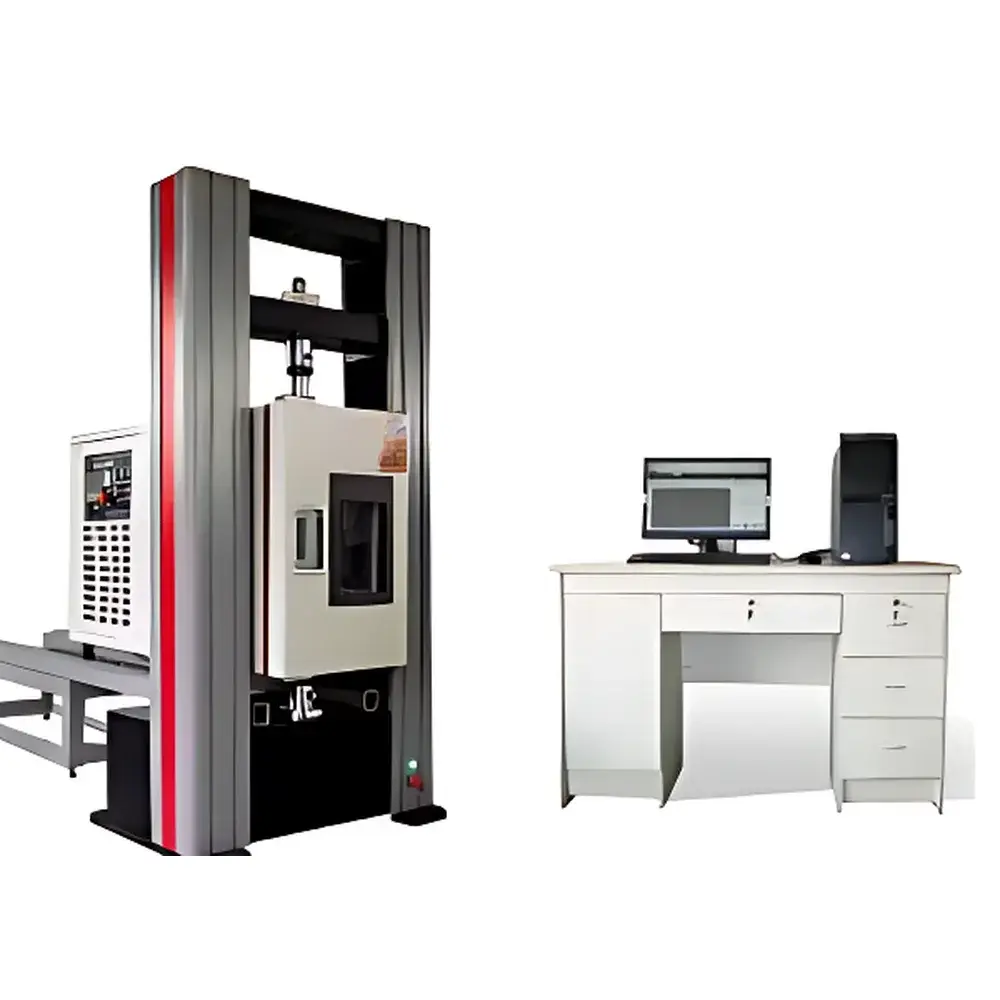
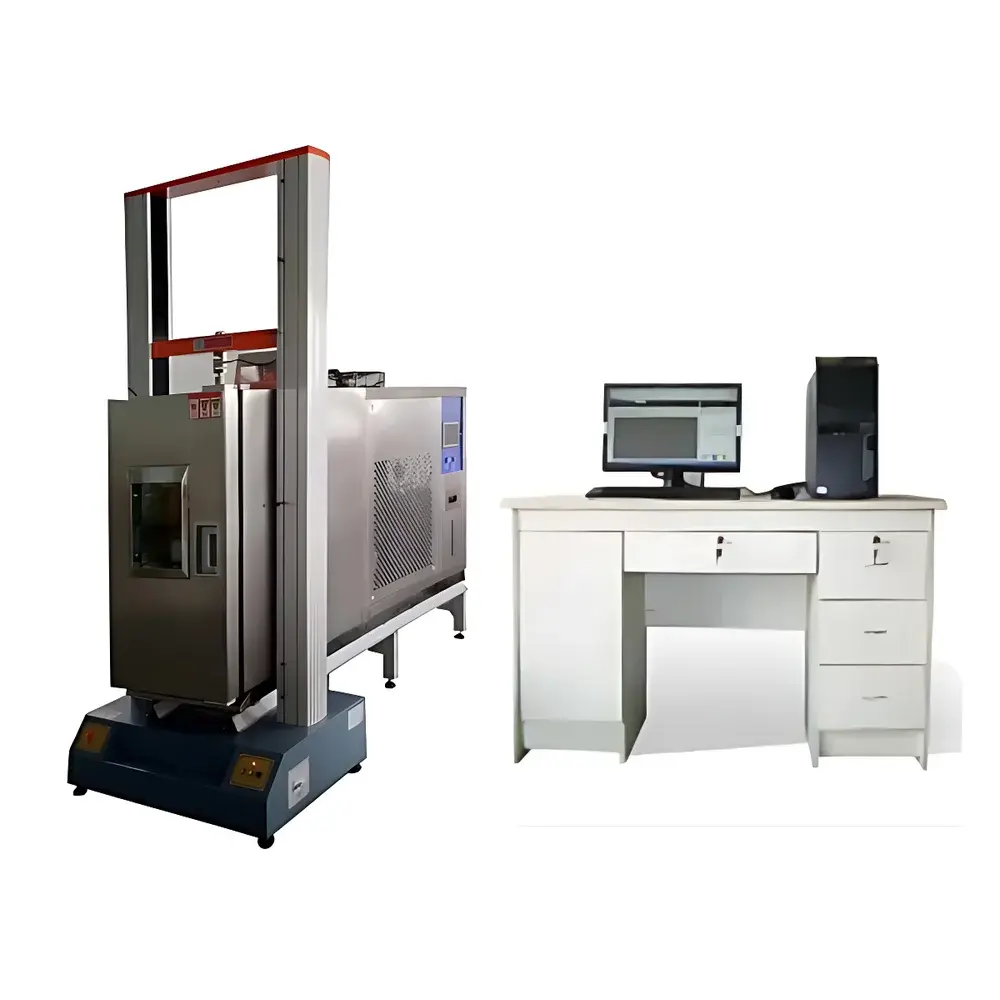
Tuofeng GDW Series High-Low Temperature Universal Testing Machine
| Brand | Tuofeng |
|---|---|
| Model | GDW |
| Type | Electromechanical Universal Testing Machine |
| Max Test Load | 5–100 kN |
| Accuracy Class | 0.5 |
| Force Measurement Range | 0.4–100% FS |
| Force Error | ±0.5% of reading |
| Force Resolution | 1/500,000 of full scale (ungraded, constant throughout) |
| Deformation Measurement Range | 0.2–100% FS |
| Deformation Error | ±0.5% of reading |
| Deformation Resolution | up to 1/300,000 |
| Displacement Error | ±0.5% of reading |
| Column Spacing | 840 mm |
| Crosshead Travel (standard) | 1000 mm |
| Host Dimensions | 1250 × 560 × 2400 mm |
| Power Supply | AC 220 V / 50 Hz ±10%, 750 W |
| Weight | ~380 kg |
| Environmental Chamber Temp Range | −40 °C to +100 °C |
| Chamber Heating Power | 1500 W |
| Chamber Internal Dimensions | 360 × 300 × 500 mm (W × D × H) |
| Chamber Construction | 304 stainless steel exterior, 316 mirror-finish stainless interior, ceramic fiber insulation |
| Temperature Control | Programmable PID with Pt100 sensors |
| Temp Uniformity | ±2 °C over 100 mm axial zone |
| Heating Rate | ≤30 min to +100 °C from ambient |
| Thermal Equilibration Time | ≤5 min (both below and above 0 °C) |
| Safety Features | Leakage current protection, overcurrent circuit breaker |
Overview
The Tuofeng GDW Series High-Low Temperature Universal Testing Machine is an electromechanical materials testing system engineered for precision mechanical characterization across extreme thermal conditions. It integrates a high-stiffness dual-column universal testing frame with a programmable environmental chamber capable of stable operation from −40 °C to +100 °C. This architecture enables standardized uniaxial tensile, compression, flexural, tear, peel, and shear testing per ISO 6892-1, ASTM E8/E21, ASTM D638/D790/D1708, GB/T 228.1, JIS Z2241, and DIN 50125. Unlike ambient-only systems, the GDW series maintains metrological integrity under thermal stress by compensating for thermal drift in load cell output, crosshead positioning, and extensometer signal acquisition—critical for evaluating polymer crystallinity transitions, metal ductility loss at cryogenic temperatures, or elastomer modulus shifts near glass transition points.
Key Features
- Modular environmental chamber with 316 mirror-finish stainless steel interior and multi-layer ceramic fiber insulation ensures thermal stability and corrosion resistance during long-duration tests.
- High-resolution force measurement system compliant with ISO 7500-1 Class 0.5: full-scale resolution of 1/500,000, constant across all ranges without range switching.
- True linear displacement feedback via non-contact encoder and calibrated screw drive, delivering position accuracy within ±0.5% of reading up to 1000 mm travel.
- Integrated digital control cabinet with backlit LCD interface supports standalone operation; also fully compatible with Windows-based PC software for automated test sequencing and real-time data streaming.
- Thermally isolated specimen access ports (50 mm diameter, dual-position) with retractable ceramic shielding minimize heat leakage and enable precise extensometer mounting inside the chamber.
- Robust mechanical design includes reinforced A-frame base, preloaded ball screws, and guided crosshead motion—optimized for low-noise, high-reproducibility testing under dynamic thermal cycling.
Sample Compatibility & Compliance
The GDW platform accommodates specimens ranging from thin polymer films (≥0.1 mm thickness) to structural metal coupons (up to 25 mm thick), with standard grips including wedge-action pneumatic, hydraulic, and vise-type configurations. All chamber-integrated fixtures are thermally anchored to minimize parasitic expansion effects. The system conforms to ISO/IEC 17025 requirements for test equipment calibration traceability and supports GLP/GMP-compliant audit trails when paired with optional 21 CFR Part 11–enabled software modules. Mechanical validation follows ISO 7500-1 and ASTM E4 procedures; thermal uniformity verification adheres to ASTM E2203 and IEC 60068-3-5 standards.
Software & Data Management
The bundled Windows-native test control software provides ISO-compliant test method templates (e.g., tensile rate control per ISO 527-2, ramp-hold profiles for creep testing), real-time curve overlay (stress–strain, load–displacement, temperature–modulus), and automatic parameter extraction—including ultimate tensile strength, yield offset (0.2%), elongation at break, Young’s modulus, and secant modulus. Raw data export is supported in CSV, XLSX, and XML formats; report generation complies with ISO 14289-1 (PDF/A-1a) archival standards. Optional add-ons include automated batch processing, multi-user role management, electronic signature workflows, and integration with LIMS via RESTful API.
Applications
This system serves as a primary mechanical evaluation tool in R&D and QA/QC laboratories across sectors where thermal-mechanical coupling governs performance: aerospace composites (e.g., carbon-fiber/epoxy response at −55 °C service temperature), automotive thermoplastics (PP, PA66 behavior near Tg), battery separator film integrity under thermal runaway conditions, biomedical polymer degradation kinetics, and high-temperature alloy weld joint assessment per ASME BPVC Section IX. Universities utilize it for graduate-level materials science instruction on viscoelastic time–temperature superposition, while national metrology institutes apply it for inter-laboratory round-robin validation of low-temperature fracture toughness protocols.
FAQ
What temperature ramp rates does the chamber support?
The chamber achieves controlled heating at up to 10 °C/min and cooling at up to 5 °C/min within its operational range, with programmable multi-segment profiles supporting hold times, dwell steps, and conditional triggers.
Can the system perform closed-loop strain control at sub-zero temperatures?
Yes—when equipped with a cryo-compatible extensometer (e.g., non-contact video or capacitive type), the controller maintains strain rate accuracy per ISO 6892-1 Annex G, with active thermal compensation applied to both load and displacement signals.
Is third-party calibration certification available?
Tuofeng provides factory calibration reports traceable to NIM (China) or NIST (US) equivalents; accredited on-site calibration services are available through ISO/IEC 17025-certified partners upon request.
How is thermal expansion of the testing frame managed during prolonged high-temperature tests?
The column assembly uses low-CTE alloy components and incorporates real-time thermal drift compensation algorithms that adjust zero offsets based on chamber wall temperature feedback from redundant Pt100 sensors.
Does the software support custom test method development?
Yes—the scripting module accepts Python-based user-defined logic for adaptive loading sequences, conditional branching, and external device synchronization (e.g., infrared thermography, acoustic emission sensors).



