
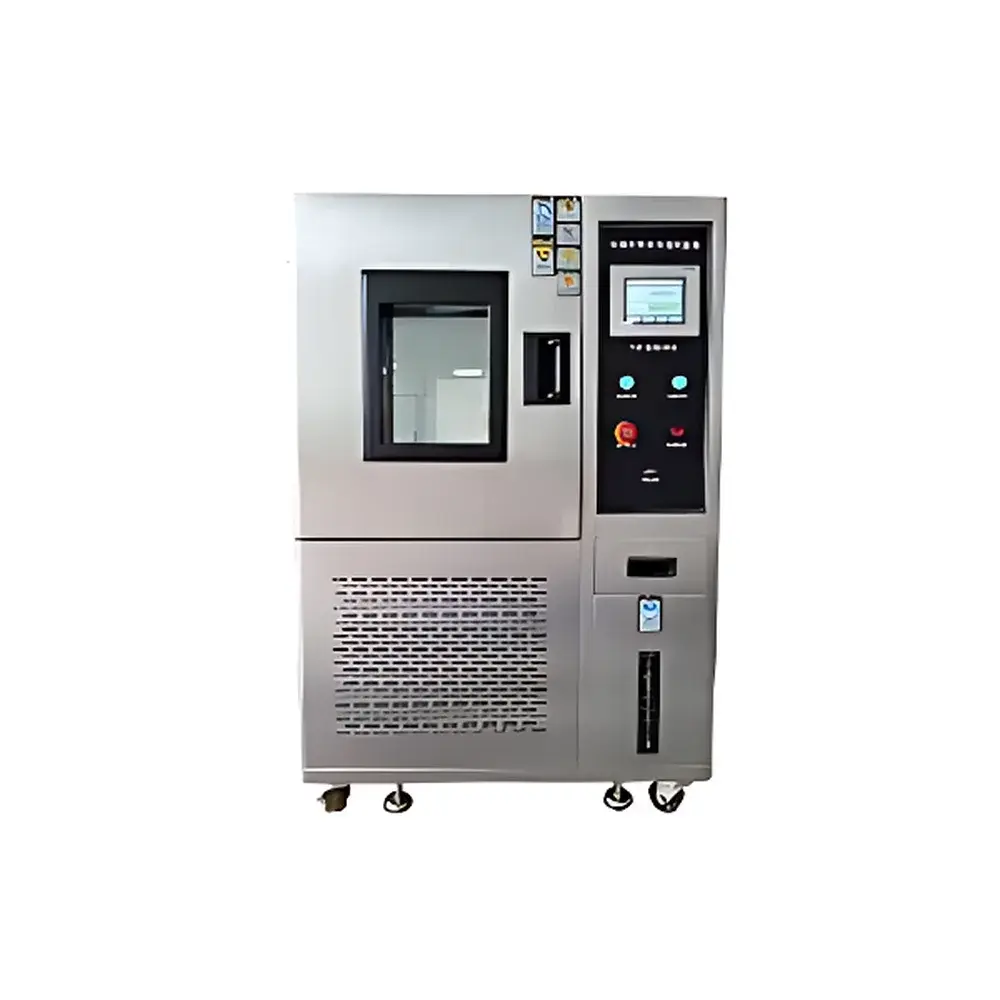
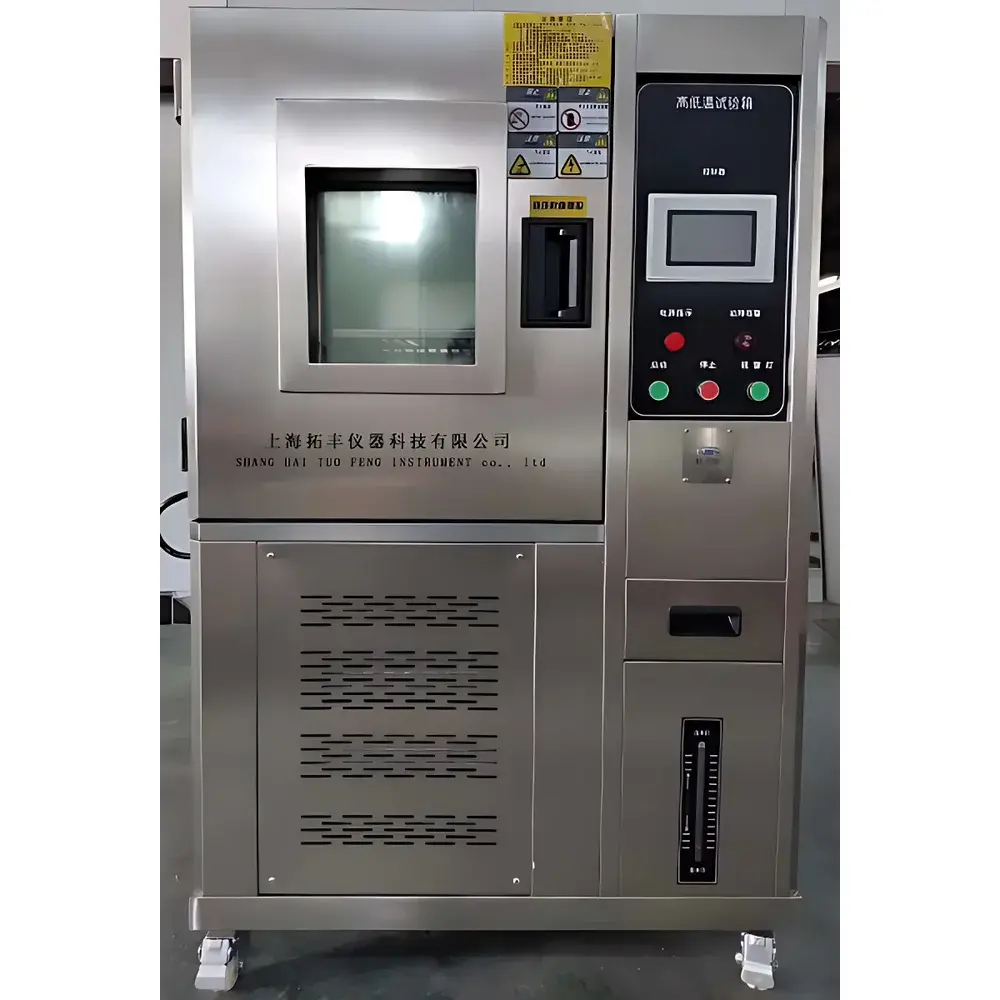
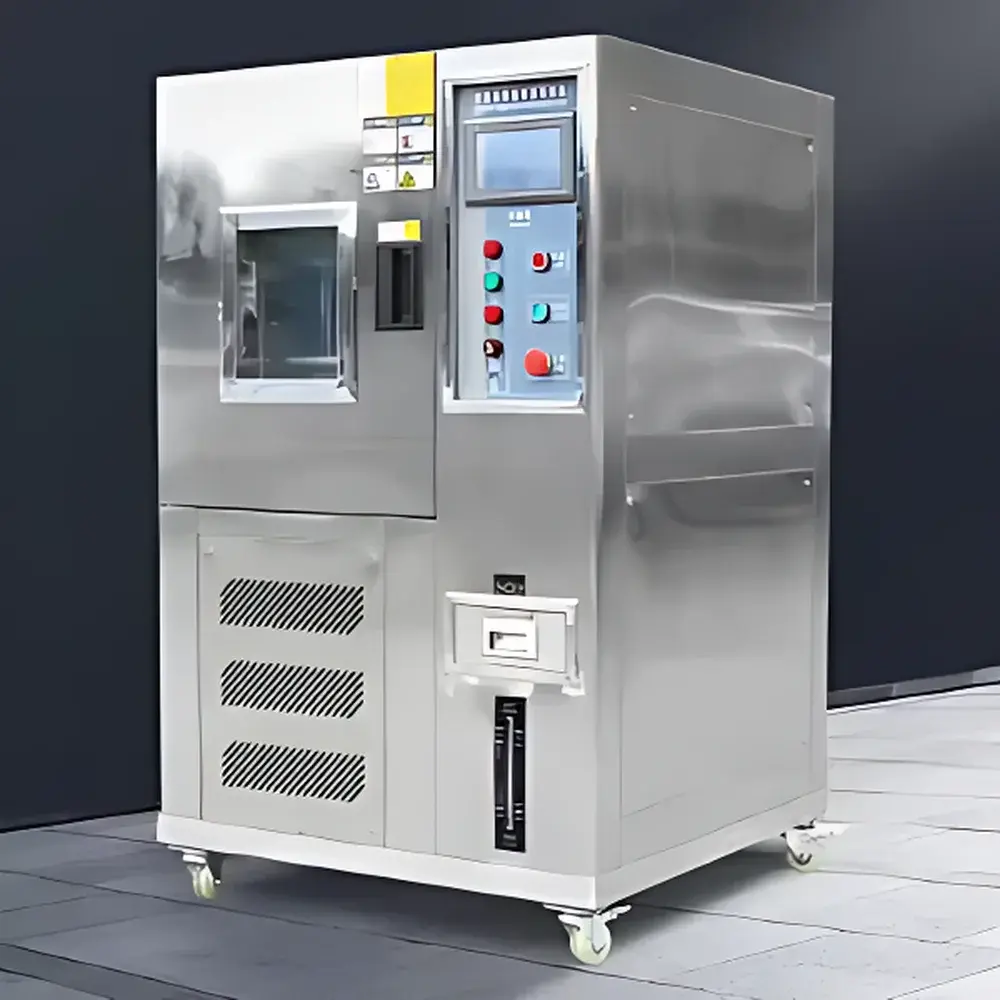
Tuofeng TF-320A High-Low Temperature and Humidity Cycling Environmental Test Chamber
| Brand | Tuofeng |
|---|---|
| Origin | Shanghai, China |
| Manufacturer Type | Direct Manufacturer |
| Model | TF-320A |
| Temperature Range | −70 °C to +150 °C |
| Temperature Uniformity | ±0.1 °C |
| Temperature Fluctuation | ±0.1 °C |
| Temperature Deviation | ±0.1 °C |
| Heating Rate | ≤60 min (−70 °C to +150 °C) |
| Cooling Rate | ≤45–80 min (depending on configuration) |
| Internal Chamber Dimensions (W×H×D) | 800 mm × 1000 mm × 1000 mm |
| Humidity Range | 20–98 % RH |
| Humidity Uniformity | ±3.0 % RH |
| Humidity Control Accuracy | ±2.0 % RH |
| Controller | TEMI (South Korea) |
| Compressor | Tecumseh (France) |
| Construction Material | SUS304 Stainless Steel |
| Insulation | High-Density Polyurethane Foam |
| Cooling System | Air/Water-Cooled Single/Dual-Stage Refrigeration |
| Power Supply | 1φ220VAC±10% 50/60 Hz or 3φ380VAC±10% 50/60 Hz (configurable) |
Overview
The Tuofeng TF-320A High-Low Temperature and Humidity Cycling Environmental Test Chamber is an engineered solution for accelerated environmental stress testing of materials and finished products under precisely controlled thermal and hygrometric conditions. Based on the principle of forced-air convection with dual-stage refrigeration and PID-controlled steam humidification, the chamber delivers high reproducibility in temperature and humidity cycling profiles—critical for validating product reliability across automotive, aerospace, electronics, medical device, and industrial component sectors. Its design complies with fundamental thermodynamic stability requirements for climatic testing, enabling stable setpoint maintenance within ±0.1 °C temperature uniformity and ±2.0 % RH humidity accuracy over the full operational range (−70 °C to +150 °C; 20–98 % RH). The chamber supports programmable ramp-soak-cycle sequences, facilitating standardized evaluation of thermal shock resistance, condensation behavior, and long-term aging effects under combined thermal-hygrometric stress.
Key Features
- High-precision dual-stage refrigeration system with French Tecumseh compressors, optimized for rapid cooling (≤45 min from +25 °C to −40 °C) and stable low-temperature hold at −70 °C
- PID-driven steam humidification system with stainless-steel water reservoir and anti-scale heating elements, ensuring consistent RH generation without droplet carryover
- SUS304 stainless-steel interior and exterior construction with high-density polyurethane insulation (≥100 mm thickness), minimizing thermal bridging and energy loss
- Korean TEMI touchscreen controller with 30 programmable segments, real-time data logging, USB export capability, and user-level access control
- Comprehensive safety architecture including high/low refrigerant pressure switches, compressor overload protection, over-temperature/over-humidity cutoffs, and fuse-integrated fault diagnostics
- Configurable power input options (single-phase 220 V or three-phase 380 V), supporting global laboratory infrastructure standards
Sample Compatibility & Compliance
The TF-320A accommodates test specimens up to 800 mm × 1000 mm × 1000 mm (W×H×D), making it suitable for PCB assemblies, automotive ECUs, lithium-ion battery modules, polymer enclosures, and packaged pharmaceutical devices. Its operational envelope meets the physical and metrological requirements of multiple international test standards, including ISO 16750-4 (road vehicles – environmental conditions), IEC 60068-2-1 (cold testing), IEC 60068-2-2 (dry heat), IEC 60068-2-30 (cyclic damp heat), and MIL-STD-810G Method 502.6 (low temperature) and Method 507.5 (humidity). For regulated industries, the system supports audit-ready data integrity when paired with optional 21 CFR Part 11-compliant software add-ons, including electronic signatures, change tracking, and immutable log archives.
Software & Data Management
The embedded TEMI controller provides local sequence programming, real-time graphing of chamber temperature and humidity, and event-triggered alarm notifications (visual and relay output). Logged data—including setpoints, actual values, alarm timestamps, and system status—is stored internally for ≥30 days and exportable via USB to CSV format for traceability. Optional PC-based software enables remote monitoring, multi-chamber synchronization, statistical process control (SPC) charting, and automated report generation aligned with GLP/GMP documentation workflows. All data files include embedded metadata (operator ID, test ID, calibration certificate reference), satisfying ISO/IEC 17025 clause 7.5.2 on result reporting integrity.
Applications
- Qualification testing of avionics hardware per DO-160 Section 4 (temperature) and Section 10 (humidity)
- Accelerated life testing of electric vehicle battery packs under extreme thermal cycling (−40 °C ↔ +85 °C, 1000 cycles)
- Validation of moisture barrier performance in flexible OLED display encapsulation layers
- Stability assessment of Class II medical devices under IEC 60601-1 Clause 10.2 (environmental testing)
- Material compatibility screening for adhesives, sealants, and conformal coatings used in outdoor telecom infrastructure
- Pre-compliance screening for consumer electronics prior to formal ISTA or JEDEC JESD22-A110 certification
FAQ
What is the maximum allowable ambient temperature for continuous operation?
The chamber is rated for uninterrupted use in environments between 5 °C and 30 °C, with relative humidity ≤85 % RH non-condensing. Operation outside this range may impair refrigeration efficiency and compromise long-term calibration stability.
Does the TF-320A support automated calibration verification?
Yes—optional NIST-traceable PT100 sensor kits and integrated self-diagnostic routines enable periodic verification of temperature and humidity sensor drift against defined reference points, generating calibration logs compliant with ISO/IEC 17025 Annex A.2.
Can the controller interface with a central LIMS or MES platform?
Via RS485 Modbus RTU or optional Ethernet TCP/IP module, the TEMI controller supports bi-directional communication for setpoint synchronization, alarm forwarding, and real-time parameter polling—enabling integration into enterprise-level quality management systems.
Is the chamber suitable for testing lithium-ion batteries under UN 38.3 thermal abuse protocols?
The TF-320A meets the thermal ramp rate and temperature accuracy specifications required for T.1 (high temperature) and T.2 (thermal cycling) tests per UN Manual of Tests and Criteria, Part III, Subsection 38.3. Battery-specific safety interlocks (e.g., gas venting, fire suppression interface) must be implemented externally per site risk assessment.
What maintenance intervals are recommended for optimal performance?
Compressor oil inspection every 12 months, refrigerant leak check every 6 months, steam generator descaling every 3 months (frequency dependent on local water hardness), and full calibration verification annually using accredited third-party services.



