
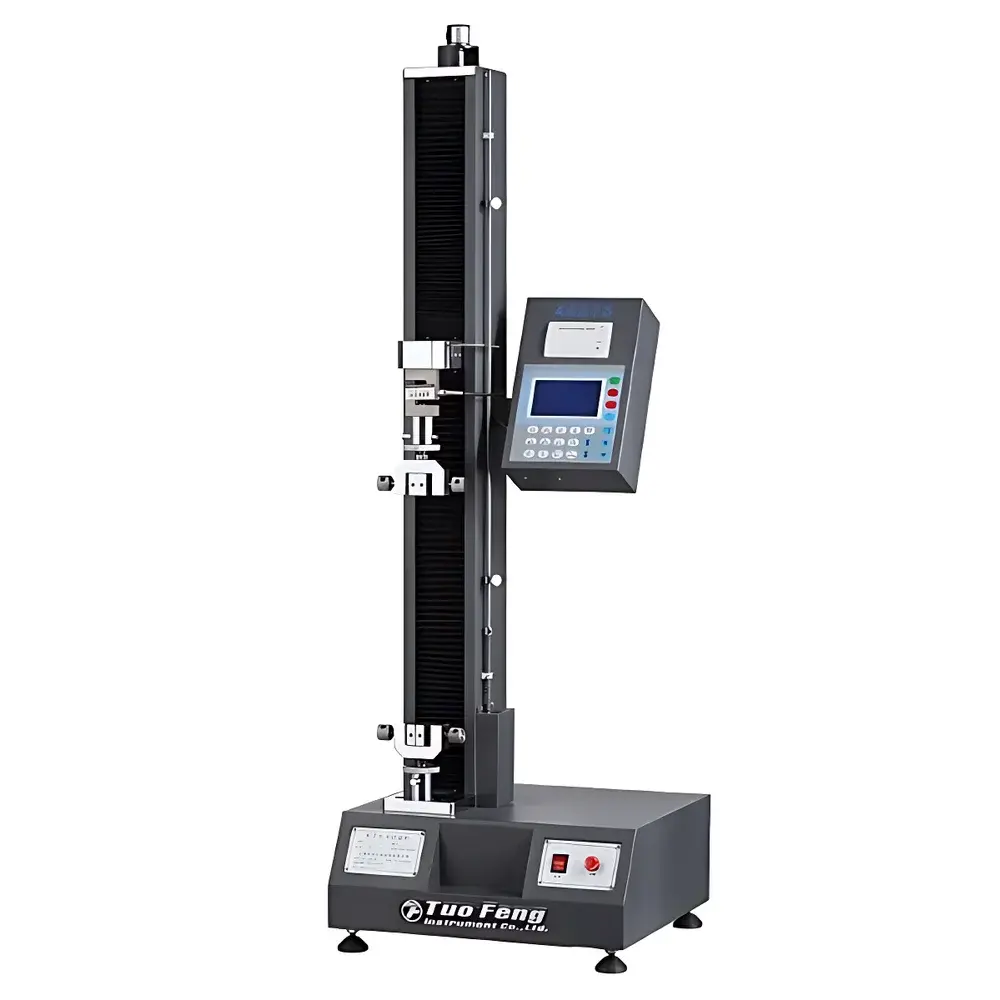
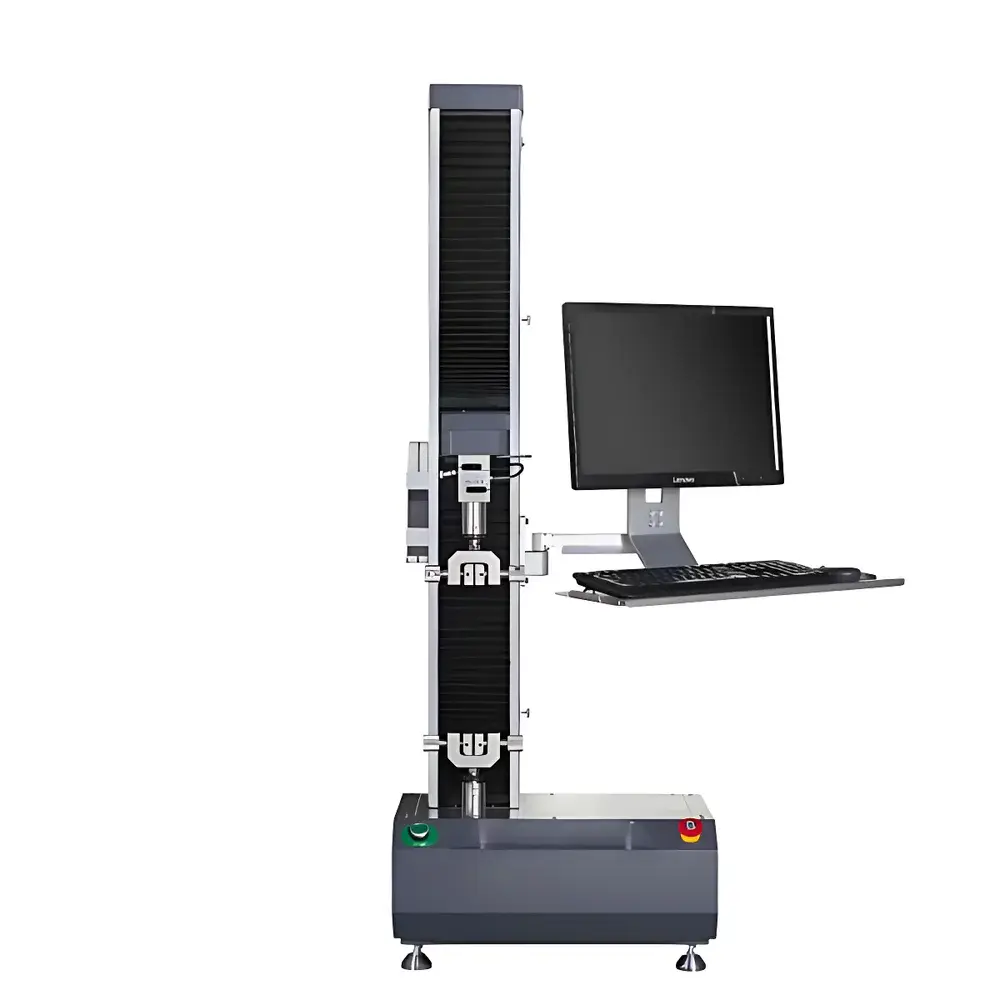
TuoFeng TFL-06 Button-Type Electronic Tensile Testing Machine
| Brand | TuoFeng |
|---|---|
| Origin | Shanghai, China |
| Manufacturer Type | Direct Manufacturer |
| Product Category | Domestic |
| Model | TFL-06 |
| Instrument Type | Electronic Tensile Testing Machine |
| Maximum Test Load | 0.1 kN |
| Force Measurement Range | 1–5000 N |
| Force Accuracy | ±0.5% of reading |
| Crosshead Travel | 700 mm |
| Displacement Resolution | 0.0001 mm |
Overview
The TuoFeng TFL-06 Button-Type Electronic Tensile Testing Machine is a compact, single-column, microprocessor-controlled mechanical testing system engineered for precision force measurement and displacement control in R&D laboratories and quality control environments. Designed around fundamental principles of uniaxial tensile mechanics—applying controlled axial load to specimens while synchronously recording force, displacement, and derived mechanical properties—the TFL-06 delivers high reproducibility for small-scale material characterization. Its rigid frame architecture, high-resolution encoder-based motion control, and calibrated load cell ensure traceable performance across low-force regimes (1 N to 5000 N), making it particularly suited for evaluating delicate or miniature specimens where traditional floor-standing testers lack resolution or spatial compatibility.
Key Features
- Single-column, space-efficient design optimized for benchtop integration in constrained lab spaces
- High-precision load cell with ±0.5% full-scale accuracy and seamless 1–5000 N measurement range (equivalent to 0.1 kN maximum capacity)
- Crosshead travel of 700 mm with programmable speed control from 0.01 to 500 mm/min (stepless adjustment)
- Sub-micron displacement resolution of 0.0001 mm, enabled by optical encoder feedback and 300,000-count A/D conversion
- Dual-mode operation: manual jog control and automated test sequencing with pre-defined load/displacement/time profiles
- Integrated safety systems including electronic limit switches, emergency stop circuitry, and over-load protection (auto-shutdown at >110% of rated capacity)
- Motor-driven crosshead with three-speed preset modes (fast/medium/slow) and automatic return-to-start functionality
Sample Compatibility & Compliance
The TFL-06 supports standardized mechanical testing of fine-dimension specimens commonly encountered in electronics, packaging, biomedical device, and advanced materials manufacturing. Typical applications include tensile strength evaluation of metal wires (e.g., Cu, NiCr, Au-plated leads), peel adhesion of pressure-sensitive tapes, tear resistance of thin films (PET, PP, aluminum foil), bond strength of solder joints and conductive adhesives, and puncture resistance of medical packaging laminates. The system is fully compliant with core international test standards—including ISO 6892-1 (metallic materials – tensile testing), ASTM D882 (thin plastic sheeting), ASTM D3330 (pressure-sensitive tape peel), ISO 11339 (adhesive peel strength), and GB/T 228.1 (Chinese national standard for metallic tensile testing). All force and displacement calibrations are traceable to national metrological institutes, supporting GLP/GMP documentation requirements.
Software & Data Management
The Windows-based TFL Control Suite (compatible with Windows 10/11) provides comprehensive test configuration, real-time data acquisition, and post-processing capabilities. It supports multiple control modes—constant rate of extension (CRE), constant load ramping, hold-at-load, and displacement-targeted testing—enabling method development aligned with USP , ISO 17025, and FDA 21 CFR Part 11 audit-trail requirements (when configured with user authentication and electronic signature modules). Real-time visualization includes synchronized force–time, force–displacement, stress–strain, and displacement–time plots. Software outputs include ASTM/ISO-compliant reports with calculated parameters: tensile strength, yield point, elongation at break, modulus of elasticity, peel adhesion (N/mm), tear energy (kJ/m²), and bond strength (MPa). Data export is supported in CSV, XML, and PDF formats; batch comparison tools allow overlay of up to 12 curves with statistical summary (mean, min, max, CV%). Firmware and software updates are provided free of charge throughout the instrument’s service life.
Applications
- Electronics: Pull testing of SMT component terminations, wire bonding strength verification, flex circuit peel adhesion
- Packaging: Seal integrity assessment of blister packs, pouch seal strength, film puncture resistance
- Medical Devices: Suture tensile strength, catheter shaft stiffness, adhesive bond durability on implantable sensors
- Materials Science: Mechanical screening of nanocomposite films, hydrogel elasticity, biodegradable polymer degradation profiling
- Quality Assurance: In-process verification of adhesive curing, coating cohesion, and thermal interface material compression set
FAQ
What is the minimum resolvable force increment on the TFL-06?
The system achieves force resolution better than 0.003 N within its 1–5000 N range, based on a 300,000-count internal ADC and calibrated 5000 N load cell.
Can the TFL-06 perform compression or bending tests?
Yes—when equipped with optional compression platens or three-point bend fixtures, the machine supports compressive yield testing and flexural modulus determination per ASTM D790 and ISO 178.
Is third-party calibration certification available?
TuoFeng provides factory calibration certificates traceable to CNAS-accredited standards; optional on-site calibration by ISO/IEC 17025-certified providers can be arranged.
How is data integrity ensured during long-duration creep or relaxation tests?
The embedded controller maintains continuous sampling at ≥10 Hz even during 72-hour tests, with automatic timestamping, power-failure recovery, and checksum-verified data logging to prevent corruption.
Does the software support custom calculation formulas for proprietary material metrics?
Yes—the “User Formula Editor” allows definition of derived parameters using raw force, displacement, time, and specimen geometry inputs, with immediate graphical integration into report templates.
Related Products



