
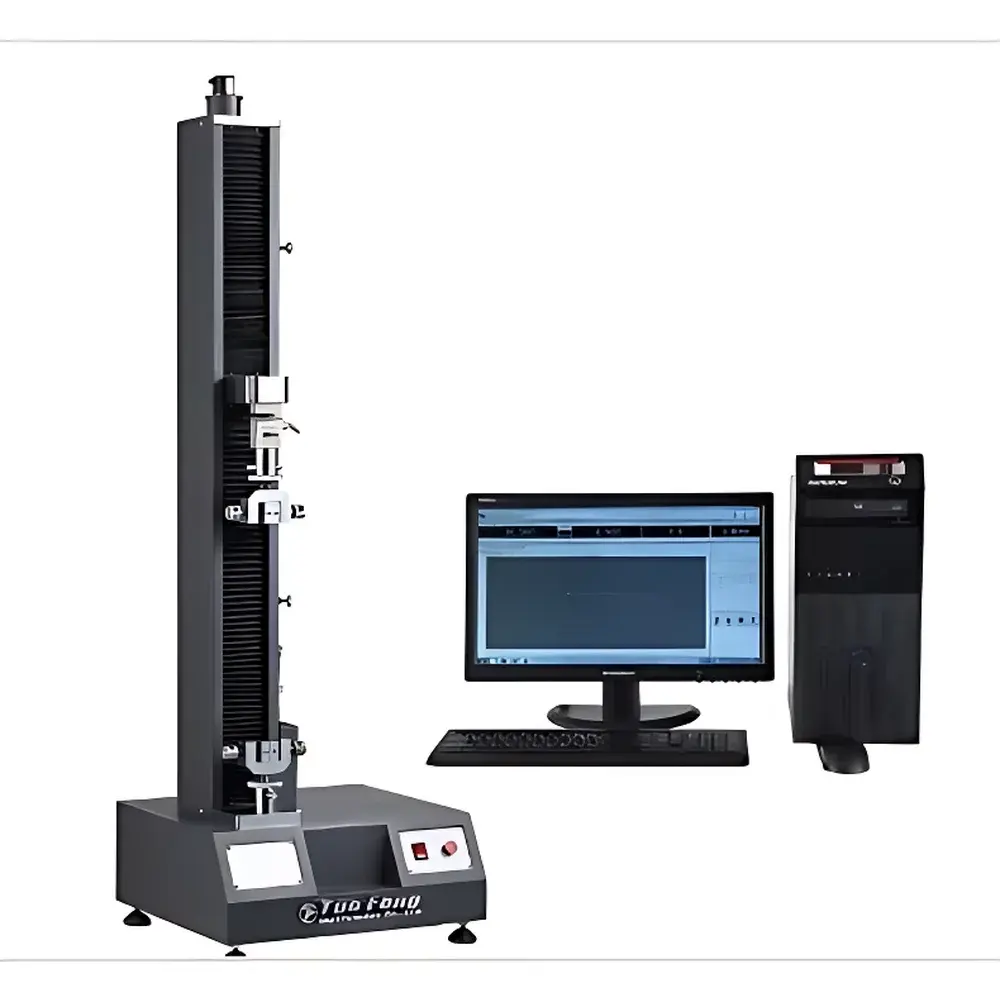
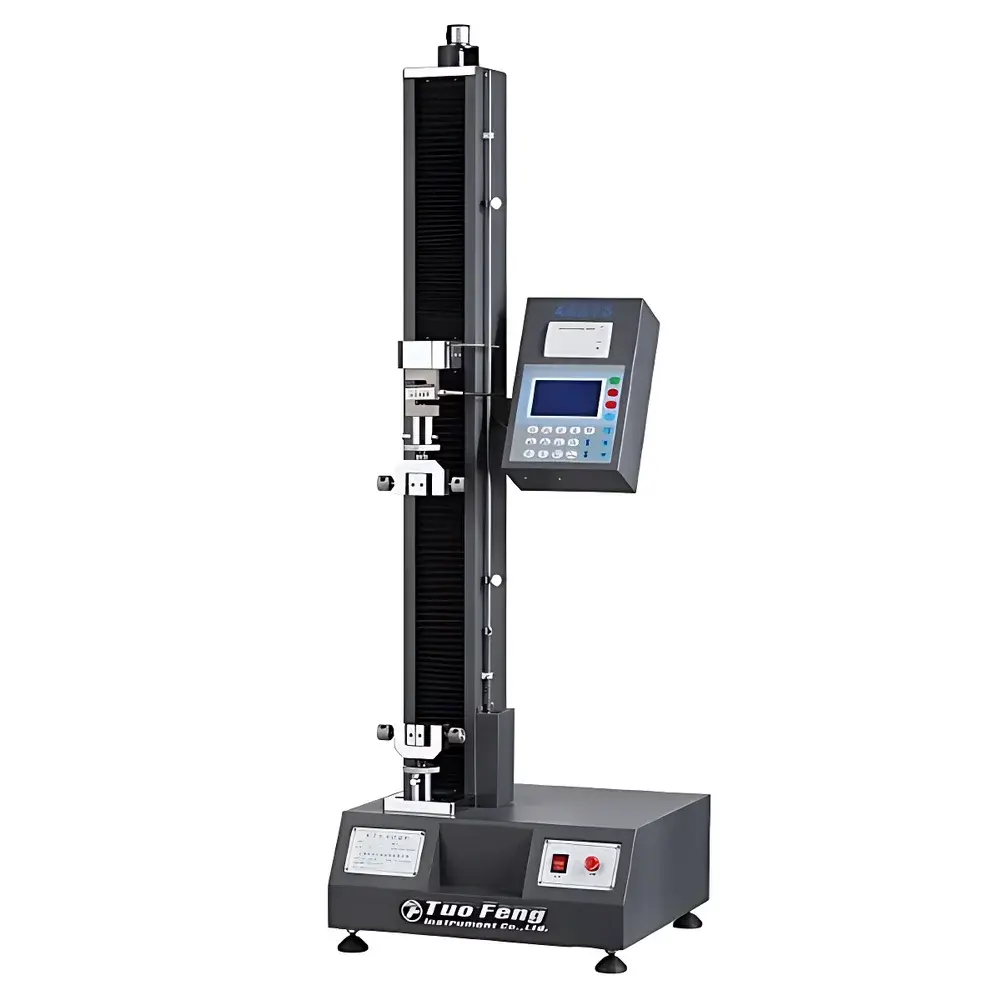
Tuofeng TFL-12 Single-Column Microcomputer-Controlled Electronic Tensile Testing Machine
| Brand | Tuofeng |
|---|---|
| Origin | Shanghai, China |
| Manufacturer Type | Direct Manufacturer |
| Country of Origin | China |
| Model | TFL-12 |
| Instrument Type | Electronic Tensile Testing Machine |
| Maximum Test Load | 0.1 kN (100 N) |
| Force Measurement Range | 1–1000 N |
| Force Accuracy | ±0.5% of reading |
| Crosshead Travel | 700 mm |
| Displacement Resolution | 0.0001 mm |
Overview
The Tuofeng TFL-12 is a single-column, microcomputer-controlled electronic tensile testing machine engineered for precision mechanical property evaluation of low-force specimens. It operates on the fundamental principle of uniaxial force application under controlled displacement or load conditions, utilizing high-stability load cells and optical encoder-based position feedback to deliver repeatable, traceable measurements in accordance with international mechanical testing standards. Designed for laboratories requiring reliable characterization of fine-dimension materials—such as metallic wires, thin foils, polymer films, textile filaments, adhesive bonds, and packaging substrates—the TFL-12 delivers calibrated force measurement across a 1–1000 N range with a maximum capacity of 100 N (0.1 kN), making it especially suited for quality control, R&D validation, and incoming material inspection where sub-newton sensitivity and micron-level displacement resolution are critical.
Key Features
- Single-column rigid frame architecture with integrated crosshead drive system for minimal deflection and high axial alignment stability
- High-resolution load cell with ±0.5% full-scale accuracy, compliant with ISO 7500-1 Class 0.5 and ASTM E4 calibration requirements
- Precision ball-screw-driven crosshead actuation enabling smooth, noise-free motion across the full 700 mm travel range
- Optical encoder-based displacement measurement with 0.0001 mm resolution and ±0.5% accuracy over full stroke
- Three-speed motorized crosshead control (fast/medium/slow) with programmable return-to-start functionality
- Dual safety architecture: hardware-based electronic limit switches plus software-configurable overload protection (triggered at 110% of full scale)
- Modular clamping interface supporting standardized wedge, pneumatic, and custom fixtures per specimen geometry and standard requirements
Sample Compatibility & Compliance
The TFL-12 accommodates specimens up to 700 mm in effective gauge length and is routinely deployed for tensile, peel, tear, and bond strength evaluation of materials including copper/nickel wire (diameters ≤ 0.5 mm), PET/PP films (thickness ≤ 250 µm), nonwoven fabrics, laminated food packaging, PCB terminations, and medical-grade adhesives. It supports method execution per GB/T 228.1, ISO 6892-1, ASTM D638, ASTM D903, ASTM D1876, ISO 11339, and JIS Z 0237. All force and displacement outputs are traceable to national metrological standards; system compliance documentation—including calibration certificates, uncertainty budgets, and verification reports—is provided upon installation. The instrument meets CE marking requirements for mechanical safety (EN ISO 12100) and electromagnetic compatibility (EN 61326-1).
Software & Data Management
The bundled Windows-based testing software (compatible with Windows 10/11) provides full GLP/GMP-aligned data integrity: audit-trail-enabled user access control, electronic signatures, and 21 CFR Part 11-compliant data archiving options (optional module). It supports multiple test modes—constant rate of extension (CRE), constant load, constant displacement—and real-time plotting of force–time, force–displacement, stress–strain, and displacement–time curves. Calculated parameters include tensile strength, yield point, elongation at break, modulus of elasticity, peel strength, and tear resistance—all auto-derived from user-input cross-sectional area and gauge length. Data export is supported in CSV, XLSX, and PDF formats; curve overlay comparison across up to 16 test records is available for statistical trend analysis. Software updates are delivered remotely with version-controlled release notes and backward-compatible data file handling.
Applications
- Quality assurance of thin-gauge metal products (e.g., bonding wire pull tests per MIL-STD-883 Method 2011)
- Adhesive bond strength validation for flexible electronics assembly (ISO 11339 peel testing)
- Mechanical screening of biodegradable films used in pharmaceutical blister packaging
- Tensile performance benchmarking of synthetic fibers during textile process development
- Peel resistance assessment of pressure-sensitive labels per ASTM D3330
- Creep and relaxation behavior analysis of thermoplastic elastomers under low-load conditions
FAQ
What standards does the TFL-12 support for tensile testing?
It complies with GB/T 228.1, ISO 6892-1, ASTM D638, ASTM D903, and other widely adopted mechanical test standards for metals, polymers, and composites.
Can the system be configured for high-temperature or environmental testing?
Yes—optional environmental chambers (−70°C to +300°C) and humidity control modules can be integrated via third-party suppliers using standardized mounting interfaces and analog/digital I/O synchronization.
Is the force transducer factory-calibrated and certified?
Each unit ships with an ISO/IEC 17025-accredited calibration certificate covering the full 1–1000 N range, with uncertainty values reported per ISO 376 Annex B.
How is data integrity ensured during regulatory audits?
With optional 21 CFR Part 11 module enabled, the software enforces role-based permissions, electronic signatures, immutable audit logs, and encrypted database storage—fully aligned with FDA and EU GMP Annex 11 expectations.
What maintenance is required to sustain measurement accuracy?
Annual recalibration is recommended; routine verification using certified reference load cells and displacement standards is advised before each testing shift per ISO/IEC 17025 Clause 5.9.



