
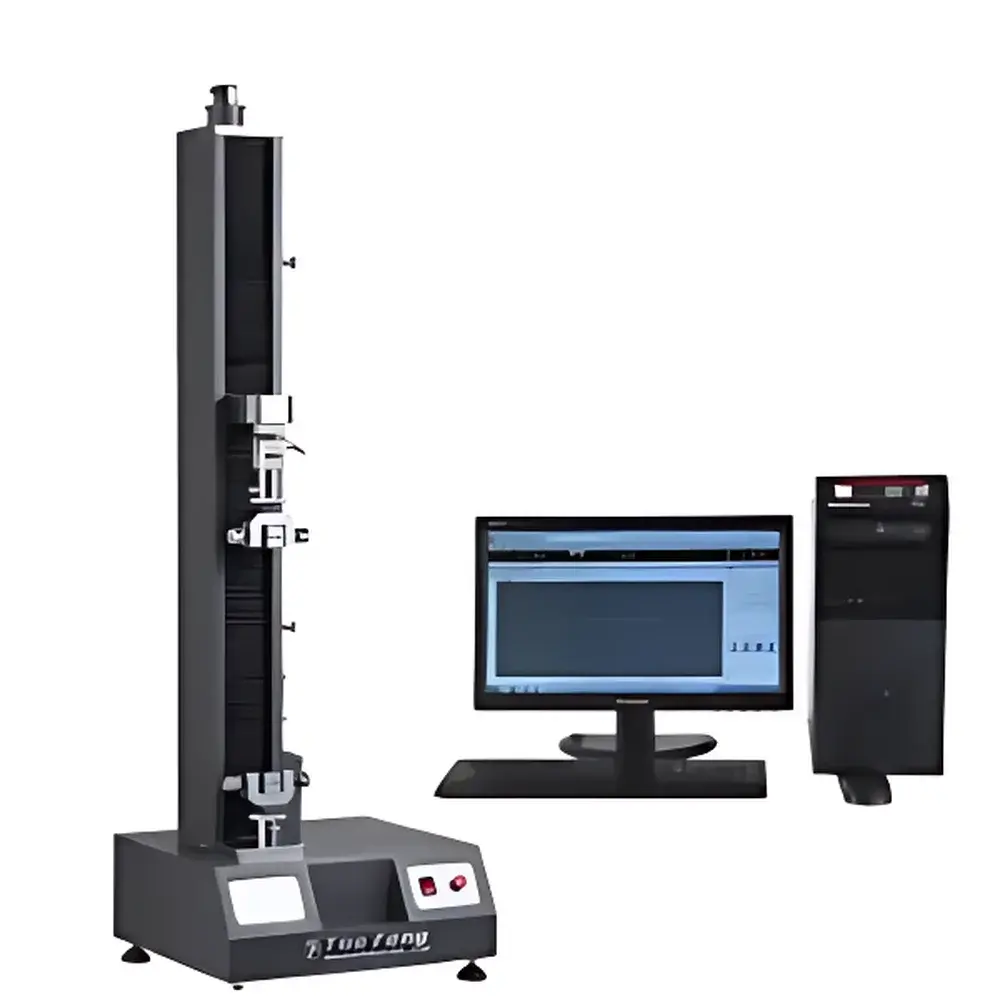
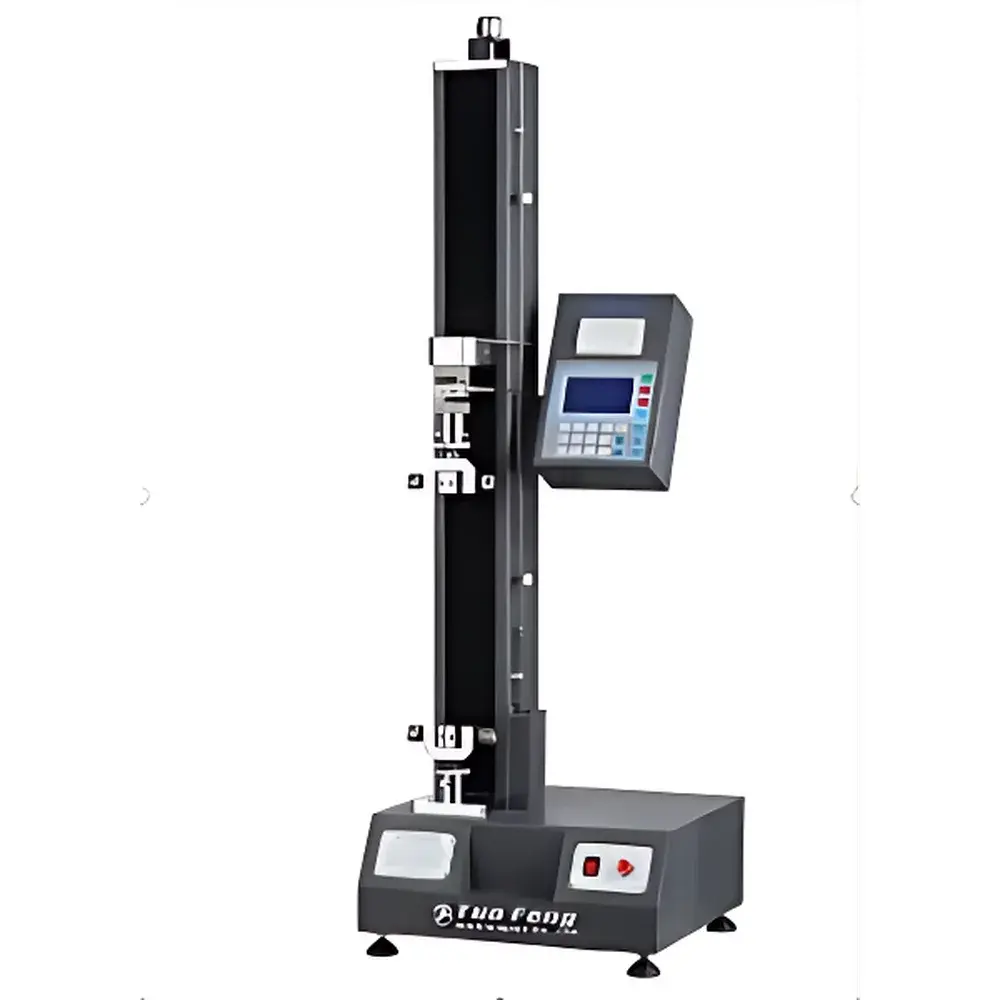
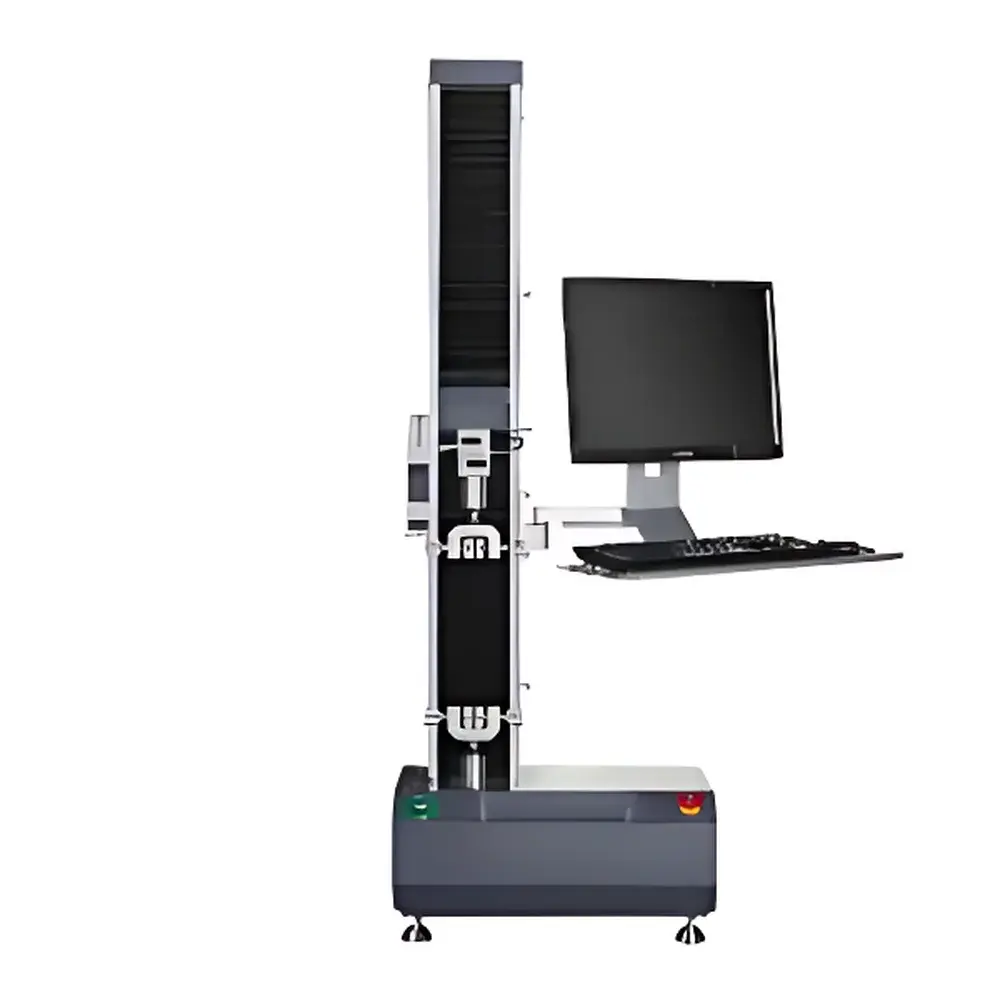
Tuofeng TFL-20 Digital Display Tensile Testing Machine
| Brand | Tuofeng |
|---|---|
| Origin | Shanghai, China |
| Manufacturer Type | Direct Manufacturer |
| Model | TFL-20 |
| Instrument Type | Electronic Tensile Testing Machine |
| Maximum Test Load | 5 kN |
| Force Measurement Range | 0.4%–100% of Full Scale (FS) |
| Force Accuracy | ±0.5% of reading |
| Crosshead Travel | 700 mm |
| Displacement Resolution | ±0.5% of reading |
Overview
The Tuofeng TFL-20 Digital Display Tensile Testing Machine is an entry-level electronic universal testing system engineered for precision mechanical property evaluation of low-to-medium strength materials. It operates on the fundamental principle of uniaxial force application—applying controlled tensile, peel, tear, or shear loads to specimens while continuously measuring load and displacement in real time. The machine employs a high-stiffness dual-column frame, a precision ball-screw-driven crosshead, and a calibrated load cell compliant with ISO 7500-1 Class 0.5 accuracy requirements. Designed for laboratories requiring traceable, repeatable mechanical data without full PC integration, the TFL-20 features an integrated LCD control panel with intuitive menu navigation, eliminating dependency on external computers for routine operation. Its architecture supports standardized testing protocols across metallurgy, polymer science, packaging engineering, and electronics manufacturing—particularly for fine wires, thin foils, elastomeric films, adhesives, and fiber-based substrates.
Key Features
- Integrated 5-inch high-contrast LCD display with real-time digital readout of load (N/kN), displacement (mm), and test speed (mm/min)
- Load cell calibrated to ISO 7500-1 Class 0.5, delivering force measurement accuracy within ±0.5% of reading across 0.4%–100% FS
- Electromechanical drive system with adjustable speed range from 0.01 to 500 mm/min (infinitely variable, no gear shifting required)
- Rigid dual-column steel frame with 700 mm usable crosshead travel; optional extended-height configurations available upon request
- Displacement sensing via high-resolution optical encoder, ensuring displacement accuracy of ±0.5% of reading
- Multi-stage safety architecture: electronic limit switches, emergency stop button, overload protection (>110% FS), and programmable soft limits
- Motorized crosshead with three-speed preset modes (fast/medium/slow) for rapid positioning and precise approach control
- Modular fixture interface compatible with standard wedge-action, pneumatic, or custom-designed grips for diverse specimen geometries
Sample Compatibility & Compliance
The TFL-20 accommodates specimens ranging from ultra-thin polymer films (≥10 µm thickness) to metallic wires (diameter ≤3 mm), textile yarns, laminated packaging structures, and adhesive-bonded joints. Its modular design allows seamless integration of optional extensometers (e.g., clip-on or video-based) for strain measurement where required by ASTM D638, ISO 527-2, or GB/T 1040.1. The system complies with core international standards including ISO 7500-1 (static calibration), ISO 5893 (tensile testing machines), and ASTM E4 (load verification). All test procedures can be configured to meet GLP documentation requirements—including operator ID logging, test parameter timestamping, and result export in CSV format for audit trail integrity. While not FDA 21 CFR Part 11–certified out-of-the-box, its data export functionality supports integration into validated LIMS or QMS environments.
Software & Data Management
The TFL-20 includes embedded firmware supporting five primary test modes: constant rate of extension (CRE), constant load ramping, hold-at-load, hold-at-displacement, and cyclic loading (with user-defined cycles). Data acquisition occurs at ≥100 Hz sampling rate, enabling accurate capture of peak load, yield point, and fracture events. Results are displayed as real-time curves (load vs. time, load vs. displacement, stress vs. strain) directly on the LCD screen. Export options include USB flash drive storage of raw data (.txt), summary reports (.pdf), and graphical overlays for comparative analysis. The firmware supports multilingual UI (English, Simplified Chinese, Traditional Chinese) and unit conversion (N/lbf/kgf, mm/inch, MPa/psi) without software reinstallation. All test parameters—including calibration coefficients, user profiles, and method templates—are stored in non-volatile memory with password-protected access levels for administrator and operator roles.
Applications
- Tensile characterization of copper/nickel alloy wires per ASTM B33 and GB/T 4909
- Peel strength assessment of pressure-sensitive adhesives on PET or aluminum foil substrates (ASTM D903, GB/T 2790)
- Tear resistance testing of polyethylene films using Elmendorf-type fixtures (ISO 6383-2)
- Breaking strength and elongation evaluation of nonwoven medical fabrics (ISO 9073-3)
- Shear bond strength validation of solder joint terminations on PCB substrates
- Quality control of paperboard packaging seams and corrugated box compression resistance (ASTM D642)
- Validation of biodegradable film mechanical stability under accelerated aging conditions
FAQ
Does the TFL-20 support automatic data export to Excel-compatible formats?
Yes—test results and raw time-series data can be saved to USB storage devices in .csv and .txt formats, fully compatible with Microsoft Excel, MATLAB, and statistical analysis platforms.
Is third-party calibration certification included with delivery?
A factory calibration certificate traceable to CNAS-accredited national standards is provided. On-site ISO/IEC 17025 calibration services are available upon request.
Can the machine perform compression tests?
Yes—by installing optional compression platens and adjusting test direction, the TFL-20 supports compressive modulus and crush strength measurements per ASTM D695 and GB/T 1041.
What maintenance intervals are recommended for long-term accuracy?
Load cell zero-point verification every 3 months; annual full recalibration and mechanical inspection of screw preload, guide rail lubrication, and encoder alignment are advised.
Is remote firmware update supported?
Firmware upgrades are performed manually via USB; no cloud connectivity or remote update capability is implemented to ensure network isolation in regulated lab environments.



