
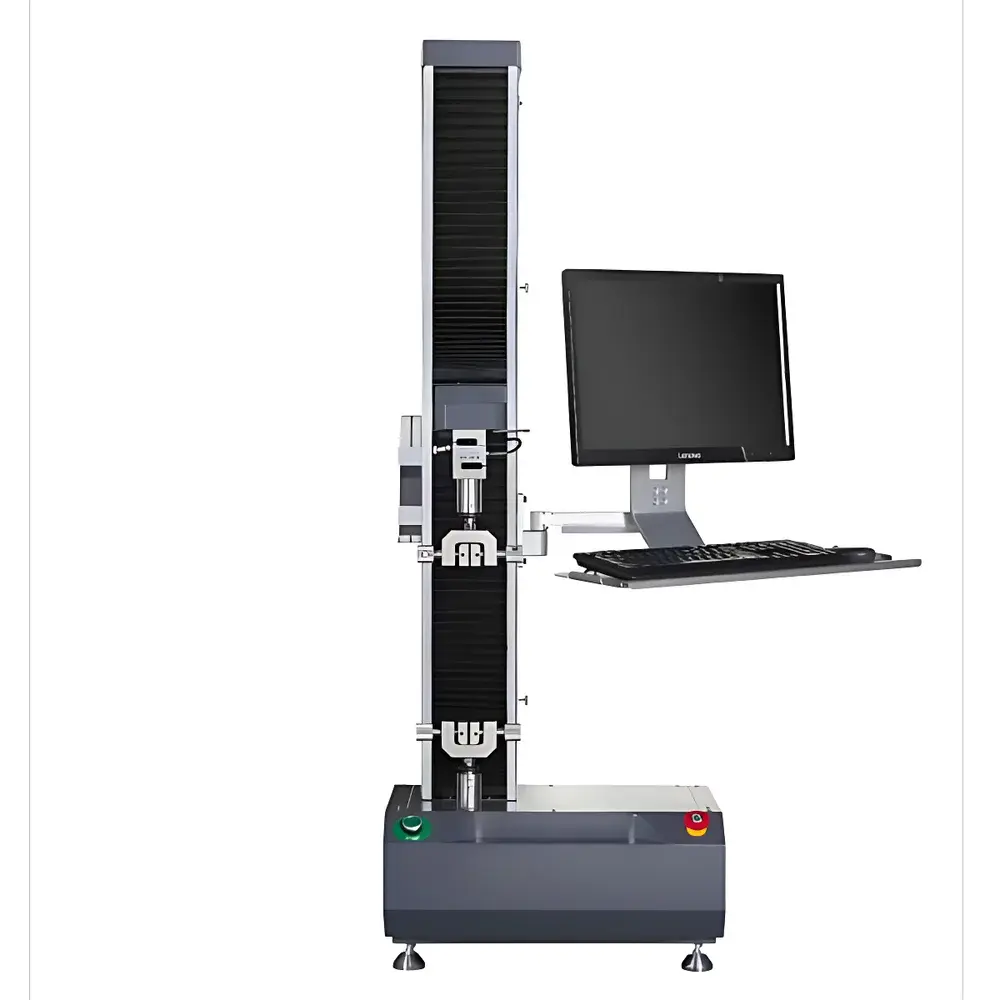
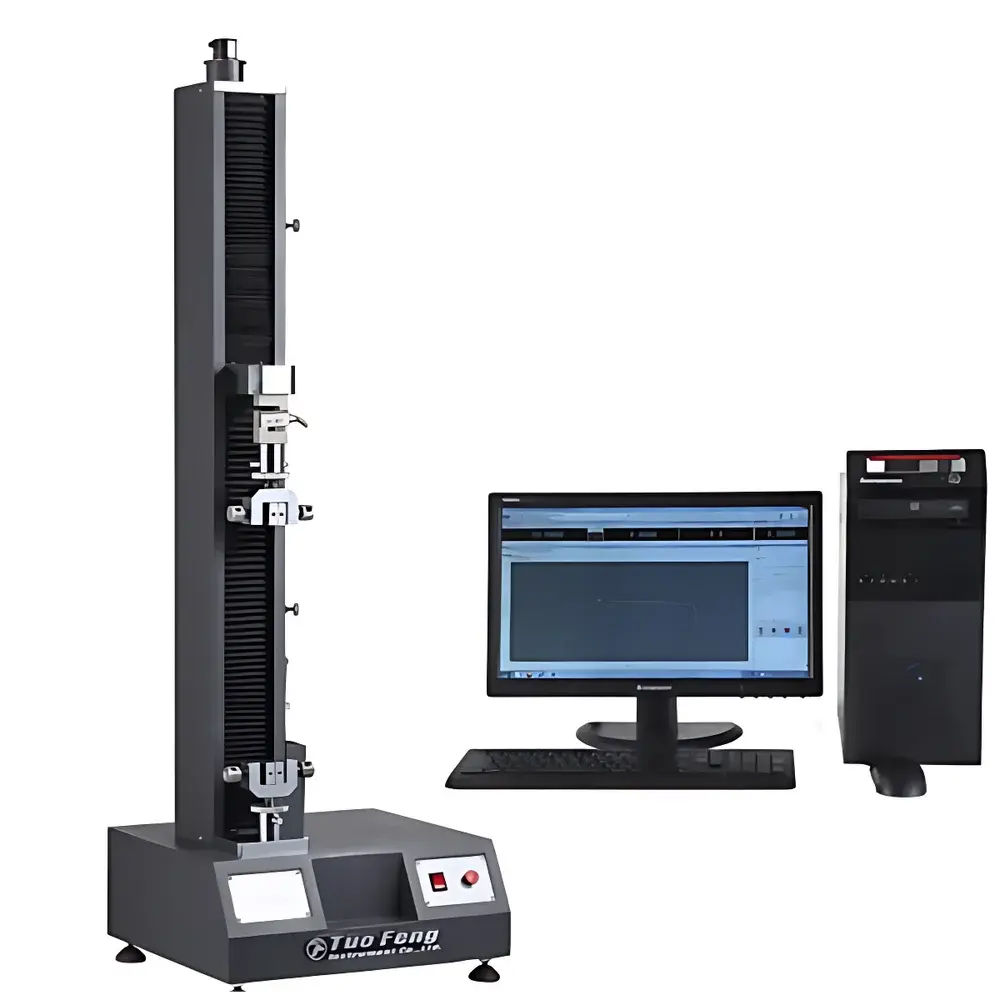
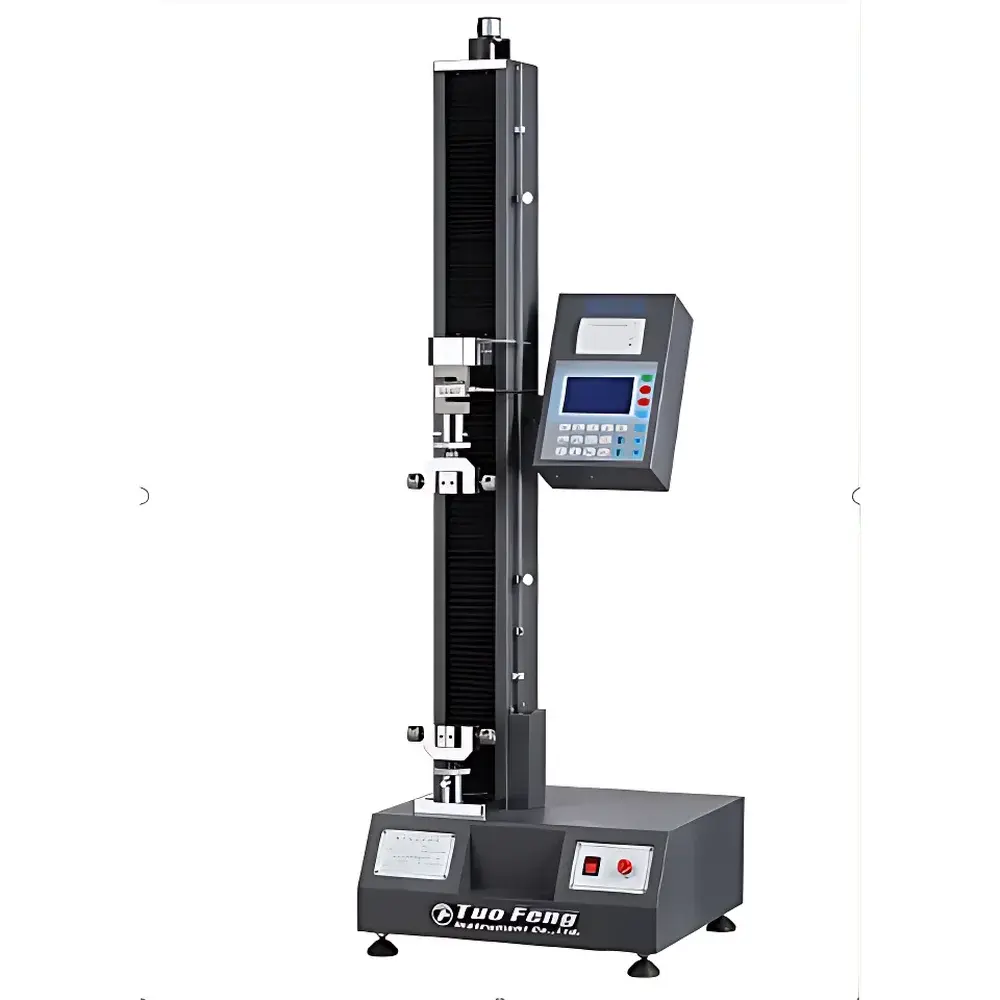
Tuofeng TFL-23S Computer-Controlled Electronic Tensile Testing Machine
| Brand | Tuofeng |
|---|---|
| Origin | Shanghai, China |
| Manufacturer Type | Direct Manufacturer |
| Model | TFL-23S |
| Max Test Load | 5 kN |
| Force Measurement Range | 0.4%–100% of Full Scale |
| Force Accuracy | ±0.5% of reading |
| Crosshead Travel | 700 mm |
| Displacement Resolution | ±0.5% of reading |
| Test Speed Range | 0.01–500 mm/min (infinitely variable) |
| Position Sensing | Optical Encoder |
| Protection | Electronic Limit Switches, Emergency Stop, Overload Protection (≥110% FS) |
| Power Supply | 220 V, 50 Hz, 400 W |
| Dimensions (W×D×H) | ≈460×460×1500 mm |
| Weight | ≈120 kg |
| Compliance | ASTM D882, ISO 527-3, GB/T 1040.3, DIN 53455, JIS K7127 |
Overview
The Tuofeng TFL-23S is a precision-engineered computer-controlled electronic tensile testing machine designed for standardized mechanical property evaluation of thin polymeric films, foils, fibers, and other low-to-medium strength materials. It operates on the fundamental principle of uniaxial tension—applying controlled axial force to a specimen while simultaneously measuring load, displacement, and deformation in real time. The system conforms to internationally recognized test methodologies including ASTM D882 (Standard Test Method for Tensile Properties of Thin Plastic Sheeting), ISO 527-3 (Plastics — Determination of Tensile Properties — Part 3: Films and Sheets), GB/T 1040.3 (Chinese national standard for plastics tensile testing), DIN 53455 (German standard for film tensile behavior), and JIS K7127 (Japanese Industrial Standard for plastic films). Its modular architecture supports both routine quality control and R&D-grade characterization across polymer science, packaging engineering, and flexible electronics manufacturing.
Key Features
- High-fidelity load measurement with ±0.5% accuracy across 0.4%–100% of full scale (5 kN), enabled by a calibrated load cell and 300,000-count A/D resolution—ensuring consistent repeatability across low-force film testing and higher-load foil validation.
- Optically encoded crosshead displacement system delivering ±0.5% positional fidelity over a 700 mm travel range; optional height extension available for extended gauge length applications.
- Infinitely variable speed control from 0.01 to 500 mm/min, supporting quasi-static film elongation tests as well as rapid peel or tear rate protocols.
- Dual-mode operation: manual point-to-point positioning and automated programmable test sequences—including pre-set hold steps, multi-stage ramp profiles, and conditional termination logic.
- Integrated safety architecture featuring hardware-based electronic limit switches, dual-channel emergency stop circuitry, and automatic overload cutoff at ≥110% of full-scale capacity.
- Modular fixture interface compatible with pneumatic, wedge-grip, roller-clamp, and custom-designed grips—enabling secure clamping of specimens as thin as 12 µm without slippage or edge damage.
Sample Compatibility & Compliance
The TFL-23S is optimized for planar, flexible specimens with thicknesses ranging from 10 µm to 500 µm, including biaxially oriented polypropylene (BOPP), polyester (PET), polyethylene (PE), metallized films, laminated barrier structures, and adhesive-coated substrates. It accommodates standard test widths per ASTM D882 (e.g., 15 mm, 25 mm) and supports non-standard geometries via user-defined grip spacing and extensometer integration. All test routines are traceable to documented calibration certificates compliant with ISO/IEC 17025 requirements. The instrument meets mechanical safety standards per EN 61000-6-2 (EMC immunity) and EN 61000-6-4 (EMC emissions), and its software architecture supports audit-ready data integrity when configured for GLP/GMP environments.
Software & Data Management
The Windows-based testing software provides full IEC 62304-compliant control and analysis functionality. It supports multiple test modes—constant rate of extension (CRE), constant load, constant displacement, and dwell-hold—and enables real-time switching between force–time, force–displacement, stress–strain, and strain–time plots. Units for force (N, kN, lbf), displacement (mm, in), and stress (MPa, psi) are freely convertible within the interface. Raw data files are stored in ASCII CSV format with embedded metadata (operator ID, timestamp, calibration ID, environmental conditions), ensuring long-term archival compatibility and third-party analysis interoperability. The system logs all operator actions and parameter changes for 21 CFR Part 11–compliant audit trails when enabled. Software updates are delivered remotely with version-controlled release notes and backward-compatible file handling.
Applications
- Quantification of tensile strength, yield point, modulus (secant and tangent), elongation at break, and Poisson’s ratio for plastic films used in food, medical, and industrial packaging.
- Evaluation of interlayer adhesion in co-extruded or laminated structures via 90° or 180° peel testing per ASTM D903 and ISO 8510-2.
- Tear resistance assessment using Elmendorf-type or trouser-tear configurations under controlled strain rates.
- Creep and stress-relaxation profiling for thermoplastic films subjected to sustained loading at elevated temperatures (when integrated with environmental chamber).
- Validation of coating integrity and substrate–coating bond strength in functional barrier films for flexible OLED and thin-film photovoltaic applications.
- Comparative benchmarking of raw material batches against internal specifications or supplier qualification criteria.
FAQ
What standards does the TFL-23S support out-of-the-box?
ASTM D882, ISO 527-3, GB/T 1040.3, DIN 53455, and JIS K7127 test methods are pre-configured in the software with default parameters and report templates.
Can the system be validated for regulated environments such as pharmaceutical packaging QC?
Yes—the software supports 21 CFR Part 11 compliance mode with electronic signatures, audit trail logging, and role-based access control when deployed on a validated Windows OS platform.
Is extensometer integration possible?
Yes, the TFL-23S includes analog and digital input channels for contact and non-contact extensometers, enabling high-accuracy strain measurement independent of crosshead motion.
What maintenance is required to maintain force calibration integrity?
Annual verification using NIST-traceable deadweight standards is recommended; load cell drift compensation routines are accessible via service mode.
Does the machine support batch testing with automatic pass/fail evaluation?
Yes—user-defined acceptance criteria (e.g., “tensile strength ≥120 MPa ±5%”) can be applied during post-test analysis, with results color-coded and exported to Excel or LIMS.



