
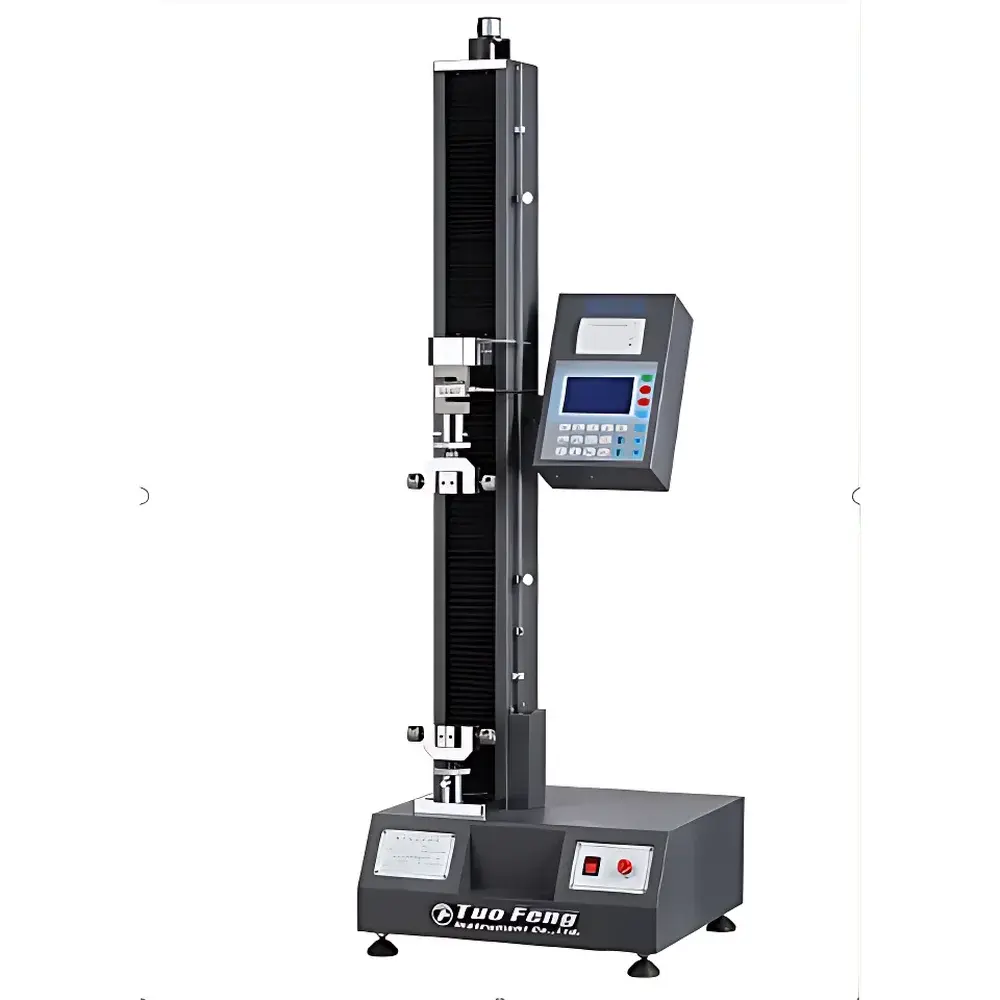
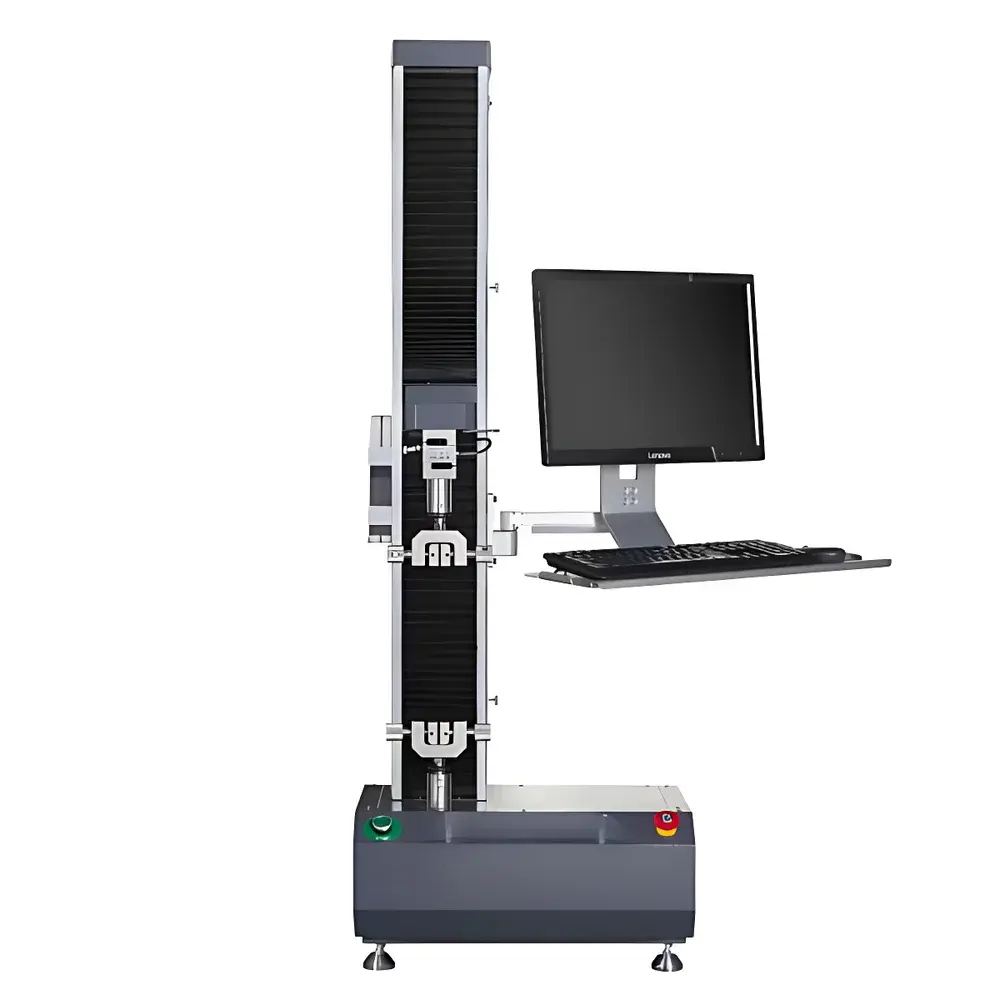
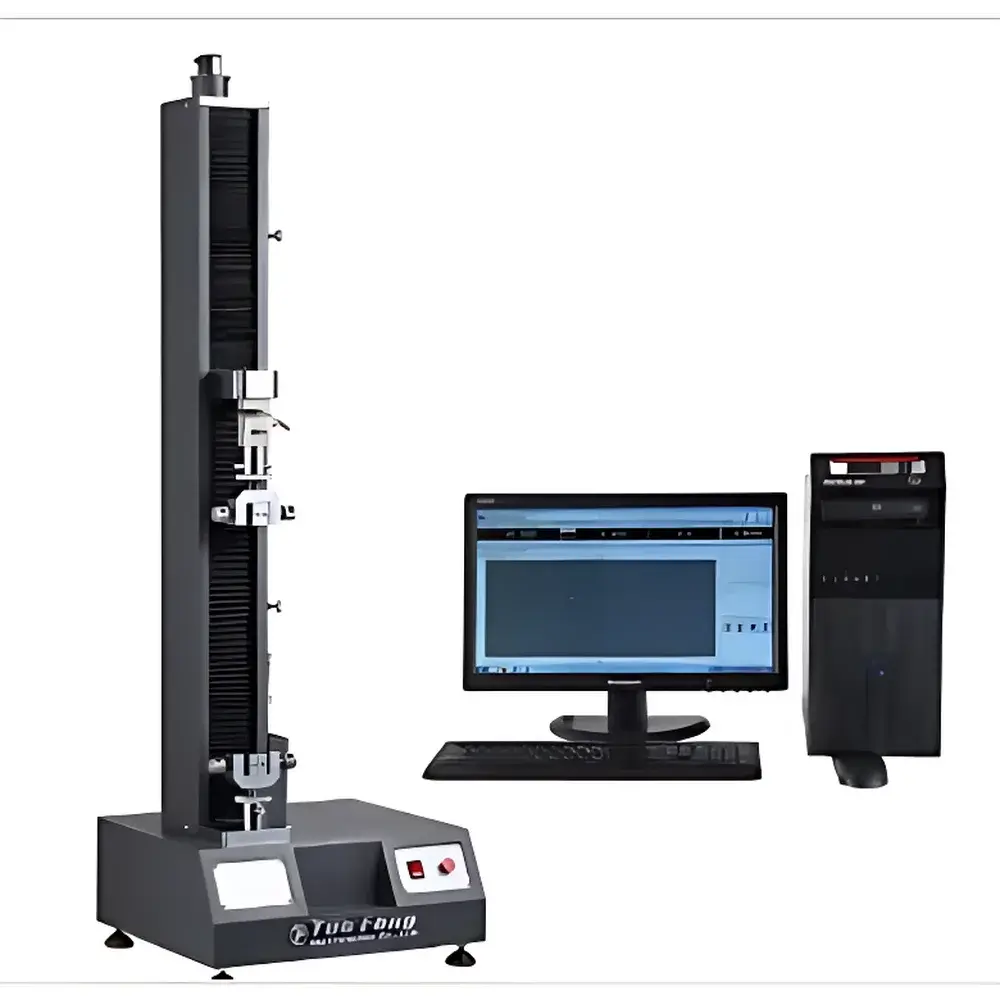
Tuofeng TFL-28S Computer-Controlled Electronic Tensile Testing Machine
| Brand | Tuofeng |
|---|---|
| Origin | Shanghai, China |
| Manufacturer Type | Direct Manufacturer |
| Model | TFL-28S |
| Maximum Test Load | 5 kN |
| Force Measurement Range | 0.4%–100% of Full Scale (FS) |
| Force Accuracy | ±0.5% of reading |
| Crosshead Travel | 700 mm |
| Displacement Resolution | ±0.5% of reading |
| Test Speed Range | 0.01–500 mm/min (infinitely variable) |
| Position Sensing | Optical Encoder |
| Load Cell Resolution | 1 part in 300,000 full-scale codes (single-range, no auto-ranging) |
| Safety Protection | Electronic limit switches, emergency stop, overload protection (>110% FS) |
| Power Supply | 220 V AC, 50 Hz, 400 W |
| Dimensions (W×D×H) | ≈460×460×1500 mm |
| Weight | ≈120 kg |
| Compliance Standards | GB/T, ISO 6892, ASTM E8/E21, DIN 50125, JIS Z2241 |
Overview
The Tuofeng TFL-28S is a precision-engineered computer-controlled electronic tensile testing machine designed for static mechanical property evaluation of thin metallic and non-metallic specimens—including aluminum foil, fine metal wires, foils, films, fibers, elastomers, adhesives, and laminated packaging materials. It operates on the principle of uniaxial quasi-static loading, applying controlled axial force via a servo-motor-driven crosshead while simultaneously measuring load, displacement, and (optionally) strain through high-fidelity transducers and optical encoders. The system conforms to internationally recognized test methodologies defined in ISO 6892-1 (metallic materials — tensile testing), ASTM E8/E21 (tension testing of metallic materials), GB/T 228.1 (Chinese national standard for metallic tensile testing), and JIS Z2241. Its modular architecture supports both routine quality control and R&D-grade material characterization, delivering repeatable, traceable, and audit-ready results under GLP-compliant laboratory environments.
Key Features
- High-resolution dual-channel data acquisition: Load resolution up to 1 part in 300,000 full-scale codes; displacement measured via quadrature optical encoder with ±0.5% accuracy across full travel (700 mm).
- Wide dynamic test speed range: 0.01–500 mm/min, continuously adjustable without gear shifting—enabling compliance with low-strain-rate creep assessments and high-speed peel or tear protocols.
- Robust mechanical design: Rigid four-column frame with preloaded ball screws and precision linear guides ensures minimal deflection (<0.02 mm under 5 kN load), critical for accurate modulus and yield point determination.
- Integrated safety architecture: Dual hardware-based protections—electronic end-of-travel limits and emergency stop circuit—complement software-driven overload cutoff (>110% FS) and automatic return-to-home sequencing.
- Intuitive crosshead control: Three-speed motorized vertical adjustment (fast/medium/slow) with jog mode and programmable return logic—reducing setup time between specimen batches.
- Modular extensometry support: Optional large-deformation sensor (10 mm gauge length, 0–800 mm range) and clip-on extensometers compatible with ASTM E83 Class B-1 requirements.
Sample Compatibility & Compliance
The TFL-28S accommodates specimens ranging from ultra-thin aluminum foils (≥6 µm thickness) to stiff polymer composites and wire forms (diameter ≤3 mm). Standard fixtures include pneumatic vise grips, wedge-action clamps, and peel/adhesion fixtures compliant with ASTM D903, D1876, and ISO 8510-2. All test configurations adhere to regulatory expectations for instrument qualification (IQ/OQ/PQ), including linearity verification per ISO 7500-1 Class 0.5, and are fully documented for FDA 21 CFR Part 11 readiness when paired with audit-trail-enabled software configuration. Calibration certificates traceable to NIM (China National Institute of Metrology) or equivalent national metrology institutes are available upon request.
Software & Data Management
The embedded Windows-based testing platform (compatible with Windows 10/11 LTSB editions) provides full ICH-GCP and GLP-aligned functionality. Users select from multiple control modes—constant rate of extension (CRE), constant load ramping, or displacement-targeted hold sequences—with real-time feedback of load, position, and derived parameters (e.g., tensile strength, elongation at break, Young’s modulus, yield offset, peel resistance). Multi-curve overlay, statistical batch analysis (min/max/mean/stdev), and automated report generation (PDF/Excel) meet internal SOPs and external accreditation requirements (CNAS, ISO/IEC 17025). Raw data files are stored in vendor-neutral ASCII format; software updates are delivered free of charge for the instrument’s operational lifetime.
Applications
- Aluminum foil tensile strength and elongation validation per ASTM B209 and GB/T 3198.
- Peel strength assessment of laminated food packaging structures (e.g., PET/AL/PE) per ASTM F904.
- Adhesive bond integrity testing for medical device assembly (ISO 10993-4).
- Wire drawability and ductility screening in electronics interconnect manufacturing.
- Quality conformance testing of textile yarns and nonwovens per ISO 20795-2.
- Comparative mechanical aging studies under thermal or humidity preconditioning protocols.
FAQ
Does the TFL-28S comply with ISO/IEC 17025 calibration requirements?
Yes—the system supports full metrological traceability via factory calibration reports aligned with ISO/IEC 17025:2017 Annex A.3, including uncertainty budgets for force and displacement measurements.
Can the software generate 21 CFR Part 11-compliant audit trails?
When configured with user access controls, electronic signatures, and immutable raw-data archiving, the software meets core technical requirements for Part 11 compliance in regulated QC labs.
Is custom fixture design supported for proprietary sample geometries?
Tuofeng offers OEM fixture engineering services, including CAD-based design review, FEA stress simulation, and mechanical validation per ASTM E1012 guidelines.
What is the recommended recalibration interval?
Annual calibration is advised for routine QC use; biannual verification is required for GMP-regulated applications, with interim performance checks using certified reference standards.
Can the system integrate with LIMS or MES platforms?
Yes—via TCP/IP API or OPC UA interface, enabling bidirectional data exchange with major laboratory information management systems (e.g., LabWare, STARLIMS) and enterprise manufacturing execution systems.



