
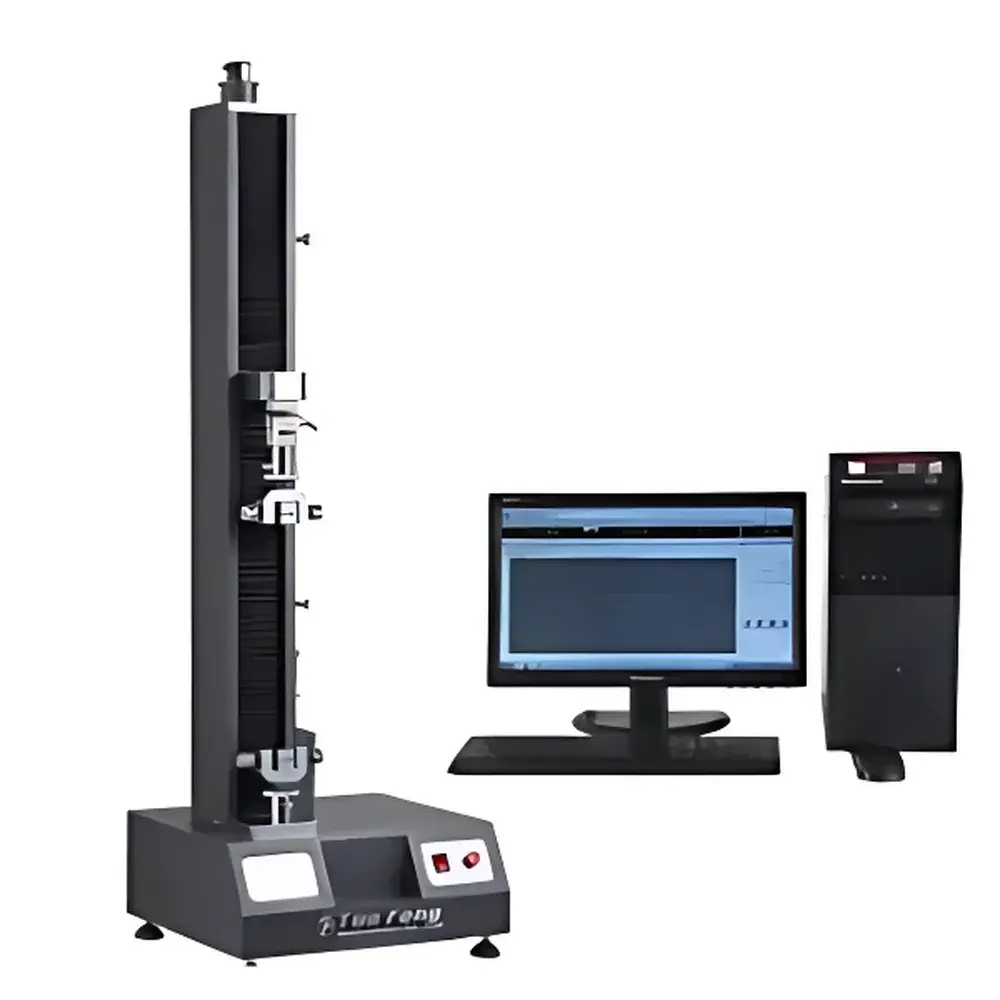
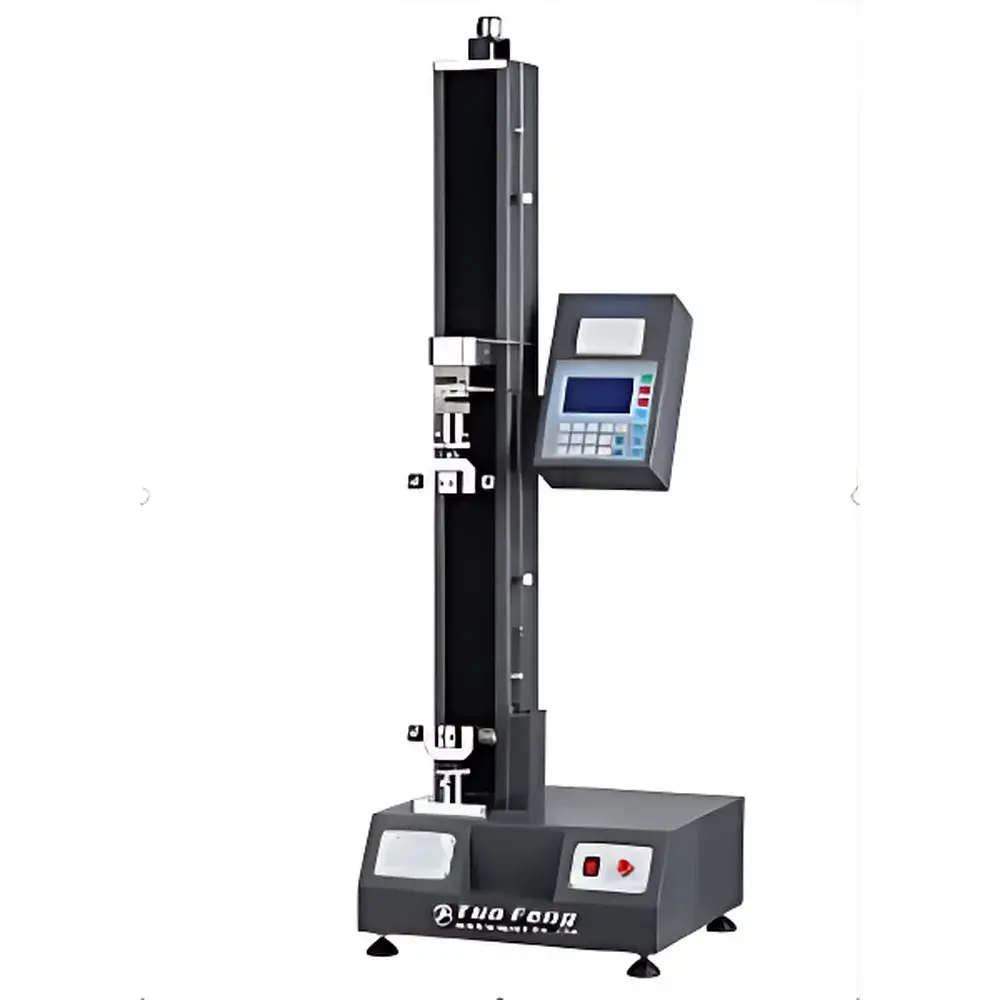
Tuofeng TFL-2S Microcomputer-Controlled Electronic Tensile Testing Machine
| Brand | Tuofeng |
|---|---|
| Origin | Shanghai, China |
| Manufacturer Type | Direct Manufacturer |
| Model | TFL-2S |
| Maximum Test Load | 5 kN |
| Force Measurement Range | 0.4%–100% of Full Scale (FS) |
| Force Accuracy | ±0.5% of reading |
| Crosshead Travel | 700 mm |
| Displacement Resolution | ±0.5% of reading |
| Test Speed Range | 0.01–500 mm/min (infinitely variable) |
| Position Measurement | Optical Encoder |
| Load Cell Resolution | 1 part in ±300,000 full-scale counts (single-range, no auto-ranging) |
| Protection Features | Electronic limit switches, emergency stop, overload protection at 110% of max load |
| Power Supply | 220 V AC, 50 Hz, 400 W |
| Dimensions (W×D×H) | Approx. 460 × 460 × 1500 mm |
| Weight | Approx. 120 kg |
Overview
The Tuofeng TFL-2S Microcomputer-Controlled Electronic Tensile Testing Machine is a precision-engineered electromechanical system designed for static mechanical property evaluation of solid materials under uniaxial tension, compression, peel, tear, and flexural loading conditions. It operates on the principle of servo-controlled crosshead displacement with high-fidelity load cell feedback, enabling closed-loop control of force, displacement, or strain rate during test execution. The machine conforms to fundamental metrological requirements defined in ISO 7500-1 (static calibration of tensile testing machines), ASTM E4 (load verification), and ISO 5893 (tensile testing instrumentation). Its rigid dual-column frame, low-inertia drive train, and real-time digital signal processing architecture ensure high reproducibility and long-term stability across repeated test cycles—critical for quality control laboratories operating under GLP or ISO/IEC 17025-accredited environments.
Key Features
- High-resolution load measurement with ±0.5% accuracy over 0.4–100% of full scale (5 kN), achieved via a temperature-compensated S-type load cell with 300,000-count internal resolution and no range switching.
- Optically encoded crosshead positioning system delivering ±0.5% displacement accuracy over a standard 700 mm travel range—extendable upon request without recalibration.
- Infinitely variable speed control from 0.01 to 500 mm/min, supporting both creep, stress-relaxation, and high-speed rupture tests per ASTM D638, ISO 527, and GB/T 1040 standards.
- Dual-mode operation: manual jog control for fixture alignment and automated program execution for standardized test sequences.
- Integrated safety architecture including hardware-based electronic limit switches, dual-channel emergency stop circuitry, and software-enforced overload cutoff at 110% of rated capacity.
- Modular fixture interface compatible with wedge-action, pneumatic, and custom-designed grips for wires, films, textiles, composites, and biomedical specimens.
Sample Compatibility & Compliance
The TFL-2S accommodates specimens ranging from fine metallic filaments (diameter ≥ 0.05 mm) to rigid plastic bars (cross-section ≤ 25 × 25 mm), thin-film substrates (thickness ≥ 10 µm), elastomeric sheets, laminated packaging structures, and adhesive-bonded joints. Standardized test configurations support specimen gauge lengths from 10 mm (with optional large-deformation extensometer) up to 250 mm. The system is validated for compliance with international material testing standards including ISO 6892-1 (metallic tensile), ASTM D882 (thin plastics), ASTM D3330 (adhesive peel), ISO 11339 (tear resistance), and GB/T 228.1 (Chinese national standard for metallic materials). All calibration certificates and traceability documentation align with ISO/IEC 17025 requirements and are supplied with each unit.
Software & Data Management
The embedded Windows XP–based control and analysis software provides multi-mode test sequencing (constant rate of extension, constant load ramp, hold-to-failure, cyclic loading) with full parameter logging at ≥100 Hz sampling rate. Data acquisition supports simultaneous recording of load, crosshead displacement, and optional extensometer signals. Real-time visualization includes synchronized plots of force–time, force–displacement, stress–strain, and % elongation–time. Post-test calculations automatically derive tensile strength, yield point (0.2% offset), modulus of elasticity, elongation at break, peel strength, and tear energy—using user-defined cross-sectional area and gauge length inputs. Export formats include CSV, XML, and PDF reports compliant with FDA 21 CFR Part 11 requirements (audit trail enabled, electronic signature ready). Raw data files are stored in proprietary binary format with embedded metadata (operator ID, timestamp, environmental conditions, calibration status) and support batch comparison with statistical summary (mean, SD, min/max).
Applications
This instrument serves as a primary mechanical characterization tool in R&D labs, QC/QA departments, and third-party testing facilities across industries including wire & cable manufacturing (conductor tensile integrity), automotive component suppliers (sealant bond strength), medical device producers (suture tensile performance), packaging engineering (peel adhesion of laminates), and polymer compounding (filler dispersion effect on ductility). It is routinely deployed for incoming raw material verification, in-process lot release testing, failure root cause analysis, and regulatory submission dossier preparation (e.g., ISO 13485, IEC 60601-1 mechanical compliance).
FAQ
What standards does the TFL-2S support out-of-the-box?
The system includes preconfigured test methods for ASTM D638, ISO 527-1, GB/T 1040.1, ISO 6892-1, and ASTM D3330, with editable parameters to accommodate lab-specific deviations.
Is the software compatible with modern Windows OS versions?
While shipped with Windows XP for legacy driver compatibility, the software is fully functional under Windows 10/11 via virtualization or updated USB-to-serial drivers—technical support provides migration guidance.
Can I integrate an extensometer for true strain measurement?
Yes—the system features analog and digital input channels for contact and non-contact extensometers (e.g., video-based or laser Doppler), with automatic synchronization to load and displacement data streams.
How often does the load cell require recalibration?
Annual calibration is recommended per ISO/IEC 17025; however, daily verification using certified reference load standards is advised prior to critical test runs.
Does the machine support networked data export for LIMS integration?
Yes—CSV and XML exports are script-accessible via COM/ActiveX interfaces, enabling direct ingestion into laboratory information management systems (LIMS) or enterprise quality databases.



