
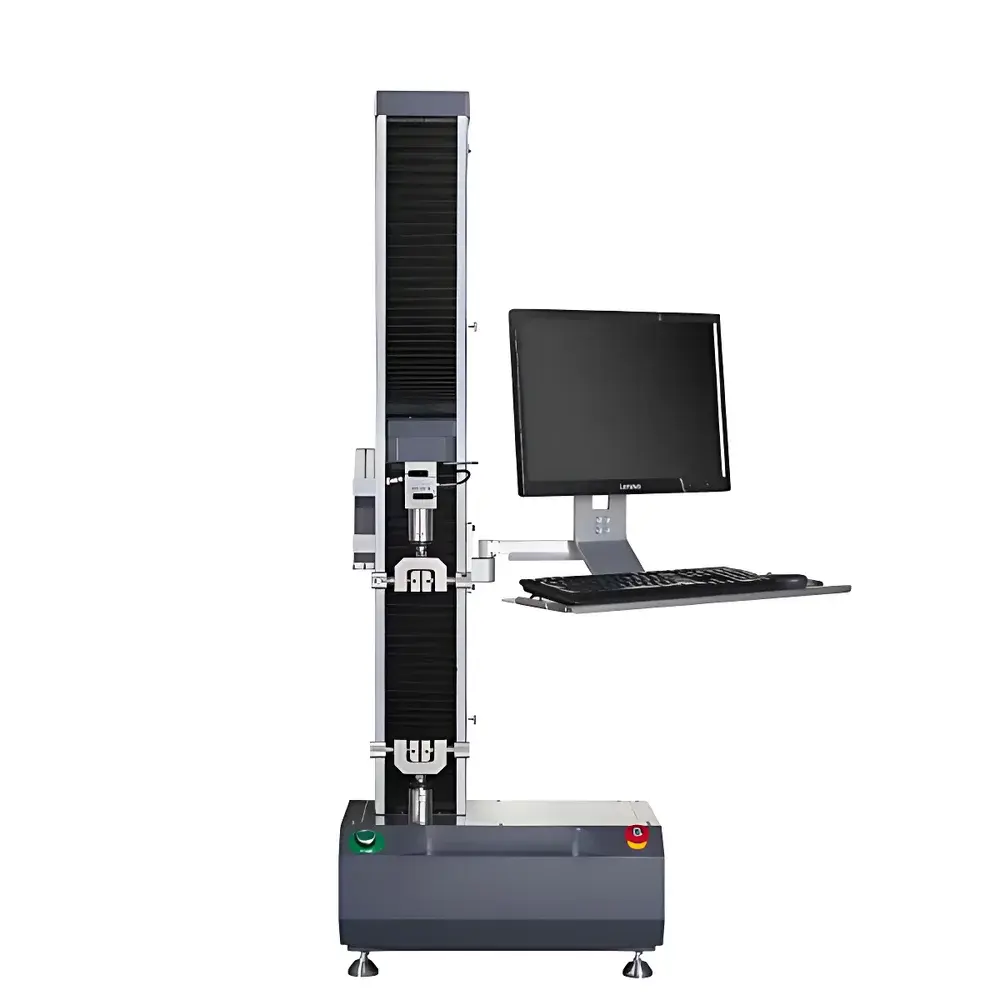
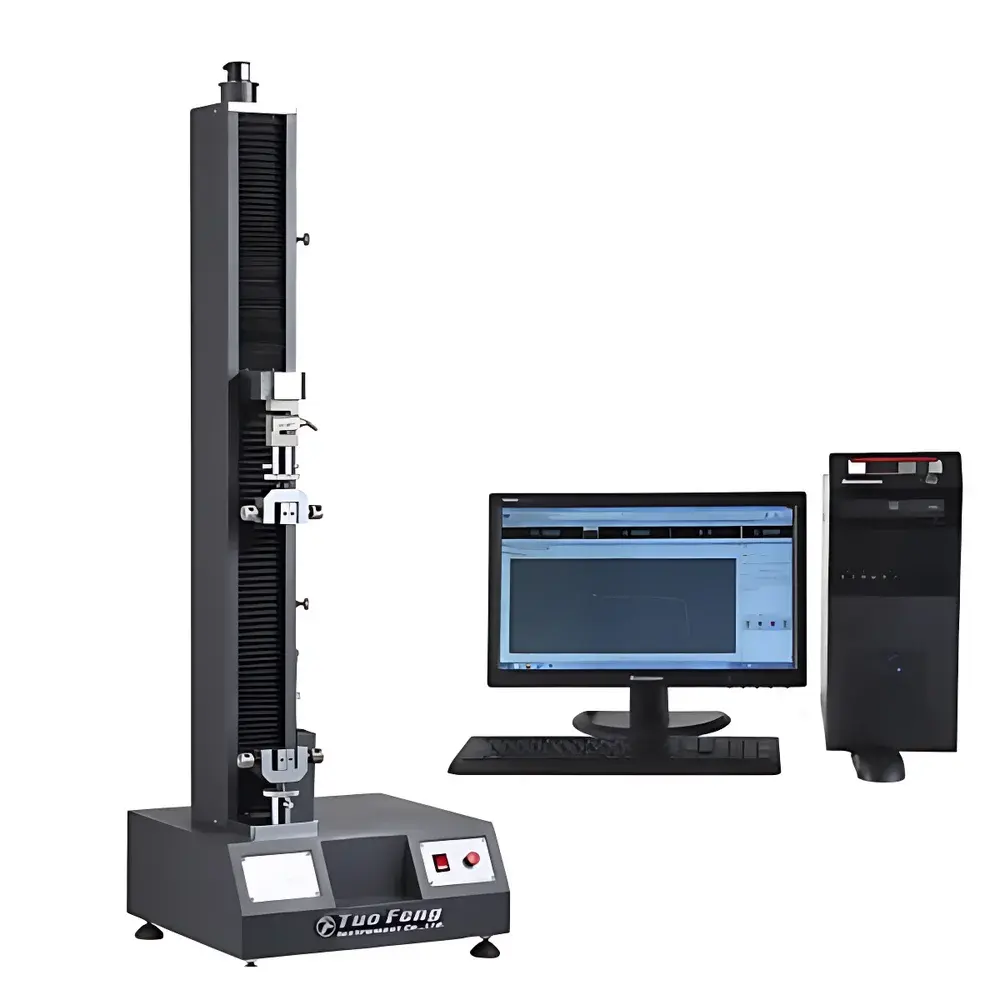
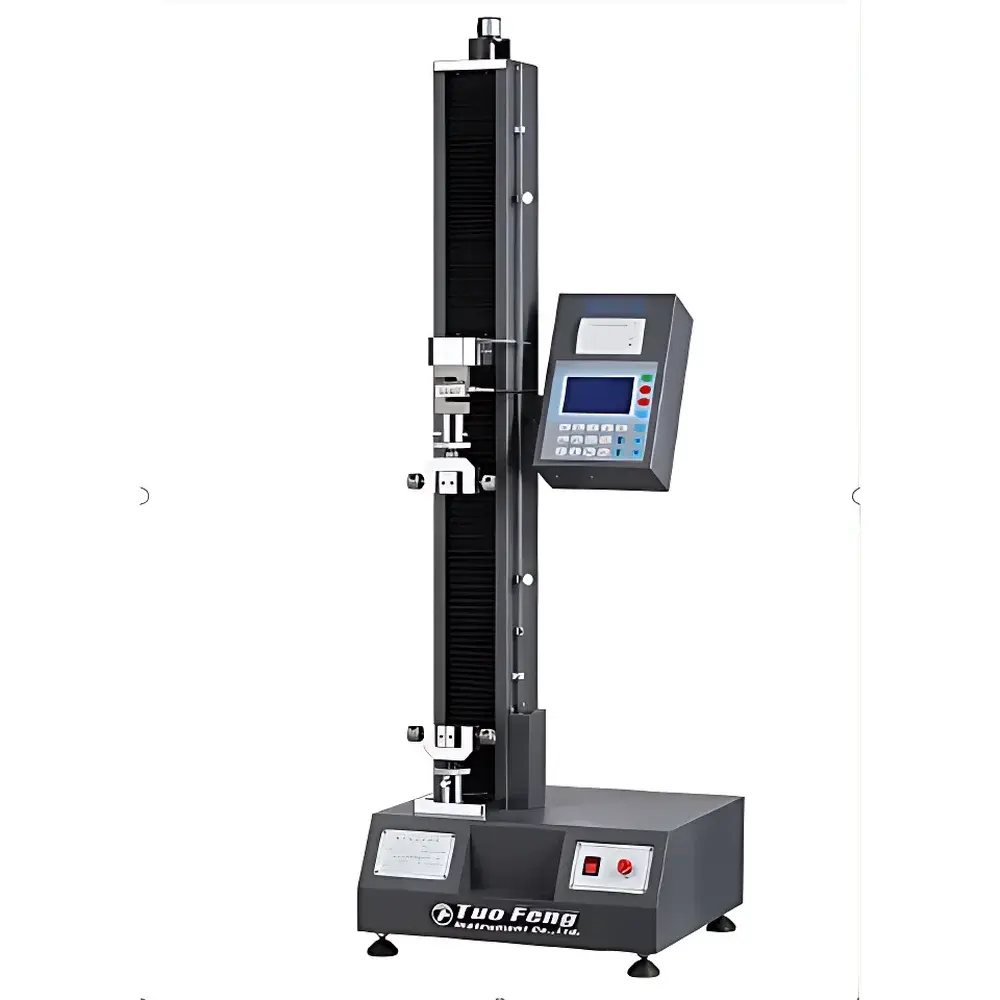
Tuofeng TFL-37S Computer-Controlled Electronic Tensile Testing Machine
| Brand | Tuofeng |
|---|---|
| Origin | Shanghai, China |
| Manufacturer Type | Direct Manufacturer |
| Model | TFL-37S |
| Max Test Load | 5 kN |
| Force Measurement Range | 0.4%–100% of Full Scale |
| Force Accuracy | ±0.5% of reading |
| Crosshead Travel | 700 mm |
| Displacement Resolution | ±0.5% of reading |
| Test Speed Range | 0.01–500 mm/min (infinitely variable) |
| Position Sensing | Optical Encoder |
| Load Cell Resolution | 1 part in 300,000 full-scale counts (single-range, no auto-ranging) |
| Safety Protection | Electronic limit switches, emergency stop, overload protection (>110% FS) |
| Power Supply | 220 V AC, 50 Hz, 400 W |
| Dimensions (W×D×H) | ~460 × 460 × 1500 mm |
| Weight | ~120 kg |
| Compliance | ASTM D638, ISO 527, GB/T 1040, DIN 53455, JIS K7113 |
Overview
The Tuofeng TFL-37S is a precision-engineered computer-controlled electronic tensile testing machine designed for static mechanical property evaluation of thin films, foils, fibers, elastomers, adhesives, packaging materials, and fine metallic specimens. It operates on the fundamental principle of uniaxial force application under controlled displacement or load rate, measuring real-time tensile force, elongation, and deformation to derive standardized mechanical parameters including tensile strength, yield strength, modulus of elasticity, elongation at break, tear resistance, peel adhesion, and bond strength. Its rigid dual-column frame, high-resolution load cell, and optically encoded crosshead positioning system ensure repeatable, traceable, and metrologically sound results—critical for R&D laboratories, quality control departments, and contract testing facilities operating under GLP or GMP frameworks.
Key Features
- High-accuracy 5 kN load cell with ±0.5% force measurement uncertainty across 0.4–100% of full scale, certified per ISO 7500-1 Class 0.5 requirements
- Full-range displacement resolution of ±0.5%—enabled by a calibrated optical encoder integrated into the lead-screw drive system
- Infinitely variable crosshead speed from 0.01 to 500 mm/min, programmable via software for multi-step test profiles (e.g., pre-load → ramp → hold → return)
- Robust single-range analog-to-digital conversion architecture delivering 1:300,000 internal resolution without range switching or signal degradation
- Dual-mode operation: closed-loop load control and closed-loop displacement control, supporting both force-targeted and strain-targeted test protocols
- Integrated safety architecture including hardware-based electronic end-limit detection, momentary emergency stop button, and automatic overload cutoff at 110% of rated capacity
- Motorized crosshead with three-speed manual jog (fast/medium/slow) and programmable return-to-start functionality for high-throughput batch testing
Sample Compatibility & Compliance
The TFL-37S accommodates specimens ranging from sub-millimeter polymer films (e.g., PET, BOPP, PE laminates) to 2 mm diameter metal wires and 0.1–2.0 mm thick aluminum or copper foils. Standard fixtures include pneumatic wedge grips, roller-type film clamps, and peel-adhesion fixtures compliant with ASTM D903 and ISO 8510-2. Optional accessories support large-deformation testing (up to 800 mm extension), extensometry (contact and non-contact), and environmental chamber integration (-40°C to +150°C). The system meets essential performance criteria outlined in ISO 527-2 (plastics), ASTM D882 (thin plastic sheeting), GB/T 1040.3 (film tensile testing), and JIS K7127 (adhesive peel strength), and supports audit-ready data generation aligned with FDA 21 CFR Part 11 requirements when paired with validated software configuration.
Software & Data Management
The TFL-37S runs on a dedicated Windows-based testing platform compatible with Windows 7 through Windows 11 (32/64-bit). The software supports seven standard test modes: constant rate of extension (CRE), constant rate of loading (CRL), stress relaxation, creep, cyclic loading, break-point capture, and multi-stage ramp-hold sequences. Real-time visualization includes synchronized force–time, force–displacement, stress–strain, and displacement–time plots, with on-screen digital readouts of peak load, maximum displacement, and instantaneous modulus. All units—including force (N, kN, lbf), displacement (mm, in), stress (MPa, psi), and strain (% or mm/mm)—are user-selectable and automatically applied during calculation. Raw data export is supported in CSV, Excel (.xlsx), and universal .txt formats; report templates comply with ISO/IEC 17025 documentation standards. Audit trails, electronic signatures, and password-protected method libraries are available under optional validation packages.
Applications
- Quantitative assessment of tensile integrity in pharmaceutical blister packaging films under accelerated aging conditions
- Interfacial adhesion strength measurement of multilayer food packaging laminates (e.g., PET/Alu/PE structures) per ASTM F904
- Mechanical screening of conductive nanocomposite films for flexible electronics substrates
- Quality conformance testing of lithium-ion battery separator membranes (e.g., PP/PE microporous films) per UL 2591
- Comparative tear propagation resistance of medical-grade silicone elastomers used in implantable devices
- Peel strength verification of pressure-sensitive adhesive tapes per PSTC-101 and AFERA 4001
- Yield behavior characterization of ultra-thin copper foils (<12 µm) employed in high-density PCB manufacturing
FAQ
What standards does the TFL-37S support out-of-the-box?
It natively implements test method templates for ASTM D638, ISO 527-3, GB/T 1040.3, DIN 53455, and JIS K7113, with customizable parameter sets for non-standard protocols.
Can the system be integrated into an existing LIMS or MES environment?
Yes—the software provides OPC UA and TCP/IP communication interfaces, enabling bidirectional data exchange with laboratory information management systems and enterprise manufacturing execution platforms.
Is calibration certification included with delivery?
Each unit ships with a factory-issued calibration certificate traceable to NIM (National Institute of Metrology, China), covering force, displacement, and speed axes; third-party ISO/IEC 17025 accreditation is available upon request.
What is the recommended maintenance interval?
Preventive maintenance—including load cell zero drift verification, encoder alignment check, and lubrication of lead screw assembly—is advised every 12 months or after 5,000 test cycles, whichever occurs first.
Does the software support multi-user role-based access control?
Yes—administrator, operator, and reviewer roles can be assigned with granular permissions for method editing, test execution, data export, and report approval, fulfilling ALCOA+ data integrity principles.



