
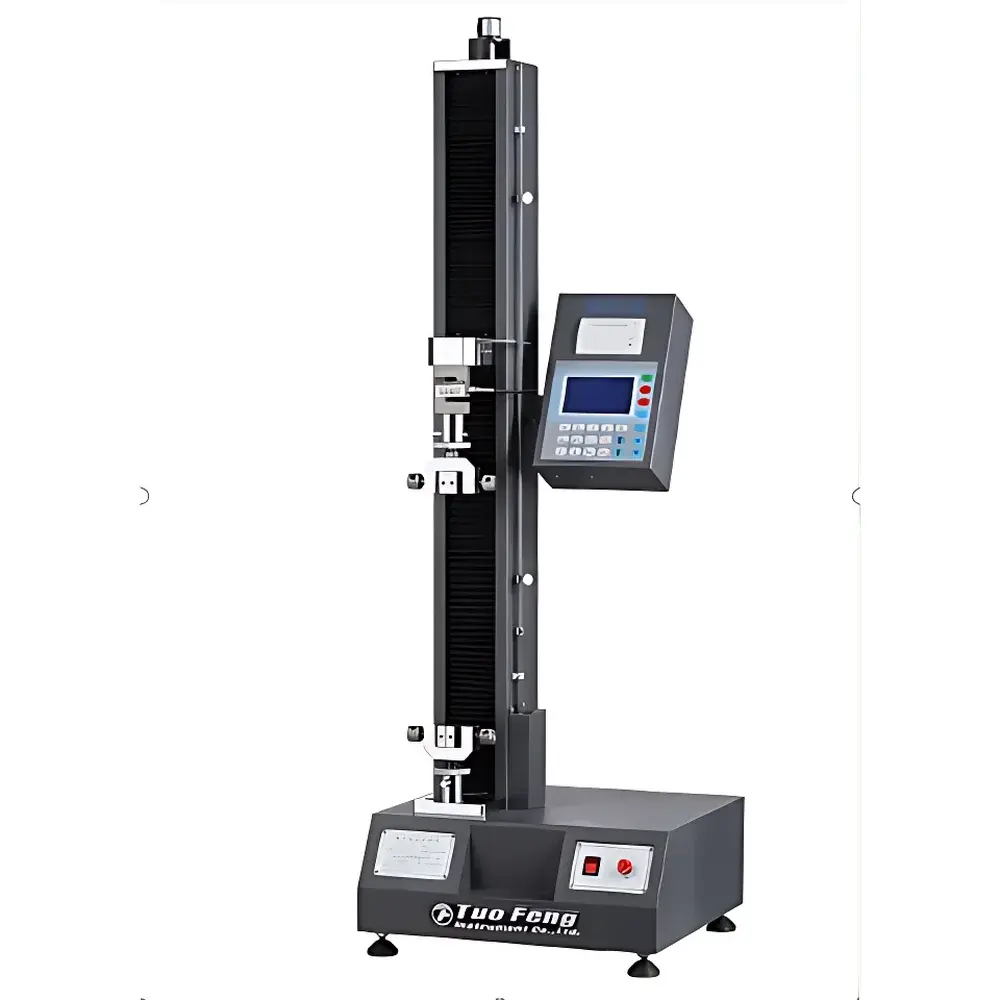
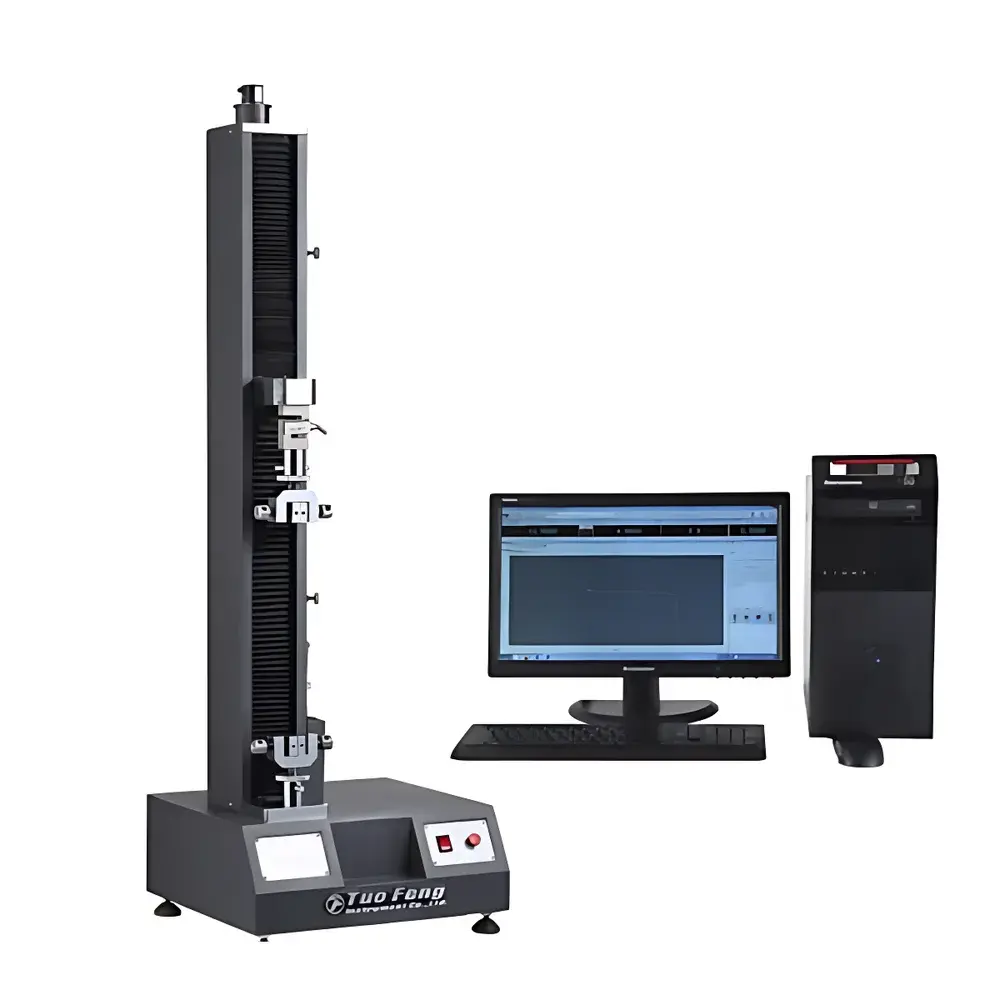
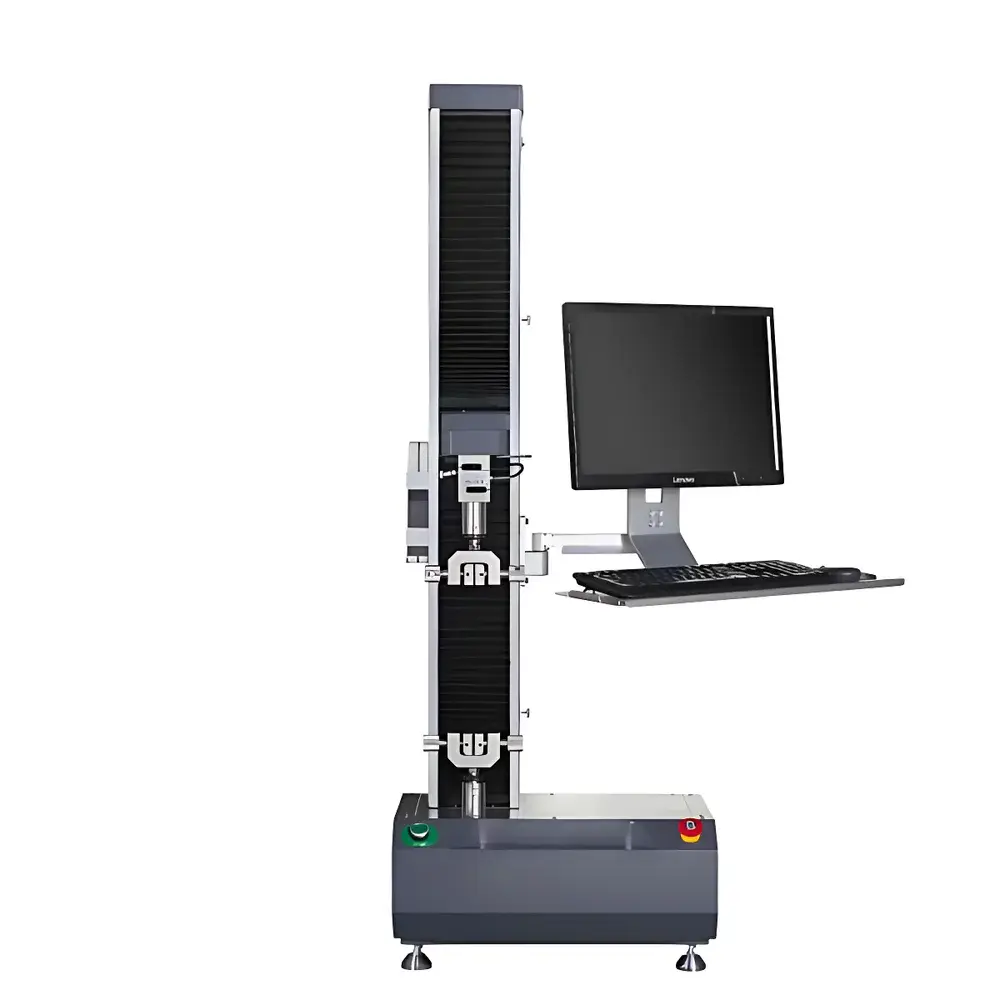
Tuofeng TFL-38S Computer-Controlled Electronic Tensile Testing Machine
| Brand | Tuofeng |
|---|---|
| Origin | Shanghai, China |
| Manufacturer Type | Direct Manufacturer |
| Model | TFL-38S |
| Maximum Test Load | 5 kN |
| Force Measurement Range | 0.4%–100% of Full Scale (FS) |
| Force Accuracy | ±0.5% of reading |
| Crosshead Travel | 700 mm |
| Displacement Resolution | ±0.5% of reading |
| Test Speed Range | 0.01–500 mm/min (infinitely variable) |
| Position Sensing | Optical Encoder |
| Load Cell Resolution | 1 part in 300,000 full-scale codes, single-range, constant resolution |
| Protection Features | Electronic limit switches, emergency stop, overload protection (>110% FS) |
| Power Supply | 220 V AC, 50 Hz, 400 W |
| Dimensions (W×D×H) | ≈460×460×1500 mm |
| Weight | ≈120 kg |
Overview
The Tuofeng TFL-38S is a precision-engineered computer-controlled electronic tensile testing machine designed for static mechanical property evaluation of flexible and semi-rigid materials under uniaxial loading conditions. It operates on the fundamental principle of controlled crosshead displacement, where force is measured via a high-stability load cell and displacement via a calibrated optical encoder system. The instrument conforms to internationally recognized test methodologies defined in ASTM D882 (tensile properties of thin plastic sheeting), ASTM D638 (tensile properties of plastics), ISO 1798 (flexible cellular polymeric materials), ISO 527 (plastics—determination of tensile properties), GB/T 1040 (Chinese national standard for tensile testing of plastics), and JIS K 7113 (Japanese standard for tensile testing of plastics). Its modular architecture supports standardized tensile, peel, tear, and bond strength measurements across diverse sample geometries and compliance requirements.
Key Features
- High-fidelity force measurement with ±0.5% accuracy over 0.4–100% of full scale (5 kN), enabled by a temperature-compensated strain-gauge load cell and 300,000-count A/D resolution without range switching.
- Infinitely variable crosshead speed control from 0.01 to 500 mm/min, ensuring optimal strain rate selection per material class—from slow creep testing of elastomers to rapid tear propagation in films.
- 700 mm standard travel range with optional extension, supporting both short-gauge high-strain tests and long-travel low-force applications such as adhesive peel or textile elongation.
- Dual-mode operation: manual jog control for fixture alignment and automated program execution for repeatable, protocol-driven testing sequences.
- Integrated safety architecture including hardware-based emergency stop, electronic end-of-travel limits, and automatic overload cutoff at 110% of rated capacity.
- Modular fixture interface compatible with pneumatic, wedge, and custom-designed grips—including peel arms, trouser-tear clamps, and puncture probes—for multi-standard compliance.
Sample Compatibility & Compliance
The TFL-38S accommodates specimens ranging from sub-millimeter-diameter metallic wires and polymer monofilaments to laminated food packaging films (e.g., PET/Al/PE composites), paperboard cartons, nonwoven medical fabrics, and pressure-sensitive adhesive tapes. Its design enables direct implementation of regulatory test protocols required under FDA 21 CFR Part 11 (when paired with audit-trail-enabled software configuration), ISO/IEC 17025 laboratory accreditation frameworks, and GMP-aligned quality control workflows. All mechanical calibrations are traceable to NIM (National Institute of Metrology, China) standards, and force verification follows ISO 7500-1 Class 0.5 procedures. Routine calibration checks can be performed using certified reference loads prior to each test session.
Software & Data Management
The Windows-based testing software (compatible with Windows 10/11, 64-bit) provides full GLP-compliant data acquisition and reporting. It supports dual-language UI (English, Simplified/Traditional Chinese) and customizable unit systems (N, kN, lbf; mm, inch; MPa, psi). Test modes include constant-rate-of-extension (CRE), constant-load hold, and displacement-targeted ramping. Real-time plotting includes load–time, load–displacement, stress–strain, and extension–time curves, with on-the-fly parameter derivation—including tensile strength, yield point, modulus (secant/tangent), elongation at break, peel adhesion (N/25 mm), and tear resistance (kN/m). Raw data exports to CSV or Excel; graphical reports include embedded metadata (operator ID, timestamp, environmental conditions, calibration status). Audit trail functionality logs all user actions, method modifications, and result edits—supporting FDA 21 CFR Part 11 readiness when configured with electronic signatures.
Applications
- Quality assurance of flexible packaging: seal strength, peel resistance of laminated pouches, puncture resistance of blister foils.
- Mechanical validation of biomedical materials: suture tensile strength (ASTM D2256), hydrogel elongation, wound dressing cohesion.
- Wire and cable manufacturing: tensile integrity of copper-clad aluminum conductors, insulation jacket elongation (UL 1581).
- Paper and board industry: ring crush test correlation, linerboard tensile index (ISO 1924), corrugated board edgewise compression simulation.
- Adhesive R&D: lap-shear strength of structural epoxies, tack and holding power of PSA tapes per PSTC-101/107.
- Textile and nonwovens: grab tensile and strip tensile per ASTM D5034/D5035, seam slippage resistance (ASTM D434).
FAQ
What international standards does the TFL-38S support out of the box?
The system is pre-configured with test templates for ASTM D882, ASTM D638, ISO 527, ISO 1798, GB/T 1040, and JIS K 7113. Custom method creation is supported via editable parameter sets.
Can the software generate 21 CFR Part 11–compliant reports?
Yes—when deployed with password-protected user roles, electronic signature capture, and immutable audit logging enabled, the software meets core technical requirements for regulated environments.
Is external calibration certification included with purchase?
A factory calibration certificate traceable to NIM is supplied. Optional UKAS-accredited calibration services are available upon request.
How is fixture compatibility managed across material types?
The machine uses a standardized T-slot crosshead and base plate interface. Tuofeng provides application-specific grip kits (e.g., pneumatic film clamps, roller-type peel fixtures) with documented compliance documentation.
What maintenance intervals are recommended for long-term accuracy?
Load cell zero drift and encoder linearity should be verified quarterly; full recalibration is advised annually or after any impact event or overload incident.



