
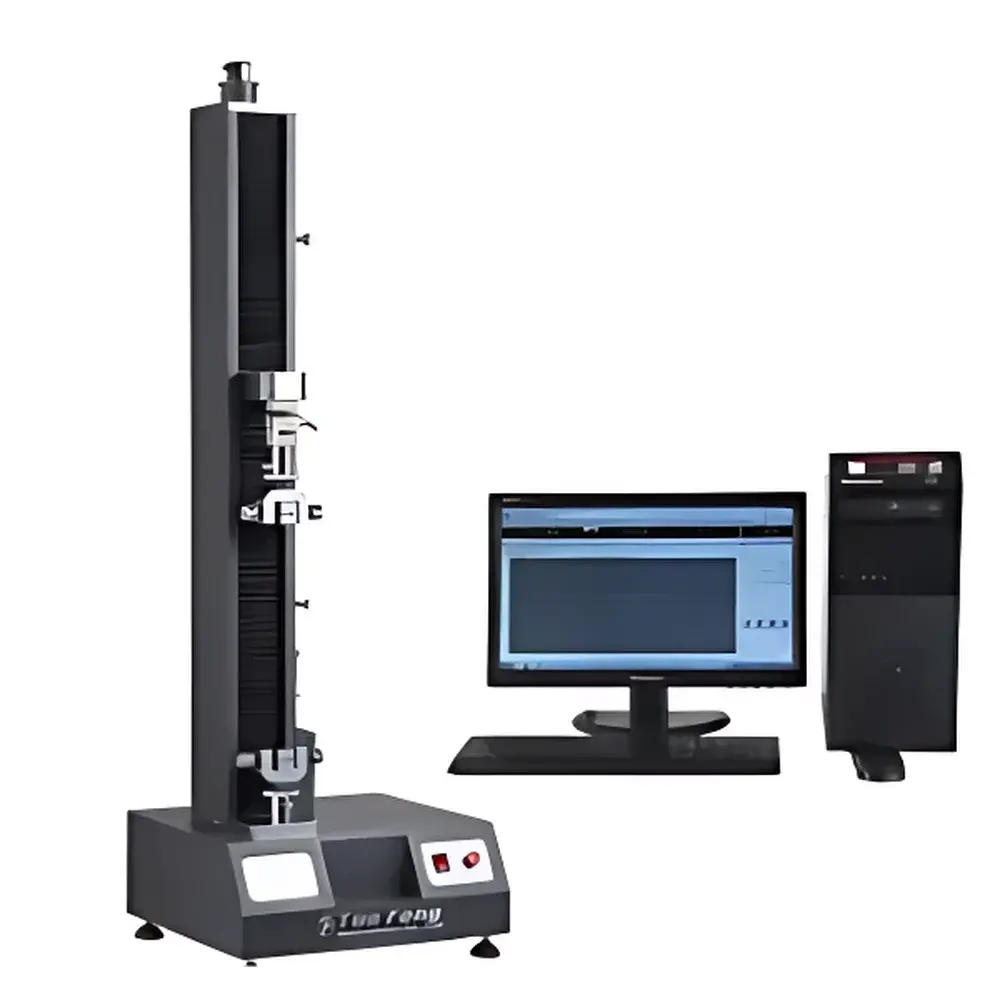
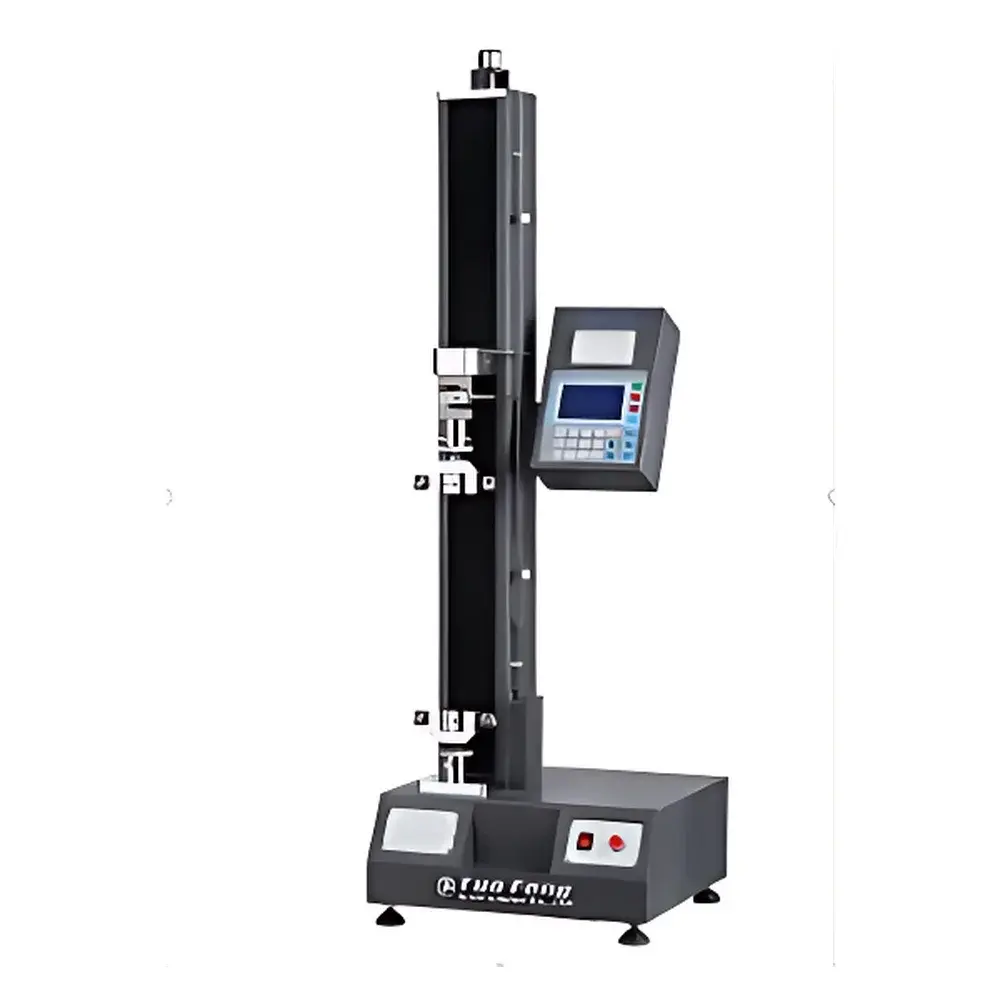
Tuofeng TFL-3S Microcomputer-Controlled Electronic Tensile Testing Machine
| Brand | Tuofeng |
|---|---|
| Origin | Shanghai, China |
| Manufacturer Type | Direct Manufacturer |
| Model | TFL-3S |
| Maximum Test Load | 5 kN |
| Force Measurement Range | 0.4%–100% of Full Scale (FS) |
| Force Accuracy | ±0.5% of reading |
| Crosshead Travel | 700 mm |
| Displacement Resolution | ±0.5% of reading |
| Test Speed Range | 0.01–500 mm/min (infinitely variable) |
| Position Sensing | Optical Encoder |
| Load Cell Resolution | 1 part in 300,000 full-scale counts, single-range, constant resolution throughout |
| Protection Features | Electronic limit switches, emergency stop, overload protection (>110% FS) |
| Power Supply | 220 V AC, 50 Hz, 400 W |
| Dimensions (W×D×H) | ≈460×460×1500 mm |
| Weight | ≈120 kg |
Overview
The Tuofeng TFL-3S Microcomputer-Controlled Electronic Tensile Testing Machine is a precision-engineered universal testing system designed for static mechanical characterization of materials under uniaxial tension, compression, bending, peel, tear, and shear loading conditions. Based on servo-controlled electromechanical actuation and high-fidelity load-cell transduction, the system implements closed-loop force and displacement control per ISO 7500-1 (Class 0.5 accuracy), ASTM E4, and ASTM E8/E8M standards. Its architecture integrates a rigid dual-column frame, precision-ground ball-screw drive, and real-time digital signal processing to ensure high reproducibility across repeated tests—critical for quality control laboratories, R&D departments, and contract testing facilities operating under GLP or ISO/IEC 17025 frameworks.
Key Features
- High-accuracy load measurement with ±0.5% indication error over 0.4–100% FS range, certified to ISO 7500-1 Class 0.5
- Optical encoder-based displacement sensing with ±0.5% linearity and 0.001 mm effective resolution
- Infinitely variable crosshead speed from 0.01 to 500 mm/min, enabling compliance with low-strain-rate creep tests and high-speed peel protocols
- Integrated electronic limit protection, hardware-triggered emergency stop, and automatic overload cutoff at 110% of rated capacity
- Motorized crosshead with three-speed preset modes (fast/medium/slow) and programmable return-to-start functionality
- Modular fixture interface supporting standardized grips (pneumatic, wedge, vise-type) and custom tooling for wires, films, foils, fibers, adhesives, and biomedical specimens
- Robust structural design: 120 kg cast-iron base, reinforced steel columns, and vibration-damped mounting platform
Sample Compatibility & Compliance
The TFL-3S accommodates specimens ranging from fine metallic filaments (diameter ≥0.1 mm) to rigid plastic bars (cross-section up to 25 × 25 mm), thin films (≥5 µm thickness), woven textiles, laminated composites, and elastomeric sheets. Standard test configurations include tensile elongation per ASTM D638 and ISO 527, peel adhesion per ASTM D903 and ISO 8510-2, tear resistance per ASTM D1938, and puncture strength per ASTM F1306. The system supports full traceability and audit readiness through configurable user access levels, electronic signature support, and optional 21 CFR Part 11-compliant software modules. All mechanical calibrations are documented per ISO/IEC 17025 requirements, with certificate-of-conformance available upon request.
Software & Data Management
The Windows-based TensileTest Pro™ software (compatible with Windows 10/11, 64-bit) provides multi-mode control—including constant rate of extension (CRE), constant load ramping, and displacement-limited hold sequences. Real-time visualization includes synchronized force–time, stress–strain, force–displacement, and extension–time plots, with overlay capability for up to eight test curves. Automated calculations generate standardized outputs: tensile strength (MPa), yield point (offset method), modulus of elasticity (secant/tangent), elongation at break (%), peel strength (N/mm), and tear propagation resistance (kN/m). Data export supports CSV, Excel (.xlsx), PDF report generation, and direct integration with LIMS via ODBC. Audit trails record operator ID, timestamp, parameter changes, and result modifications—fully compliant with GLP documentation practices.
Applications
This system serves as a core instrument in materials qualification workflows across regulated and non-regulated sectors. In wire & cable manufacturing, it verifies conductor tensile integrity and insulation jacket adhesion. In packaging R&D, it quantifies seal strength of thermoformed trays and delamination resistance of multilayer laminates. For medical device producers, it validates suture tensile performance per USP and balloon catheter burst pressure precursors. Academic labs utilize its repeatability for polymer viscoelastic modeling, while QC labs in automotive supply chains rely on its stability for rubber compound batch release testing against DIN 53504 and ISO 37 specifications.
FAQ
What international standards does the TFL-3S support out-of-the-box?
The system complies with ISO 7500-1 (load cell calibration), ISO 5893 (testing machine verification), ASTM E4 (force verification), and ASTM E8/E8M (metal tensile testing). Software templates are preconfigured for ASTM D638, ISO 527, ASTM D882, and ISO 1184.
Can the system be upgraded for dynamic testing or high-temperature environments?
No—the TFL-3S is strictly a static testing platform. For fatigue or thermal-mechanical testing, Tuofeng offers complementary systems including electrodynamic servohydraulic testers and environmental chamber-integrated variants.
Is third-party calibration certification included with purchase?
A factory-issued calibration certificate traceable to NIM (China National Institute of Metrology) is provided. ISO/IEC 17025-accredited field calibration services are available as an optional add-on.
How is data integrity ensured during long-duration tests?
All raw sensor data is streamed continuously to non-volatile memory at ≥1 kHz sampling rate; power-loss recovery preserves unsaved buffers, and checksum-verified file writes prevent corruption.
Does the software meet FDA 21 CFR Part 11 requirements?
Yes—when configured with the optional Compliance Edition, the software delivers role-based access control, biometric or token-based electronic signatures, immutable audit logs, and automated backup archiving.
Related Products



