
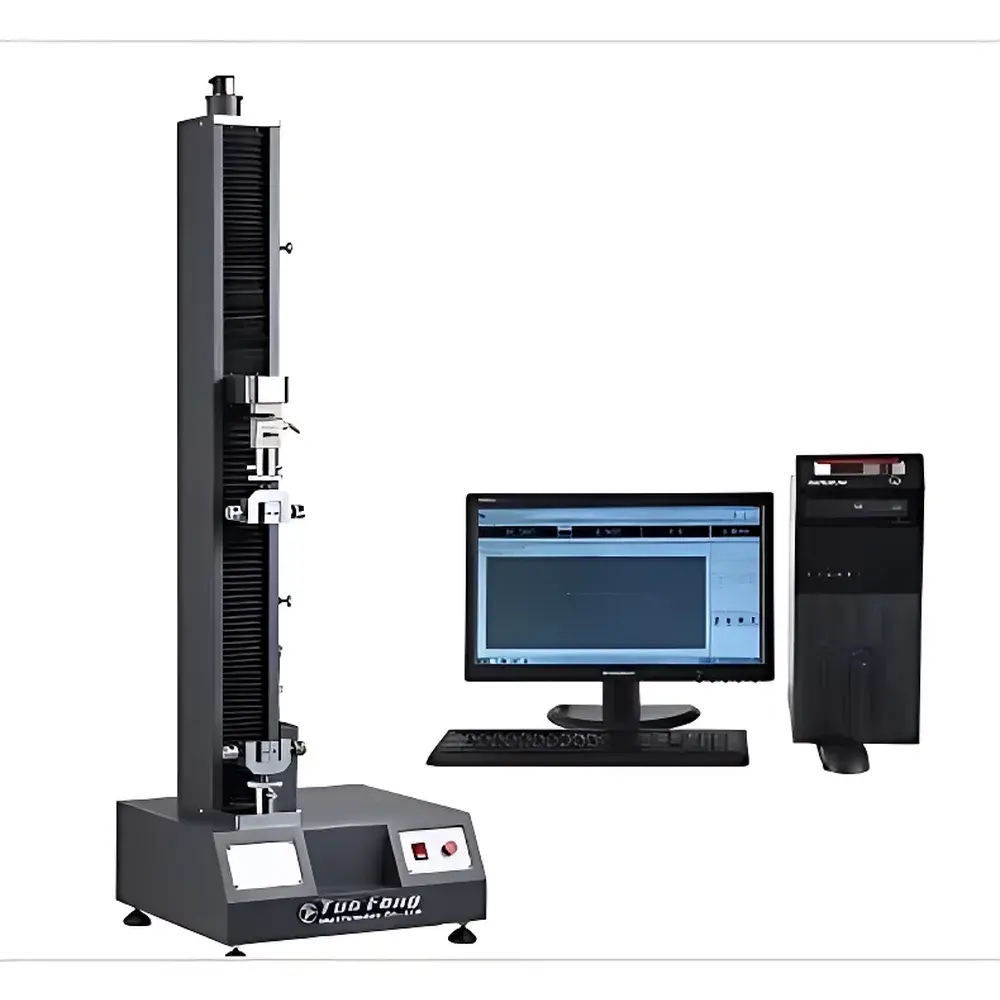
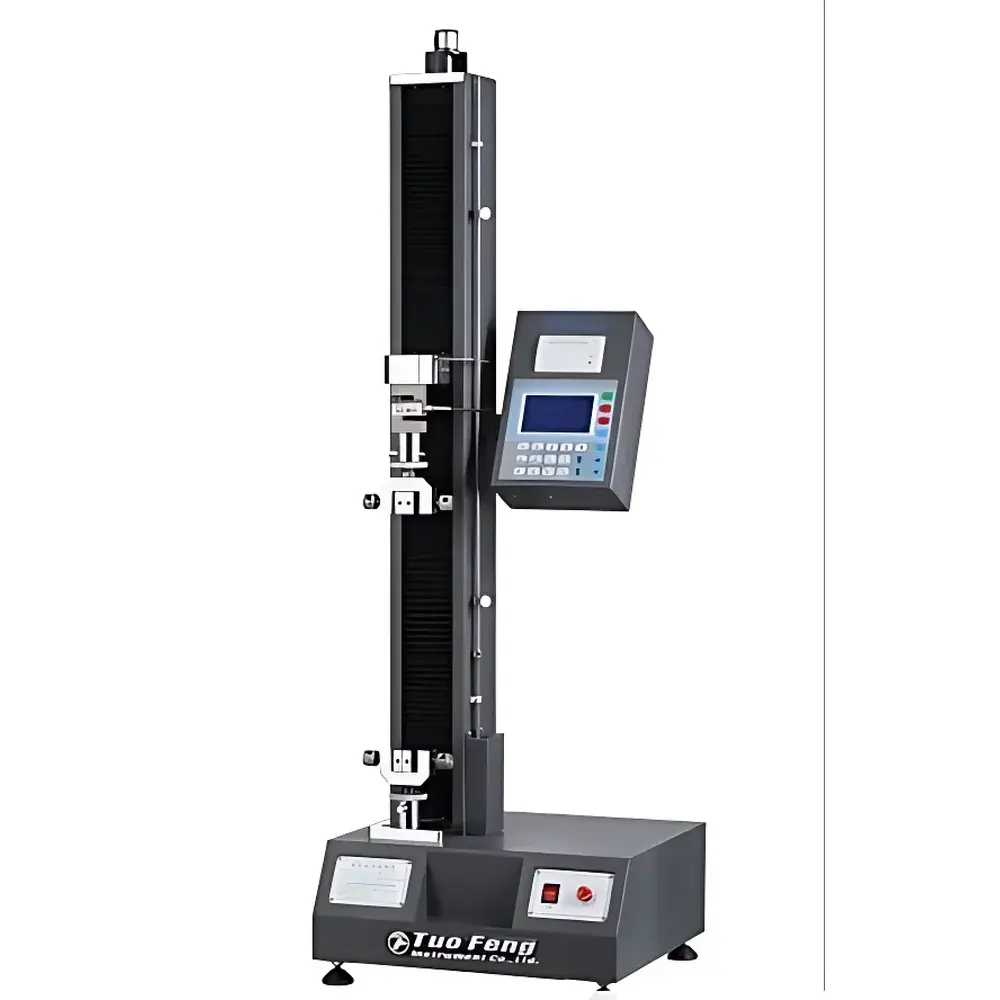
TuoFeng TFL Series Single-Column Microcomputer-Controlled Electronic Tensile Testing Machine
| Brand | TuoFeng |
|---|---|
| Origin | Shanghai, China |
| Manufacturer Type | Direct Manufacturer |
| Model | TFL-5S |
| Max Test Load | 5 kN |
| Force Measurement Range | 0.4%–100% FS |
| Force Accuracy | ≤ ±0.5% of reading |
| Crosshead Travel | 700 mm |
| Displacement Resolution | 0.0001 mm |
| Test Speed Range | 0.01–500 mm/min (infinitely variable) |
| Displacement Accuracy | ±0.5% of reading |
| Overload Protection | Activates at >110% of full scale |
| Safety Features | Electronic limit switches, emergency stop button |
| Power Supply | 220 V, 50 Hz, 400 W |
| Dimensions (W×D×H) | ~460 × 460 × 1500 mm |
| Weight | ~120 kg |
| Compliance | GB/T 228.1, ISO 6892-1, ASTM E8/E21, DIN 50125, JIS Z 2241 |
Overview
The TuoFeng TFL Series is a single-column, microprocessor-controlled electronic tensile testing machine engineered for precision mechanical property evaluation of low-to-medium force-range specimens. Based on servo-motor-driven crosshead motion and high-stability load cell transduction, the system operates under closed-loop control to deliver repeatable force–displacement data in accordance with standardized uniaxial tensile, peel, tear, and bond strength protocols. Designed for laboratories requiring regulatory-compliant mechanical testing without the footprint or cost of dual-column systems, the TFL platform supports static and quasi-static loading modes across a broad spectrum of materials—including metallic wires and foils, polymer films, elastomers, textiles, paperboard, adhesives, and biomedical packaging substrates.
Key Features
- Single-column rigid frame architecture with reinforced aluminum alloy uprights and precision-ground lead screws for minimal deflection under load
- High-resolution digital load cell calibrated to ISO 376 Class 0.5 accuracy (±0.5% of reading), with internal 300,000-count A/D resolution and no range switching required
- Optical encoder-based displacement measurement system offering 0.0001 mm resolution and ±0.5% linearity over full 700 mm travel range
- Variable-speed AC servo drive enabling smooth, programmable test velocities from 0.01 to 500 mm/min—fully adjustable via software interface
- Dual-mode actuation control: motorized crosshead positioning with three preset speeds (fast/medium/slow) plus manual jog capability for specimen alignment
- Integrated safety subsystem including electronic end-limit detection, hardware-triggered emergency stop circuit, and automatic overload cutoff (>110% FS)
- Modular fixture interface compatible with standard wedge-action, pneumatic, or custom-designed grips for flat, round, or irregular geometries
Sample Compatibility & Compliance
The TFL series accommodates specimens up to 700 mm in gauge length and supports tensile testing of wires (Ø0.1–3 mm), thin metal strips (≤1.5 mm thick), polymer films (≥12 µm), woven/nonwoven textiles, laminated packaging, and pressure-sensitive adhesive tapes. It meets essential metrological and procedural requirements of multiple international standards, including GB/T 228.1–2021 (metallic materials), ISO 6892–1:2019 (tensile testing at ambient temperature), ASTM E8/E21 (metal tension testing), DIN 50125 (tensile test specimens), and JIS Z 2241 (metallic materials tensile test). All force and displacement channels are traceable to national metrology institutes; calibration certificates conform to ISO/IEC 17025 guidelines.
Software & Data Management
The Windows-based TFL Control Suite (compatible with Windows XP through Windows 10) provides full GMP/GLP-aligned operation. It supports six independent test modes: constant rate of extension (CRE), constant load, constant displacement, dwell, cyclic loading, and stress relaxation. Real-time plotting includes force–time, force–displacement, displacement–time, stress–strain, and force–extension curves—with on-screen display of current and peak values. Software calculates and exports standardized metrics—including tensile strength, yield strength (0.2% offset), elongation at break, modulus of elasticity, peel adhesion (90°/180°), tear resistance (Elmendorf), and bond strength—automatically upon entry of specimen geometry (width, thickness, gauge length). Audit trail functionality logs user actions, method changes, and calibration events in compliance with FDA 21 CFR Part 11 requirements. Data export supports CSV, PDF, and XML formats; curve overlay and statistical reporting (max/min/mean) are enabled for batch comparisons.
Applications
This instrument serves quality control laboratories in wire & cable manufacturing, flexible packaging R&D, medical device component validation, textile performance testing, and adhesive formulation development. Typical use cases include: verification of copper wire tensile strength per IEC 60228; peel strength assessment of sterile barrier packaging per ISO 8553; elongation and modulus characterization of thermoplastic elastomer films; tensile integrity testing of surgical suture materials per USP ; and comparative mechanical aging studies of UV-exposed polyethylene films. Its compact form factor and modular design make it suitable for ISO 17025-accredited facilities where space-constrained benchtop deployment is required.
FAQ
What standards does the TFL series support out-of-the-box?
The system includes pre-configured test methods aligned with GB/T 228.1, ISO 6892-1, ASTM E8, and DIN 50125. Custom method templates can be created for non-standard protocols.
Is the software compliant with FDA 21 CFR Part 11?
Yes—the TFL Control Suite implements electronic signatures, audit trails, role-based access control, and data integrity safeguards meeting Part 11 requirements for regulated environments.
Can the machine perform compression or flexural tests?
Compression testing is supported with optional compression platens; flexural testing requires a three-point bending fixture (available as accessory kit).
What is the calibration interval recommendation?
Annual calibration is recommended per ISO/IEC 17025; however, user-performed daily verification using certified reference load cells is advised before critical test runs.
Does the system support multi-specimen batch processing?
Yes—batch mode allows sequential execution of identical test configurations across up to 99 specimens, with individual result archiving and summary statistics generation.



