
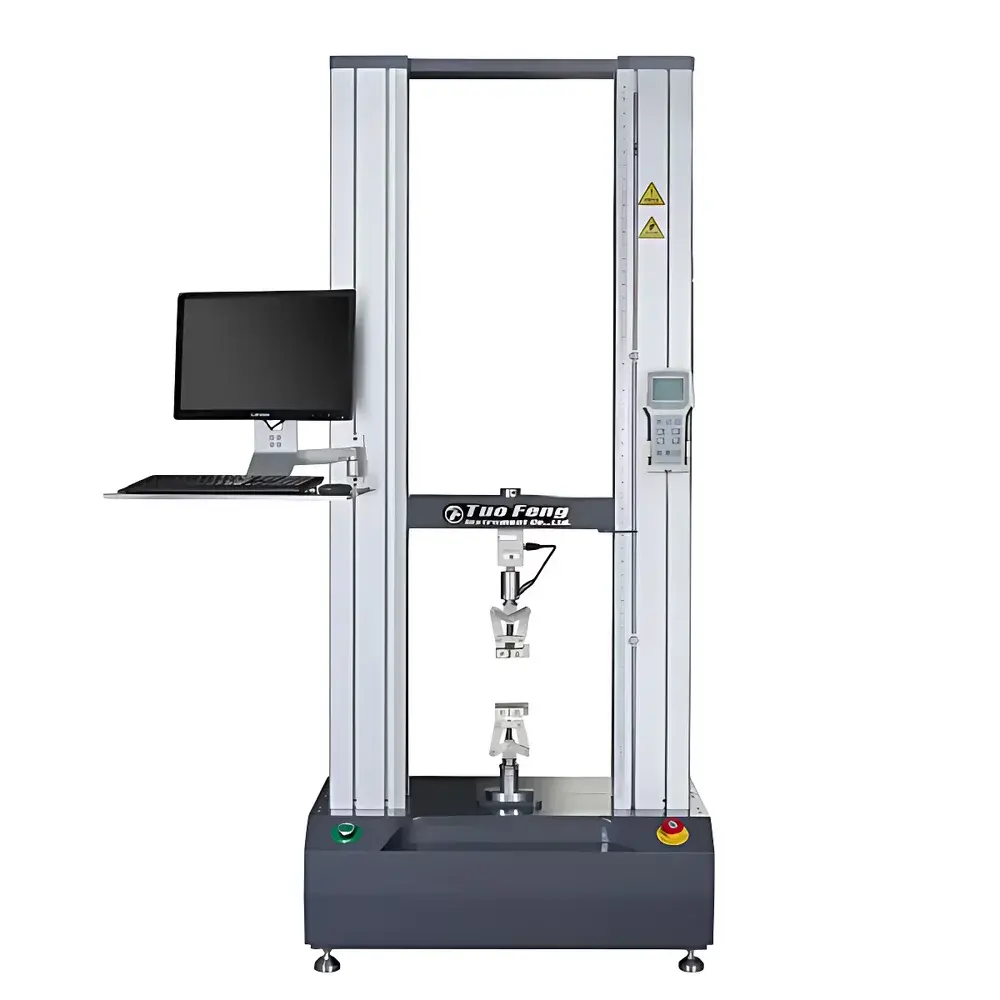
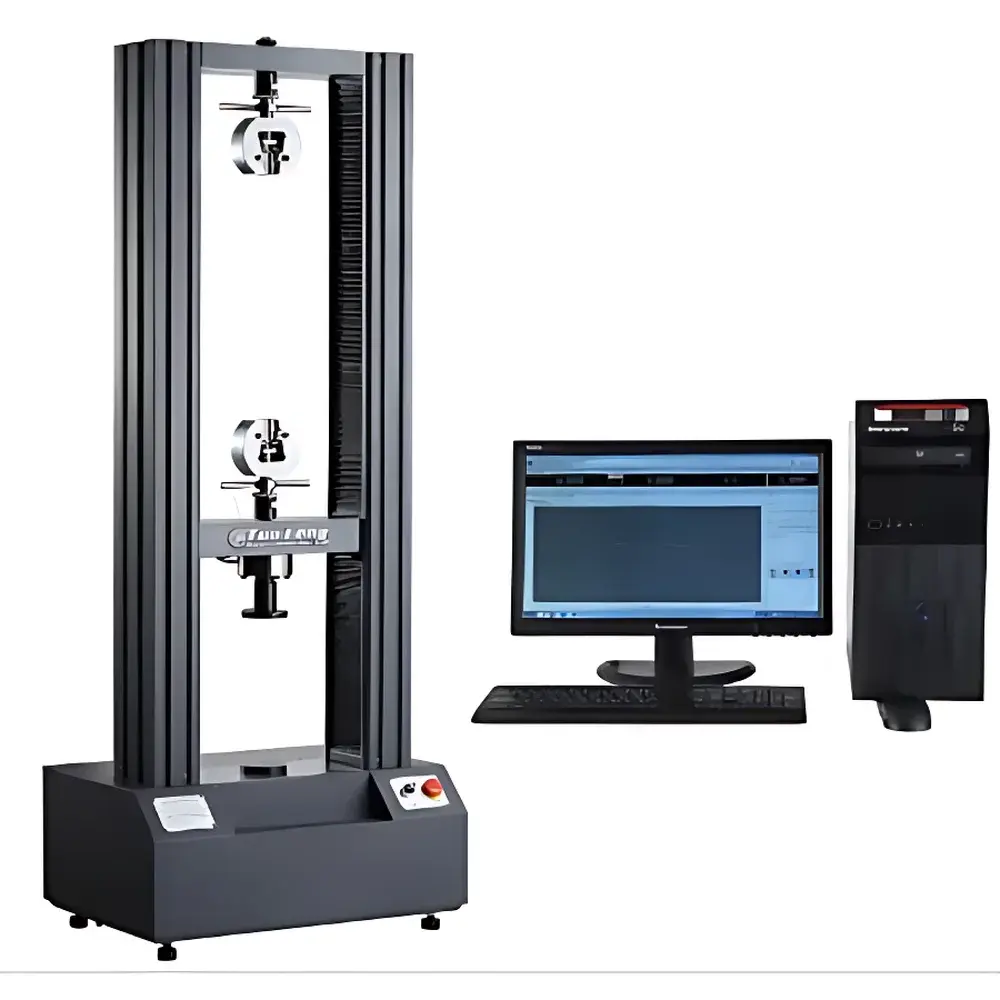
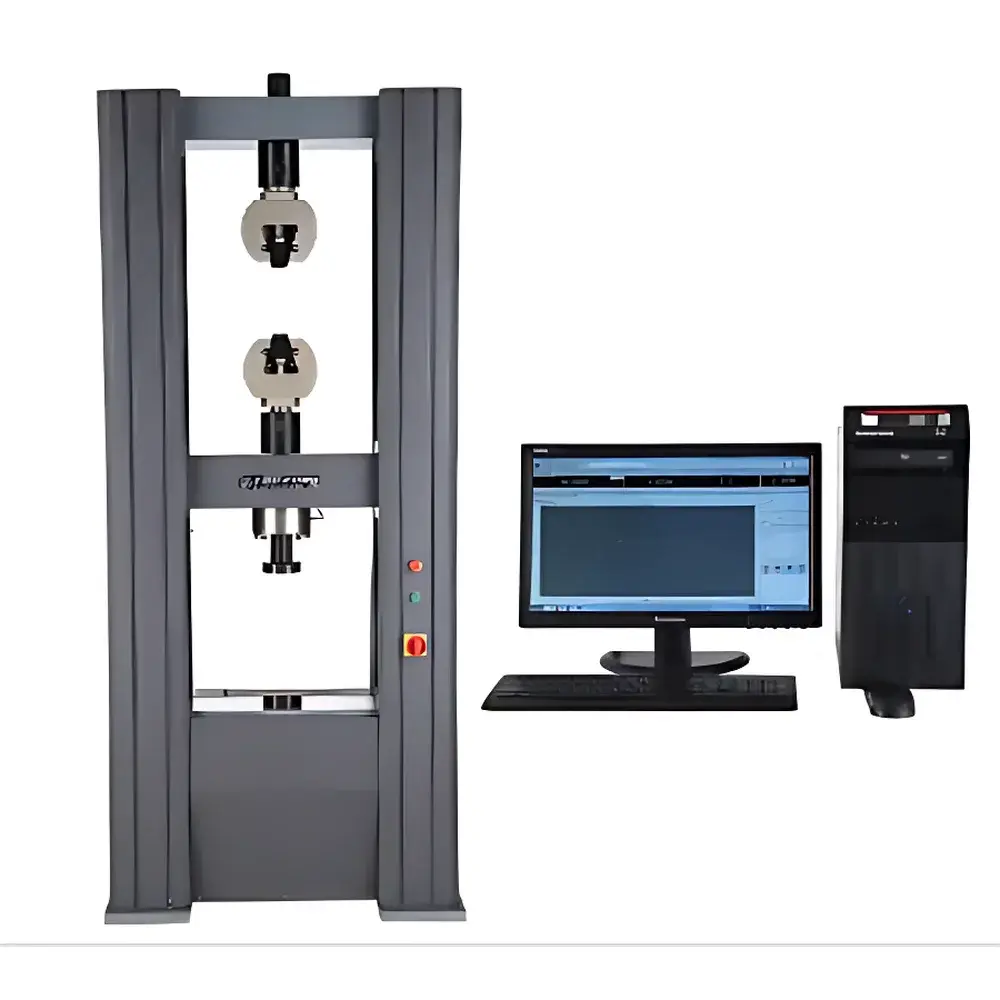
Tuofeng TFW-132 Microcomputer-Controlled Servo Electromechanical Universal Testing Machine
| Brand | Tuofeng |
|---|---|
| Origin | Shanghai, China |
| Manufacturer Type | Direct Manufacturer |
| Product Category | Domestic |
| Model | TFW-132 |
| Price Range | USD 7,000–14,000 (FOB Shanghai) |
| Instrument Type | Electromechanical Universal Testing Machine |
| Maximum Test Load | 200 kN |
| Force Measurement Range | 0.2%–100% of Full Scale |
| Force Accuracy | ±0.5% of reading |
| Crosshead Travel | 1000 mm |
| Displacement Resolution | 0.001 mm |
| Control System | PC-based closed-loop servo control |
| Drive System | Imported AC servo motor with precision worm-gear reducer |
| Actuation Mechanism | High-precision preloaded ball screw |
| Effective Test Width | 600 mm (customizable up to 1000 mm) |
| Speed Range | 0.001–500 mm/min (infinitely variable, programmable) |
| Displacement Measurement | Optical encoder |
| Displacement Accuracy | ±0.005% of reading |
| Strain Measurement Options | Extensometer (clip-on or non-contact), large-deformation extensometer (optional) |
| Strain Accuracy | ±0.005% of reading |
| Safety Protection | Dual-limit electronic travel stops, emergency stop button, overload protection (110% FS auto-shutdown) |
| Crosshead Adjustment | Dual-speed motorized up/down control with jog function |
| Return Mode | Automatic high-speed return to initial position post-test |
| Load Frame Stiffness | ≥1.2 × 10⁶ N/mm |
| Weight | ~1500 kg |
| Power Supply | 220 V AC, 3.0 kW |
| Compliance | GB/T 16491–2008, JJG 475–2008, ASTM E4, ASTM E8/E21, ISO 6892-1, ISO 7500-1, DIN 51221, JIS Z2241, BS EN ISO 6892-1 |
Overview
The Tuofeng TFW-132 is a microcomputer-controlled, electromechanical universal testing machine engineered for high-precision static mechanical property evaluation of metallic, polymeric, composite, and ceramic materials under uniaxial loading conditions. It operates on a closed-loop servo control architecture, utilizing a high-torque AC servo motor coupled with a preloaded precision ball screw transmission system to deliver stable, low-noise, and repeatable force application across its full 200 kN capacity. The machine implements the fundamental principles of axial tensile, compressive, flexural, shear, tear, peel, and puncture testing in accordance with standardized test methodologies defined by international material testing standards. Its rigid load frame—designed with finite element-optimized structural stiffness (>1.2 × 10⁶ N/mm)—minimizes deflection-induced measurement error, ensuring metrological integrity during high-load, high-stiffness specimen evaluation.
Key Features
- Full-scale force range coverage from 0.2% to 100% FS with ±0.5% force accuracy per ISO 7500-1 Class 0.5 certification.
- Displacement resolution of 0.001 mm and displacement accuracy of ±0.005% of reading, enabled by high-resolution optical rotary encoders integrated into the crosshead drive train.
- Programmable speed control spanning 0.001–500 mm/min, supporting both quasi-static and moderate-rate testing protocols without mechanical gear shifting.
- Dual-mode crosshead positioning: precision jog control for sample alignment and automatic high-speed return to home position after test completion.
- Integrated safety architecture including electronic dual-end limit switches, hardware emergency stop circuitry, and real-time overload cutoff at 110% of rated load capacity.
- Modular extensometry support: compatibility with clip-on axial extensometers (ASTM E83 Class B-1), video-based non-contact strain systems, and large-deformation digital image correlation (DIC) modules for advanced strain field analysis.
- Thermally stable load cell design with temperature compensation circuitry to maintain calibration stability across ambient laboratory conditions (10–35 °C).
Sample Compatibility & Compliance
The TFW-132 accommodates specimens ranging from thin polymer films (<0.1 mm thickness) to structural steel coupons (up to 60 mm thick), enabled by its 600 mm standard test width (expandable to 1000 mm) and 1000 mm vertical stroke. Standardized fixtures—including wedge-action tensile grips, compression platens, three- and four-point bending assemblies, shear adapters, and peel test jigs—are designed to meet dimensional and surface finish requirements specified in ASTM D638, ISO 527-2, ASTM C39, ISO 178, ASTM D1876, and ISO 8510-2. The system complies with national and international regulatory frameworks for test instrumentation: GB/T 16491–2008 (Chinese standard for electronic universal testers), JJG 475–2008 (verification regulation), ISO 7500-1:2018 (static calibration of force-proving instruments), and ASTM E4–2022 (load verification procedures). It supports audit-ready documentation for GLP and GMP environments when configured with 21 CFR Part 11-compliant software modules.
Software & Data Management
The proprietary Windows-based testing software provides multi-modal control logic—including constant rate of extension (CRE), constant load ramping, hold-at-load, hold-at-displacement, and cyclic loading sequences—with full scriptability via built-in macro language. Real-time data acquisition operates at ≥1 kHz sampling rate, synchronized across load, displacement, and optional strain channels. The interface supports dynamic curve overlays (e.g., stress–strain, load–time, load–displacement), automated parameter extraction (UTS, YS, E-modulus, % elongation, % reduction in area, fracture toughness proxies), and statistical aggregation across test batches. Data export formats include CSV, XML, and PDF reports compliant with ISO/IEC 17025 reporting requirements. Language localization includes English, Simplified Chinese, Traditional Chinese, German, French, and Japanese. All raw datasets are stored in encrypted binary format with SHA-256 checksums; audit trails record user login, method changes, calibration events, and test execution metadata with timestamped immutability.
Applications
This system serves as a primary mechanical characterization platform in R&D laboratories and QC departments across aerospace (e.g., titanium alloy sheet tensile qualification per AMS 2300), automotive (composite bumper beam crush testing per SAE J290), medical device manufacturing (polymer suture tensile validation per ISO 10993-12), construction materials (rebar yield verification per ASTM A615), and battery component development (separator tensile strength per UL 1642). Its versatility extends to failure mode analysis—such as necking onset detection via real-time true strain computation—and process optimization tasks like weld joint strength mapping and adhesive bond line integrity assessment under peel and shear loading.
FAQ
What international standards does the TFW-132 support out-of-the-box?
It natively supports test method templates for ASTM E8/E21 (metals), ISO 6892-1 (tensile), ISO 178 (flexure), ASTM D638 (plastics), and GB/T 228.1 (Chinese metallic materials), with customizable method editors for proprietary protocols.
Can the system be integrated into an existing LIMS or MES environment?
Yes—via OPC UA server interface or RESTful API endpoints, enabling bidirectional data exchange with laboratory information management systems and enterprise quality management platforms.
Is third-party calibration traceable to NIST or equivalent NMIs?
Factory calibration certificates are issued with traceability to CNAS-accredited reference standards; optional on-site calibration with NIST-traceable load cells and displacement standards is available upon request.
What is the recommended maintenance interval for the servo drive and ball screw assembly?
Lubrication and torque verification of the ball screw is recommended every 2,000 operational hours; servo motor health diagnostics are performed automatically during system startup and logged in the maintenance history module.
Does the software support automated pass/fail decision logic based on specification limits?
Yes—users can define upper/lower specification limits per parameter (e.g., UTS ≥ 450 MPa, Elongation ≥ 22%), triggering visual alerts and conditional report generation upon deviation detection.



