
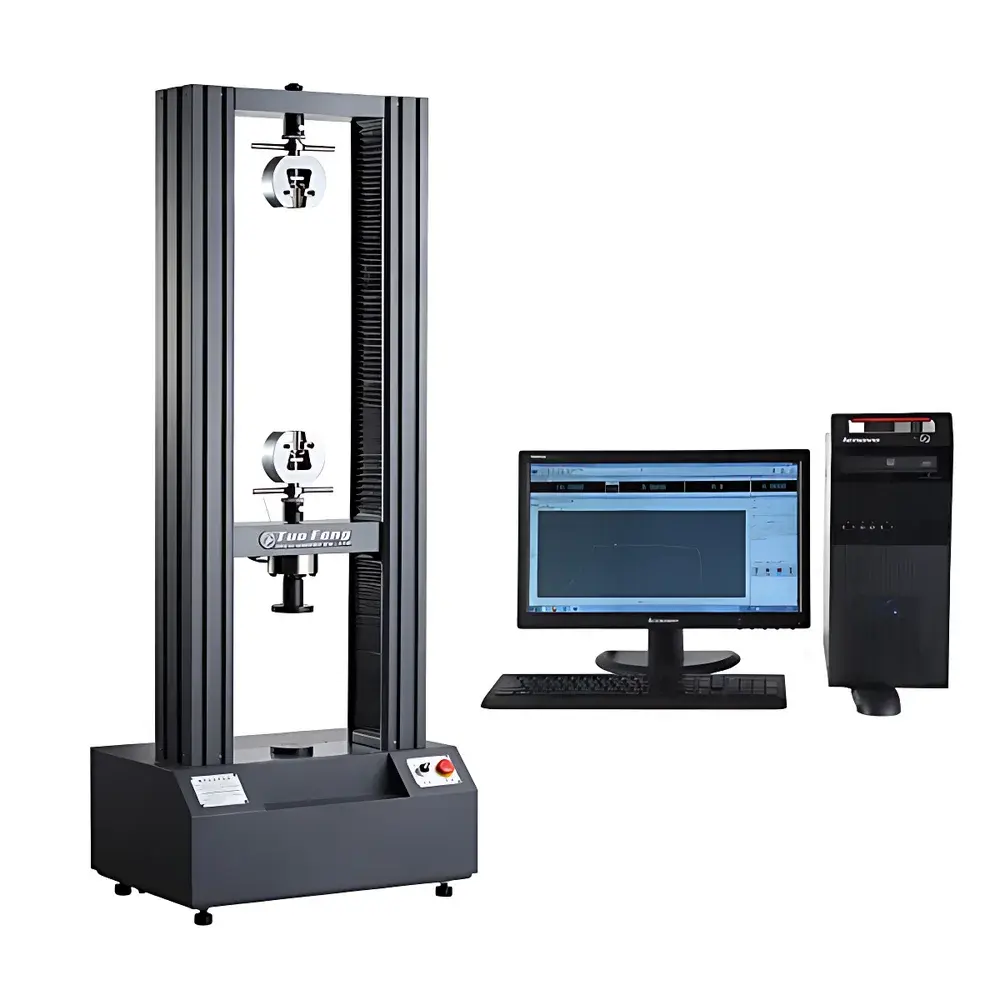
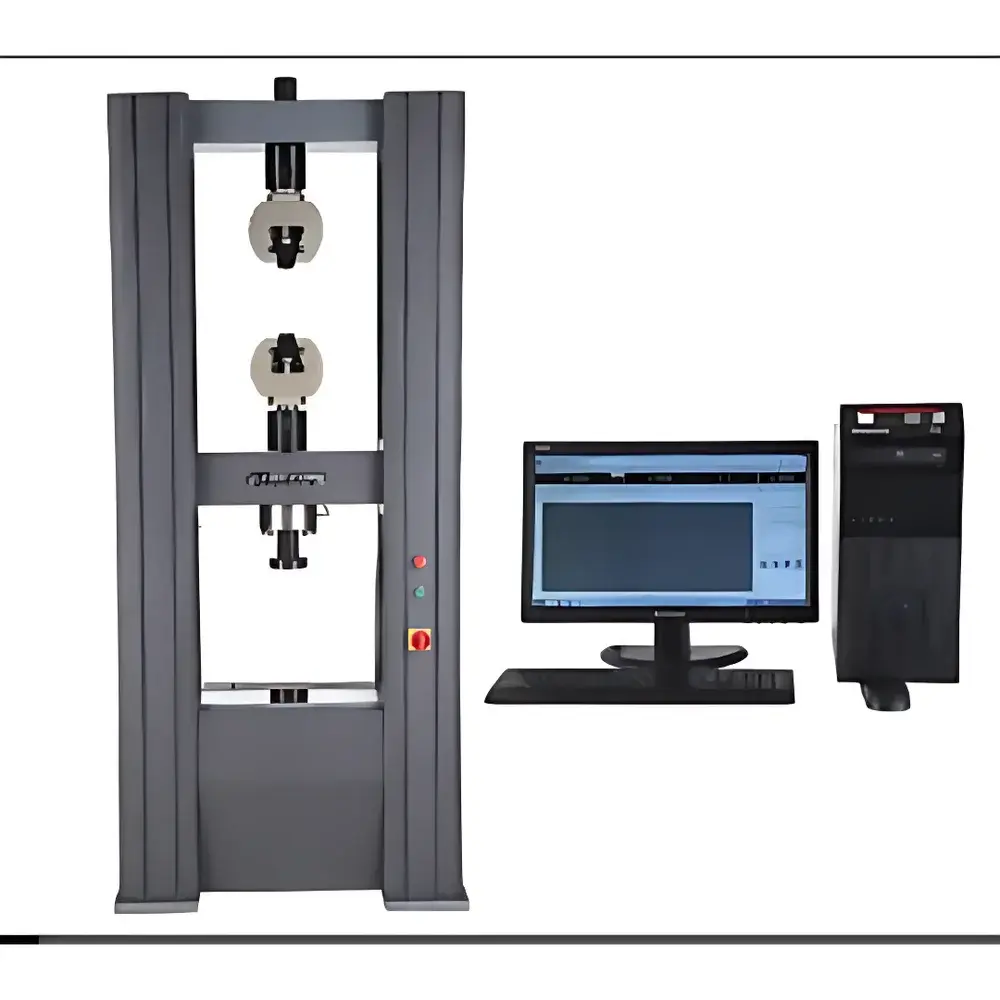
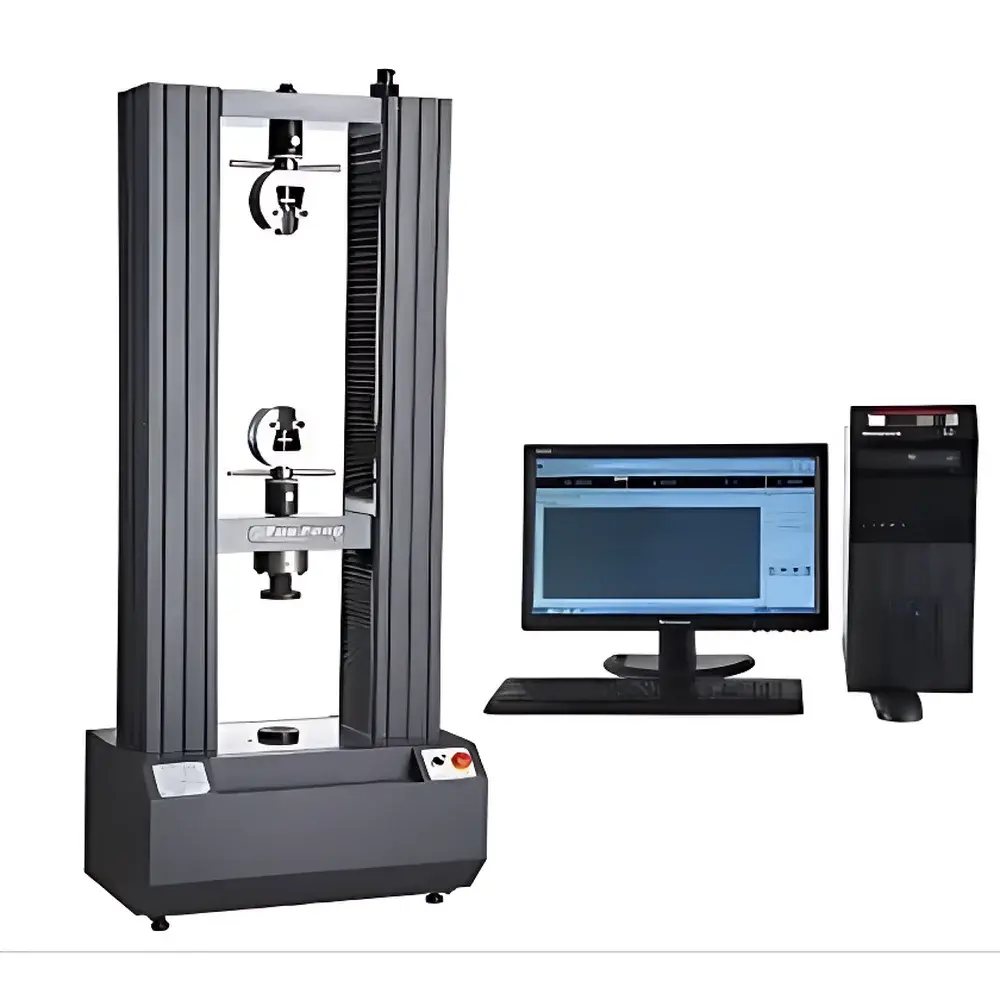
Tuofeng TFW-133 Microcomputer-Controlled Electromechanical Universal Testing Machine
| Brand | Tuofeng |
|---|---|
| Origin | Shanghai, China |
| Manufacturer Type | Direct Manufacturer |
| Model | TFW-133 |
| Max Test Load | 200 kN |
| Force Measurement Range | 0.2%–100% FS |
| Force Accuracy | ±0.5% of reading |
| Crosshead Travel | 1000 mm |
| Displacement Resolution | 0.001 mm |
| Test Speed Range | 0.001–500 mm/min (infinitely variable) |
| Effective Test Width | 600 mm (customizable) |
| Load Frame Precision Class | ISO 7500-1 Class 0.5 |
| Force Resolution | 1/500,000 full scale (fixed resolution, no range switching) |
| Drive System | Imported servo motor with precision worm-gear reducer |
| Lead Screw | High-accuracy preloaded ball screw |
| Displacement Measurement | Optical encoder (±0.005% of reading) |
| Strain Measurement | Optional extensometer or large-deformation transducer (±0.005% of reading) |
| Safety Protection | Dual-limit electronic travel stops, emergency stop button, overload cutoff (>110% of rated load) |
| Software Compliance | Supports ASTM E4, E8, E9, E21, ISO 6892-1, ISO 178, ISO 148, GB/T 228.1, GB/T 16491, JJG 475 |
Overview
The Tuofeng TFW-133 Microcomputer-Controlled Electromechanical Universal Testing Machine is a high-precision static mechanical testing system engineered for standardized tensile, compression, flexure, shear, tear, peel, and puncture testing of metallic, polymeric, ceramic, composite, and elastomeric materials. Based on the fundamental principles of electromechanical force transduction and closed-loop servo control, the system applies controlled axial loads via a high-rigidity dual-column frame and measures resulting deformation with sub-micron displacement resolution. Its architecture complies with ISO 7500-1 Class 0.5 accuracy requirements for force measurement systems and meets structural and metrological criteria defined in GB/T 16491–2008 and JJG 475–2008. Designed for laboratory and industrial QA/QC environments, the TFW-133 delivers repeatable, traceable, and audit-ready mechanical property data under ambient conditions—supporting both routine compliance verification and advanced material characterization workflows.
Key Features
- High-stiffness dual-column steel frame with preloaded ball-screw drive system ensuring minimal axial deflection and long-term dimensional stability.
- Imported AC servo motor coupled with precision worm-gear reduction for smooth, low-noise operation across the full speed range (0.001–500 mm/min).
- Integrated load cell calibrated to ±0.5% of reading over 0.2–100% full-scale range; fixed 1/500,000 internal resolution eliminates range-switching artifacts.
- Optical encoder-based crosshead displacement measurement with ±0.005% accuracy and 0.001 mm resolution—traceable to NIST-traceable standards.
- Dual-speed automatic crosshead positioning (fast/slow modes) with programmable return-to-start function and manual jog capability.
- Comprehensive hardware safety suite: electronic end-stop limits, emergency stop circuitry, real-time overload detection (>110% FS), and software-enforced operational boundaries.
- Modular fixture interface supporting standardized grips (e.g., wedge, pneumatic, hydraulic) and custom tooling for ASTM, ISO, and GB-compliant specimen geometries.
Sample Compatibility & Compliance
The TFW-133 accommodates specimens ranging from thin films (<0.1 mm thick) to structural steel coupons (up to 60 mm thick), with adjustable test width (standard 600 mm, extendable upon request) and 1000 mm vertical travel. It supports standard specimen configurations per ASTM E8/E21 (tensile bars), ASTM D638/D790 (plastics), ISO 6892-1 (metallic tensile), ISO 178 (flexural), ISO 148 (impact pre-test conditioning), and GB/T 228.1 (Chinese metallic materials). All mechanical and software subsystems are designed to satisfy GLP and GMP documentation requirements, including configurable audit trails, user-access controls, and electronic signature support per FDA 21 CFR Part 11 when deployed with optional validation packages.
Software & Data Management
The Windows-based testing software provides ISO/IEC 17025-aligned data acquisition and reporting functionality. It supports multiple control modes—including load-controlled, displacement-controlled, strain-controlled, and hold-mode protocols—and enables real-time visualization of up to four synchronized curves (e.g., stress–strain, load–time, displacement–time, load–extension). Units are freely convertible between SI, imperial, and CGS systems; language options include English, Simplified Chinese, and Traditional Chinese. Raw data files (.tdf) store timestamped, metadata-embedded readings with full traceability to calibration certificates. Reports conform to ASTM E29, ISO/IEC 17025 Annex A, and GB/T 27025 requirements, featuring automatic calculation of tensile strength, yield strength (0.2% offset), Young’s modulus, elongation at break, compressive strength, flexural modulus, tear strength, and peel adhesion. Data export supports CSV, Excel, PDF, and XML formats; batch analysis tools allow statistical comparison across datasets (mean, min, max, CV%).
Applications
The TFW-133 serves as a primary mechanical characterization platform across regulated and research-intensive sectors. In aerospace manufacturing, it validates titanium alloy sheet formability and composite interlaminar shear strength per AMS and SAE standards. In automotive R&D, it assesses polymer blend tensile performance under ISO 527 and evaluates rubber compound hysteresis during cyclic loading. Within construction materials labs, it performs compressive strength testing of concrete cylinders (ASTM C39) and flexural testing of reinforced beams (ASTM C78). Wire and cable producers rely on its peel and torsion modules to verify jacket adhesion integrity (UL 1581), while medical device manufacturers use it for suture tensile validation (ISO 10993-12) and balloon burst pressure correlation studies. Universities employ the system for graduate-level mechanics of materials instruction and fracture mechanics research requiring high-fidelity load–displacement histories.
FAQ
What international standards does the TFW-133 support out-of-the-box?
The system includes preconfigured test methods for ASTM E8, E21, D638, D790, ISO 6892-1, ISO 178, ISO 148, and GB/T 228.1, with customizable method templates for proprietary or emerging standards.
Is the force sensor calibrated and certified?
Yes—each load cell is factory-calibrated against NIST-traceable deadweight standards and supplied with a UKAS-accredited calibration certificate valid for 12 months.
Can the system integrate with LIMS or enterprise QA databases?
Via optional OPC UA or RESTful API modules, the software supports bidirectional data exchange with LabWare LIMS, Thermo Fisher SampleManager, and SAP QM modules.
What is the recommended maintenance schedule?
Preventive maintenance is advised every 12 months or after 2,000 test cycles, including ball-screw lubrication, encoder alignment verification, and load cell zero-drift assessment.
Does the software meet FDA 21 CFR Part 11 requirements?
When configured with the Validation Package (VP-TFW), the system provides electronic signatures, audit trails, role-based access control, and data integrity safeguards compliant with Part 11 Subpart B.



