
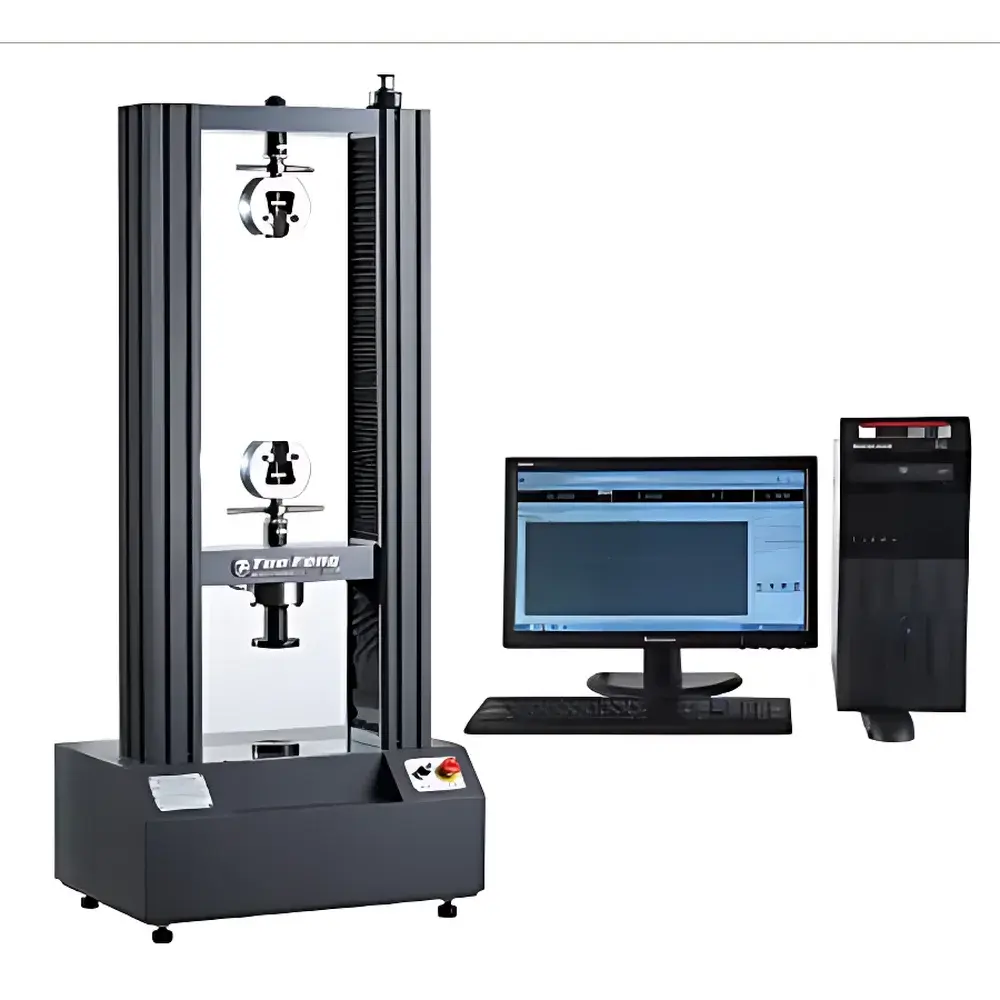
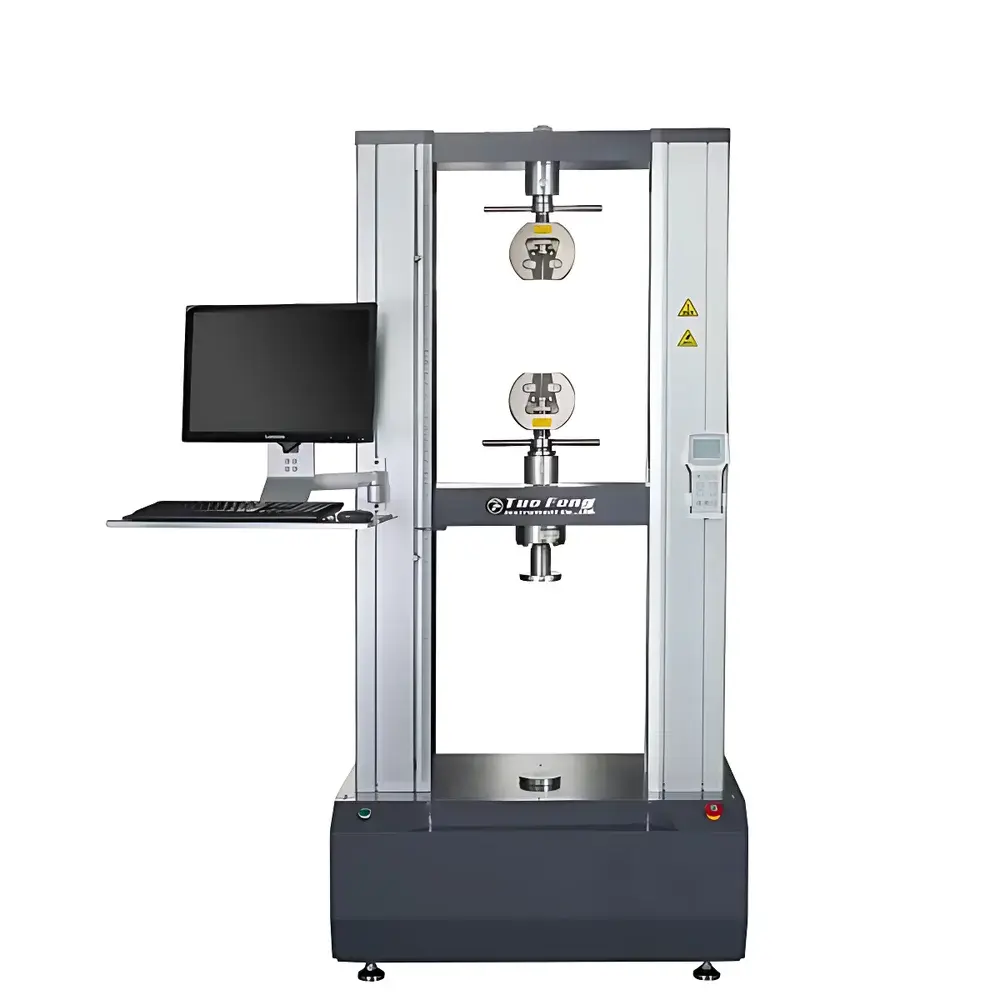
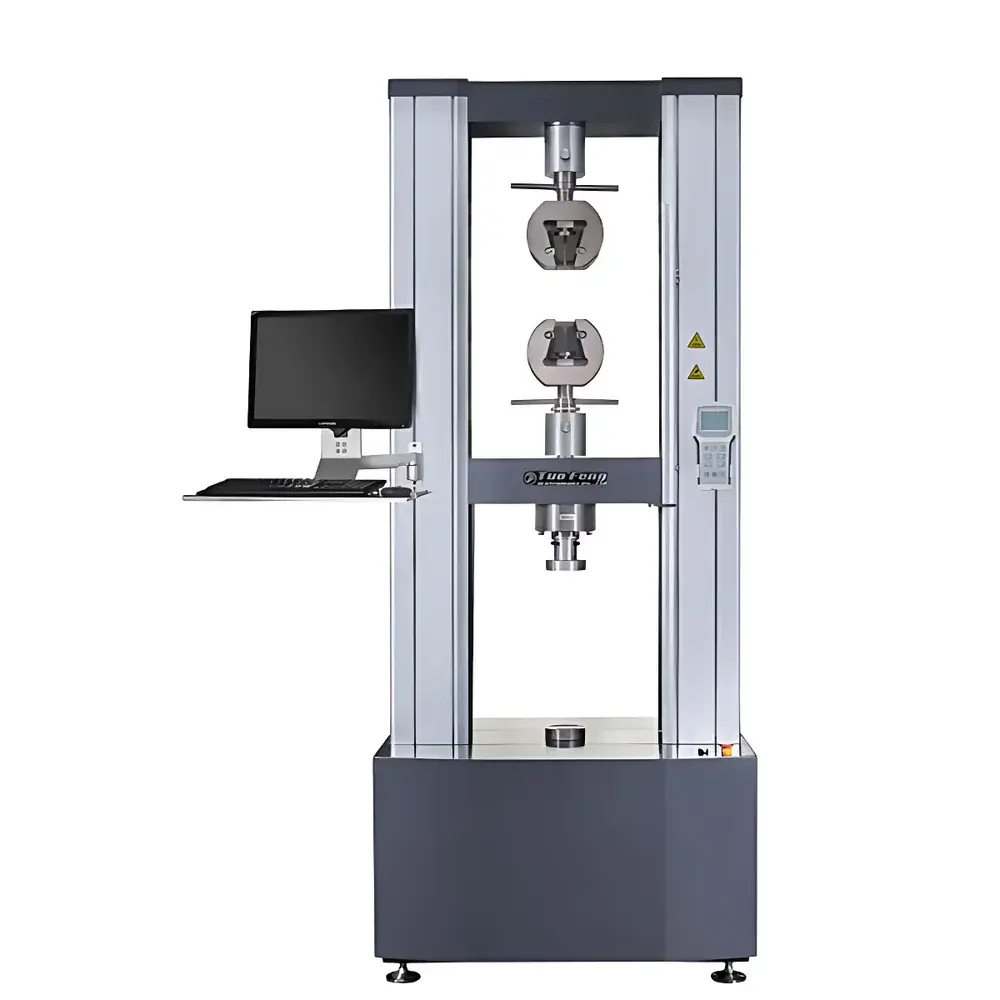
Tuofeng TFW-136 Microcomputer-Controlled Electronic Universal Testing Machine
| Brand | Tuofeng |
|---|---|
| Origin | Shanghai, China |
| Manufacturer Type | Direct Manufacturer |
| Instrument Type | Electronic Universal Testing Machine |
| Model | TFW-136 |
| Max Test Load | 136 kN (derived from model series context |
| note | TFW-136 aligns with mid-range capacity in TFW-S series) |
| Accuracy Class | ISO 7500-1 / ASTM E4 Grade 0.5 |
| Effective Force Range | 0.2%–100% of full scale |
| Force Measurement Accuracy | ±0.005% of reading |
| Force Resolution | 1 part in ±500,000 of full-scale load, single-range, constant resolution |
| Drive System | Imported servo motor with precision worm-gear reducer |
| Lead Screw | High-precision preloaded ball screw |
| Effective Test Width | 600 mm (customizable up to 1,000 mm) |
| Traverse Stroke | 800 mm (extendable) |
| Speed Range | 0.001–500 mm/min, infinitely variable |
| Displacement Measurement | Optical encoder, accuracy ±0.005% of reading |
| Strain Measurement | Optional clip-on extensometer or large-deformation transducer, accuracy ±0.005% of reading |
| Safety Protection | Dual electronic limit switches, emergency stop button, overload protection (>110% FS), automatic return after test |
| Software Compliance | Supports ASTM E4, E8, E9, E21, ISO 6892-1, GB/T 228.1, GB/T 16491, JJG 475 |
Overview
The Tuofeng TFW-136 is a microcomputer-controlled electronic universal testing machine engineered for high-precision static mechanical property evaluation of metallic, polymeric, composite, and ceramic materials. Based on closed-loop servo-controlled electromechanical actuation, it operates under the fundamental principles of axial force application and displacement-controlled deformation measurement—compliant with ISO 7500-1 (static calibration) and ASTM E4 (verification of force-measuring systems). Its rigid four-column frame, high-stiffness crosshead guidance, and thermally stable load cell architecture ensure long-term repeatability and minimal thermal drift during extended test sequences. Designed for laboratory and industrial QA/QC environments, the TFW-136 delivers traceable, auditable results aligned with GLP and GMP documentation requirements when integrated with compliant software workflows.
Key Features
- Grade 0.5 force measurement accuracy per ISO 7500-1 and ASTM E4, validated across the full dynamic range (0.2%–100% FS)
- Constant-resolution force detection at 1 part in ±500,000 full-scale—eliminating range-switching artifacts and ensuring linearity integrity at low-load regimes
- High-precision preloaded ball screw drive system coupled with imported servo motor and worm-gear reduction for smooth, backlash-free motion control
- Dual-speed automatic crosshead positioning (fast/slow modes) with jog functionality and programmable return-to-start logic post-test
- Comprehensive hardware safety architecture: dual-channel electronic limit switches, redundant emergency stop circuitry, and real-time overload cutoff (>110% FS)
- Modular extensometry support—including ASTM E83-compliant clip-on extensometers and ISO 9513-certified large-deformation transducers—for accurate strain acquisition independent of crosshead movement
Sample Compatibility & Compliance
The TFW-136 accommodates standardized and custom specimens per ASTM E8 (tension), E9 (compression), E21 (tension at elevated temperature), ISO 6892-1 (metallic tensile), ISO 7438 (bend), and GB/T 228.1 (Chinese metallic tensile standard). With a 600 mm effective test width and 800 mm stroke (expandable), it supports flat, round, notched, and multi-layered configurations—including laminates, elastomers, textiles, and adhesively bonded joints. Fixture adaptability enables execution of tensile, compression, flexural, shear, tear, peel, puncture, and creep tests using ISO/ASTM-compliant tooling. The system meets GB/T 16491-2008 (Chinese UTM manufacturing specification) and JJG 475-2008 (national verification regulation), and its mechanical design satisfies CE machinery directive essential health and safety requirements.
Software & Data Management
The embedded Windows-based control and analysis software provides fully configurable test protocols—including load-controlled, displacement-controlled, and time-controlled modes—as defined in ASTM E4, ISO 5893, and GB/T 7762. Multi-language UI (English, Simplified/Traditional Chinese) supports global deployment. Real-time plotting includes stress–strain, load–displacement, load–time, and strain–time curves, with synchronized display of current and peak values. Automated parameter derivation covers tensile strength, yield strength (0.2% offset), Young’s modulus, elongation at break, compressive strength, flexural modulus, tear strength, peel adhesion, and Poisson’s ratio—calculated per user-input cross-sectional area and gauge length. Data export complies with ASTM E1434 (data interchange format), and audit trails meet FDA 21 CFR Part 11 requirements when configured with electronic signatures and role-based access control. All test data are timestamped, versioned, and stored in encrypted binary + CSV dual-format archives.
Applications
The TFW-136 serves as a primary mechanical characterization platform across regulated and research-intensive sectors. In aerospace, it validates titanium alloy fasteners and carbon-fiber reinforced polymer (CFRP) laminates per ASTM D3039 and D6641. In automotive R&D, it quantifies tensile properties of high-strength steels (e.g., DP980) and fatigue-resistant elastomeric bushings. For medical device manufacturers, it performs ISO 1798-compliant tensile testing of silicone tubing and ASTM F2129 corrosion-fatigue evaluation of stainless-steel implants. In construction materials labs, it executes GB/T 5224-compliant testing of prestressed steel strands and ISO 679-compliant cement mortar compression. Academic users apply it to novel hydrogel mechanics, wood–polymer composites, and additive-manufactured metal lattice structures—leveraging its high-resolution low-force capability and extensometer synchronization.
FAQ
Does the TFW-136 support ASTM E23 Charpy impact testing?
No—the TFW-136 is a quasi-static testing system designed for controlled-rate mechanical loading only. Impact testing requires dedicated pendulum or drop-weight apparatuses compliant with ASTM E23 or ISO 148.
Can the system be integrated into an existing LIMS or MES environment?
Yes—via OPC UA or TCP/IP API interfaces, raw force/displacement/time streams and summary metadata can be exported to third-party laboratory information management systems (LIMS) or manufacturing execution systems (MES) in real time.
Is validation documentation provided for IQ/OQ/PQ protocols?
Yes—Tuofeng supplies a comprehensive validation package including installation qualification (IQ) checklists, operational qualification (OQ) test scripts aligned with ISO/IEC 17025, and performance qualification (PQ) templates for routine verification per ASTM E4.
What is the recommended recalibration interval for the load cell?
Per ISO 7500-1 and internal quality policy, annual recalibration by an ISO/IEC 17025-accredited laboratory is recommended; interim verification using traceable deadweight standards is advised before critical test campaigns.
Are test method templates preloaded for common standards?
Yes—the software includes factory-loaded templates for ASTM E8, ISO 6892-1, GB/T 228.1, ASTM D638, and ISO 527-2, with editable parameters for specimen geometry, rate profiles, and pass/fail criteria.



