
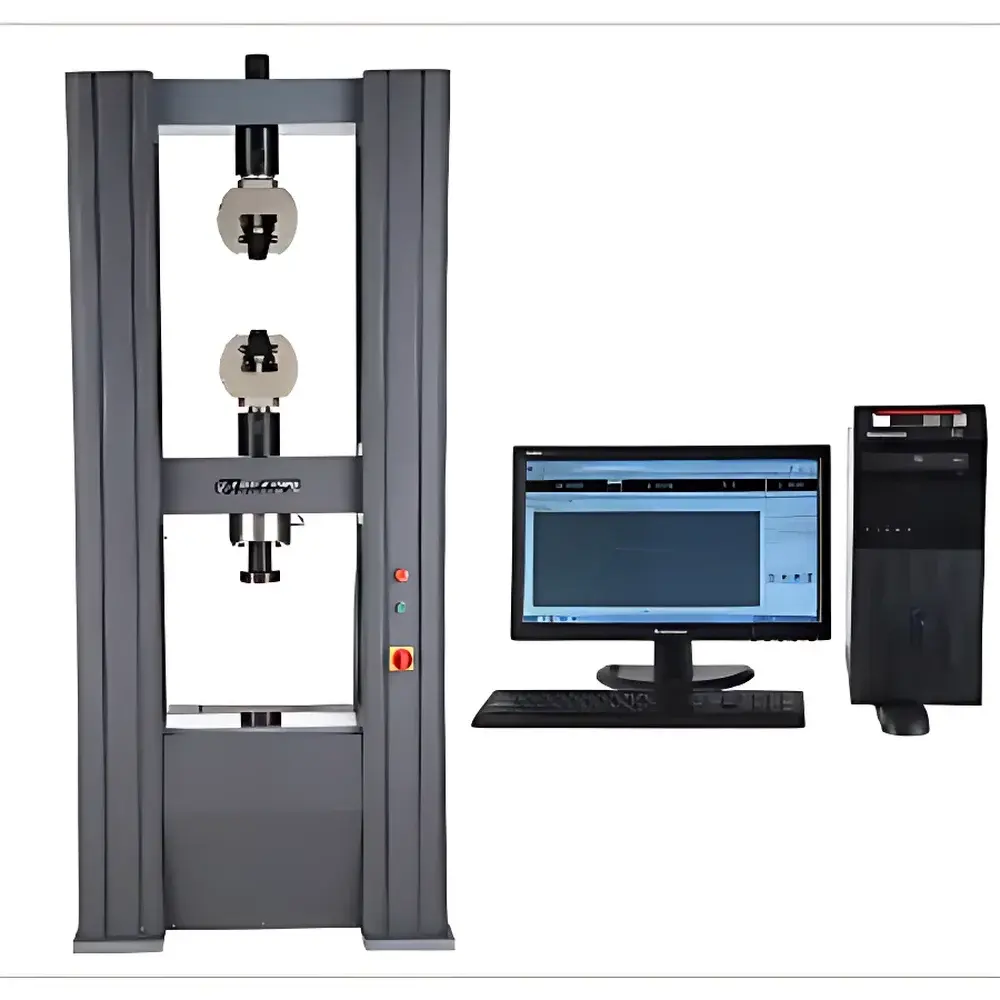
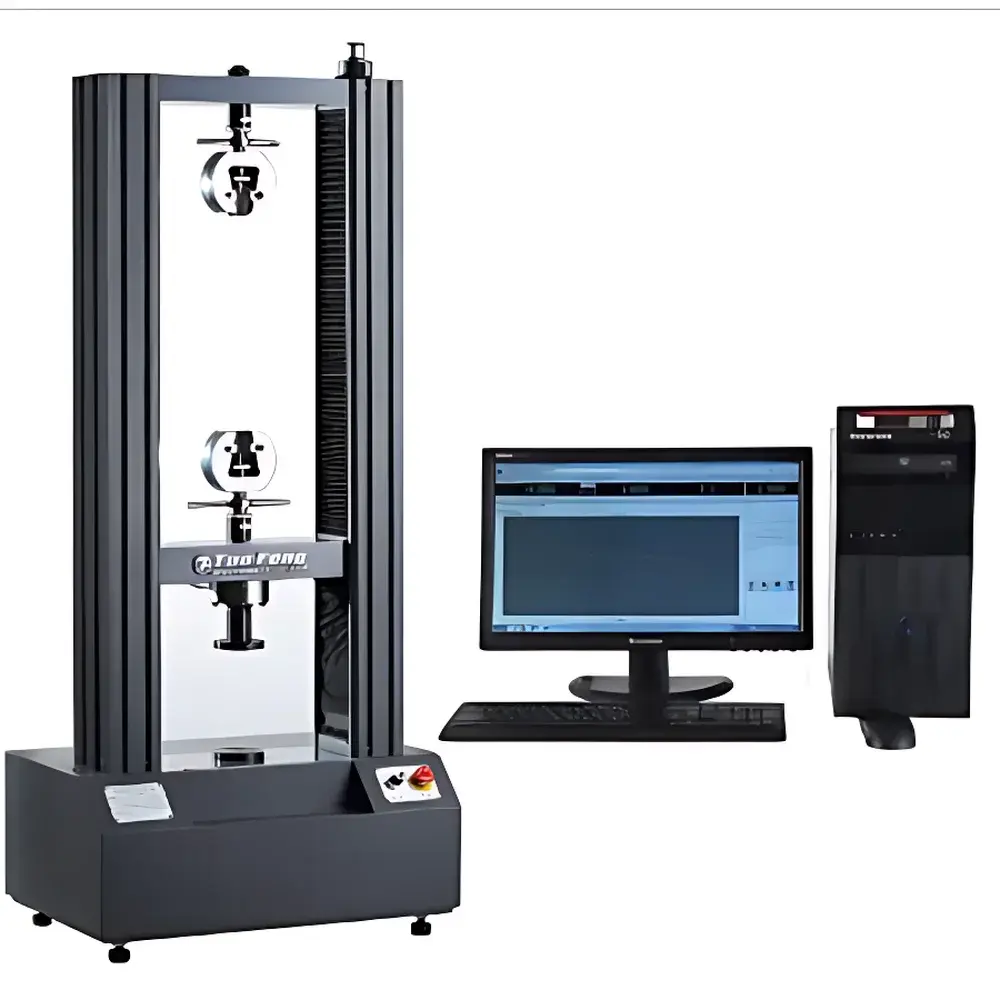
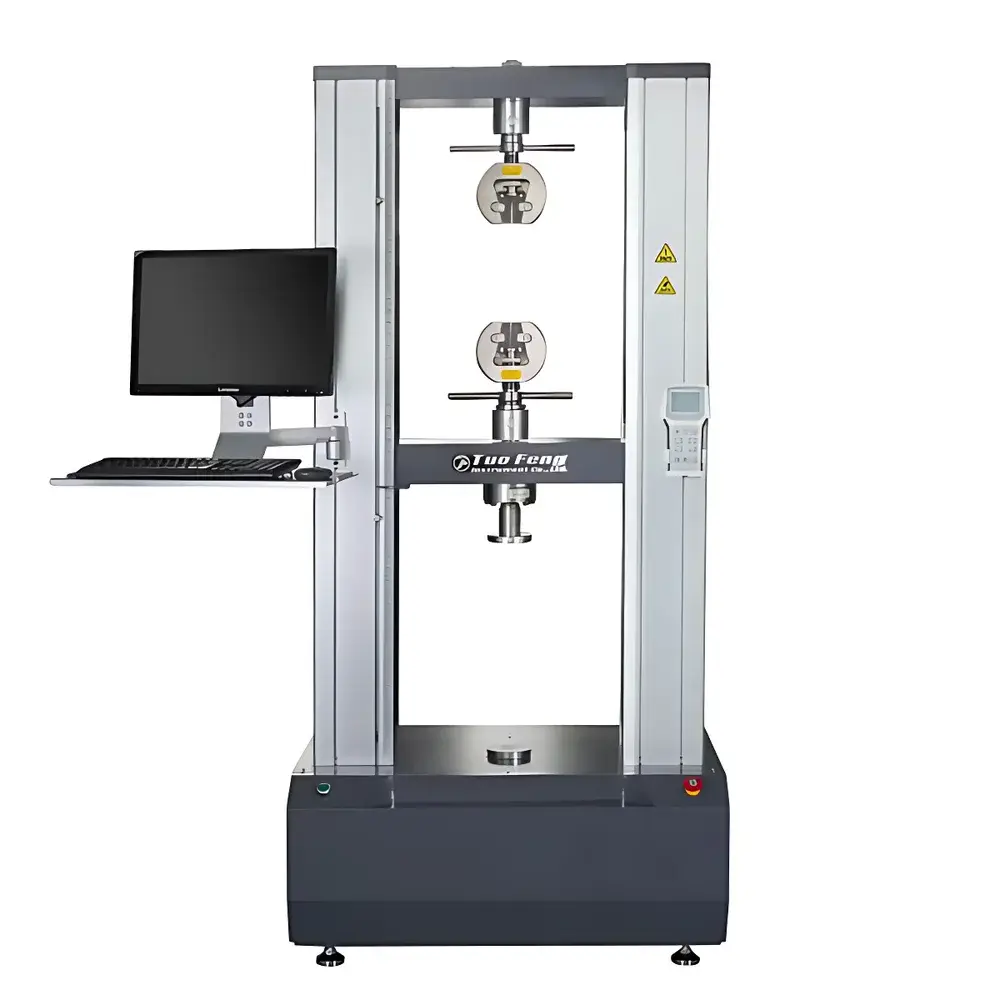
Tuofeng TFW-145 Microcomputer-Controlled Servo Universal Testing Machine
| Brand | Tuofeng |
|---|---|
| Origin | Shanghai, China |
| Manufacturer Type | Direct Manufacturer |
| Instrument Type | Electromechanical Universal Testing Machine |
| Model | TFW-145 |
| Max Test Load | 145 kN |
| Accuracy Class | 0.5 |
| Effective Force Range | 0.2–100% of Full Scale |
| Force Measurement Accuracy | ±0.005% of Reading |
| Resolution | 1 part in ±500,000 full-scale codes (no range switching) |
| Drive System | Imported Servo Motor with Precision Worm Gear Reducer |
| Lead Screw | High-Accuracy Ball Screw |
| Effective Test Width | 600 mm (customizable) |
| Stroke | 800 mm (extendable) |
| Speed Range | 0.001–500 mm/min (infinitely variable) |
| Displacement Measurement | Optical Encoder |
| Displacement Accuracy | ±0.005% of Reading |
| Strain Measurement | Optional Extensometer or Large-Deformation Gauge |
| Safety Protection | Electronic Limit Switches, Emergency Stop, Overload Protection (110% FS), Dual-Speed Motorized Crosshead Return |
| Power Supply | 220 V AC, 1.5 kW |
| Approx. Weight | 800 kg |
Overview
The Tuofeng TFW-145 Microcomputer-Controlled Servo Universal Testing Machine is a high-precision electromechanical system engineered for static mechanical property characterization of metallic, polymeric, ceramic, composite, and elastomeric materials. It operates on the principle of controlled displacement actuation via a servo-driven ball screw mechanism, enabling precise application of tensile, compressive, flexural, shear, tear, peel, and puncture loads in accordance with standardized test protocols. Designed to meet stringent metrological requirements, the machine complies with ISO 7500-1 (Class 0.5), ASTM E4, ASTM E8/E8M, ASTM D638/D695/D790/D1708, and GB/T 16491–2008. Its closed-loop control architecture ensures traceable force and displacement linearity across the entire operational envelope — from sub-newton preload stabilization to 145 kN maximum load capacity — making it suitable for both R&D validation and quality assurance in regulated manufacturing environments.
Key Features
- High-resolution force transduction with ±0.005% reading accuracy and 1:500,000 internal resolution, eliminating range-switching artifacts and ensuring consistent sensitivity from 0.2% to 100% of full scale.
- Dual-speed motorized crosshead control (fast return + fine positioning) with programmable point-to-point movement and automatic post-test return to home position.
- Modular extensometry support: compatible with clip-on axial extensometers (for modulus and yield determination) and non-contact video extensometers (for large-strain or brittle-material testing).
- Robust mechanical architecture featuring preloaded high-precision ball screws, rigid cast-iron frame, and integrated overload protection (110% FS trip threshold) with hardware-level emergency stop circuitry.
- Comprehensive safety suite including electronic travel limits, mechanical hard stops, real-time torque monitoring, and software-enforced parameter boundaries to prevent operator-induced misconfiguration.
Sample Compatibility & Compliance
The TFW-145 accommodates specimens ranging from miniature coupons (e.g., ASTM E8M sub-size tensile bars) to structural components up to 600 mm wide and 800 mm stroke depth. Standardized fixtures include wedge-action tensile grips, compression platens, three- and four-point bend assemblies, shear adapters, and peel/tear fixtures — all designed to minimize stress concentration and ensure alignment per ISO 527-2 and ASTM D3039. The system supports full compliance with GLP and GMP documentation workflows through audit-trail-enabled software logging, user-access controls, and electronic signature capability. Calibration certificates are traceable to NIM (National Institute of Metrology, China) and optionally to NIST or UKAS-accredited reference standards upon request.
Software & Data Management
The Windows-based testing software provides multi-mode control (constant rate of extension, constant load, constant strain, hold, cyclic ramp-hold sequences) and real-time visualization of up to six synchronized plots: load–time, load–displacement, stress–strain, displacement–time, and dual-extensometer comparisons. All raw data (1 kHz sampling rate) are stored in open-format ASCII files with embedded metadata (operator ID, sample ID, standard reference, environmental conditions). Reporting modules generate PDF or Excel outputs compliant with ISO 17025 technical records, including statistical summaries (mean, SD, CV%), curve overlay comparisons, and pass/fail evaluation against user-defined specification limits. The platform supports 21 CFR Part 11 readiness via optional digital certificate integration, role-based permissions, and immutable audit logs recording every parameter change, test execution, and data export event.
Applications
This system serves as a primary mechanical characterization tool across industrial sectors requiring material certification or process validation. In aerospace, it validates titanium alloy sheet tensile properties per AMS 2304 and composite interlaminar shear strength (ILSS) per ASTM D2344. In automotive, it quantifies polymer weld integrity (ASTM D638), rubber hysteresis (ISO 48-4), and battery electrode adhesion (peel per ASTM D903). In construction, it assesses rebar yield strength (GB/T 1499.2), concrete compressive behavior (GB/T 50081), and geotextile tensile performance (ISO 10319). Academic users leverage its flexibility for constitutive modeling, creep–fatigue interaction studies, and temperature-compensated mechanical mapping when paired with environmental chambers.
FAQ
Does the TFW-145 comply with ISO/IEC 17025 calibration requirements?
Yes — the system includes factory calibration documentation traceable to national metrology institutes, and optional on-site verification services are available with certified reference load cells and displacement standards.
Can the software generate reports meeting FDA or EU MDR submission criteria?
Yes — with the Part 11 Add-on module, the software delivers electronic signatures, audit trails, and data integrity controls aligned with 21 CFR Part 11 and Annex 11 expectations.
Is third-party verification of force accuracy possible?
Yes — the machine’s load cell interface supports external verification using calibrated deadweight machines or hydraulic comparators per ISO 376 Annex C.
What is the recommended maintenance interval for the servo drive and ball screw assembly?
Preventive maintenance is scheduled every 1,000 operating hours or annually, whichever occurs first; lubrication intervals for the ball screw are specified in the operator manual and depend on ambient particulate exposure.
Can custom test methods be programmed without developer assistance?
Yes — the software includes a scriptable test sequence editor supporting conditional logic, multi-step ramps, and real-time pass/fail branching based on measured parameters.



