
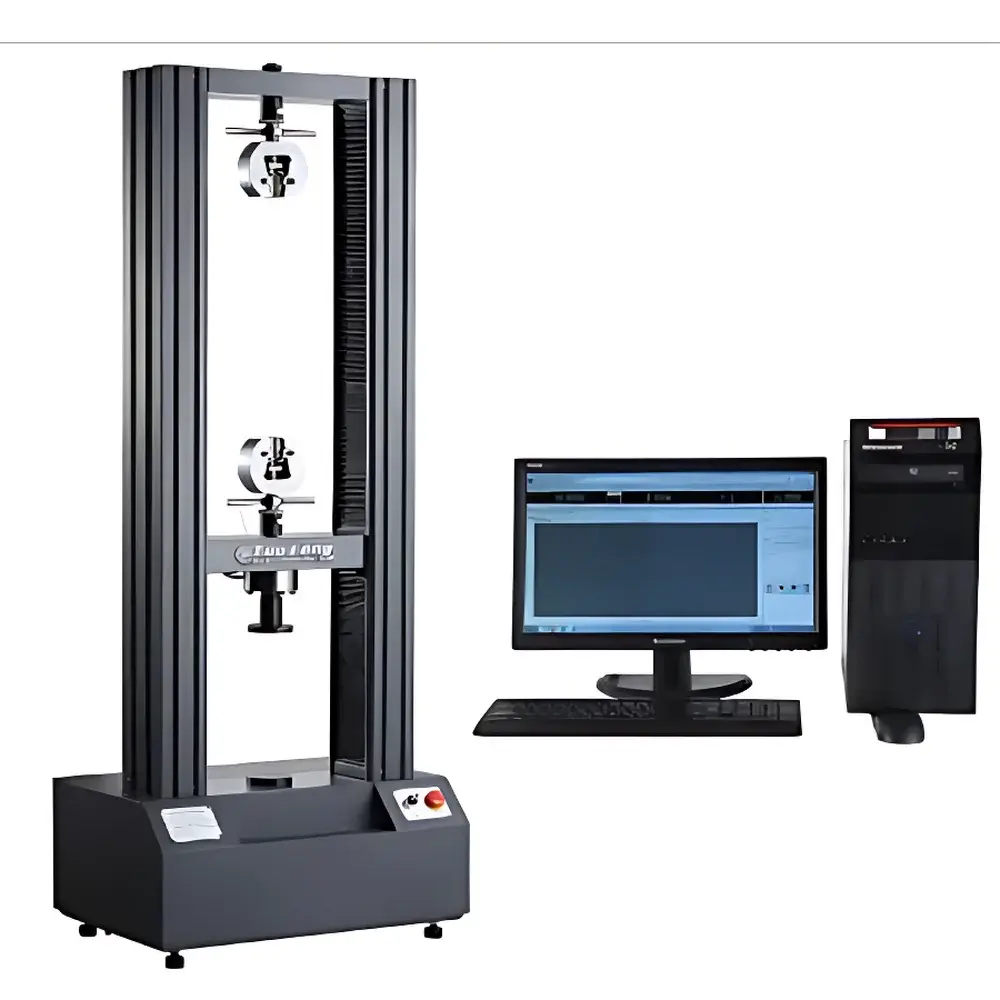
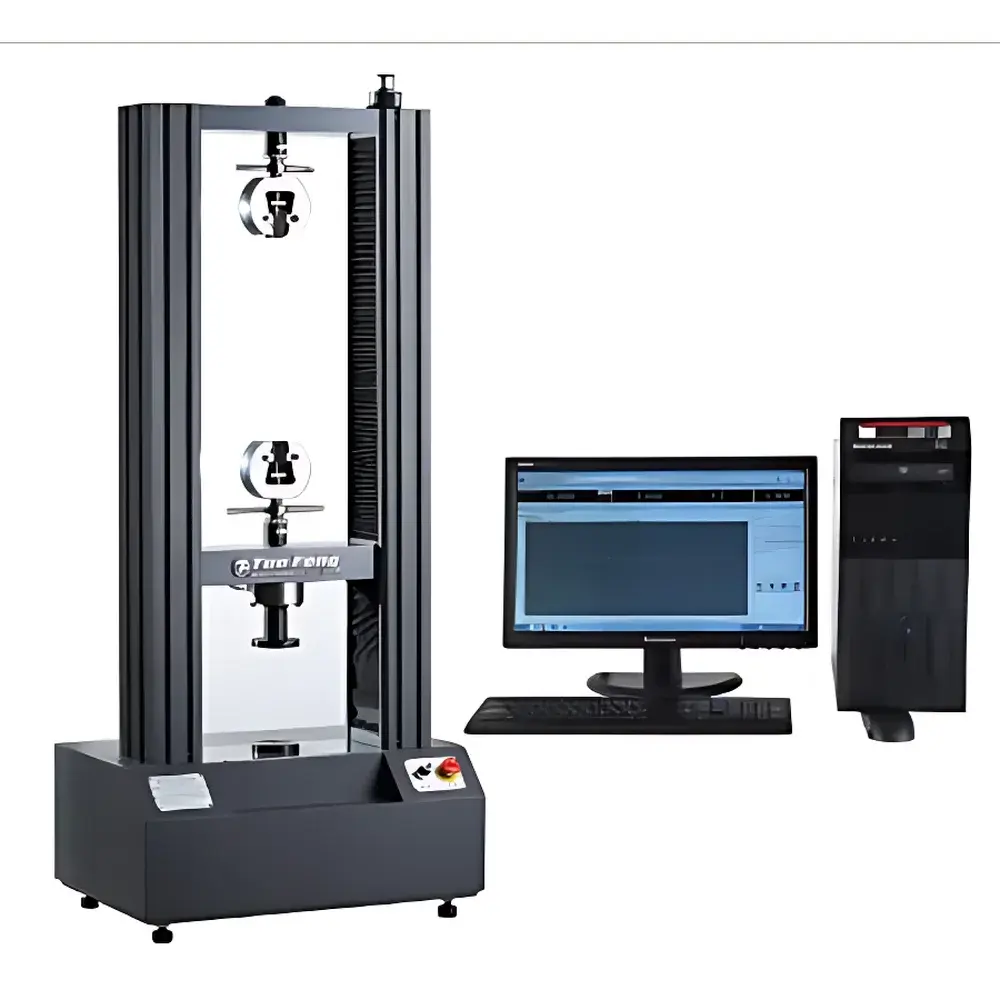
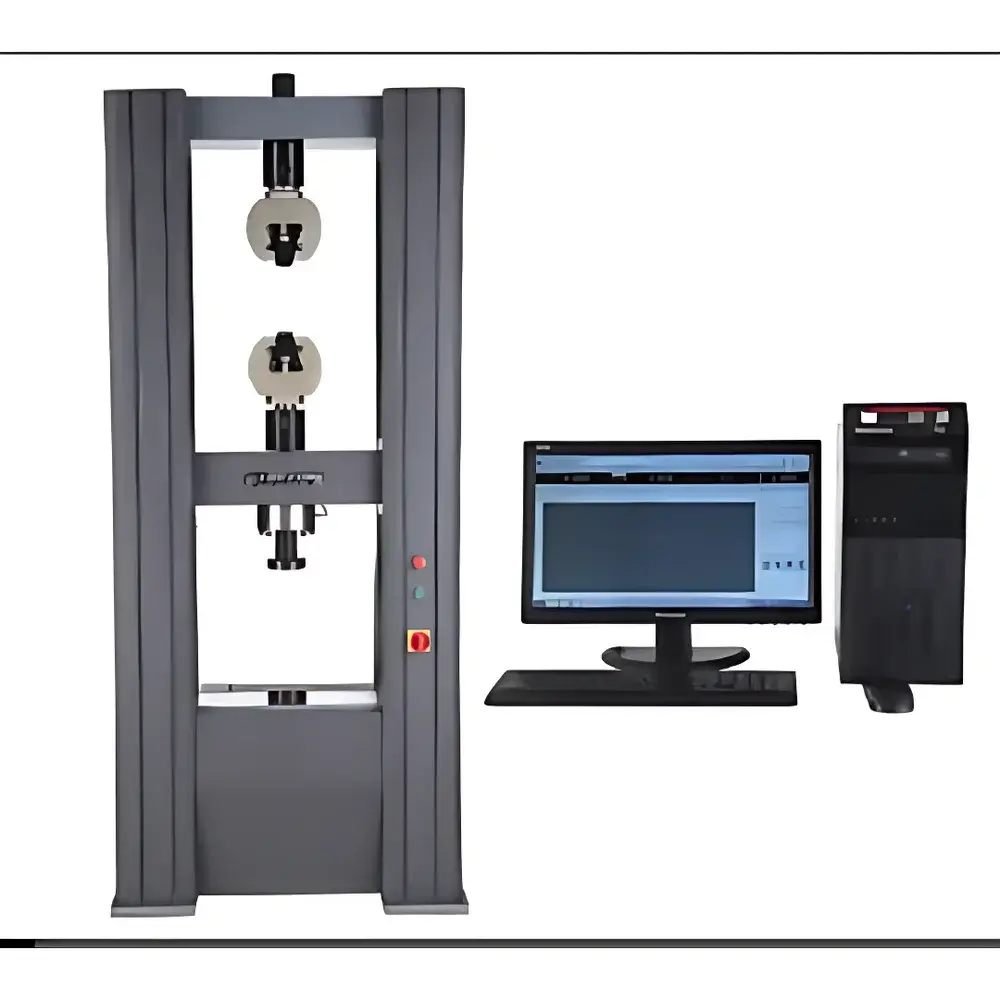
Tuofeng TFW-147 Microcomputer-Controlled Servo Universal Testing Machine
| Brand | Tuofeng |
|---|---|
| Origin | Shanghai, China |
| Manufacturer Type | Direct Manufacturer |
| Instrument Type | Electromechanical Universal Testing Machine |
| Model | TFW-147 |
| Compliance | GB/T 16491-2008, JJG 475-2008, ASTM E4, ISO 7500-1, DIN 51221, JIS B 7721 |
| Load Capacity | 147 kN (customizable from 5–200 kN) |
| Accuracy Class | 0.5 |
| Effective Force Range | 0.2%–100% of full scale |
| Force Measurement Uncertainty | ±0.005% of reading |
| Resolution | 1 part in ±500,000 full-scale codes (single-range, no auto-ranging) |
| Drive System | Imported servo motor with precision worm-gear reducer |
| Lead Screw | High-accuracy preloaded ball screw |
| Test Width (standard) | 600 mm (expandable) |
| Stroke (standard) | 800 mm (extendable) |
| Speed Range | 0.001–500 mm/min (infinitely variable, closed-loop controlled) |
| Displacement Measurement | Optical encoder |
| Displacement Accuracy | ±0.005% of reading |
| Strain Measurement | Optional clip-on extensometer or video-based digital image correlation (DIC) system |
| Strain Accuracy | ±0.005% of reading |
| Safety Protection | Dual electronic limit switches, emergency stop button, overload cutoff (>110% FS), mechanical crash barrier |
| Crosshead Control | Dual-speed (fast/slow) motorized adjustment with jog function |
| Return Mode | Programmable automatic return to preload position or origin at maximum speed post-test |
| Fixture Customization | Application-specific grips (tensile, compression, bend, shear, peel, tear, puncture) per ISO 6892-1, ASTM D638, D790, D1876, D3330, etc. |
| Power Supply | 220 V AC, 1.5 kW (for TFW-147 configuration) |
| Dimensions (W×D×H) | 1000 × 700 × 2000 mm |
| Weight | ~450 kg |
Overview
The Tuofeng TFW-147 Microcomputer-Controlled Servo Universal Testing Machine is a high-precision electromechanical system engineered for static mechanical property characterization under uniaxial loading conditions. It operates on the principle of closed-loop servo control, where real-time feedback from load cells, optical encoders, and optional extensometers regulates crosshead motion to maintain precise force, displacement, or strain trajectories per test protocol. Designed in strict accordance with GB/T 16491-2008 and JJG 475-2008, and validated against international metrological standards including ISO 7500-1 Class 0.5 and ASTM E4, the system delivers traceable, reproducible results across tensile, compressive, flexural, shear, peel, tear, and puncture testing modes. Its modular architecture supports seamless integration of application-specific fixtures and transducers—enabling standardized evaluation of metallic alloys, polymer composites, elastomers, ceramics, textiles, adhesives, and biomedical materials in R&D, QC, and regulatory environments.
Key Features
- Class 0.5 force measurement accuracy per ISO 7500-1, with resolution of 1 part in ±500,000 full-scale codes and linearity error ≤ ±0.005% of reading
- Infinitely variable crosshead speed (0.001–500 mm/min), fully programmable via closed-loop PID control with dynamic response compensation
- Preloaded high-rigidity ball screw drive coupled with imported servo motor and low-backlash worm-gear reduction for minimal hysteresis and thermal drift
- Dual-mode displacement sensing: high-resolution optical encoder (±0.005% accuracy) + optional ASTM E83-compliant extensometer or DIC-based non-contact strain mapping
- Integrated safety architecture: triple-redundant electronic limit detection, hardware emergency stop, mechanical end-stop buffers, and automatic overload cutoff at 110% of rated capacity
- Motorized dual-speed crosshead positioning with jog functionality and programmable return-to-origin logic post-test
- Expandable test width (up to 600 mm standard) and stroke (800 mm base, extendable), supporting large-format specimens and multi-specimen fixtures
Sample Compatibility & Compliance
The TFW-147 accommodates specimens ranging from thin films (<0.1 mm) to structural profiles (≤150 mm cross-section), with customizable grip systems—including pneumatic wedge grips, hydraulic clamps, compression platens, 3-/4-point bending fixtures, peel arms, and puncture anvils—designed to meet specimen geometry and surface integrity requirements per ISO 6892-1, ASTM D638, D790, D1876, D3330, D882, and EN 10002-1. All mechanical and software functions comply with GLP and GMP documentation prerequisites, including audit-trail-enabled user access control, electronic signature support (21 CFR Part 11 ready), and calibration certificate traceability to NIM (China) or NIST-equivalent national standards. Routine verification follows ISO/IEC 17025 procedures, and factory calibration reports include uncertainty budgets per ISO/IEC Guide 98-3.
Software & Data Management
The Windows-based TFW-TestSuite v5.2 software provides ISO/IEC 17025-aligned test execution and data governance. It supports multiple control modes—force-controlled ramping, displacement-controlled stepping, strain-rate regulation, hold-at-load/strain, and cyclic profiling—with real-time switching between load-time, stress-strain, displacement-time, and extension-force plots. Units are freely convertible among SI, imperial, and legacy metric systems; language interfaces include English, Simplified Chinese, Traditional Chinese, German, French, and Japanese. Raw data streams (load, displacement, strain, time) are logged at ≥1 kHz sampling rate, stored in vendor-neutral CSV and XML formats, and archived with embedded metadata (operator ID, calibration status, environmental conditions). Batch analysis tools enable statistical comparison across up to 99 curves, with automated calculation of tensile strength, yield offset (0.2%), modulus (secant/tangent), elongation at break, Poisson’s ratio, compressive yield, flexural modulus, peel adhesion energy, and tear propagation resistance. All reports conform to ASTM E29, ISO 80000, and internal QA templates.
Applications
The TFW-147 serves as a primary mechanical characterization platform in accredited laboratories performing material qualification per aerospace specifications (e.g., AMS, NADCAP), automotive OEM standards (e.g., VW PV, GMW), medical device regulations (ISO 14243, ASTM F2129), and construction material certifications (GB/T 228.1, EN 10002). Typical use cases include: validation of aluminum extrusion tensile properties in aircraft fuselage components; creep rupture analysis of polyetheretherketone (PEEK) orthopedic implants; interlaminar shear strength assessment of carbon fiber prepreg laminates; peel strength quantification of pressure-sensitive adhesive tapes per FINAT FTM 1; compression testing of lightweight concrete foams; and fatigue life prediction of rubber bushings under ISO 6942 protocols. Its modularity also supports custom method development for emerging applications such as battery electrode delamination resistance, textile seam strength, and additive manufacturing lattice structure collapse behavior.
FAQ
Does the TFW-147 support ASTM E238-compliant pin-and-ring tensile testing for brittle materials?
Yes—the system accepts ISO 20483-compliant pin-and-ring fixtures and implements displacement-controlled loading with sub-micron position resolution, enabling accurate measurement of fracture load and stiffness for ceramics and cast metals.
Can the software generate 21 CFR Part 11-compliant audit trails without third-party add-ons?
Yes—TFW-TestSuite v5.2 includes built-in electronic signatures, role-based access levels, immutable operation logs, and timestamped calibration event tracking meeting FDA and EMA requirements.
Is the load cell calibrated independently from the frame, and what is the recalibration interval recommendation?
Each load cell is individually calibrated against deadweight standards prior to installation, with certificates traceable to NIM. Recommended recalibration interval is 12 months or after 10,000 cycles, whichever occurs first.
What level of environmental conditioning integration is supported?
The system offers analog/digital I/O ports for synchronization with external environmental chambers (temperature: –70°C to +300°C; humidity: 10–95% RH), with real-time chamber parameter overlay on test curves.
Are DIC-based strain measurement packages validated per ISO/IEC 17025 for accredited reporting?
Yes—Tuofeng’s optional DIC module includes NIST-traceable speckle pattern validation kits, spatial resolution certification reports, and uncertainty quantification protocols aligned with ISO/IEC 17025 Annex A.3.
Related Products



