
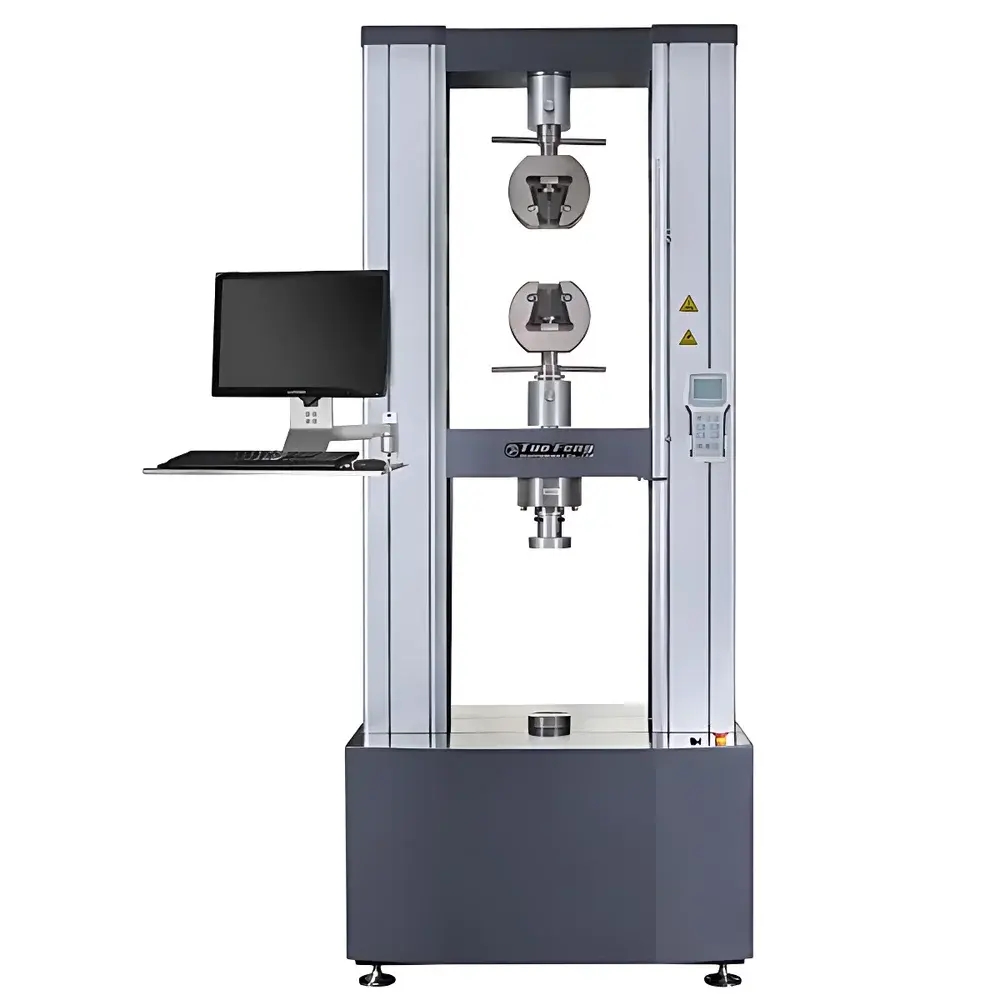
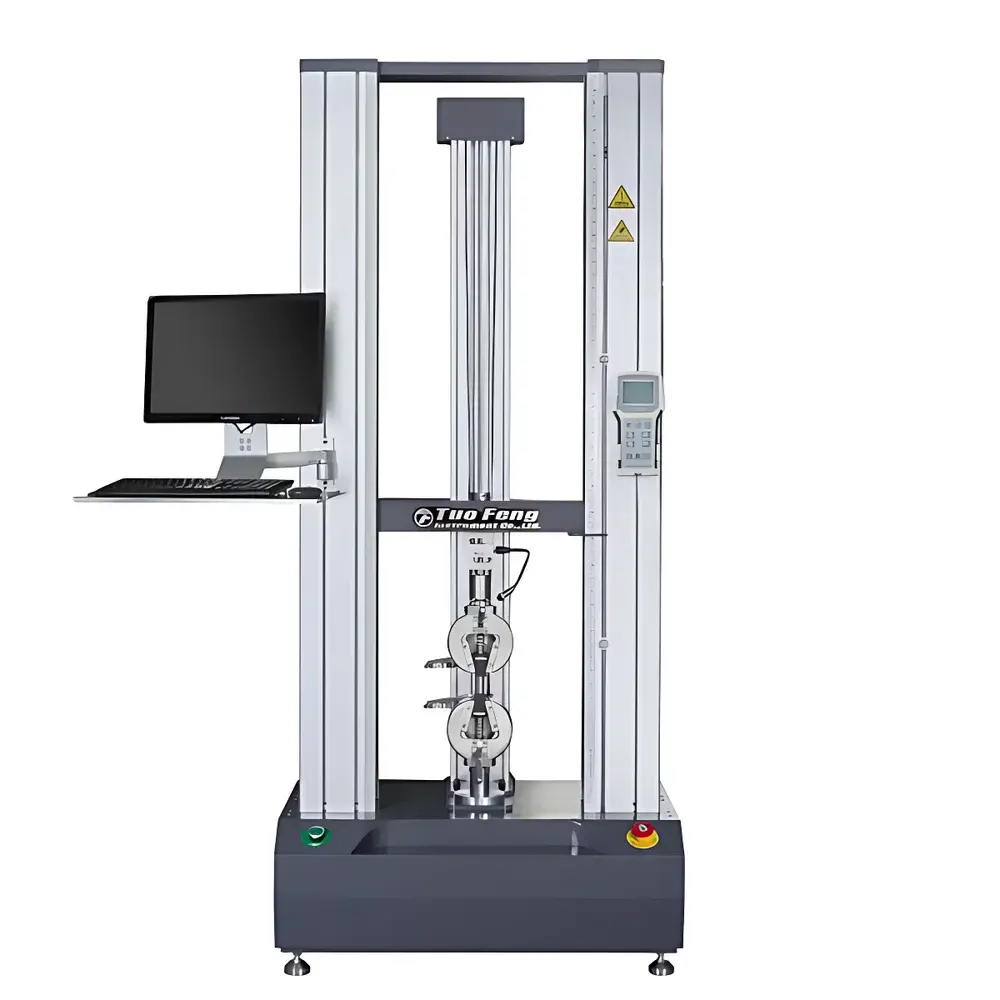
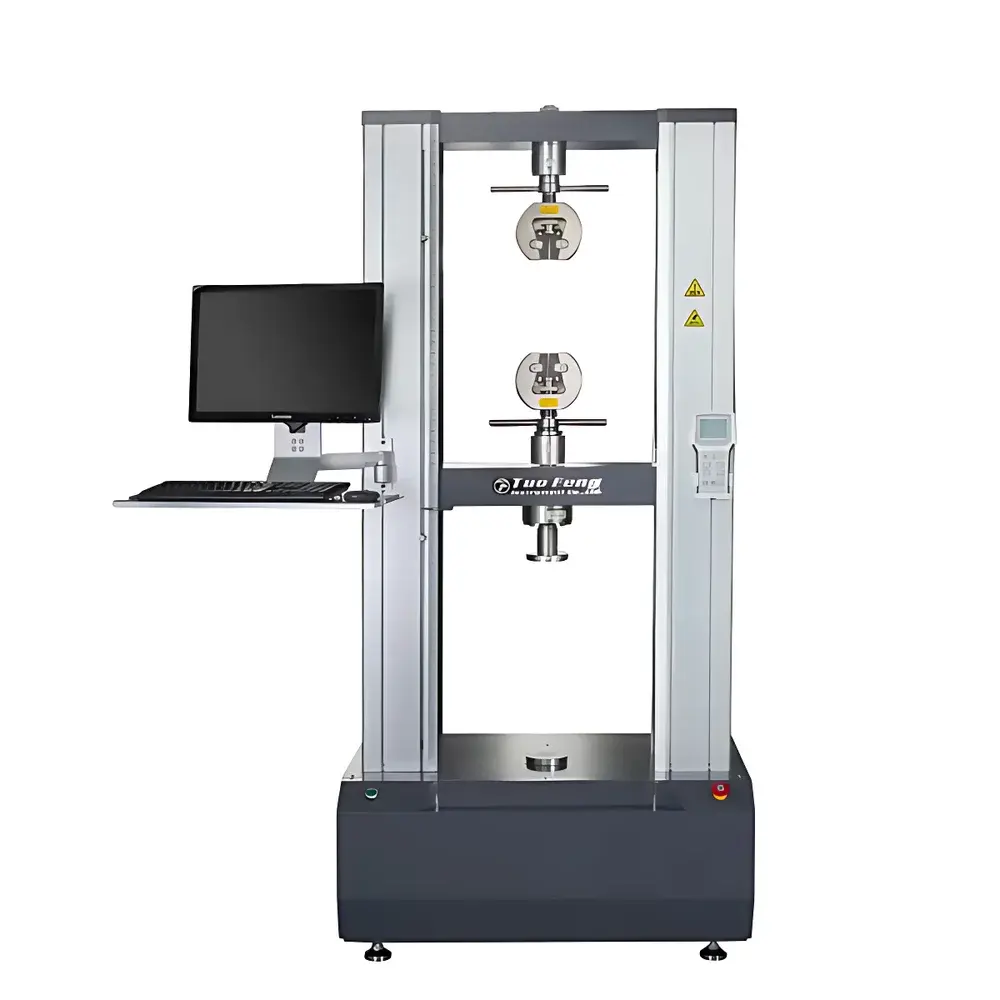
Tuofeng TFW-152 Servo-Controlled Universal Testing Machine
| Brand | Tuofeng |
|---|---|
| Model | TFW-152 |
| Type | Electromechanical Universal Testing Machine |
| Max Test Load | 150 kN |
| Accuracy Class | 0.5 |
| Effective Force Range | 0.2–100% of Full Scale |
| Force Measurement Accuracy | ±0.005% of Reading |
| Force Resolution | 1/500,000 full-scale code (fixed resolution, no range switching) |
| Drive System | Imported AC servo motor with precision worm gear reducer |
| Lead Screw | High-accuracy preloaded ball screw |
| Effective Test Width | 600 mm (customizable) |
| Stroke | 800 mm (extendable) |
| Speed Range | 0.001–500 mm/min (infinitely variable) |
| Displacement Measurement | Optical encoder |
| Displacement Accuracy | ±0.005% of Reading |
| Strain Measurement | Optional extensometer or large-deformation sensor |
| Strain Accuracy | ±0.005% of Reading |
| Safety Protection | Electronic limit switches, emergency stop, overload protection (10% over capacity), dual-speed motorized crosshead control |
| Software | Windows-based, multi-language (English/Chinese), compliant with ASTM E4, ISO 7500-1, GB/T 16491–2008, JJG 475–2008, supports GLP audit trail and FDA 21 CFR Part 11 optional modules |
Overview
The Tuofeng TFW-152 Servo-Controlled Universal Testing Machine is a high-precision electromechanical system engineered for static mechanical property characterization of metallic, polymeric, composite, and ceramic materials. It operates on the principle of controlled displacement actuation via a closed-loop servo drive system, enabling accurate force application and real-time feedback of load, displacement, and strain data. Designed in strict accordance with international metrological standards—including ISO 7500-1 (class 0.5 verification), ASTM E4 (verification of force-measuring instruments), and GB/T 16491–2008—the TFW-152 delivers traceable, reproducible results suitable for quality control, R&D validation, and regulatory submission workflows. Its modular architecture supports standardized tensile, compression, flexure, shear, tear, peel, and puncture testing across diverse specimen geometries and loading configurations.
Key Features
- High-fidelity force measurement system with ±0.005% reading accuracy and fixed 1/500,000 full-scale resolution—no auto-ranging or resolution loss across the 0.2–100% test range.
- Precision preloaded ball screw transmission paired with an imported AC servo motor and low-backlash worm gear reducer ensures smooth, vibration-damped motion and long-term positional stability.
- Dual-speed motorized crosshead control (fast return + fine positioning) with programmable point-to-point movement and automatic return-to-initial-position functionality after test completion.
- Integrated triple-layer safety architecture: electronic travel limits, hardware emergency stop circuitry, and software-enforced overload cutoff at 110% of rated capacity.
- Modular extensometry support—including clip-on axial extensometers and non-contact video extensometers—for compliant strain measurement per ASTM E83 or ISO 9513 requirements.
- Robust structural frame with reinforced base and column assembly, delivering minimal deflection (<0.02 mm under full load) and optimal alignment repeatability.
Sample Compatibility & Compliance
The TFW-152 accommodates specimens up to 600 mm wide and 800 mm stroke depth, with customizable fixtures for ASTM D638, ISO 527, ASTM D790, ISO 178, ASTM D1876 (T-peel), ASTM D624 (tear), and ISO 11339 (puncture) test configurations. Standard compliance includes GB/T 228.1, ASTM E8/E9, ISO 6892-1, ISO 37, and JIS Z2241. The system meets national verification requirements per JJG 475–2008 and is fully compatible with GLP/GMP environments when equipped with optional 21 CFR Part 11-compliant software modules—including electronic signatures, audit trail logging, and user-access-level controls.
Software & Data Management
The embedded Windows-based testing platform supports seven real-time display modes (load–time, load–displacement, stress–strain, etc.) and allows seamless unit switching (N/kN/lbf, mm/in, MPa/psi). All test parameters—including gauge length, cross-sectional area, and test standard—are entered pre-test to enable automatic derivation of tensile strength, yield strength (0.2% offset), Young’s modulus, elongation at break, compressive strength, flexural modulus, tear strength, and peel adhesion. Data export is available in CSV, XLSX, and PDF formats; batch analysis tools permit curve superposition, statistical reporting (mean/min/max), and comparative trend visualization. Software updates are provided free of charge for the lifetime of the instrument, with version-controlled release notes and ISO-compliant validation documentation available upon request.
Applications
The TFW-152 serves as a primary mechanical characterization tool in aerospace component qualification (e.g., carbon fiber layup tensile verification), automotive material certification (polymer dashboards, rubber bushings), medical device polymer validation (ISO 10993-12 compliant elastomer testing), construction material compliance (rebar, grout, fiber-reinforced concrete), and electronics packaging integrity assessment (PCB substrate bending, solder joint shear). It is routinely deployed in ISO/IEC 17025-accredited laboratories, university mechanics labs, and Tier-1 supplier QC departments requiring full traceability from raw material receipt to final product release.
FAQ
Does the TFW-152 support ASTM E23 for impact-modified polymer Charpy testing?
No—this is a quasi-static universal testing machine; impact testing requires dedicated pendulum or drop-weight systems.
Can third-party extensometers be integrated?
Yes—via analog voltage input (±10 V) or digital RS-422 interface, provided calibration certificates and linearity specifications meet ISO 9513 class 1 or better.
Is firmware upgrade capability included?
Yes—field-upgradable firmware is delivered via secure USB key with SHA-256 checksum verification and version rollback support.
What is the recommended recalibration interval?
Annually under normal use; semi-annually in high-throughput production environments or following any mechanical shock event.
Does the system include factory calibration documentation?
Yes—each unit ships with NIST-traceable calibration certificates for load cell, displacement encoder, and optional extensometer, all issued by CNAS-accredited calibration lab.



