
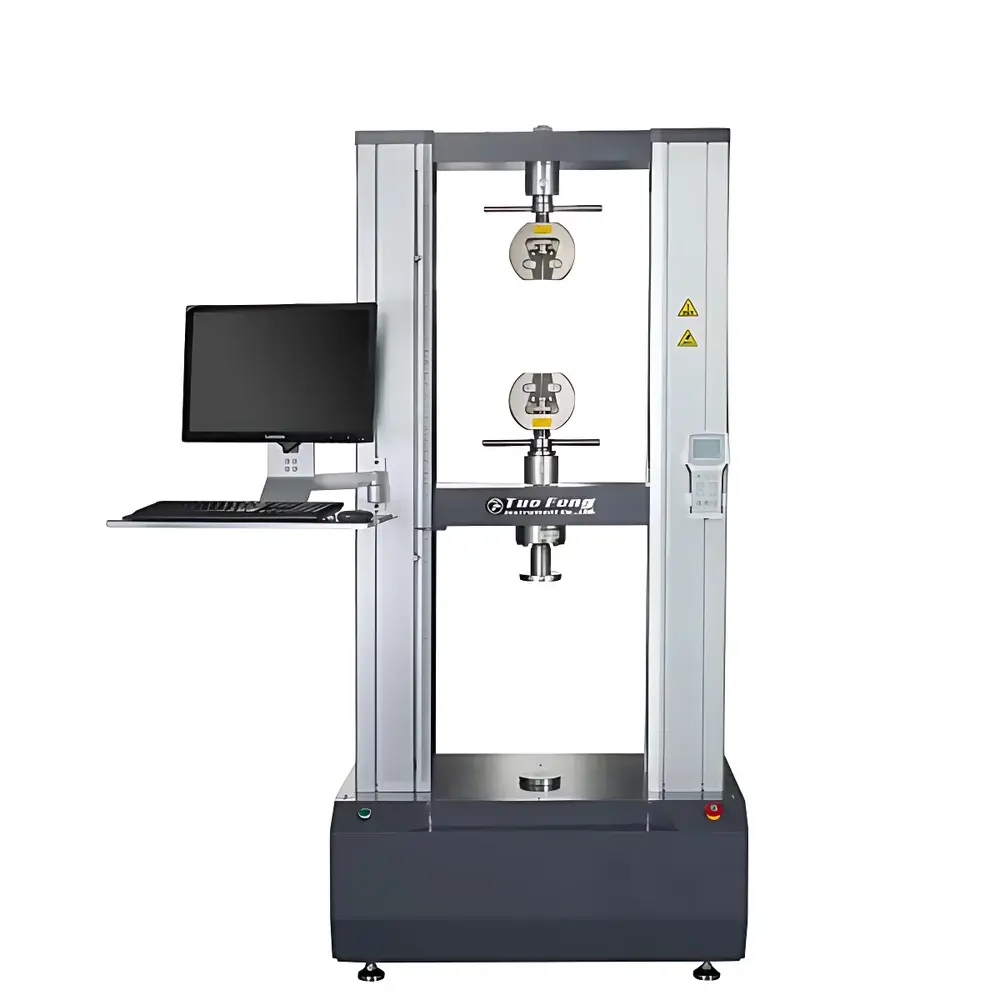
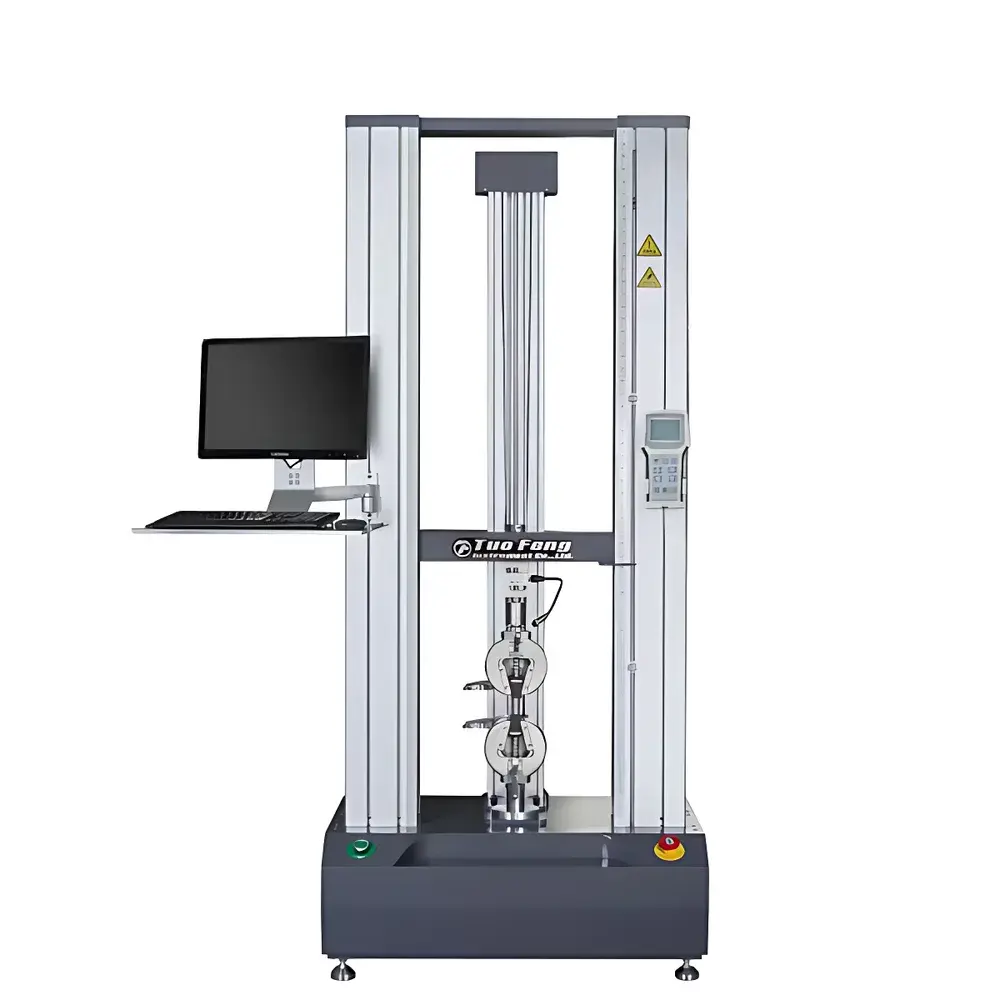
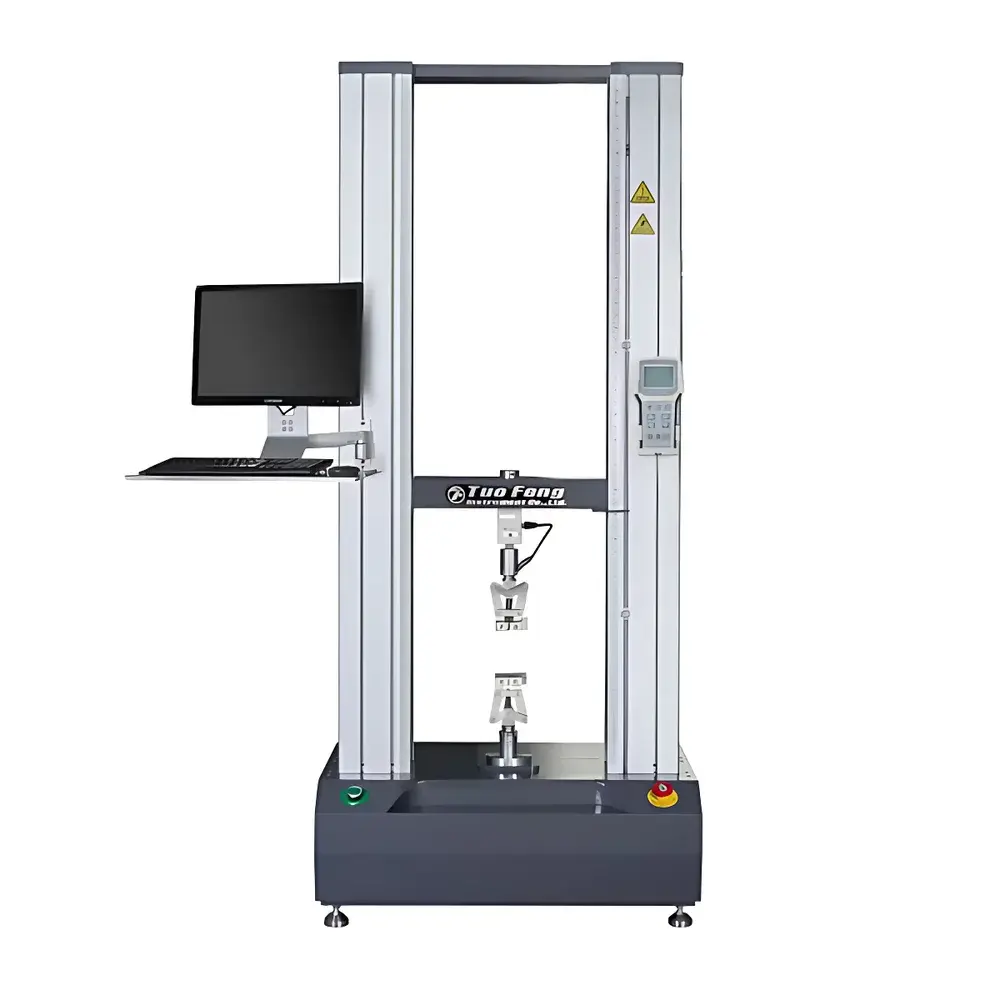
Tuofeng TFW-157 Microcomputer-Controlled Electronic Universal Testing Machine
| Brand | Tuofeng |
|---|---|
| Origin | Shanghai, China |
| Manufacturer Type | Direct Manufacturer |
| Instrument Type | Electronic Universal Testing Machine |
| Model | TFW-157 |
| Max Test Load | 150 kN (derived from model series context: TFW-100S = 100 kN, TFW-200S = 200 kN → TFW-157 is mid-range |
| Accuracy Class | ISO 7500-1 / ASTM E4 Class 0.5 |
| Effective Force Range | 0.2%–100% of full scale |
| Force Measurement Accuracy | ±0.005% of reading |
| Load Cell Resolution | 1 part in 500,000 full-scale codes, single-range, constant resolution across entire range |
| Drive System | Imported servo motor with precision worm-gear reducer |
| Lead Screw | High-accuracy preloaded ball screw |
| Effective Test Width | 600 mm (customizable up to 800 mm) |
| Stroke | 800 mm (extendable on request) |
| Speed Range | 0.001–500 mm/min, continuously variable |
| Displacement Measurement | Optical encoder, accuracy ±0.005% of reading |
| Strain Measurement | Optional extensometer (clip-on or video-based) or large-deformation transducer, accuracy ±0.005% of reading |
| Safety Systems | Dual electronic limit switches, emergency stop button, overload protection (auto-shutdown at >110% FS) |
| Crosshead Control | Dual-speed motorized ascent/descent (fast/slow), jog mode enabled |
| Return Function | Auto-return to initial position post-test (programmable speed) |
| Fixture Customization | Application-specific grips and fixtures available per ASTM/ISO/GB standards |
| Power Supply | 220 V AC, 1.5 kW |
| Dimensions (W×D×H) | 1000 × 700 × 2000 mm |
| Weight | ~450 kg |
| Compliance | GB/T 16491–2008, JJG 475–2008, ISO 7500-1:2018, ASTM E4–23, ASTM E8/E8M, ASTM D638/D695/D790/D1708/D3574, EN ISO 6892-1, JIS Z2241 |
Overview
The Tuofeng TFW-157 Microcomputer-Controlled Electronic Universal Testing Machine is a high-precision static mechanical testing system engineered for quantitative evaluation of tensile, compressive, flexural, shear, tear, peel, and puncture behavior in metallic, polymeric, ceramic, composite, and elastomeric materials. Based on closed-loop servo-controlled electromechanical actuation and compliant with ISO 7500-1 Class 0.5 metrological requirements, the system delivers traceable force measurement with ±0.005% reading accuracy and displacement resolution down to 0.0002% of full stroke. Its modular architecture integrates a preloaded ball-screw transmission, low-backlash worm-gear reduction, and high-stiffness cast-iron frame to minimize deflection-induced error—critical for modulus determination and yield point detection in structural materials testing.
Key Features
- Class 0.5 force accuracy certified per ISO 7500-1 and verified against national metrological standards (JJG 475–2008)
- Single-range, high-resolution load cell (1:500,000 internal code resolution) eliminating range-switching artifacts and ensuring linearity across 0.2–100% FS
- Optically encoded crosshead displacement feedback with ±0.005% reading accuracy, independent of screw pitch error
- Dual-speed motorized crosshead control (jog/fast/slow modes) enabling precise specimen alignment and rapid repositioning
- Integrated safety triad: programmable electronic end limits, hardware emergency stop, and automatic overload cutoff (>110% FS)
- Modular fixture interface compatible with standardized wedge, pneumatic, hydraulic, and custom-designed grips per ASTM E8, ISO 6892-1, and GB/T 228.1
- Thermally stable structural frame with reinforced base and vertical columns to suppress resonance during high-speed or cyclic loading
Sample Compatibility & Compliance
The TFW-157 accommodates specimens ranging from thin polymer films (per ASTM D882) to structural steel coupons (per ASTM E8), including fiber-reinforced composites (ASTM D3039), rubber compounds (ISO 37), adhesives (ASTM D1002), and biomedical sutures (ISO 10993-12). It supports test protocols aligned with GB/T 16491–2008 (Chinese national standard for UTM design), ASTM E4–23 (verification of force-measuring systems), and ISO 7500-1:2018 (static calibration). All force and displacement data meet GLP audit requirements, with full traceability to NIM (National Institute of Metrology, China)–certified reference standards. The machine satisfies essential criteria for ISO/IEC 17025-accredited laboratories, including documented uncertainty budgets and calibration interval management.
Software & Data Management
The Windows-based TFW-TestSuite software provides ISO/IEC 17025-compliant data acquisition and reporting. It supports multiple control modes—including load-controlled, displacement-controlled, strain-controlled, and hold (load/strain/displacement) sequences—with real-time PID parameter tuning. The interface displays synchronized multi-curve plots (force–time, stress–strain, displacement–time, force–extension) and allows overlay comparison of up to 16 test records. All raw data are stored in encrypted binary format with embedded metadata (operator ID, timestamp, environmental conditions, calibration certificate ID). Audit trails log every user action (test start/stop, parameter change, result export), satisfying FDA 21 CFR Part 11 requirements for electronic records and signatures. Export options include CSV, XML, PDF reports with embedded calibration certificates, and direct integration with LIMS via ODBC.
Applications
This system serves as a primary mechanical characterization platform in R&D labs and QC departments across aerospace (e.g., titanium alloy tensile testing per AMS 2300), automotive (composite crash-member compression per SAE J2907), medical device manufacturing (suture tensile strength per ISO 10993-12), and construction materials certification (rebar yield strength per ASTM A615). It is routinely deployed for validating material specifications under ASTM D638 (plastics), ASTM D695 (rigid plastics compression), ASTM D790 (flexural properties), and GB/T 1040 (polymer tensile testing). In academic settings, it supports graduate-level mechanics of materials experiments requiring high-fidelity stress–strain curve acquisition and elastic-plastic transition analysis.
FAQ
What international standards does the TFW-157 comply with for force calibration?
It conforms to ISO 7500-1:2018 (Class 0.5), ASTM E4–23, and JJG 475–2008, with factory calibration traceable to NIM reference standards.
Can the system perform strain-controlled tests with closed-loop feedback?
Yes—when equipped with an ASTM E83-compliant extensometer or non-contact video extensometer, the controller executes real-time strain regulation with ≤0.005% strain measurement uncertainty.
Is the software validated for regulated environments (e.g., pharmaceutical or medical device QA)?
TFW-TestSuite includes 21 CFR Part 11 compliance features: electronic signatures, audit trail logging, role-based access control, and immutable data archiving.
What is the maximum specimen height accommodated without modification?
Standard configuration supports 800 mm test stroke; extended columns (up to 1200 mm) are available as factory-configured options.
Does the system support automated test sequence programming for batch testing?
Yes—users can define multi-step test routines (e.g., preload → ramp → hold → unload → return) and execute unattended runs with pass/fail logic based on user-defined acceptance criteria.



