
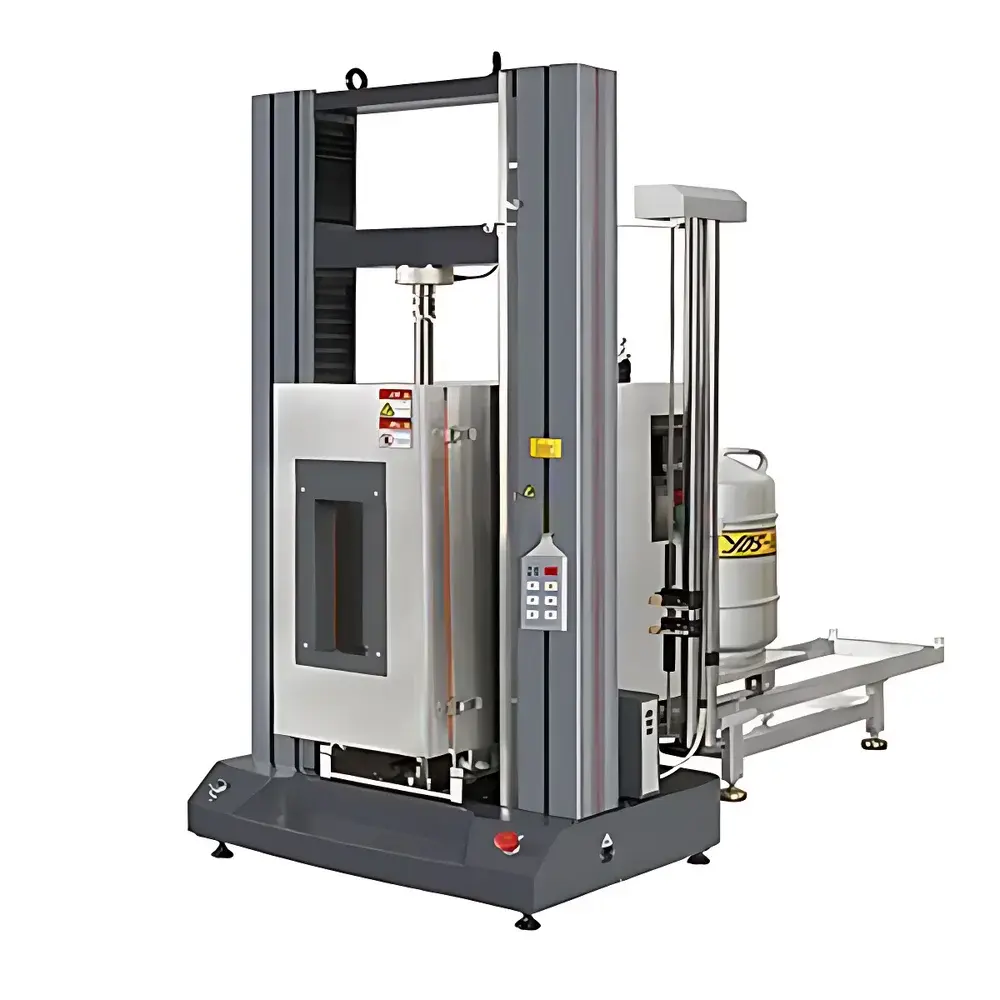
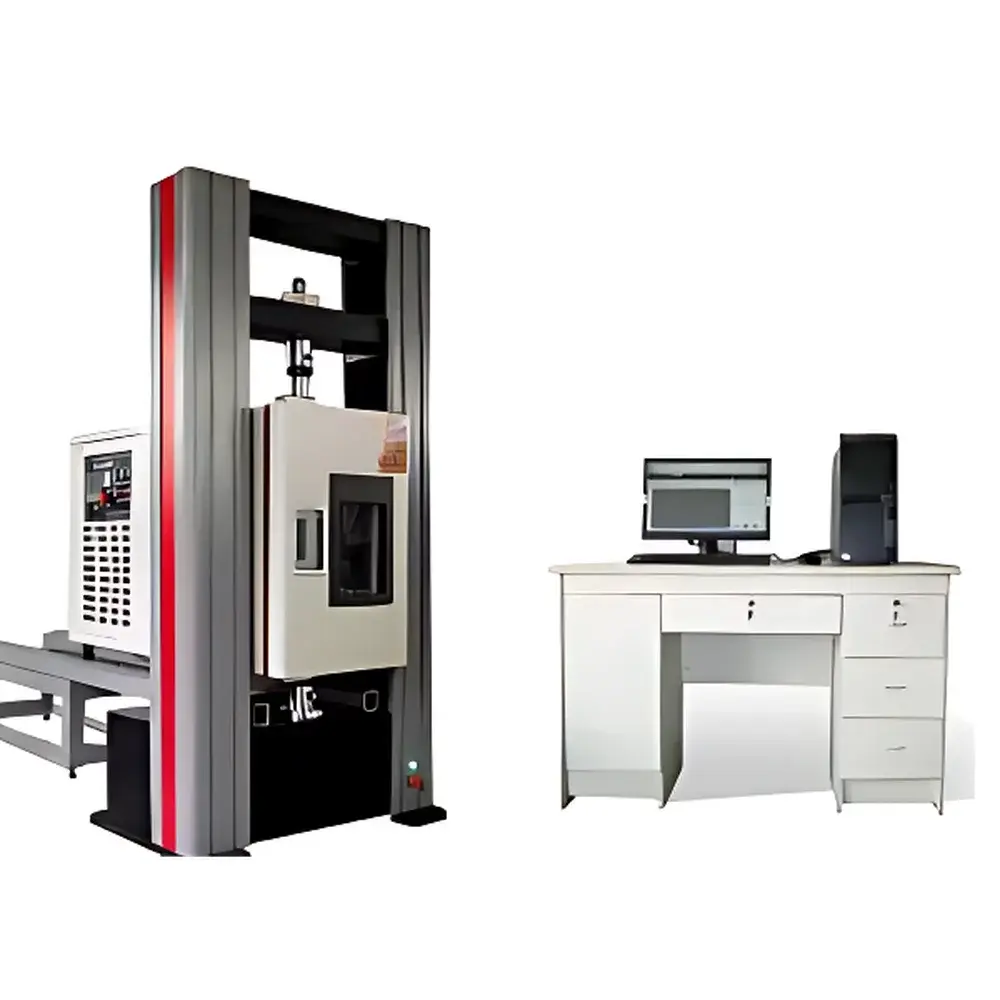
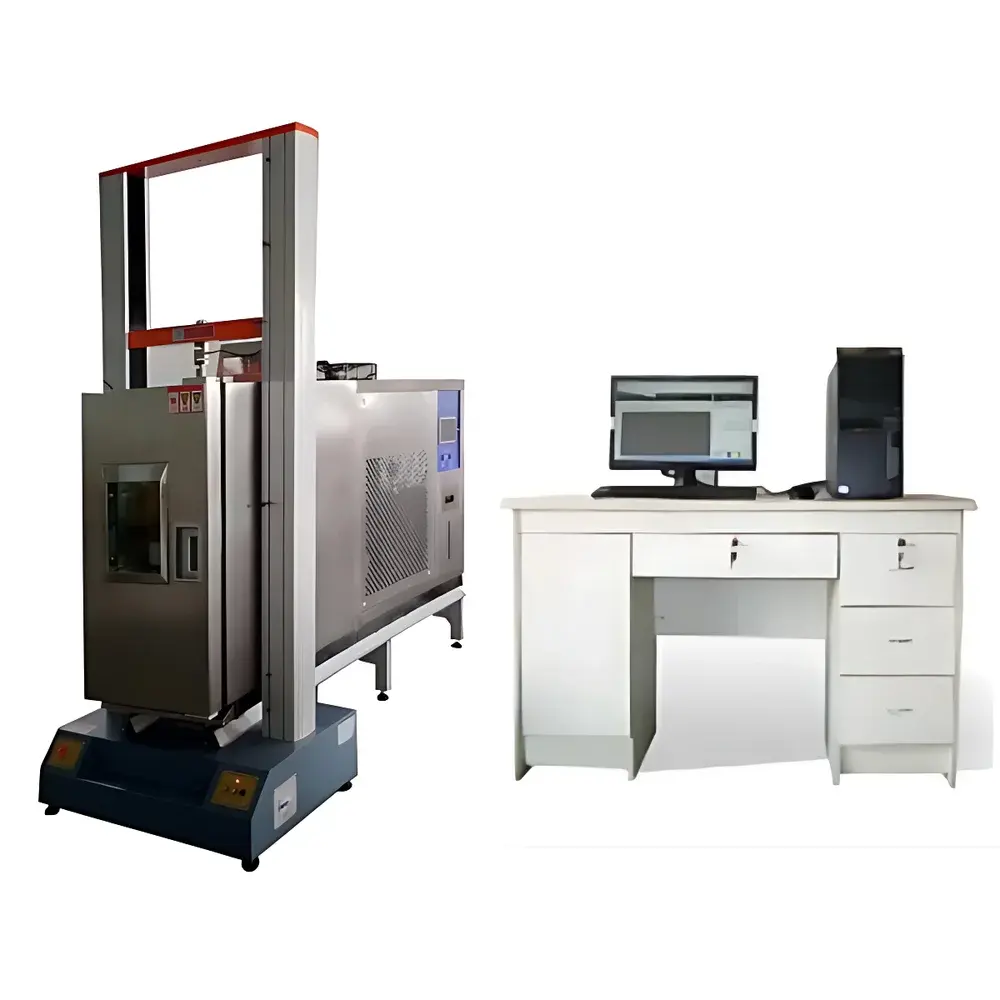
Tuofeng TFW-164 Microcomputer-Controlled High-Low Temperature Universal Testing Machine
| Brand | Tuofeng |
|---|---|
| Origin | Shanghai, China |
| Manufacturer Type | Direct Manufacturer |
| Product Origin | Domestic (China) |
| Model | TFW-164 |
| Instrument Type | Electromechanical Universal Testing Machine |
| Max Test Load | 5–100 kN (configurable) |
| Accuracy Class | 0.5 |
| Force Measurement Range | 0.4–100% FS |
| Force Indication Error | ±0.5% of reading |
| Force Resolution | 1/500,000 of full scale, constant across entire range |
| Deformation Measurement Range | 0.2–100% FS |
| Deformation Error | ±0.5% of reading |
| Deformation Resolution | up to 1/300,000 |
| Displacement Error | ±0.5% of reading |
| Column Internal Width | 840 mm |
| Crosshead Travel (standard) | 1000 mm |
| Host Dimensions (W×D×H) | 1250 × 560 × 2400 mm |
| Power Supply | AC 220 V / 50 Hz, ±10%, 750 W |
| Host Weight | ~380 kg |
| Environmental Chamber Temp Range | –40 °C to +100 °C |
| Chamber Heating Power | 1500 W |
| Chamber Internal Dimensions (W×D×H) | ~360 × 300 × 500 mm |
| Chamber Construction | 304 stainless steel exterior, 316 mirror-finish stainless interior, ceramic fiber insulation |
| Temperature Uniformity | ±2 °C over 100 mm vertical zone |
| Temp Ramp Rate | ≤30 min to +100 °C from ambient |
| Thermal Equilibration Time | ≤5 min (both above and below 0 °C) |
| Control System | Programmable PID with Pt100 sensors, LCD digital display, integrated safety circuits (leakage protection, overcurrent cutoff) |
Overview
The Tuofeng TFW-164 Microcomputer-Controlled High-Low Temperature Universal Testing Machine is an electromechanical testing system engineered for precision mechanical property evaluation under controlled thermal environments. It integrates a high-rigidity dual-column universal testing frame with a programmable environmental chamber capable of stable operation from –40 °C to +100 °C. The system operates on the principle of servo-controlled load application and displacement feedback, enabling accurate measurement of tensile, compressive, flexural, shear, peel, and tear responses in accordance with standardized quasi-static mechanical test protocols. Designed for compliance with international test method frameworks—including ASTM E8/E21, ISO 6892-1, GB/T 228.1, JIS Z 2241, and DIN 50125—the TFW-164 supports both ambient and conditioned testing without hardware reconfiguration. Its force transducer, extensometer interface, and crosshead position encoder are calibrated to 0.5-class accuracy per ISO 7500-1, ensuring traceable, reproducible data acquisition across the full 5–100 kN load range.
Key Features
- High-stiffness dual-column structural frame with 840 mm internal clearance and 1000 mm standard crosshead travel—optimized for specimen length and environmental chamber integration.
- Programmable temperature chamber featuring 304 stainless steel housing, 316 mirror-finish interior, and multi-layer ceramic fiber insulation for thermal stability and corrosion resistance.
- Pt100 platinum resistance temperature sensors with ±0.2 °C calibration traceability; PID-based control algorithm ensures ±2 °C uniformity over 100 mm vertical zone.
- Force measurement system with 1/500,000 full-scale resolution, zero drift compensation, and real-time auto-zeroing—maintaining linearity across the entire 0.4–100% FS range.
- Integrated microcomputer control platform running Windows-based test software with dual-mode operation: manual jog control and automated script execution.
- Comprehensive safety architecture including leakage current protection, thermal overload cutoff, emergency stop circuitry, and mechanical limit switches on all axes.
- Modular extensometer and grip interfaces compatible with clip-on, video, and non-contact strain measurement accessories per ISO 9513 requirements.
Sample Compatibility & Compliance
The TFW-164 accommodates metallic alloys (e.g., aluminum, stainless steel, titanium), polymeric films and sheets, elastomers, composites, ceramics, adhesives, and textile laminates. Specimen geometries include dog-bone tensile bars, cylindrical compression samples, three- and four-point bend fixtures, peel tabs, and trouser-tear configurations. All test routines adhere to GLP-aligned data integrity standards: audit trails record operator ID, timestamp, parameter changes, and calibration events. Software complies with FDA 21 CFR Part 11 requirements for electronic records and signatures when configured with user authentication, role-based access, and immutable log archiving. Mechanical verification follows ISO 7500-1 (static calibration) and ISO 5893 (dynamic performance), while environmental chamber validation conforms to ISO 17025-accredited procedures for thermal uniformity and stability assessment.
Software & Data Management
The embedded Windows-based test suite provides real-time plotting of stress–strain, load–displacement, and time–temperature curves with customizable scaling, overlay, and derivative calculation (e.g., modulus, yield point, elongation at break). Raw data export is supported in CSV, XLSX, and XML formats compliant with LIMS integration protocols. Automated report generation includes pre-formatted templates aligned with ASTM E4, ISO 14577, and GB/T 228.1—each embedding test metadata, statistical summaries (n≥3), uncertainty budgets, and graphical annotations. The system supports third-party API access via TCP/IP socket interface for MES or PLM synchronization. Calibration certificates are digitally signed and stored with version-controlled firmware logs, enabling full traceability from raw sensor output to final engineering units.
Applications
This system serves as a primary mechanical characterization tool in R&D laboratories and QC departments across sectors including aerospace component validation (e.g., cryogenic seal behavior), automotive polymer aging studies (–40 °C ductility retention), biomedical device tensile fatigue (hydrogel scaffolds at 37 °C), battery electrode binder adhesion (thermal cycling peel strength), and construction material certification (concrete flexure at elevated temperatures). Universities utilize it for graduate-level materials science instruction on thermomechanical coupling effects, while national metrology institutes employ its dual-temperature capability for inter-laboratory round-robin studies on reference material certification.
FAQ
What temperature ranges does the environmental chamber support, and how is thermal uniformity validated?
The chamber operates from –40 °C to +100 °C, with thermal uniformity verified per ISO 17025 procedures using nine-point mapping and certified Pt100 probes—demonstrating ≤±2 °C deviation over any 100 mm vertical segment.
Can the system perform closed-loop strain control during temperature ramping?
Yes—when equipped with a high-precision clip-on extensometer and configured with ramp-hold-strain control profiles, the system maintains target strain rate within ±0.5% tolerance throughout dynamic thermal transitions.
Is the software compliant with regulatory audit requirements for pharmaceutical or medical device testing?
When deployed with password-protected user roles, electronic signature workflows, and encrypted audit trail logging, the software meets FDA 21 CFR Part 11 and EU Annex 11 criteria for regulated environments.
What maintenance intervals are recommended for long-term force accuracy?
Annual verification against certified deadweight standards is advised; quarterly zero-load verification and biannual transducer linearity checks are included in the preventive maintenance protocol.
Are custom grips or fixtures available for non-standard specimen geometries?
Tuofeng offers OEM-designed hydraulic wedge grips, pneumatic clamps, and high-temperature furnace-compatible fixtures—engineered to ISO 26203-2 dimensional tolerances and supplied with material certification and load capacity documentation.



