
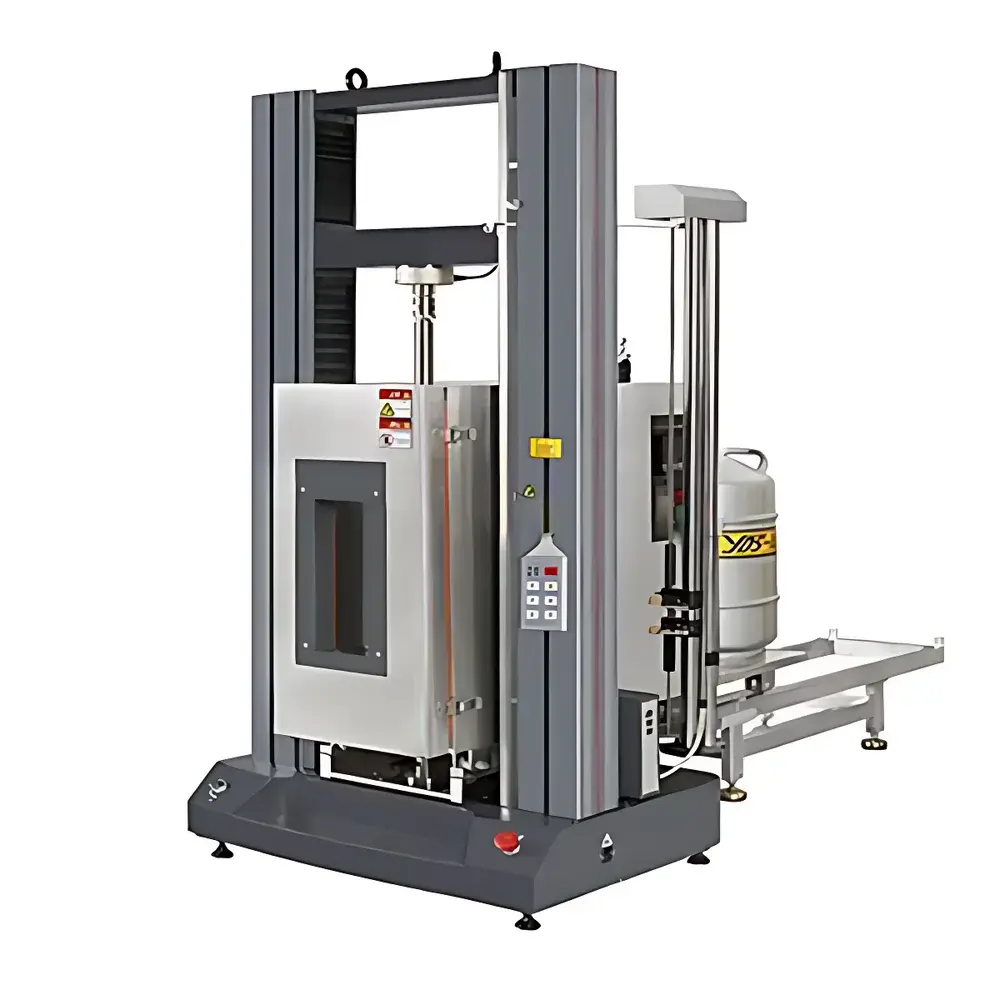
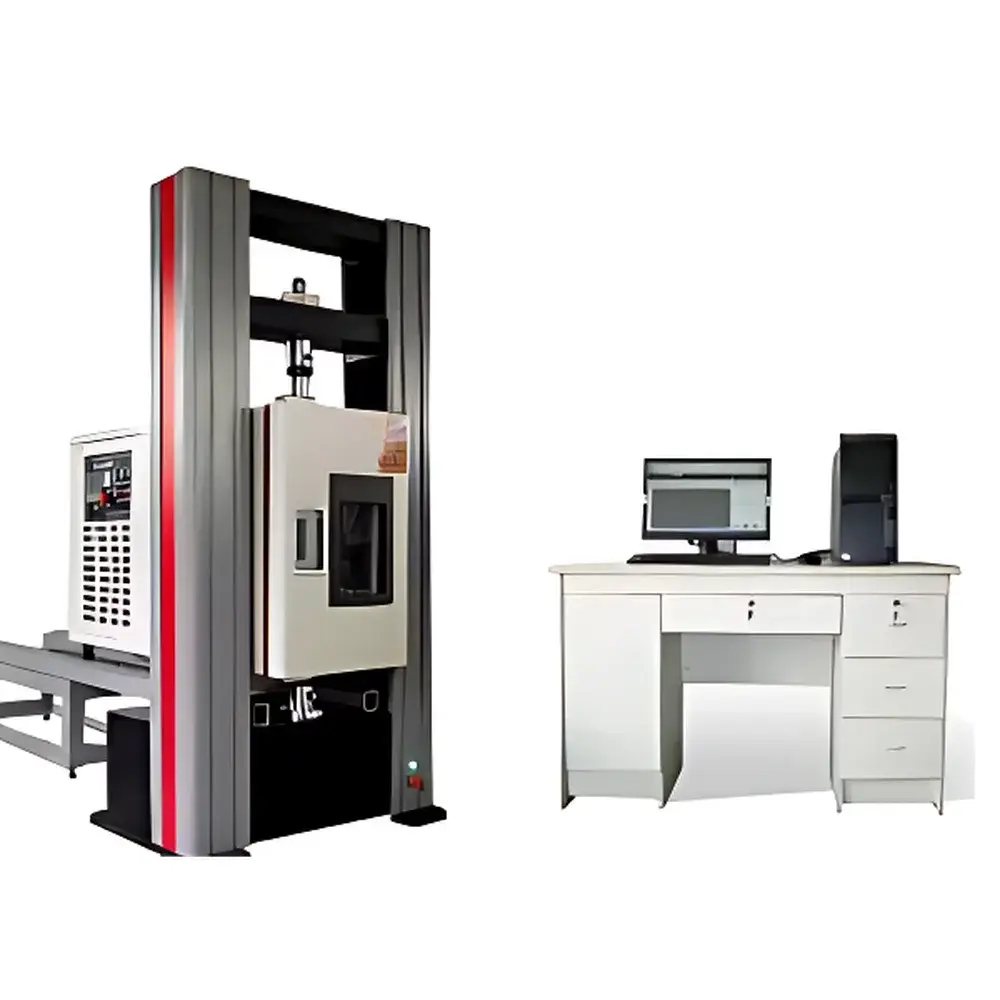
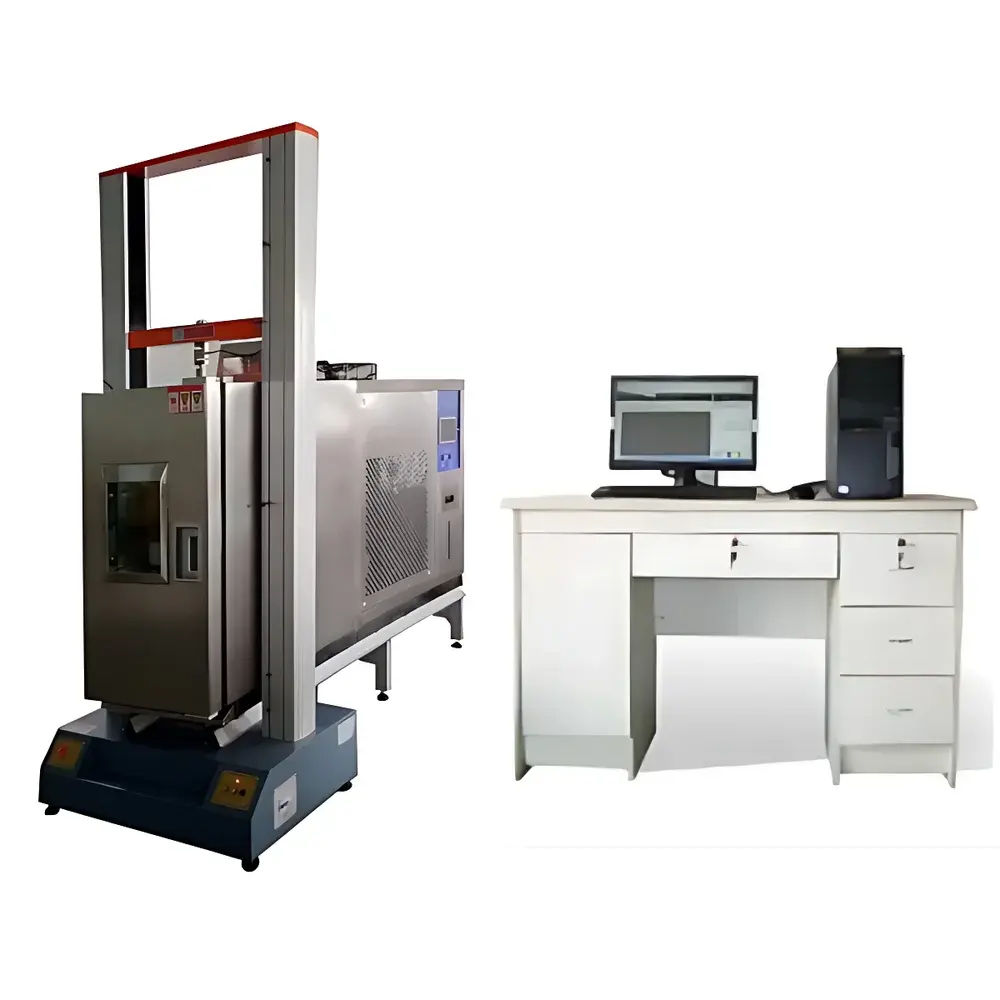
Tuofeng TFW-166 Microcomputer-Controlled Universal Testing Machine with Integrated High-Low Temperature Chamber
| Brand | Tuofeng |
|---|---|
| Origin | Shanghai, China |
| Manufacturer Type | Direct Manufacturer |
| Instrument Type | Electromechanical Universal Testing Machine |
| Model | TFW-166 |
| Max Test Load | 5 kN / 10 kN / 20 kN / 50 kN / 100 kN |
| Accuracy Class | 0.5 |
| Force Measurement Range | 0.4–100% FS |
| Force Indication Error | ±0.5% of reading |
| Force Resolution | 1/500,000 of full scale, constant across entire range |
| Deformation Measurement Range | 0.2–100% FS |
| Deformation Error | ±0.5% of reading |
| Deformation Resolution | up to 1/300,000 |
| Displacement Error | ±0.5% of reading |
| Column Inner Width | 840 mm |
| Crosshead Travel (standard) | 1000 mm |
| Dimensions (H×W×D) | 2400 × 1250 × 560 mm |
| Weight | ~380 kg |
| Power Supply | AC 220 V ±10%, 50 Hz, 750 W |
| Temperature Chamber Range | −40 °C to +100 °C |
| Chamber Internal Dimensions | 360 × 300 × 500 mm (W×D×H) |
| Heating Power | 1.5 kW |
| Cooling Method | Compressor-assisted |
| Temperature Uniformity | ±2 °C over 100 mm vertical zone |
| Temperature Stabilization Time | ≤5 min (both above and below 0 °C) |
| Chamber Control | Programmable PID controller with LCD interface |
| Safety Features | Leakage current protection, overcurrent circuit breaker |
Overview
The Tuofeng TFW-166 is a fully integrated electromechanical universal testing machine engineered for precision mechanical property evaluation under controlled thermal conditions. It combines a high-stiffness dual-column load frame with a programmable high-low temperature environmental chamber—enabling standardized tensile, compression, flexural, peel, tear, and shear testing of metallic and non-metallic materials across −40 °C to +100 °C. The system operates on the principle of servo-controlled displacement actuation with closed-loop force and displacement feedback, adhering to fundamental mechanics of materials test methodologies defined in ASTM E8/E9, ISO 6892-1, GB/T 228.1, JIS Z 2241, and DIN EN 10002-1. Unlike ambient-only testers, the TFW-166 maintains metrological traceability throughout thermal excursions via real-time compensation of thermal drift in load cell and extensometer signals—critical for generating repeatable, auditable data in GLP and GMP-regulated environments.
Key Features
- Microcomputer-based control architecture with Windows-native software platform supporting multi-language UI, real-time curve plotting (stress–strain, load–displacement, temperature–time), and automated parameter extraction (UTS, yield strength, modulus, elongation at break, fracture toughness indicators)
- High-resolution force measurement system compliant with ISO 7500-1 Class 0.5, featuring a 1/500,000 full-scale resolution transducer with no range switching—ensuring linearity and repeatability across the entire 5–100 kN capacity spectrum
- Integrated cryogenic–thermal chamber constructed from 304 stainless steel exterior and 316 mirror-finish interior, insulated with high-density alumina-silicate fiber; equipped with dual-zone PID temperature control, platinum RTD sensing, and rapid thermal response (≤30 min to reach +100 °C from ambient)
- Modular sample access design: dual 50 mm-diameter axial ports with retractable ceramic insulation blocks, enabling uninterrupted load train alignment during thermal cycling without mechanical interference
- Rigid C-frame construction with 840 mm column spacing and 1000 mm crosshead travel—accommodating standard ASTM/ISO specimen geometries including dog-bone, rectangular, and cylindrical configurations up to 300 mm gauge length
- Comprehensive safety subsystems: electronic overload cutoff, emergency stop circuit, leakage current protection, and thermally interlocked chamber door switch—certified per IEC 61000-6-2/6-4 EMC requirements
Sample Compatibility & Compliance
The TFW-166 supports standardized test specimens per ASTM D638 (plastics), ASTM E8 (metals), ISO 527 (polymer tensile), ISO 178 (flexure), and GB/T 1040 (general plastics). Its chamber geometry permits testing of rods, sheets, films, composites, elastomers, adhesives, ceramics, and biomedical polymers—provided dimensional constraints (max 300 mm length × 50 mm width × 25 mm thickness) are observed. All force, displacement, and temperature data streams are timestamped and logged with audit-trail capability, satisfying FDA 21 CFR Part 11 requirements for electronic records when configured with user authentication and digital signature modules. System validation documentation—including IQ/OQ protocols, calibration certificates traceable to NIM (China National Institute of Metrology), and uncertainty budgets—is available upon request for regulatory submissions.
Software & Data Management
The proprietary TestMaster™ software (v4.2+) provides ISO/IEC 17025-aligned test sequence automation, customizable report templates (PDF/Excel/XML), and raw data export in CSV or HDF5 format for third-party statistical analysis (e.g., JMP, MATLAB, Python pandas). Built-in statistical process control (SPC) tools calculate Cp/Cpk, Weibull modulus, and confidence intervals for batch-to-batch comparisons. Data integrity safeguards include write-protected archive folders, automatic backup to network drives, and configurable retention policies. Optional add-ons include cloud synchronization (AWS S3), REST API integration for LIMS/MES systems, and AI-assisted anomaly detection for outlier identification in large-scale material qualification studies.
Applications
This system serves as a primary mechanical characterization tool in R&D labs evaluating polymer crystallinity transitions near Tg, metal ductility loss at cryogenic temperatures, adhesive bond durability under thermal cycling, composite interlaminar shear strength at elevated service temperatures, and rubber hysteresis behavior across seasonal ambient ranges. End-user sectors include aerospace OEMs validating titanium alloy fasteners at −40 °C, battery manufacturers assessing separator film puncture resistance at 85 °C, medical device firms qualifying PEEK spinal implants per ISO 5832-12, and national metrology institutes performing inter-laboratory comparison trials under ILAC MRA frameworks.
FAQ
What temperature uniformity can be achieved inside the chamber during static hold conditions?
Temperature deviation remains within ±2 °C over a 100 mm vertical zone at any setpoint between −40 °C and +100 °C, verified per ASTM E744 Annex A3.
Is the system compatible with extensometers rated for low-temperature operation?
Yes—optional contact-type clip-on extensometers with carbon-fiber arms and cryo-rated strain gauges (−70 °C to +200 °C) are supported via analog voltage input channels with auto-zero compensation.
Can test sequences be scheduled to execute unattended overnight?
Absolutely—the software supports queued multi-step programs with conditional branching (e.g., “hold at 60 °C for 30 min → ramp to −20 °C at 5 °C/min → begin tensile ramp”), email alerts on completion/failure, and hardware watchdog timers.
Does the system meet CE marking requirements for export to the EU?
Yes—the base configuration complies with Machinery Directive 2006/42/EC, Low Voltage Directive 2014/35/EU, and EMC Directive 2014/30/EU; CE Declaration of Conformity and technical file are supplied with shipment.
What calibration services are offered post-installation?
Tuofeng provides on-site force calibration (using NIST-traceable deadweight standards), displacement verification (laser interferometer), and thermal mapping (9-point RTD probe array), all documented per ISO/IEC 17025:2017.



