
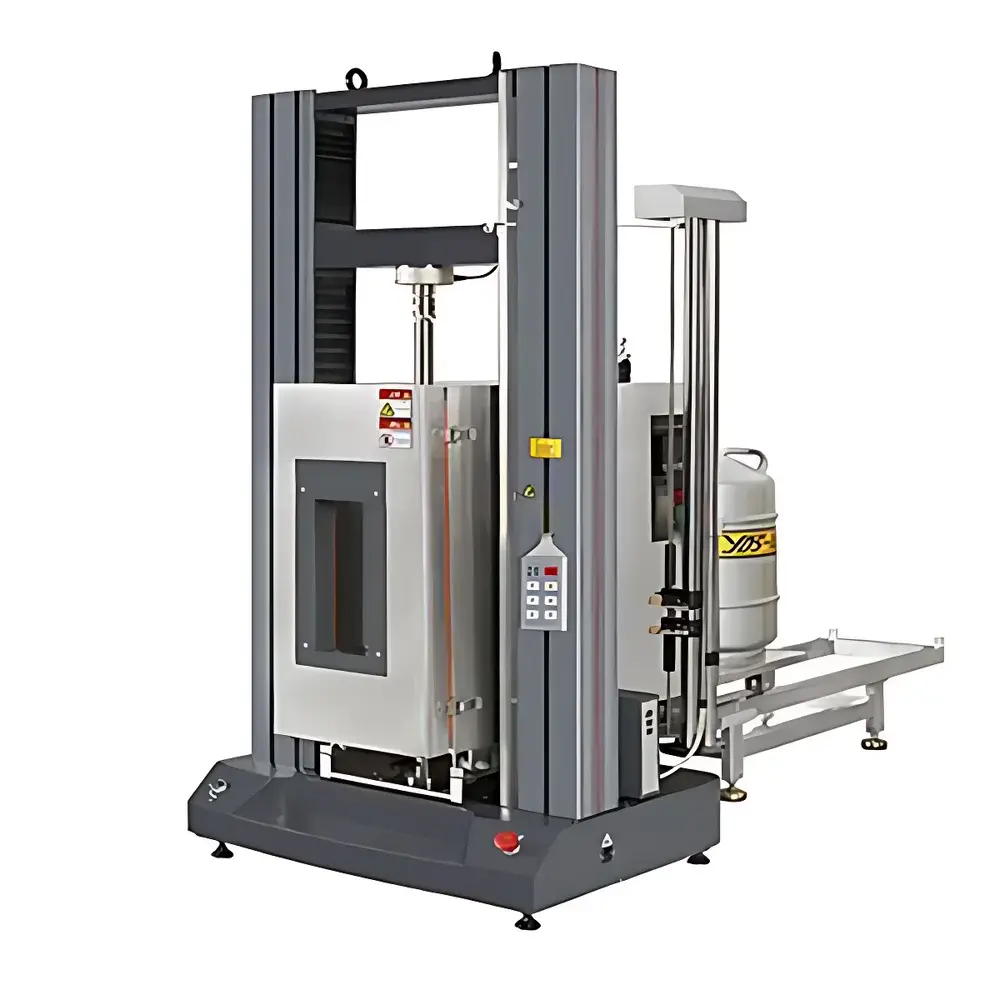
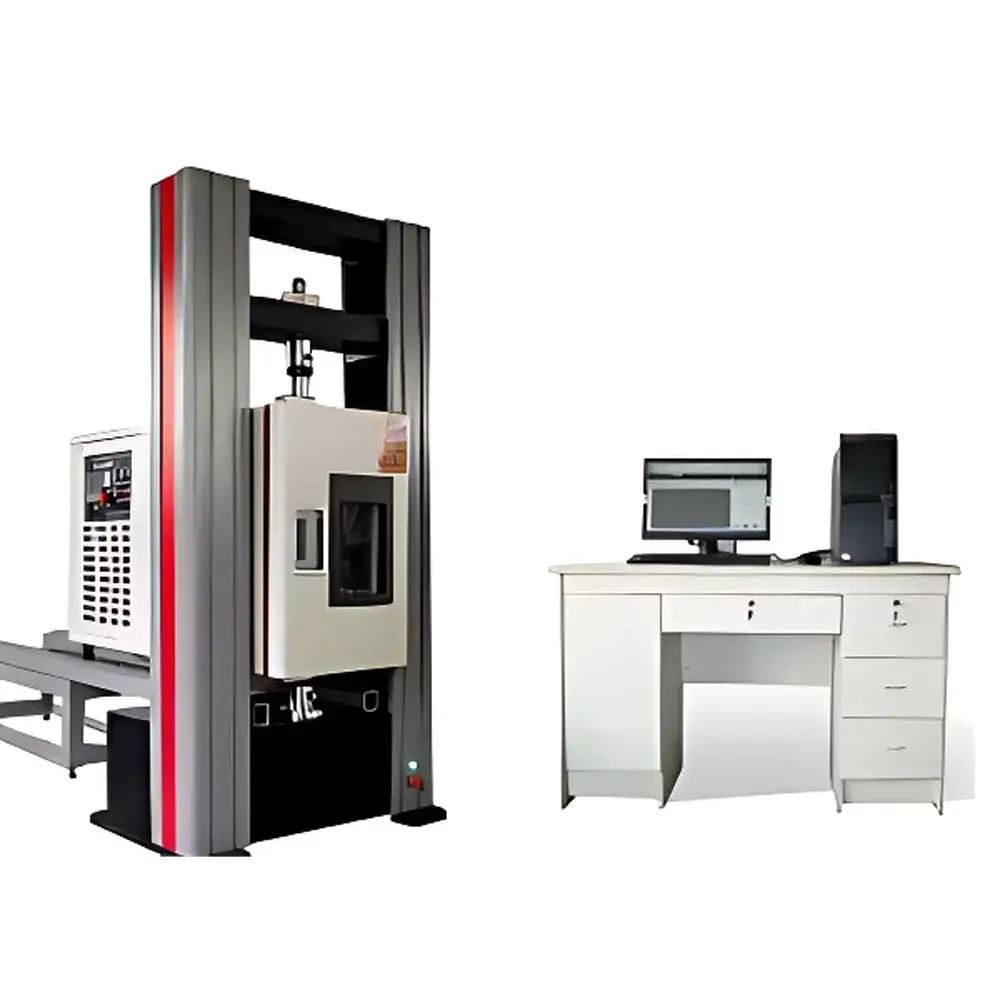
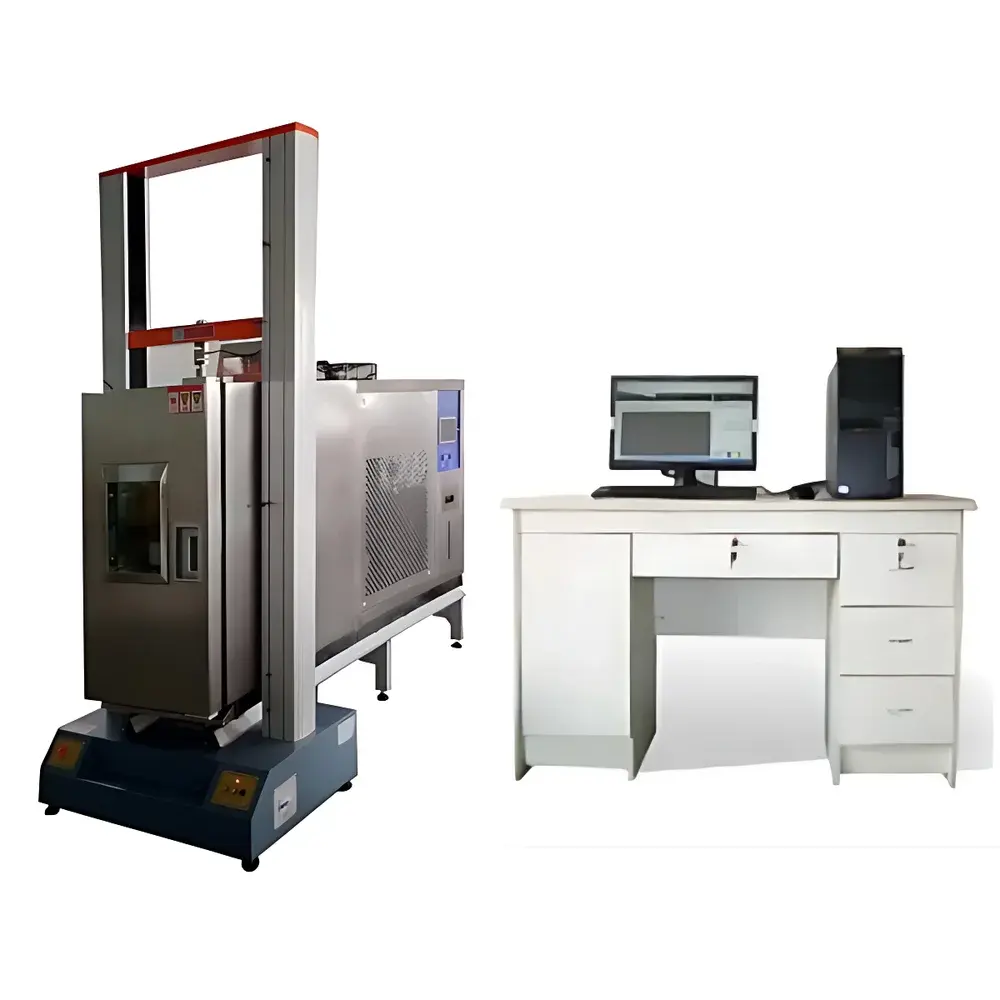
Tuofeng TFW-168 Microcomputer-Controlled High-Low Temperature Universal Testing Machine
| Brand | Tuofeng |
|---|---|
| Origin | Shanghai, China |
| Manufacturer Type | Direct Manufacturer |
| Product Origin | Domestic (China) |
| Model | TFW-168 |
| Instrument Type | Electromechanical Universal Testing Machine |
| Max Test Load | 5 kN / 10 kN / 20 kN / 50 kN / 100 kN |
| Accuracy Class | 0.5 |
| Force Measurement Range | 0.4–100% FS |
| Force Indication Error | ±0.5% of reading |
| Force Resolution | 1/500,000 of full scale, constant across entire range |
| Deformation Measurement Range | 0.2–100% FS |
| Deformation Error | ±0.5% of reading |
| Deformation Resolution | up to 1/300,000 |
| Displacement Error | ±0.5% of reading |
| Column Inner Width | 840 mm |
| Crosshead Travel (subject to environmental chamber dimensions) | 1000 mm |
| Host Dimensions (W×D×H) | 1250 × 560 × 2400 mm |
| Power Supply | AC 220 V / 50 Hz ±10%, 750 W |
| Host Weight | ~380 kg |
| Environmental Chamber Temp Range | −40 °C to +100 °C |
| Chamber Heating Power | 1500 W |
| Chamber Internal Dimensions (W×D×H) | ~360 × 300 × 500 mm |
| Chamber Control Method | Programmable PID temperature controller |
| Temperature Uniformity (100 mm axial) | ±2 °C |
| Ramp Time to +100 °C | <30 min |
| Thermal Equilibration Time | ≤5 min (both above and below 0 °C) |
Overview
The Tuofeng TFW-168 Microcomputer-Controlled High-Low Temperature Universal Testing Machine is a precision electromechanical system engineered for static mechanical characterization of metallic and non-metallic materials under controlled thermal conditions. It integrates a high-stiffness dual-column load frame with a programmable environmental chamber capable of stable operation from −40 °C to +100 °C. The system operates on the principle of servo-controlled displacement actuation, where force is measured via calibrated load cells and deformation via high-resolution extensometry or crosshead displacement transducers. This architecture enables compliant execution of tensile, compression, flexural, peel, tear, and shear tests per internationally recognized standards—including ASTM E8/E21, ISO 6892-1, GB/T 228.1, JIS Z 2241, and DIN 50125—under both ambient and thermally conditioned environments. Its modular design supports seamless integration of optional accessories such as video extensometers, pneumatic grips, and liquid nitrogen cooling modules, making it suitable for R&D validation, quality control, and regulatory-compliant material certification workflows.
Key Features
- High-accuracy force measurement system compliant with ISO 7500-1 Class 0.5, featuring 1/500,000 full-scale resolution and ±0.5% indication error across the full dynamic range.
- Programmable environmental chamber with stainless steel 304 exterior and 316 mirror-finish interior, insulated with high-density alumina-silica fiber for thermal stability and low leakage.
- Real-time PID temperature control with dual Pt100 sensors, achieving ±2 °C uniformity over a 100 mm axial zone and thermal equilibration in ≤5 minutes at all setpoints.
- Microcomputer-based control system running on Windows OS with deterministic data acquisition (≥1 kHz sampling), automatic parameter derivation (e.g., yield strength, modulus, elongation at break), and multi-curve plotting (stress–strain, load–displacement, time–temperature).
- Rigid structural frame with 840 mm column spacing and 1000 mm vertical travel, optimized for specimen lengths up to 500 mm while accommodating chamber insertion without mechanical interference.
- Comprehensive safety architecture including earth-leakage protection, overcurrent circuit breakers, emergency stop circuitry, and fail-safe chamber door interlocks.
Sample Compatibility & Compliance
The TFW-168 accommodates flat, round, and custom-shaped specimens—from thin polymer films (≥0.05 mm thick) to metallic rods (up to Ø25 mm) and composite laminates—using interchangeable grip systems (pneumatic, wedge, hydraulic, or screw-type). Specimen mounting is facilitated by standardized 50 mm-diameter top/bottom access ports in the chamber, fitted with retractable ceramic-fiber thermal shields to minimize heat loss during testing. The system meets mechanical and thermal traceability requirements for GLP and GMP environments, supporting audit-ready test reports with embedded metadata (operator ID, calibration certificate numbers, environmental log timestamps). All firmware and software comply with FDA 21 CFR Part 11 for electronic records and signatures when configured with user authentication and audit trail modules.
Software & Data Management
The proprietary Windows-based test control software provides intuitive workflow navigation, scriptable test sequences, and real-time parameter monitoring. It supports raw data export in CSV, Excel, and XML formats; generates PDF reports with customizable templates (including company logo, standard references, and statistical summaries); and maintains a secure local database with versioned test archives. Optional modules enable networked deployment across lab-wide instrument clusters, remote diagnostics via encrypted TLS connections, and integration with LIMS platforms via ASTM E1384-compliant APIs. All data handling adheres to ISO/IEC 17025 documentation integrity principles, with timestamped audit logs recording every user action, calibration event, and configuration change.
Applications
This system serves critical roles in polymer thermo-mechanical analysis (e.g., glass transition effects on tensile modulus), metal fatigue precursor evaluation at cryogenic temperatures, elastomer hysteresis quantification across service temperature ranges, and adhesive bond strength validation under thermal cycling. It is routinely deployed in petrochemical pipeline material qualification, aerospace composite certification (per AMS 2750E thermal profiling), medical device polymer aging studies (ISO 10993-12), and academic investigations into phase-dependent viscoelastic behavior. End users include QC laboratories in Tier-1 automotive suppliers, national metrology institutes performing inter-laboratory comparisons, and university materials science departments conducting NSF- or EU Horizon-funded fundamental mechanics research.
FAQ
What temperature ramp rates are achievable within the environmental chamber?
The chamber achieves a maximum heating rate of ≥3.3 °C/min (from −40 °C to +100 °C in <30 minutes) and a typical cooling rate of 1.5–2.0 °C/min using passive convection; active cooling options (e.g., LN₂ injection or cascade refrigeration) are available as factory-installed upgrades.
Can the system perform closed-loop strain-controlled tests at sub-zero temperatures?
Yes—when equipped with an attached video extensometer or clip-on mechanical extensometer rated for −40 °C operation, the controller executes displacement- or strain-rate-regulated tests with feedback update intervals ≤10 ms.
Is third-party calibration certification included with delivery?
Each unit ships with a factory calibration certificate traceable to NIM (National Institute of Metrology, China) for force, displacement, and temperature channels; ISO/IEC 17025-accredited external calibration services are available upon request.
How is thermal drift compensated during long-duration creep tests?
The system employs real-time thermal compensation algorithms that adjust zero-offset baselines using chamber wall temperature gradients and load cell thermal response models, reducing drift-induced error to <0.1% FS/hour at steady-state conditions.
Does the software support automated compliance with ASTM D638 or ISO 527-2?
Yes—the test method library includes preconfigured templates for these standards, automatically applying correct crosshead speeds, specimen geometry rules, and pass/fail criteria per clause; deviation alerts trigger on parameter violations before test initiation.
Related Products



