
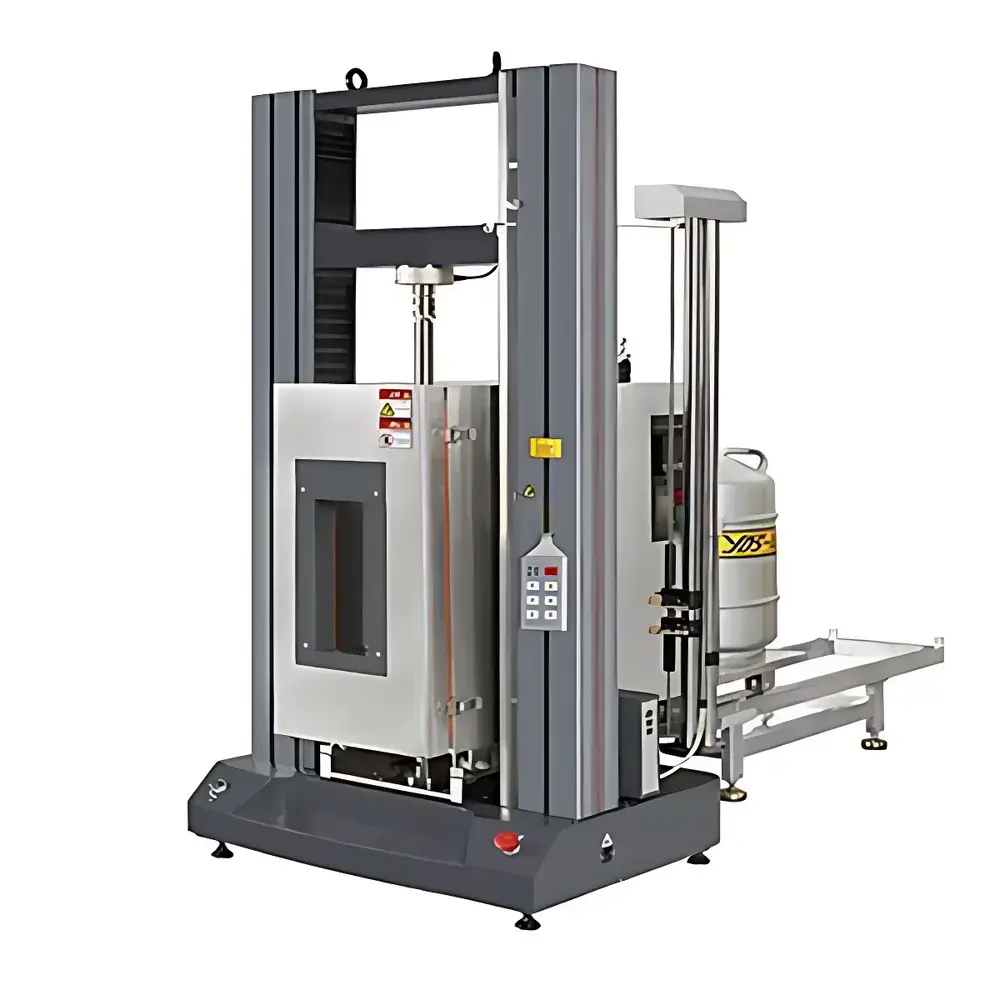
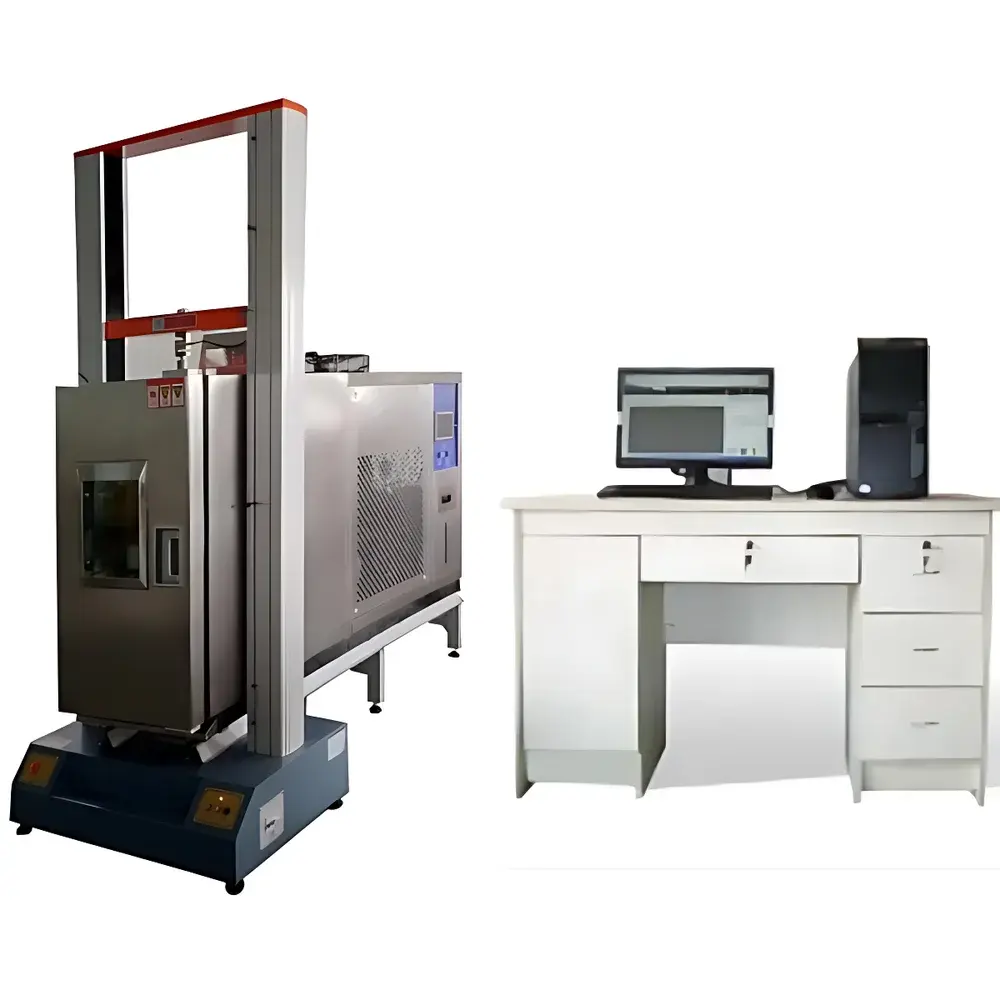
Tuofeng TFW-172 High-Low Temperature Universal Testing Machine
| Brand | Tuofeng |
|---|---|
| Origin | Shanghai, China |
| Manufacturer Type | Direct Manufacturer |
| Country of Origin | China |
| Model | TFW-172 |
| Instrument Type | Electromechanical Universal Testing Machine |
| Max Test Load | 5–100 kN (configurable) |
| Accuracy Class | 0.5 |
| Force Measurement Range | 0.4–100% FS |
| Force Indication Error | ±0.5% of reading |
| Force Resolution | 1/500,000 of full scale, unbroken range |
| Deformation Measurement Range | 0.2–100% FS |
| Deformation Error | ±0.5% of reading |
| Deformation Resolution | up to 1/300,000 |
| Displacement Error | ±0.5% of reading |
| Column Spacing (internal) | 840 mm |
| Crosshead Travel (standard) | 1000 mm |
| Host Dimensions | 1250 × 560 × 2400 mm |
| Power Supply | AC 220 V / 50 Hz ±10%, 750 W |
| Host Weight | ~380 kg |
| Environmental Chamber Temp Range | −40 °C to +100 °C |
| Chamber Heating Power | 1.5 kW |
| Chamber Internal Dimensions | 360 × 300 × 500 mm (W×D×H) |
| Temp Uniformity (longitudinal 100 mm) | ±2 °C |
| Temp Ramp Rate | ≤30 min to +100 °C from ambient |
| Temp Stabilization Time | ≤5 min (both above/below 0 °C) |
| Control System | Programmable PID with Pt100 sensors |
| Chamber Construction | 304 stainless steel exterior, 316 mirror-finish interior, ceramic fiber insulation |
| Safety Features | Leakage current protection, overcurrent circuit breaker |
Overview
The Tuofeng TFW-172 High-Low Temperature Universal Testing Machine is an electromechanical static testing system engineered for precise mechanical characterization of metallic and non-metallic materials across a broad thermal spectrum—from −40 °C to +100 °C. It integrates a high-rigidity dual-column load frame with a programmable environmental chamber, enabling controlled tensile, compression, flexural, tear, peel, and shear testing under thermally regulated conditions. The system operates on the principle of servo-controlled displacement actuation, where force is measured via high-stability load cells and deformation via precision extensometry or crosshead displacement transducers—both traceably calibrated to ISO 7500-1 and ASTM E4 standards. Its modular architecture supports seamless transition between ambient and conditioned testing, eliminating manual reconfiguration while maintaining metrological integrity throughout the full test envelope.
Key Features
- 0.5-class accuracy per ISO 7500-1 and ASTM E4, verified across the entire force range (5–100 kN configurable models)
- Force resolution of 1 part in 500,000 of full scale, maintained without range switching—critical for low-force initiation detection and high-force stability
- High-resolution deformation measurement (up to 1/300,000 FS), compatible with clip-on extensometers per ISO 9513 for true strain quantification
- Programmable environmental chamber with ±2 °C temperature uniformity over 100 mm longitudinal zone, validated per ASTM E145 and ISO 16750-4
- Integrated dual-zone thermal control: compressor-based cooling + NiCr alloy heating (1.5 kW), achieving <30 min ramp to +100 °C and ≤5 min stabilization at target setpoints
- Chamber construction using 304 stainless steel housing and electropolished 316 mirror-finish interior minimizes thermal drift and corrosion susceptibility during humid or saline exposure
- Full compliance with safety requirements: integrated RCD protection, thermal overload cutoff, emergency stop with hardware interlock, and CE-marked electrical subsystems
Sample Compatibility & Compliance
The TFW-172 accommodates standard specimen geometries per ASTM E8/E21 (tensile bars), ASTM D638/D790 (plastics), ISO 6892-1 (metal tensile), ISO 178 (flexure), and ISO 1133 (melt flow index auxiliary fixtures). Its 840 mm column spacing and 1000 mm crosshead travel support extended specimens—including coated wires, composite laminates, elastomeric seals, and ceramic substrates—while the 50 mm-diameter top/bottom apertures allow unobstructed loading axis alignment through the chamber. All mechanical and thermal performance metrics are documented per GLP-compliant calibration records, traceable to NIM (China National Institute of Metrology). The system satisfies mandatory requirements for ISO/IEC 17025-accredited laboratories and supports audit-ready data generation aligned with FDA 21 CFR Part 11 (electronic records/signatures) when configured with optional audit-trail-enabled software.
Software & Data Management
The Windows-based control and analysis suite provides real-time closed-loop control (force, displacement, strain, or temperature rate modes), automated parameter extraction (UTS, yield strength, modulus, elongation at break, fracture toughness indices), and multi-curve overlay with statistical comparison. Raw data streams are saved in vendor-neutral .csv and .txt formats; proprietary .tdf files retain full metadata—including environmental chamber logs, sensor diagnostics, and operator annotations. Software modules support custom test method scripting (per ASTM D3039 or ISO 527-2), batch report generation with company-branded templates, and direct export to LIMS via ODBC. Optional add-ons include GMP-compliant electronic signature workflows, time-stamped audit trails, and encrypted database storage compliant with ISO 27001 information security controls.
Applications
This system serves as a primary mechanical validation platform in R&D and QA/QC environments requiring thermally coupled mechanical response data. Typical use cases include: evaluating low-temperature embrittlement of aerospace aluminum alloys (per AMS 2369); assessing high-temperature creep resistance of polymer matrix composites in turbine housings; characterizing thermal expansion mismatch in solder joint interconnects (IPC-9701); validating cold-flow behavior of pharmaceutical tablet binders below 0 °C; and determining cryogenic fracture toughness of pipeline steels per API RP 5L3. It is routinely deployed in national metrology institutes, tier-1 automotive suppliers, semiconductor packaging labs, and academic mechanics research groups conducting thermo-mechanical constitutive modeling.
FAQ
What standards does the TFW-172 comply with for force calibration?
It conforms to ISO 7500-1:2018 (static calibration of uniaxial testing machines) and ASTM E4-23 (load verification of testing machines), with certificate-of-conformance issued for each delivered unit.
Can the environmental chamber be upgraded for wider temperature ranges?
The base configuration supports −40 °C to +100 °C; extended-range variants (−70 °C to +200 °C) are available as factory-installed options with enhanced refrigeration and insulation packages.
Is third-party calibration support available?
Yes—Tuofeng maintains partnerships with CNAS-accredited calibration providers in APAC, EU, and North America; on-site verification and ISO/IEC 17025-compliant recalibration services are offered under annual service contracts.
How is thermal gradient managed across the gauge length during testing?
The chamber’s dual Pt100 sensor array (top/bottom) enables active zone compensation; combined with 316 mirror-finish internal surfaces and low-conductivity ceramic fiber insulation, axial gradients are limited to ≤1.2 °C/100 mm at steady state.
Does the system support closed-loop strain control with extensometers at sub-zero temperatures?
Yes—when equipped with cryo-rated clip-on extensometers (e.g., MTS 632.12F-24 or Zwick Roell Xforce P-Cryo), the controller maintains strain-rate fidelity down to −40 °C with ≤0.5% deviation from setpoint.



