
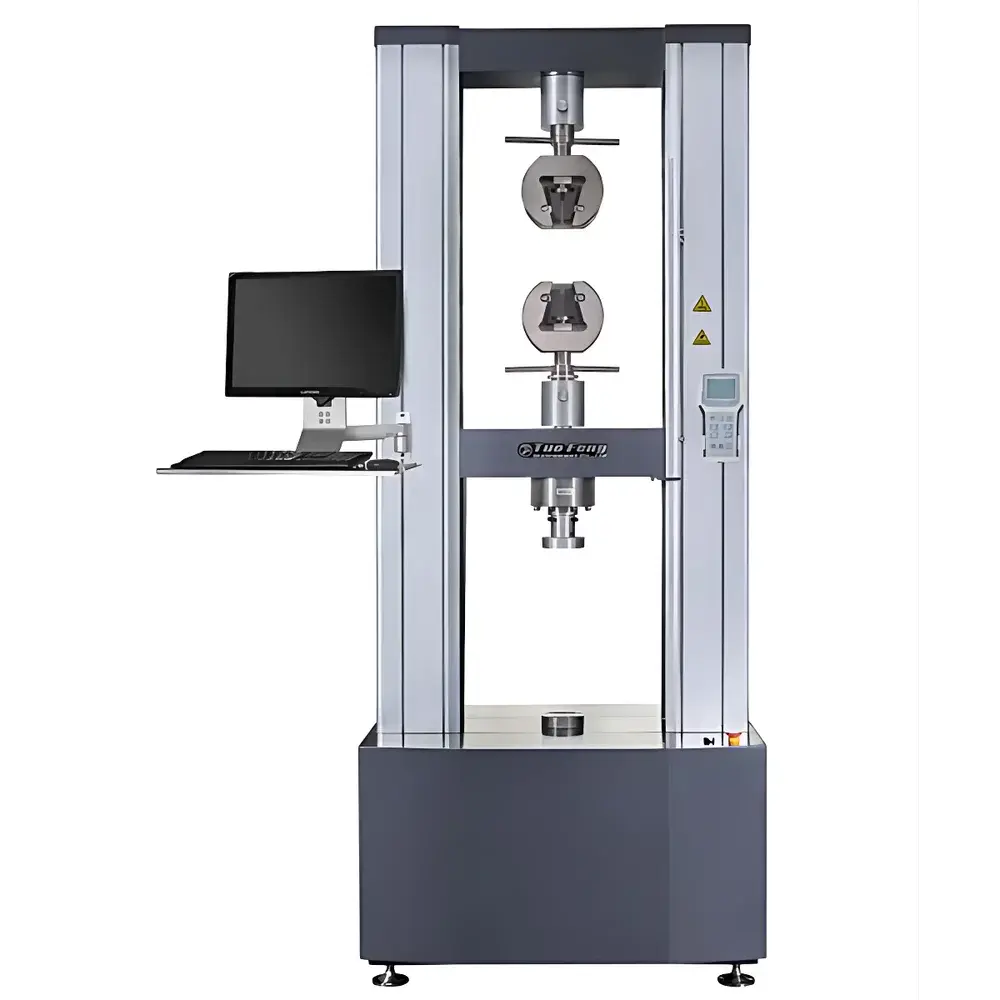
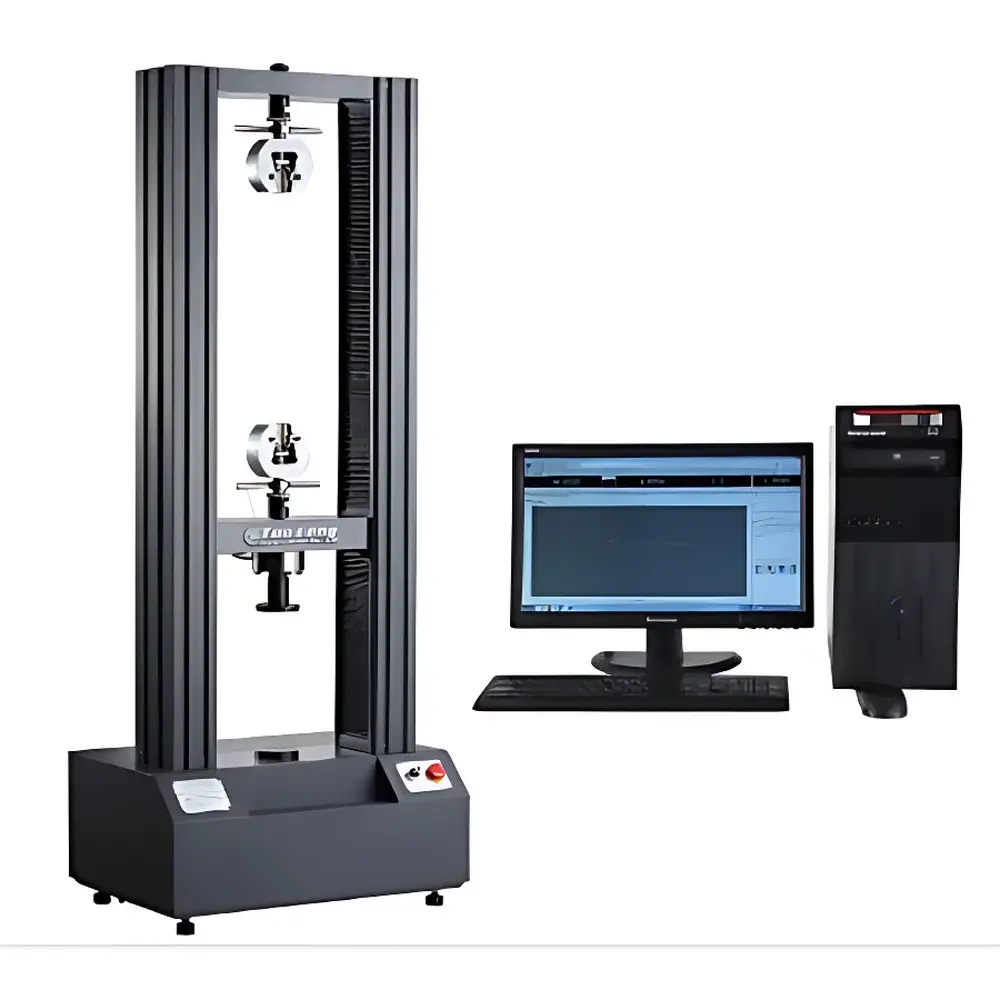
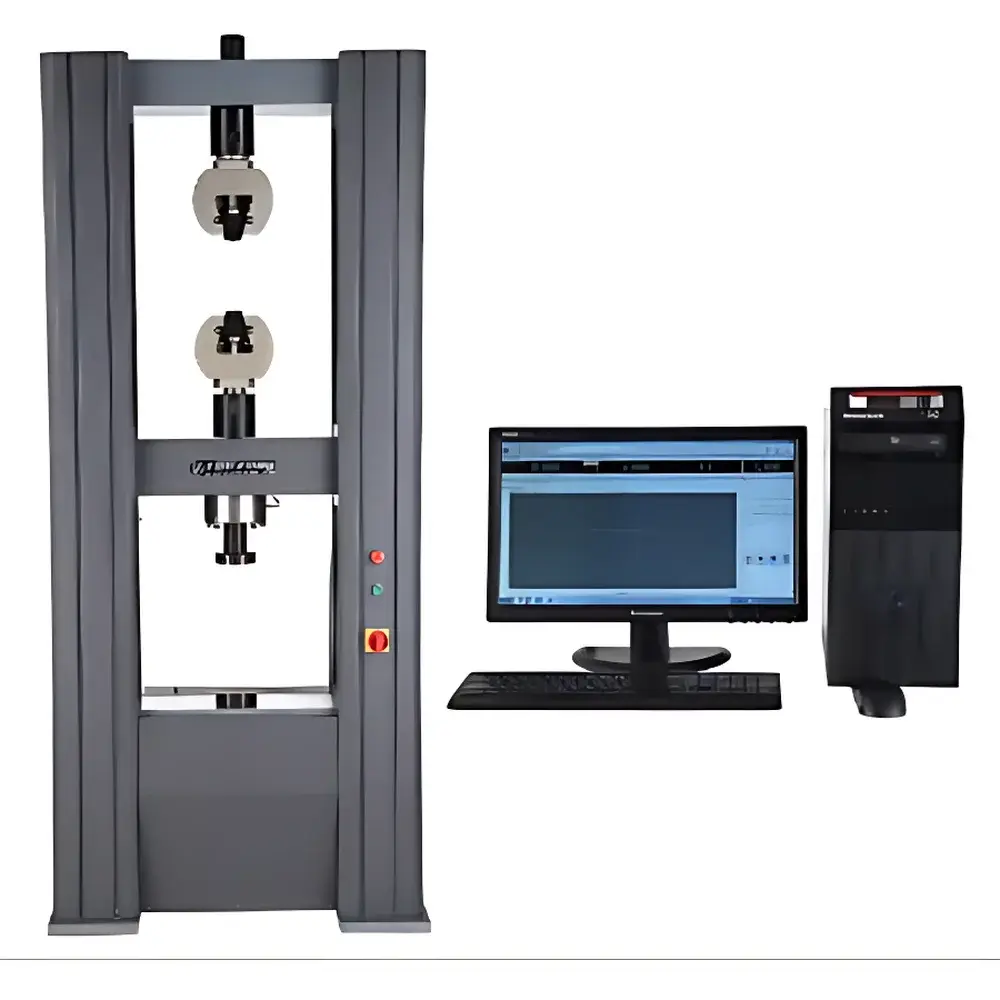
Tuofeng TFW-178 Microcomputer-Controlled Electronic Universal Testing Machine
| Brand | Tuofeng |
|---|---|
| Origin | Shanghai, China |
| Manufacturer Type | OEM Manufacturer |
| Instrument Type | Electromechanical Universal Testing Machine |
| Model | TFW-178 |
| Max Test Load | 178 kN (customizable range: 5–200 kN) |
| Accuracy Class | ISO 7500-1 Class 0.5 |
| Effective Force Range | 0.2–100% of full scale |
| Force Measurement Accuracy | ±0.005% of reading |
| Resolution | 1 part in ±500,000 full-scale load (no range switching, constant resolution) |
| Drive System | Imported servo motor with precision worm-gear reducer |
| Lead Screw | High-precision preloaded ball screw |
| Effective Test Width | 600 mm (expandable) |
| Stroke | 800 mm (extendable) |
| Speed Range | 0.001–500 mm/min (infinitely variable) |
| Displacement Measurement | Optical encoder, accuracy ±0.005% of reading |
| Strain Measurement | Optional extensometer or large-deformation sensor, accuracy ±0.005% of reading |
| Safety Protection | Electronic limit switches, emergency stop, overload cutoff (>110% FS), dual-speed motorized crosshead control |
| Software | Windows-based, multilingual (EN/ZH-T/ZH-S), ASTM/ISO/GB/JIS/DIN/BS compliant, FDA 21 CFR Part 11 ready (audit trail & user access control optional) |
Overview
The Tuofeng TFW-178 Microcomputer-Controlled Electronic Universal Testing Machine is a high-precision electromechanical system engineered for static mechanical property characterization of metallic, polymeric, composite, and ceramic materials under uniaxial loading conditions. Based on the fundamental principles of Hooke’s law and stress–strain continuum mechanics, the machine applies controlled tensile, compressive, flexural, shear, tear, peel, and puncture loads via a closed-loop servo-controlled actuation system. Its force measurement architecture complies with ISO 7500-1:2018 (Class 0.5) and JJG 475–2008 verification standards, ensuring traceable metrological integrity across the full dynamic range. Designed for laboratory-grade reproducibility and long-term stability, the TFW-178 integrates a rigid C-frame structure, preloaded ball-screw transmission, and high-resolution optical displacement feedback to minimize compliance error and thermal drift—critical for accurate modulus determination and yield point detection in R&D and QA/QC environments.
Key Features
- Class 0.5 force accuracy per ISO 7500-1, with constant 1/500,000 full-scale resolution—no auto-ranging or step-change artifacts
- Wide speed range (0.001–500 mm/min), enabling quasi-static creep testing and high-rate impact simulation protocols
- Dual-speed motorized crosshead with programmable return logic: rapid repositioning post-test without manual intervention
- Triple-layer safety architecture: hardware-based electronic limits, software-defined overload cutoff (>110% FS), and physical emergency stop circuitry
- Modular transducer interface supporting ASTM E83-compliant extensometers and large-deformation sensors for strain measurement down to 0.001% accuracy
- Thermally stable load cell housing and low-hysteresis force train design to minimize zero drift during extended hold tests (e.g., stress relaxation, load maintenance)
Sample Compatibility & Compliance
The TFW-178 accommodates specimens from thin films (<0.1 mm thickness) to structural beams (up to 200 mm wide × 50 mm thick), using customizable jaw geometries (pneumatic, wedge, hydraulic, or thread-type) and environmental fixtures (optional ambient chamber, liquid bath, or elevated-temperature stage). It supports standardized test methods including ASTM D638 (tensile plastics), ASTM D3039 (composite tension), ISO 6892-1 (metal tensile), GB/T 228.1 (Chinese metal standard), JIS Z2241, DIN 50125, and BS EN 10002-1. All mechanical and software subsystems conform to ISO 17025 requirements for accredited testing laboratories; optional validation packages include IQ/OQ documentation and GMP-aligned audit trails compliant with FDA 21 CFR Part 11 when configured with role-based user management and electronic signature modules.
Software & Data Management
The embedded Windows-based control and analysis platform delivers full test lifecycle management—from method definition and real-time parameter monitoring to automated report generation and database archiving. Users configure test profiles using intuitive wizards for common standards (e.g., “ASTM D638 Type I – 50 mm/min”), or define custom control modes: constant load, constant strain rate, load hold, displacement ramp, or cyclic loading with dwell segments. Real-time plotting includes synchronized stress–strain, load–time, load–displacement, and strain–time curves, with on-the-fly calculation of tensile strength, yield offset (0.2%), elongation at break, Young’s modulus, compressive strength, flexural modulus, tear propagation resistance, and peel adhesion energy. Data export supports CSV, XML, and PDF formats; raw data files retain full metadata (operator ID, calibration date, environmental conditions) for GLP/GMP traceability. Remote diagnostics and firmware updates are supported via secure HTTPS channel.
Applications
This system serves as a core analytical tool across multiple regulated and research-intensive sectors. In aerospace, it validates carbon-fiber laminate interlaminar shear strength (ASTM D2344) and titanium alloy fatigue crack growth thresholds. In medical device manufacturing, it verifies tensile integrity of suture materials (ISO 10993-12) and compression resilience of hydrogel wound dressings. Automotive suppliers use it for rubber bushing hysteresis evaluation (ISO 4664) and battery electrode coating adhesion (ASTM D3359). Academic labs apply it to novel biomaterials (e.g., 3D-printed scaffolds), nanocomposites, and shape-memory alloys requiring precise modulus tracking over temperature sweeps. Its modularity also supports powder metallurgy green strength testing (ASTM B925) and geosynthetic tensile performance per GRI-GM13.
FAQ
Does the TFW-178 support ASTM E4 calibration verification?
Yes—the system includes built-in calibration routines aligned with ASTM E4 procedures, and its load cell certification documentation meets NIST-traceable requirements for third-party accreditation.
Can the software generate reports compliant with ISO/IEC 17025 documentation requirements?
Absolutely—reports embed instrument ID, calibration due dates, operator credentials, environmental logs, and digital signatures; optional audit trail module records all data modifications with timestamps and user attribution.
Is it possible to integrate the TFW-178 into an existing LIMS or MES environment?
Yes—via OPC UA or TCP/IP API, the controller supports bidirectional data exchange with laboratory information management systems (LIMS) and manufacturing execution systems (MES) for automated result ingestion and workflow triggering.
What is the typical lead time for custom fixture design and validation?
Standard fixtures ship with the system; application-specific fixtures (e.g., ASTM D6252 peel jigs or ISO 148-1 Charpy impact adapters) require 3–6 weeks for engineering review, FEA validation, and mechanical testing per ISO 14253-1.
Does Tuofeng provide installation qualification (IQ) and operational qualification (OQ) documentation?
Yes—factory-certified IQ/OQ protocols are included with every unit; on-site qualification support is available globally through authorized service partners certified to ISO 9001:2015 and ISO/IEC 17025:2017 standards.



