
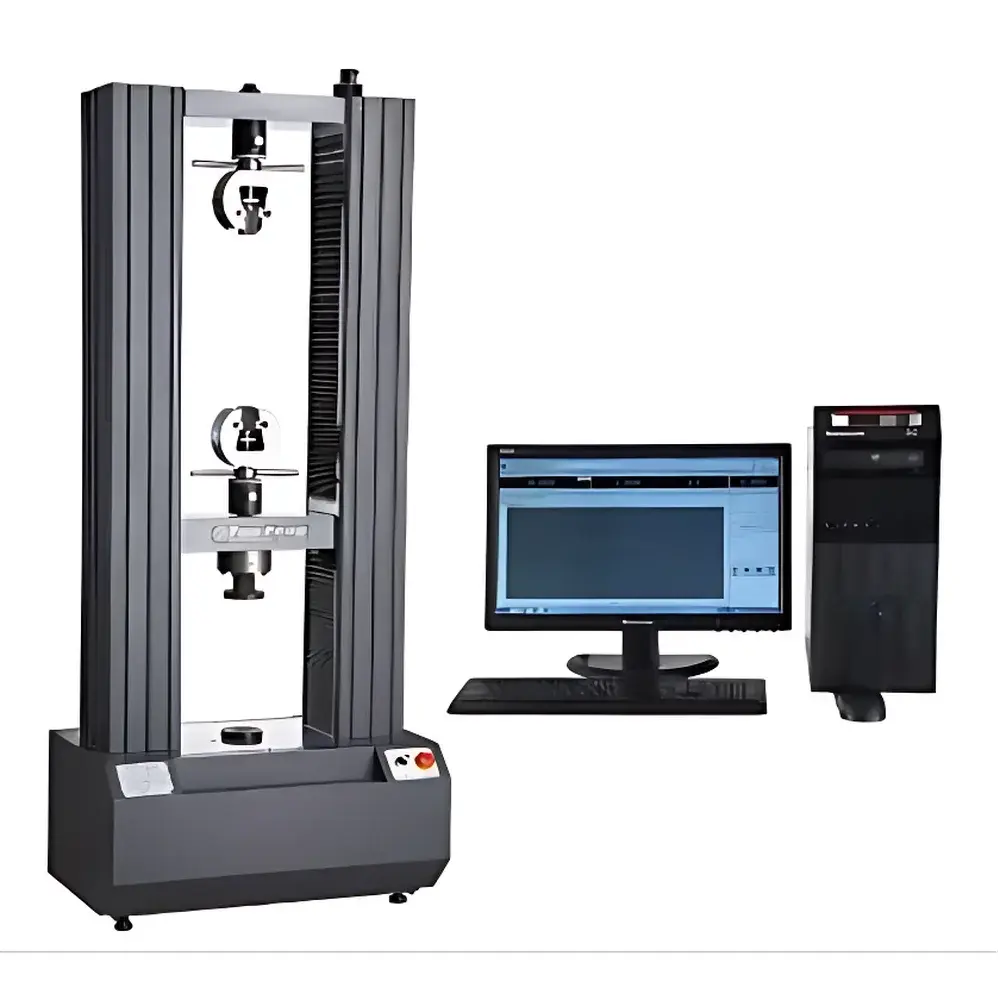
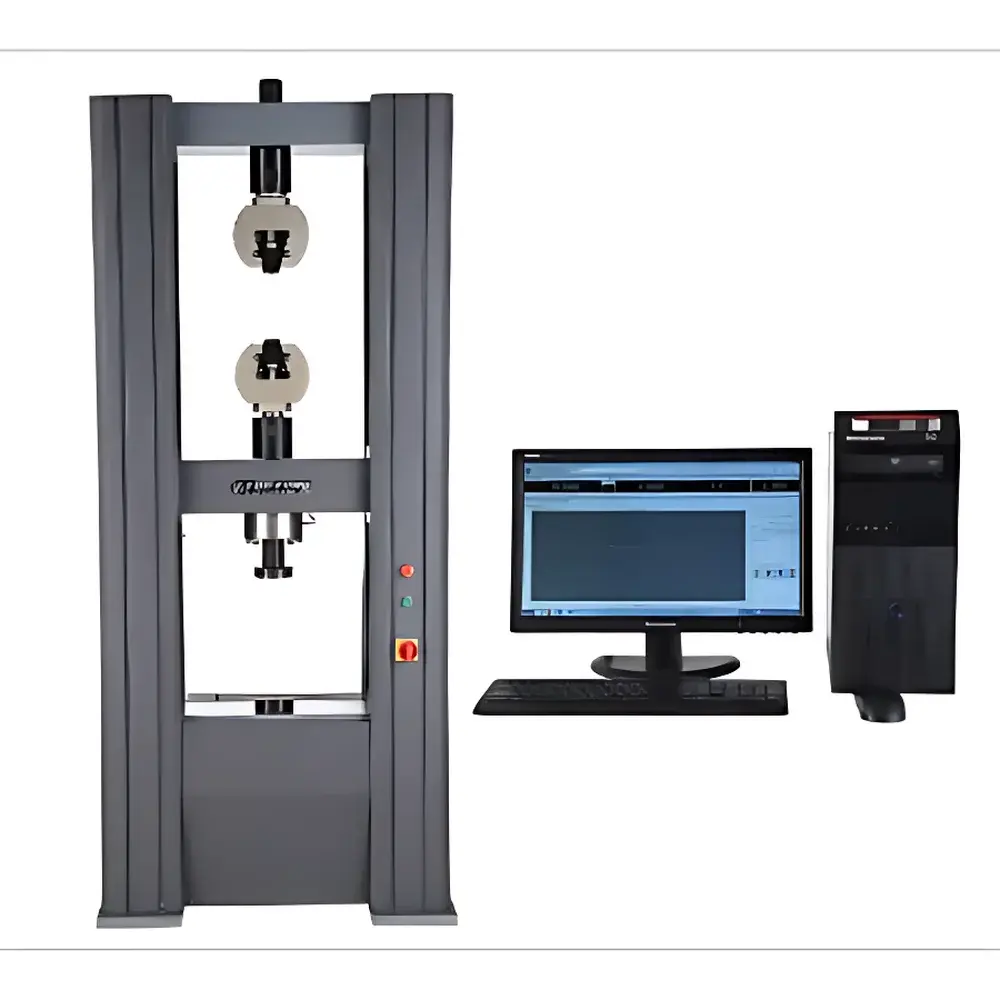
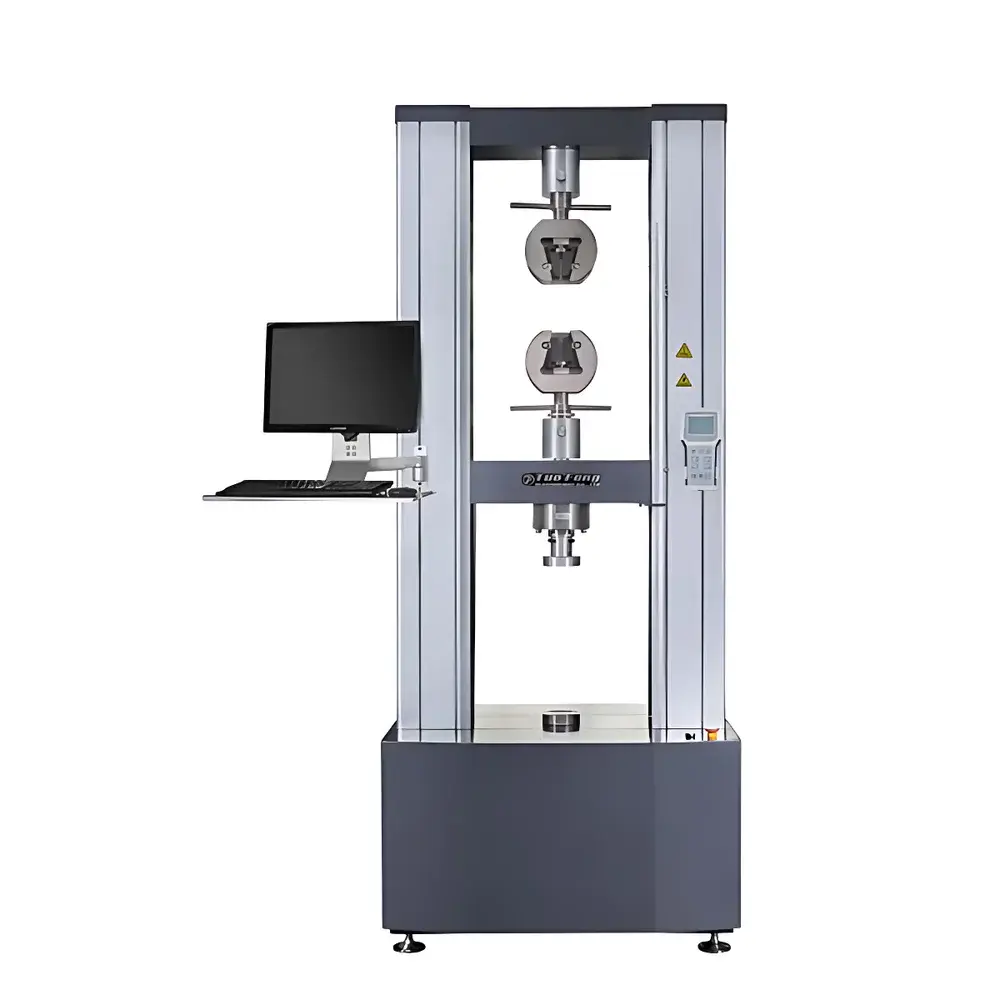
Tuofeng TFW-180 Fiber Optic Cable Computer-Controlled Universal Testing Machine
| Brand | Tuofeng |
|---|---|
| Origin | Shanghai, China |
| Manufacturer Type | Direct Manufacturer |
| Instrument Type | Electromechanical Universal Testing Machine |
| Model | TFW-180 |
| Compliance | GB/T 16491–2008, JJG 475–2008, ASTM E4, ISO 7500-1, DIN 51221, JIS B 7721 |
| Max Test Load | 180 kN |
| Accuracy Class | 0.5 |
| Effective Force Range | 0.2–100% of full scale |
| Force Measurement Accuracy | ±0.005% of reading |
| Resolution | 1/500,000 full-scale code (fixed resolution, no range switching) |
| Drive System | Imported servo motor with precision worm-gear reducer |
| Lead Screw | High-precision preloaded ball screw |
| Effective Test Width | 600 mm (customizable) |
| Stroke | 800 mm (extendable) |
| Speed Range | 0.001–500 mm/min (infinitely variable) |
| Displacement Measurement | Optical encoder, accuracy ±0.005% of reading |
| Strain Measurement | Optional extensometer or large-deformation sensor, accuracy ±0.005% of reading |
| Safety Protection | Electronic limit switches, emergency stop button, overload protection (10% over capacity), dual-speed motorized crosshead control |
Overview
The Tuofeng TFW-180 Fiber Optic Cable Computer-Controlled Universal Testing Machine is a high-precision electromechanical testing system engineered for the mechanical characterization of optical fibers, fiber optic cables, cable sheaths, strength members (e.g., aramid yarns, steel wires), and associated composite structures. Built upon a rigid, low-deflection frame and driven by a calibrated servo-motor–worm-reducer–ball-screw actuation architecture, the system delivers traceable force application and displacement control per ISO 7500-1 (Class 0.5) and GB/T 16491–2008 standards. Its design prioritizes metrological integrity in tensile, peel, crush resistance, and elongation-to-failure measurements—critical for verifying compliance with ITU-T G.652, IEC 60794-1-2, Telcordia GR-20, and MIL-DTL-24643 specifications. The machine operates under closed-loop digital control, enabling reproducible load–displacement profiling across sub-mN to 180 kN ranges without manual range switching.
Key Features
- Full-scale force resolution of 1 part in 500,000, maintained uniformly across 0.2–100% of capacity—eliminating range-dependent uncertainty.
- High-rigidity crosshead assembly with preloaded ball screws and dual-speed motorized vertical positioning (fast approach + fine adjustment), minimizing thermal drift and mechanical hysteresis.
- Integrated electronic overload cutoff (10% above rated capacity), hardware-based emergency stop, and programmable software limits—ensuring operator and specimen safety during high-force cable break tests.
- Modular fixture interface supporting standardized grips for fiber ribbons, loose-tube cables, armored cables, and jacketed single-mode/dual-core assemblies per IEC 60794-1-21 Annex A.
- Real-time synchronization of force, displacement, and optional strain signals at ≥1 kHz sampling rate—enabling accurate determination of modulus, yield point, and post-yield behavior.
Sample Compatibility & Compliance
The TFW-180 accommodates specimens from bare 125 µm optical fibers to 32-mm-diameter armored trunk cables. Standard configurations include pneumatic vise grips for coated fibers, wedge-type clamps for strength members, and custom mandrel fixtures for bend-loss sensitivity testing. All test methods align with internationally recognized protocols: tensile strength per IEC 60794-1-2 E1, crush resistance per E3, impact resistance per E4, and temperature-dependent elongation per E11. The system supports GLP-compliant audit trails when configured with FDA 21 CFR Part 11–enabled software modules—including electronic signatures, immutable data logs, and revision-controlled method templates.
Software & Data Management
The Windows-based testing software provides multi-language UI (English, Simplified/Traditional Chinese), SI/imperial unit conversion, and real-time display of up to four synchronized curves: force–time, force–displacement, stress–strain, and extension–time. It supports ASTM D638, ISO 527, and GB/T 1040-compliant automated calculations for tensile strength, elongation at break, Young’s modulus, yield stress, and secant modulus. Raw data exports to CSV, XML, or PDF report formats; batch analysis tools enable statistical comparison of up to 50 specimens per run. The software architecture includes built-in calibration certificate management, instrument configuration history, and version-tracked firmware/software updates—fully compatible with enterprise LIMS integration via OPC UA or TCP/IP APIs.
Applications
- Qualification testing of fiber optic cable tensile strength and elongation limits during manufacturing process validation.
- Evaluation of jacket adhesion strength between buffer tubes and outer sheaths under controlled strain rates.
- Verification of mechanical robustness for aerial, duct, and direct-buried cable designs per Telcordia GR-20 Core requirements.
- Research into creep behavior of polymer-based cable components at elevated temperatures (when paired with environmental chamber).
- Failure mode analysis of splice closures and connectorized assemblies under axial pull-out loads.
FAQ
Does the TFW-180 meet international calibration traceability requirements?
Yes—the force transducer is calibrated against NIST-traceable deadweight standards, and displacement measurement is verified using laser interferometry per ISO 9513. Calibration certificates include uncertainty budgets compliant with ISO/IEC 17025.
Can the system perform cyclic loading tests on fiber optic cables?
Yes—via programmable step-and-hold sequences or sinusoidal waveforms with user-defined frequency, amplitude, and dwell time, supporting fatigue life assessment per IEC 60794-1-21 Clause 8.
Is third-party verification available for regulatory submissions?
Yes—Tuofeng partners with CNAS-accredited laboratories to provide independent verification reports aligned with FDA, CE, and CCC certification pathways.
What maintenance intervals are recommended for long-term accuracy?
A biannual mechanical inspection and annual force transducer recalibration are recommended; all scheduled tasks are logged automatically within the software maintenance module.
How is data integrity ensured during extended unattended testing?
The system implements automatic checksum validation, redundant local SSD storage, and configurable auto-backup to network drives—preventing data loss during power interruption or software reset.



