
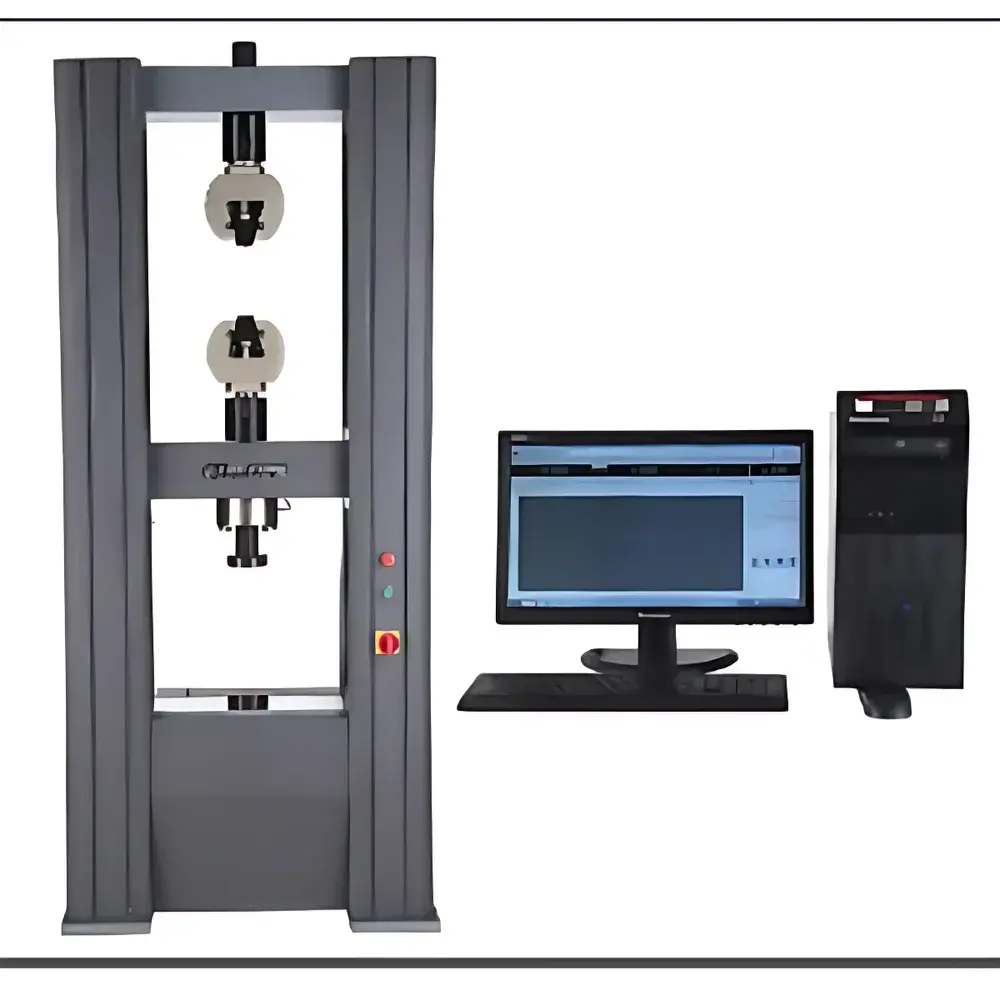
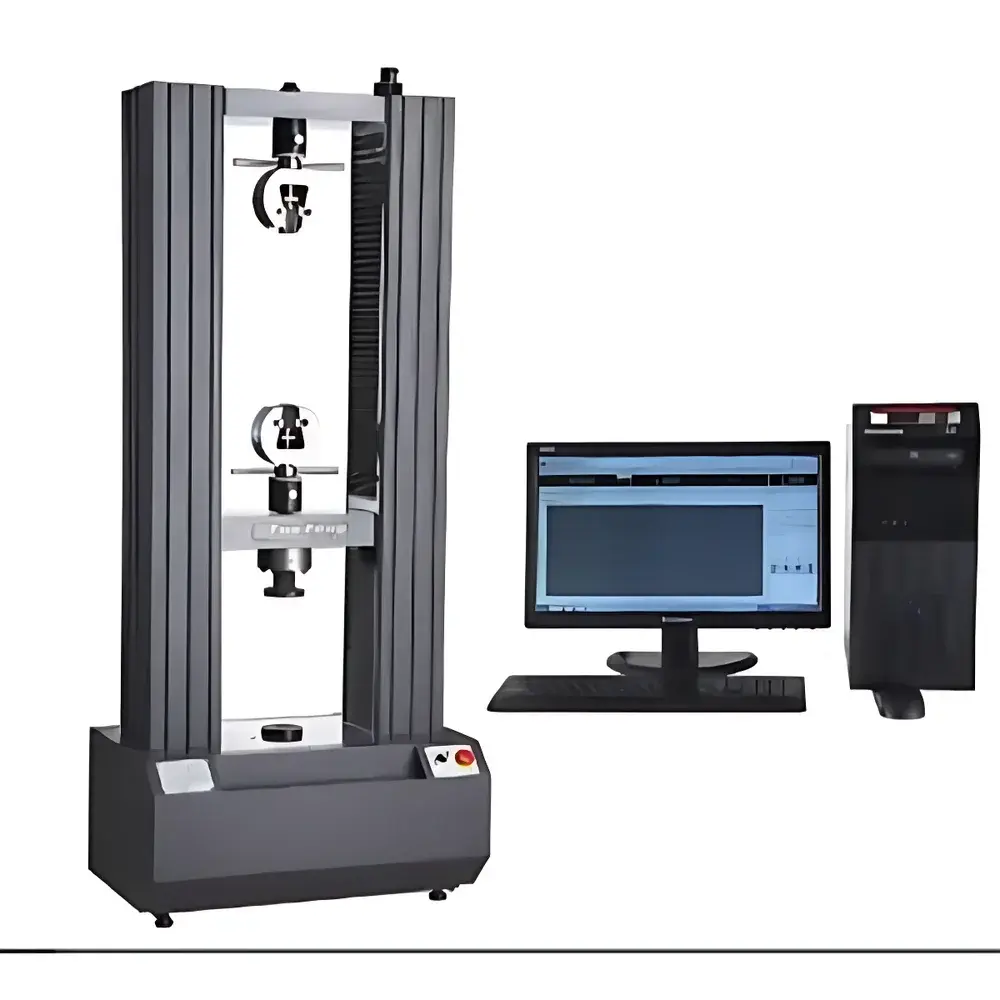
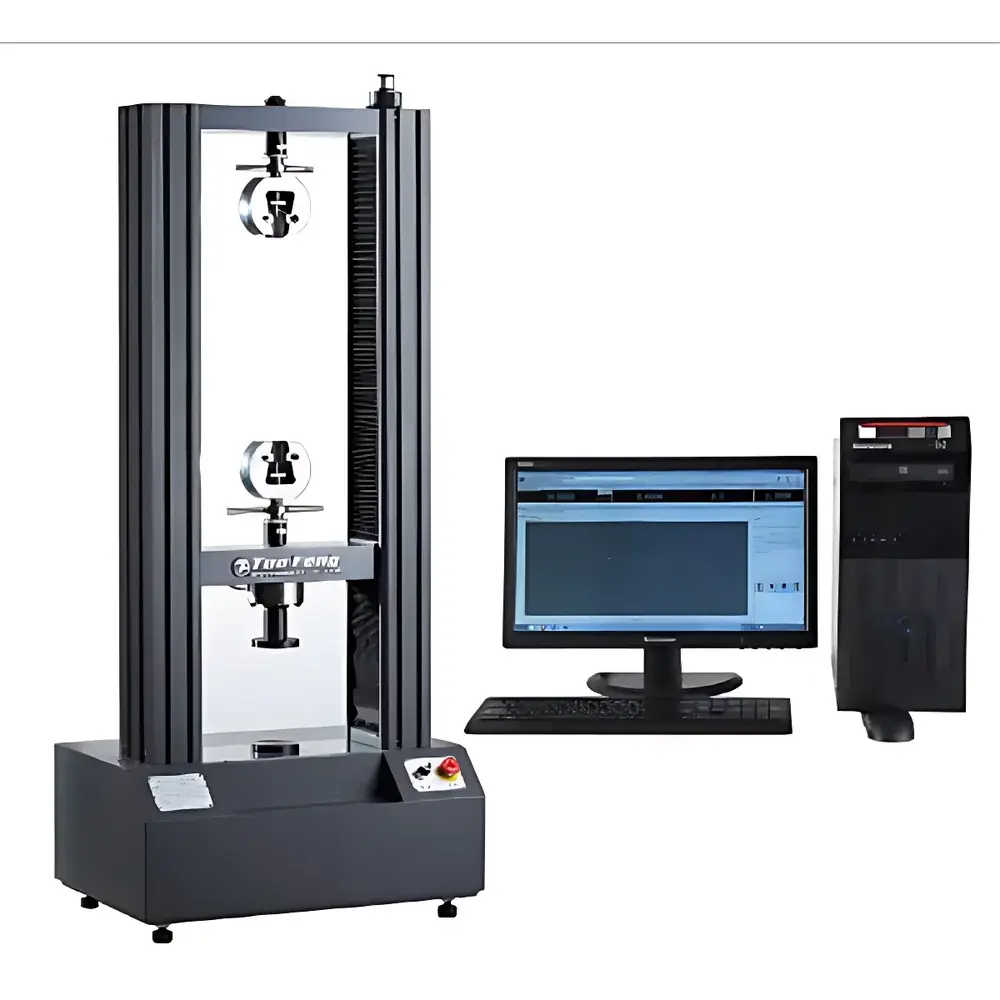
Tuofeng TFW-192 Universal Testing Machine for Rock Bolt and Anchor Cable Testing
| Brand | Tuofeng |
|---|---|
| Origin | Shanghai, China |
| Manufacturer Type | Direct Manufacturer |
| Instrument Type | Electromechanical Universal Testing Machine |
| Model | TFW-192 |
| Compliance | GB/T 16491–2008, JJG 475–2008 |
| Max Test Load | 192 kN |
| Accuracy Class | 0.5 |
| Effective Force Range | 0.2%–100% FS |
| Force Measurement Accuracy | ±0.005% of reading |
| Resolution | 1 part in ±500,000 full-scale (single-range, no auto-ranging) |
| Drive System | Imported servo motor with precision worm-gear reducer |
| Lead Screw | High-precision preloaded ball screw |
| Effective Test Width | 600 mm (customizable) |
| Stroke | 800 mm (extendable) |
| Speed Range | 0.001–500 mm/min (infinitely variable) |
| Displacement Measurement | Optical encoder |
| Displacement Accuracy | ±0.005% of reading |
| Strain Measurement | Optional extensometer or large-deformation sensor (ASTM E83 / ISO 9513 compliant) |
| Strain Accuracy | ±0.005% of reading |
| Safety Protection | Dual electronic limit switches, emergency stop button, overload protection (>110% FS), automatic return after test |
| Crosshead Control | Dual-speed (fast/slow) motorized adjustment with jog function |
| Software | Windows-based, multi-language (EN/ZH-TR/ZH-S), configurable control modes (load-controlled, displacement-controlled, time-controlled), real-time multi-curve display (F-t, F-δ, δ-t, σ-ε, F-ΔL), automatic parameter calculation per ASTM D638/D695/D790/D1876/ISO 6892-1/GB/T 228.1, batch comparison, statistical reporting, audit-trail-ready data export (CSV/PDF), GLP-compliant metadata logging |
Overview
The Tuofeng TFW-192 Universal Testing Machine is a high-precision electromechanical system engineered for the mechanical characterization of rock bolts, anchor cables, and related geotechnical reinforcement components under controlled tensile, compressive, and flexural loading conditions. Built upon a rigid, dual-column load frame with preloaded ball-screw actuation and closed-loop servo control, the system adheres to the metrological requirements of GB/T 16491–2008 and JJG 475–2008—Chinese national standards aligned with ISO 7500-1 and ASTM E4 for force verification and system classification. Its 0.5-class accuracy rating ensures traceable, repeatable measurement across the full dynamic range (0.2%–100% of 192 kN full scale), making it suitable for R&D validation, quality assurance, and third-party certification testing in mining, civil infrastructure, tunneling, and slope stabilization applications.
Key Features
- High-stiffness structural frame with 600 mm effective test width and 800 mm vertical stroke—optimized for long-length anchor assemblies and full-scale cable specimens.
- Imported servo motor coupled with a low-backlash worm-gear reducer and precision-ground ball screw—delivering smooth, vibration-damped motion and exceptional positional repeatability.
- Force transducer calibrated to ±0.005% of reading, supported by 500,000-count A/D resolution and single-range architecture—eliminating range-switching errors and maintaining consistent sensitivity across all loads.
- Dual-mode displacement feedback: high-resolution optical encoder (±0.005% accuracy) for gross motion; optional ASTM E83–compliant extensometers for localized strain measurement on bolt shanks or grouted interfaces.
- Integrated safety architecture: redundant electronic limit switches, hardware-triggered emergency stop, over-load cut-off at 110% FS, and programmable return-to-home sequence post-test.
- Motorized crosshead with independent fast/slow speed control and momentary jog capability—enabling precise specimen alignment and rapid setup between test series.
Sample Compatibility & Compliance
The TFW-192 accommodates standardized and custom anchor configurations—including fully threaded steel bolts (M16–M36), resin-grouted tendons, stranded wire anchors, and FRP-reinforced composites—via modular jaw systems and adjustable support fixtures. It supports testing protocols defined in GB/T 30914 (rock bolt anchorage performance), ASTM D4435 (rock bolt pullout), ISO 10211 (anchor system qualification), and EN 10219 (cold-formed hollow sections). All force, displacement, and time data are timestamped and logged with instrument ID, operator credentials, calibration status, and environmental metadata—meeting baseline requirements for GLP documentation and internal QA audits. While not natively 21 CFR Part 11–certified, the software architecture permits integration with validated electronic signature modules and audit-trail extensions upon customer specification.
Software & Data Management
Tuofeng’s proprietary Windows-based testing platform provides deterministic real-time control across multiple operational modes: load-controlled ramping, displacement-controlled creep hold, and time-scheduled cyclic sequencing. The interface supports simultaneous display of up to four synchronized curves—including force vs. time, stress vs. strain, displacement vs. time, and load vs. extension—with user-defined scaling, cursors, and derivative overlays. All calculated mechanical properties—tensile strength, yield offset (0.2% proof stress), modulus of elasticity, elongation at break, ultimate bond strength, and residual load retention—are derived per ISO 6892-1 Annex B and GB/T 228.1 Clause 11 algorithms. Test reports export to PDF or CSV with embedded metadata (calibration due date, transducer serial number, environmental temperature/humidity if externally logged). Data files include immutable headers, version-stamped software build IDs, and optional digital signatures—facilitating traceability in regulatory submissions and inter-laboratory round-robin studies.
Applications
- Quantification of axial load–displacement response for grouted rock bolt systems under static and quasi-static tension.
- Evaluation of bond-slip behavior between steel tendon and cementitious grout under controlled displacement rates (0.01–10 mm/min).
- Verification of anchorage capacity per mine safety regulations (e.g., China’s AQ 2006–2020) and international best practices (e.g., Australian Standard AS 4100).
- Comparative fatigue life assessment of alternative anchor materials (e.g., stainless steel vs. galvanized carbon steel vs. GFRP) under repeated loading cycles.
- Validation of installation torque–tension correlations for torque-controlled bolting procedures used in underground development.
- Support of ISO/IEC 17025–accredited testing services for third-party geotechnical certification bodies.
FAQ
Does the TFW-192 comply with ASTM E4 force calibration requirements?
Yes—the system’s force measurement subsystem is verified against Class AA deadweight standards per ASTM E4 and maintains traceability to NIM (National Institute of Metrology, China) through annual third-party calibration certificates.
Can the machine perform sustained load tests for creep analysis?
Yes—software-defined hold segments allow precise load or displacement maintenance for durations up to 999 hours, with continuous monitoring of drift and relaxation behavior.
Is strain measurement included as standard equipment?
No—extensometers (clip-on or non-contact) are optional accessories selected based on gauge length and accuracy class (e.g., ISO 9513 Class 1 or Class 0.5); they integrate seamlessly via dedicated analog input channels.
What level of software validation support is provided for regulated environments?
Tuofeng supplies IQ/OQ documentation templates, configuration change logs, and raw data integrity verification tools; full 21 CFR Part 11 compliance requires site-specific UAT and signature module deployment.
Are custom test fixtures available for non-standard anchor geometries?
Yes—Tuofeng’s engineering team collaborates with clients to design and validate application-specific grips, reaction frames, and alignment jigs per ISO 26203-2 mechanical interface specifications.



