
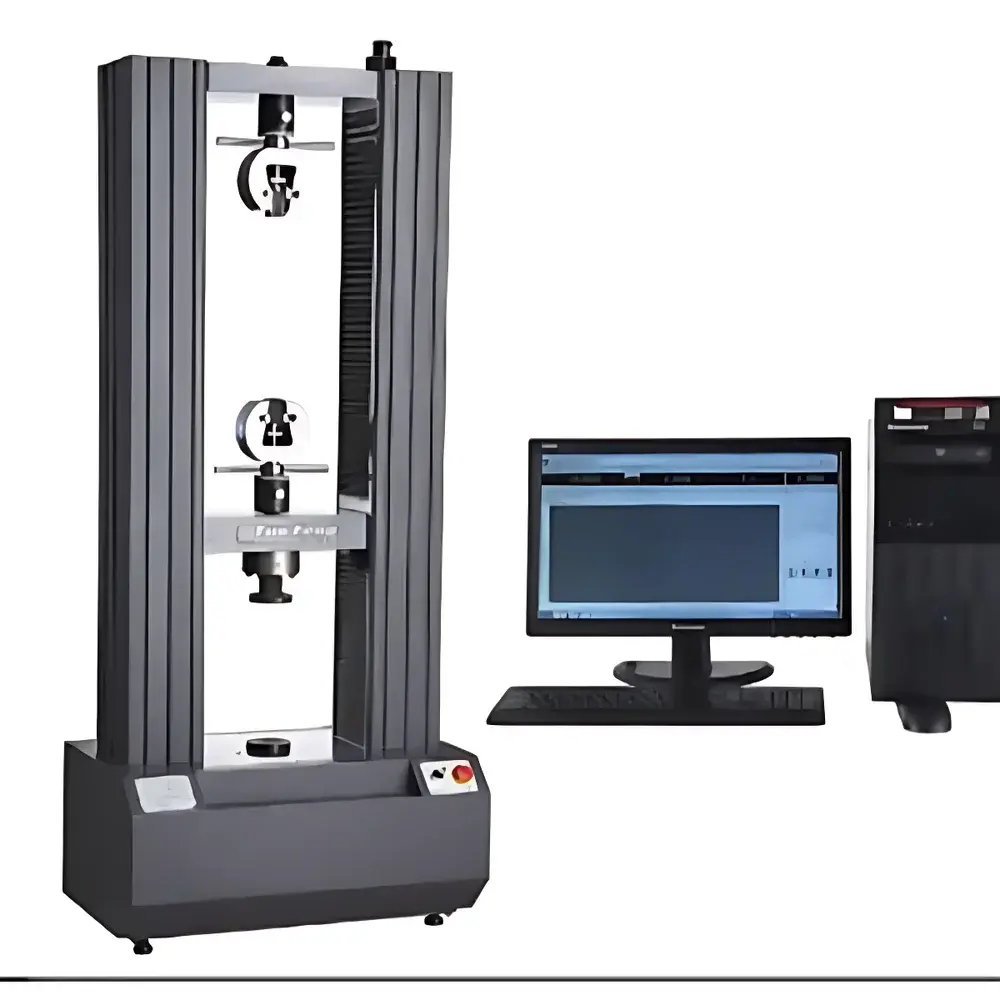
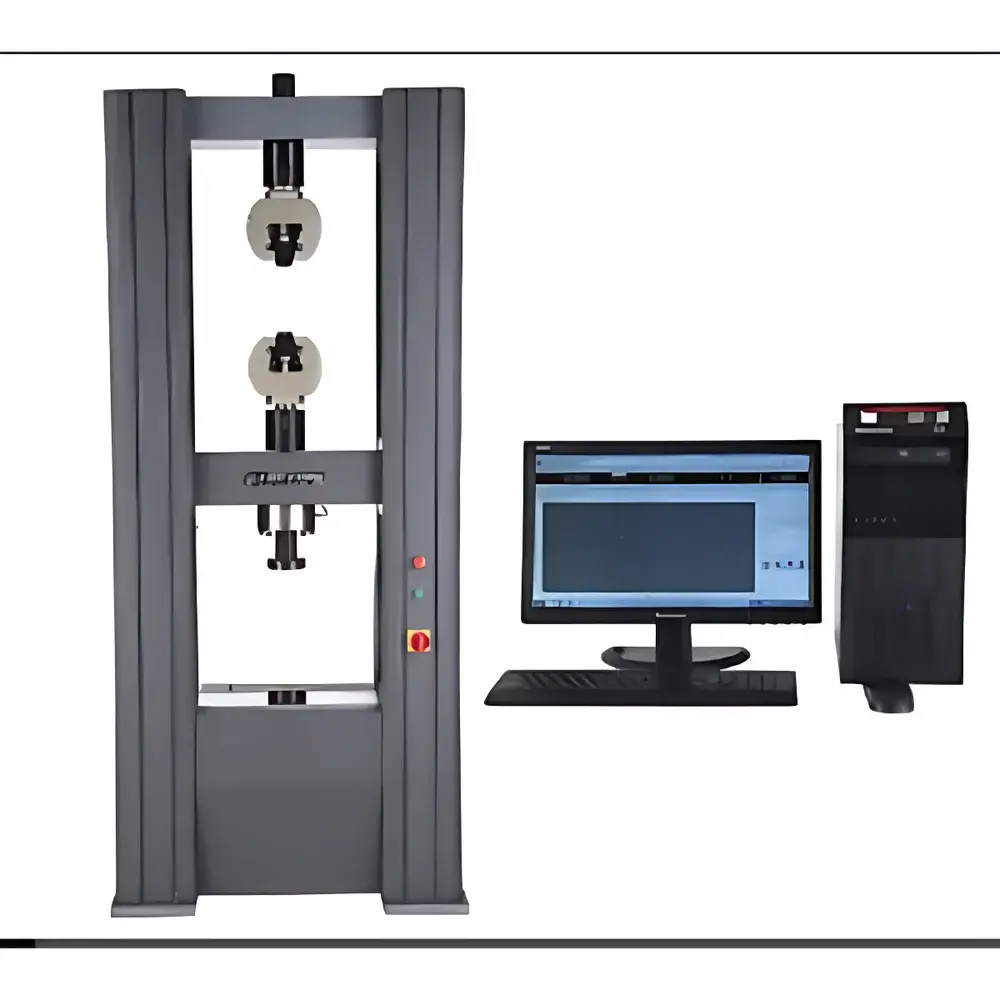
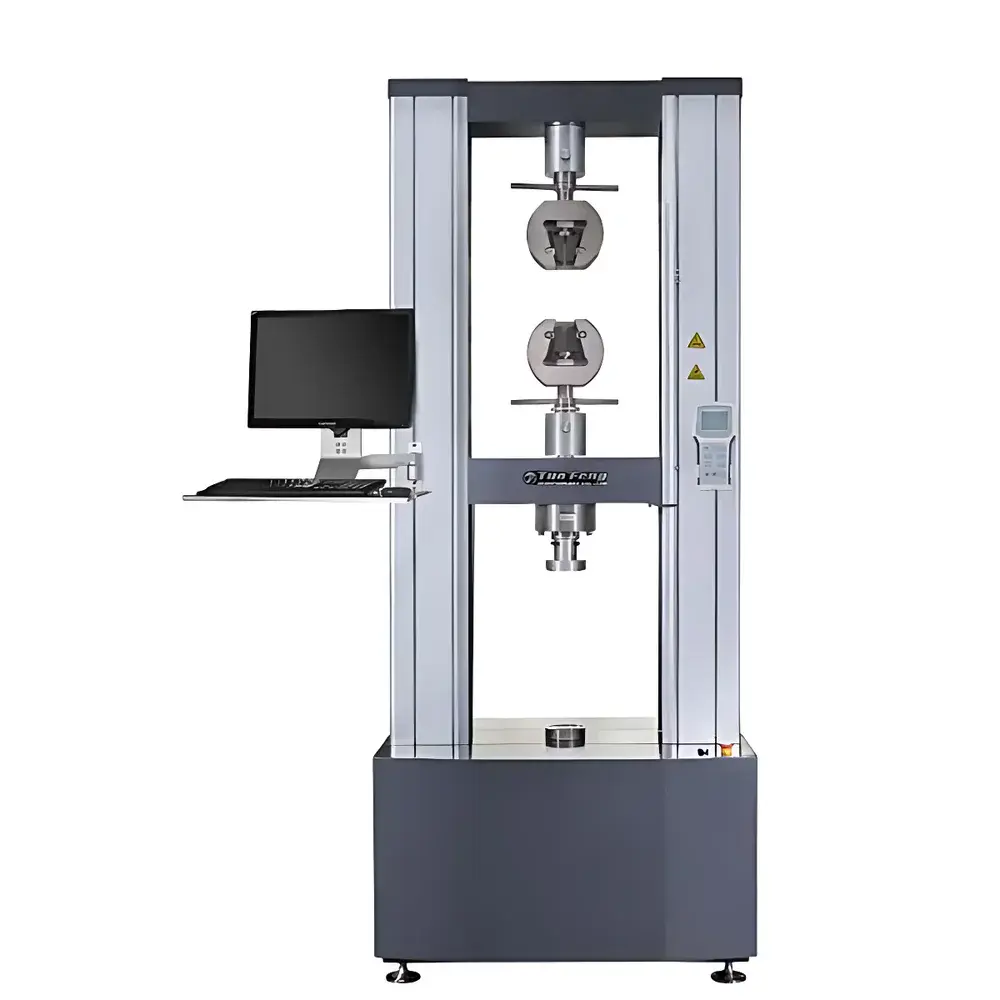
Tuofeng TFW-194 Dual-Axis Rubber Tensile Testing Machine
| Brand | Tuofeng |
|---|---|
| Origin | Shanghai, China |
| Manufacturer Type | Direct Manufacturer |
| Instrument Type | Electromechanical Universal Testing Machine |
| Model | TFW-194 |
| Compliance | GB/T 16491–2008, JJG 475–2008 |
| Standards Supported | ASTM D412, ISO 37, ISO 527, DIN 53504, GB/T 528, JIS K6251 |
| Max Test Load | 100 kN |
| Accuracy Class | 0.5 |
| Effective Force Range | 0.2%–100% FS |
| Force Measurement Accuracy | ±0.005% of reading |
| Resolution | 1/500,000 full-scale (fixed, no range switching) |
| Drive System | Imported servo motor + precision worm gear reducer |
| Lead Screw | High-precision preloaded ball screw |
| Effective Test Width | 600 mm (customizable) |
| Stroke | 800 mm (extendable) |
| Speed Range | 0.001–500 mm/min (infinitely variable) |
| Displacement Measurement | Optical encoder |
| Displacement Accuracy | ±0.005% of reading |
| Strain Measurement | Optional clip-on extensometer or large-deformation video extensometer |
| Safety Protection | Electronic limit switches, emergency stop, overload protection (10% over capacity), dual-speed motorized crosshead return |
| Software | Windows-based, multi-language (EN/CN/TC), compliant with GLP audit trail requirements, supports 21 CFR Part 11 optional modules |
Overview
The Tuofeng TFW-194 Dual-Axis Rubber Tensile Testing Machine is a high-precision electromechanical universal testing system engineered specifically for the mechanical characterization of elastomeric materials—including natural rubber, synthetic rubbers (e.g., SBR, EPDM, NBR), thermoplastic elastomers (TPEs), and rubber–reinforced composites—under biaxial and uniaxial loading conditions. Unlike conventional single-axis tensile testers, the TFW-194 integrates synchronized dual-actuator control architecture to enable true planar stretching (e.g., equi-biaxial, strip biaxial, or asymmetric extension), replicating real-world deformation states encountered in tire treads, seals, medical tubing, and flexible packaging. Its measurement principle relies on closed-loop force feedback via high-stability load cells and real-time position tracking via optical encoders, ensuring traceable, repeatable data acquisition per ISO 17025–accredited laboratory practices. The system complies fully with GB/T 16491–2008 and JJG 475–2008 national metrological verification protocols, and supports method execution across ASTM D412 (tension testing of vulcanized rubber), ISO 37 (rubber—determination of tensile stress–strain properties), and ISO 527 (plastics—determination of tensile properties).
Key Features
- 0.5-class accuracy certified force measurement system with ±0.005% reading uncertainty and 1/500,000 internal resolution—no range switching required across the full 0.2–100% FS operating envelope.
- Dual-actuator synchronization capability enabling programmable biaxial strain paths (e.g., constant aspect ratio, radial expansion, or sequential axis loading) with sub-millisecond inter-axis timing alignment.
- High-rigidity frame with preloaded ball screws and imported servo-driven motion control, delivering stable velocity control from 0.001 to 500 mm/min under full-load conditions.
- Modular extensometry support: compatibility with both contact-type clip-on extensometers (for modulus and yield determination) and non-contact digital image correlation (DIC) systems (optional) for full-field strain mapping.
- Integrated safety architecture including hardware-based electronic limit switches, redundant emergency stop circuitry, and automatic overload cutoff at 110% of rated capacity.
- Motorized crosshead with dual-speed (fast/slow) positioning and programmable return-to-start functionality—reducing operator intervention and improving throughput consistency.
Sample Compatibility & Compliance
The TFW-194 accommodates standard dumbbell-shaped specimens (ISO 37 Type 1, ASTM D412 Die C), ring specimens (ISO 37 Type 3), and custom geometries up to 600 mm wide and 800 mm stroke depth. Fixture adaptability includes pneumatic grips, wedge-action clamps, and specialized rubber-specific jaw linings to prevent slippage and premature specimen failure. All test methods are fully aligned with international regulatory expectations: data integrity meets ALCOA+ principles; software audit trails comply with FDA 21 CFR Part 11 when configured with electronic signature and role-based access controls; and calibration documentation adheres to ISO/IEC 17025 requirements for accredited testing laboratories. Routine verification follows JJG 475–2008 procedures using certified reference load cells and displacement standards.
Software & Data Management
Tuofeng’s proprietary TESTMaster™ software (v5.2+) runs natively on Windows 10/11 and provides full method definition, real-time curve visualization (force–time, stress–strain, displacement–time), and automated parameter extraction—including tensile strength, elongation at break, modulus at 100%/300%, tear strength (per ASTM D624), peel adhesion (ASTM D903), and compression set simulation profiles. Data export supports CSV, XML, and PDF formats; batch reporting enables statistical summaries (mean, SD, min/max) across up to 999 test records. The system logs all user actions, method changes, and calibration events in an immutable audit trail—essential for GLP/GMP environments. Optional validation packages include IQ/OQ documentation templates and 21 CFR Part 11 configuration guides.
Applications
- Characterization of vulcanization effects on tensile modulus and hysteresis loss in tire compound development.
- Quality control of rubber seals and gaskets for automotive and aerospace fluid systems—evaluating compression set resistance and stress relaxation behavior.
- Validation of biocompatibility-related mechanical stability in silicone elastomer medical devices (ISO 10993–12).
- R&D of sustainable elastomers—including bio-based polyisoprene and guayule-derived rubbers—under standardized biaxial fatigue protocols.
- Failure analysis of rubber–metal bonded assemblies via peel and shear testing with synchronized load–displacement monitoring.
- Supporting ISO 22856-compliant dynamic mechanical analysis (DMA) correlation studies through controlled strain-rate sweeps.
FAQ
Does the TFW-194 support true biaxial testing, or only sequential uniaxial tests?
The TFW-194 employs two independently controllable actuators with synchronized motion profiling—enabling genuine simultaneous biaxial loading (e.g., equi-biaxial stretch), not merely alternating axis activation.
Is the software validated for regulated pharmaceutical or medical device testing?
Yes—when deployed with 21 CFR Part 11 add-on modules and configured per client SOPs, TESTMaster™ supports audit-ready electronic records in FDA-regulated environments.
Can I integrate third-party extensometers or DIC systems?
The system provides analog voltage (±10 V) and digital TTL trigger interfaces compatible with leading OEM extensometers (e.g., MTS, Zwick) and open-format DIC controllers (e.g., LaVision, Correlated Solutions).
What maintenance intervals are recommended for long-term accuracy retention?
Annual recalibration against NIST-traceable standards is advised; quarterly verification using certified reference loads and displacement gauges is recommended for GLP labs.
Is technical support available outside China, and in English?
Tuofeng maintains authorized service partners in Germany, USA, and Singapore, offering remote diagnostics, on-site calibration, and English-language engineering support under global warranty terms.



