
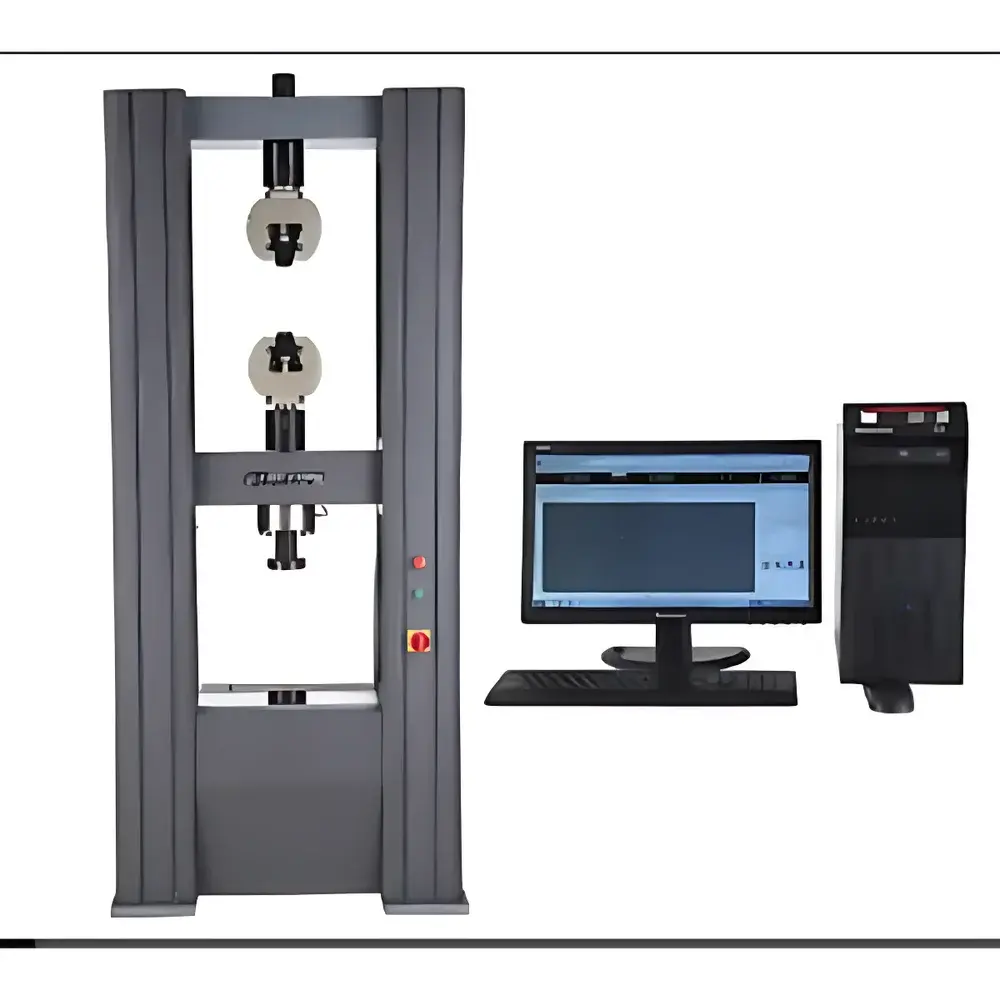
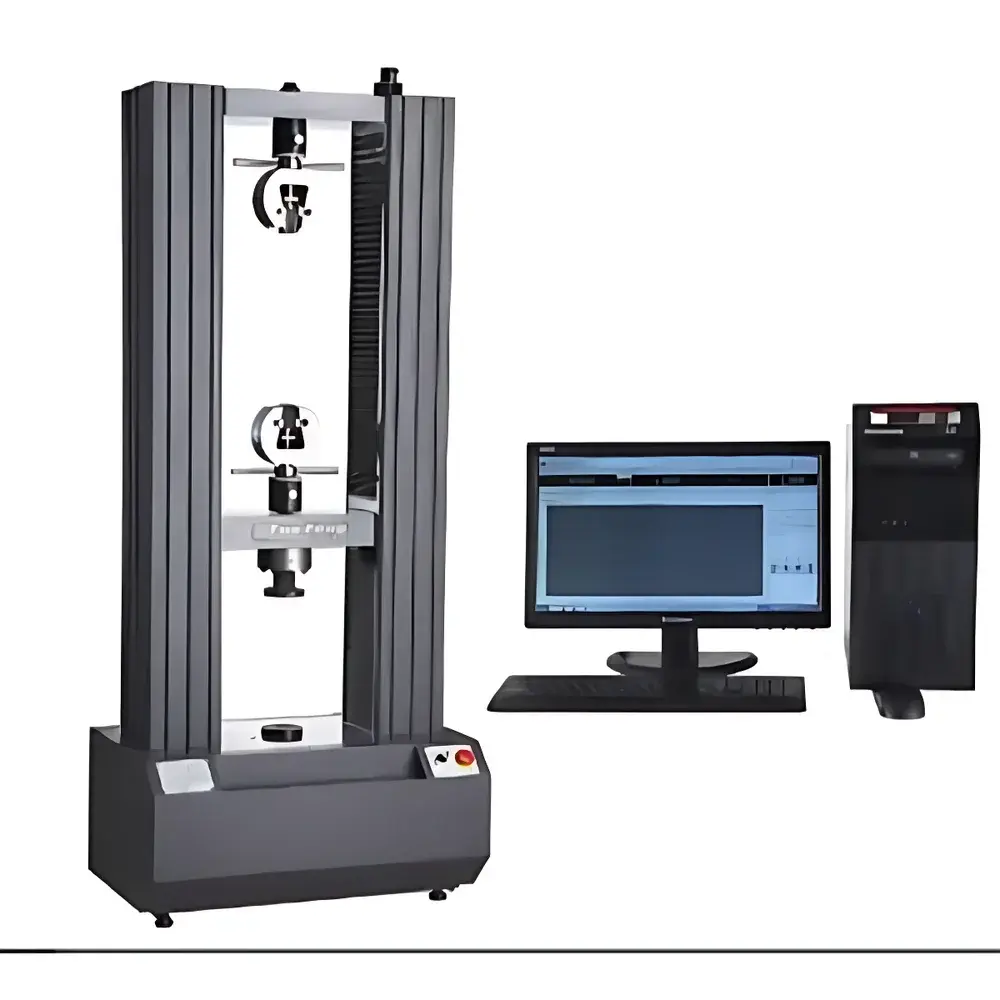
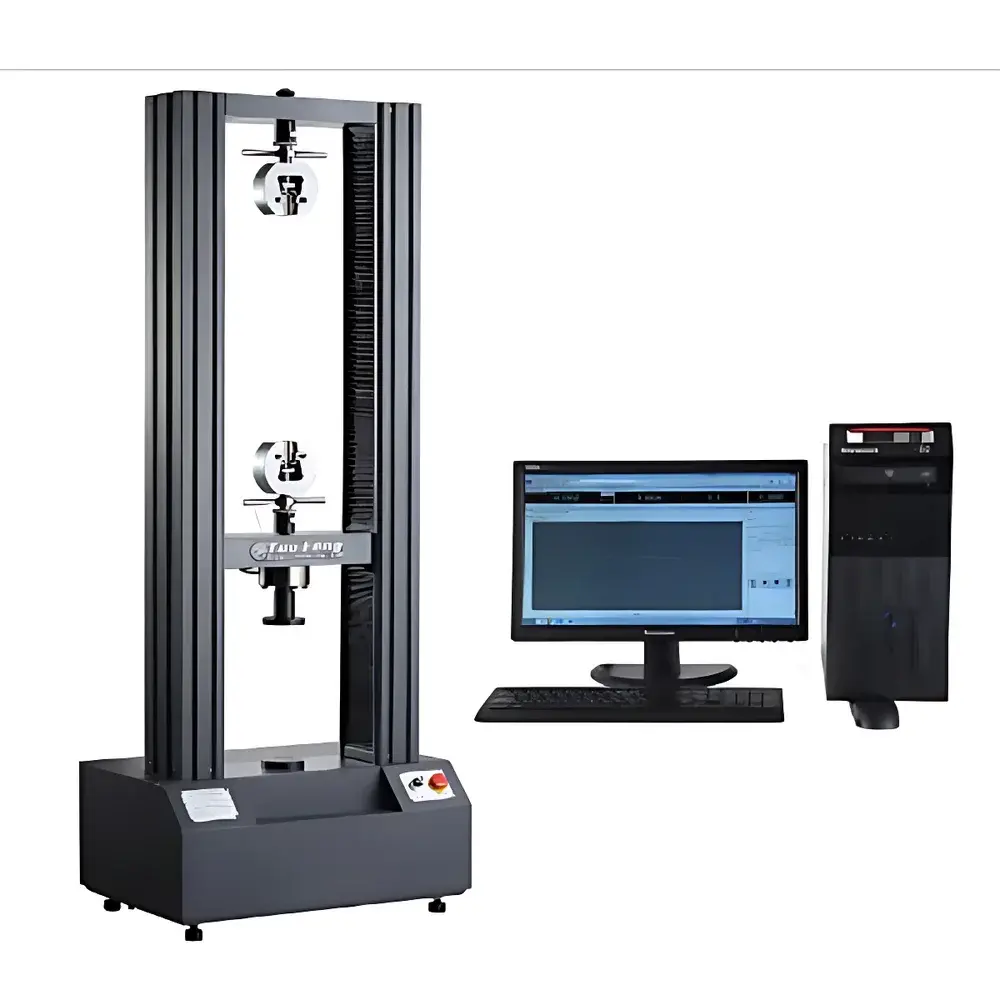
Tuofeng TFW-195 Microcomputer-Controlled Electronic Universal Testing Machine
| Brand | Tuofeng |
|---|---|
| Origin | Shanghai, China |
| Manufacturer Type | Direct Manufacturer |
| Instrument Type | Electromechanical Universal Testing Machine |
| Model | TFW-195 |
| Max Test Load | 195 kN |
| Accuracy Class | 0.5 |
| Effective Force Range | 0.2–100% of Full Scale |
| Force Measurement Accuracy | ±0.005% of Reading |
| Resolution | 1 part in ±500,000 full-scale codes (no range switching) |
| Drive System | Imported Servo Motor with Worm Gear Reducer |
| Lead Screw | High-Precision Ball Screw |
| Effective Test Width | 600 mm (customizable) |
| Stroke | 800 mm (extendable) |
| Speed Range | 0.001–500 mm/min (infinitely variable) |
| Displacement Measurement | Optical Encoder |
| Displacement Accuracy | ±0.005% of Reading |
| Strain Measurement | Optional Extensometer or Large-Deformation Sensor |
| Safety Protection | Electronic Limit Switches, Emergency Stop, Overload Protection (110% FS), Dual-Speed Motorized Crosshead Return |
| Power Supply | 220 V, 1.5 kW |
| Approx. Weight | 800 kg |
Overview
The Tuofeng TFW-195 is a microprocessor-controlled electromechanical universal testing machine engineered for high-fidelity mechanical characterization of structural and functional materials. It operates on the principle of controlled displacement actuation via a precision ball screw driven by a servo motor, enabling accurate force–displacement–time data acquisition under standardized quasi-static loading conditions. Designed in strict compliance with GB/T 16491–2008 (Chinese national standard for electronic universal testing machines) and JJG 475–2008 (verification regulation), the system meets metrological traceability requirements for laboratory accreditation and quality assurance workflows. Its 0.5-class accuracy rating—validated across 0.2% to 100% of full-scale capacity—supports reliable determination of tensile strength, compressive yield stress, Young’s modulus, fracture elongation, shear resistance, peel adhesion, and tear propagation in accordance with ISO 6892-1, ASTM E8/E9, DIN 50125, JIS Z 2241, and BS EN 10002-1 test protocols.
Key Features
- High-resolution force measurement system with ±0.005% reading accuracy and 1/500,000 internal resolution—no range switching required across full capacity.
- Imported servo drive coupled with worm gear reduction ensures smooth, low-noise operation and exceptional speed stability from 0.001 to 500 mm/min.
- Robust dual-speed crosshead control enables rapid positioning and fine-tuned testing alignment; programmable return function restores initial position post-test at maximum speed.
- Comprehensive safety architecture includes electronic end-limit switches, hardware-based emergency stop circuitry, and automatic overload cutoff at 110% of rated load.
- Modular fixture interface supports rapid interchange of tensile grips, compression platens, bend fixtures, shear adapters, peel jigs, and custom anchor bolt pull-out assemblies per EN 13894-1 and ACI 355.2.
- Thermally stable cast-iron frame with reinforced column design minimizes deflection under load, ensuring long-term repeatability and inter-laboratory comparability.
Sample Compatibility & Compliance
The TFW-195 accommodates specimens ranging from miniature metallic coupons (e.g., M6–M24 anchor bolts per ETAG 001 Annex C) to large-section concrete-reinforced composites and polymer-matrix laminates. Its 600 mm test width and 800 mm stroke allow evaluation of full-scale embedded anchors, post-installed rebar systems, and structural adhesive joints. The machine satisfies regulatory validation criteria for GLP-compliant material qualification and GMP-aligned process verification. All firmware and software modules adhere to FDA 21 CFR Part 11 requirements for audit trail generation, electronic signature support, and data integrity preservation. Calibration certificates are traceable to NIM (National Institute of Metrology, China) and internationally recognized SI standards.
Software & Data Management
The Windows-based control and analysis suite supports multilingual UI (English, Simplified/Traditional Chinese), configurable unit systems (N/kN/lbf, mm/inch, MPa/psi), and real-time visualization of up to four synchronized plots—including load–time, load–displacement, stress–strain, and extension–time. Automated parameter extraction includes ultimate tensile strength, 0.2% offset yield, secant modulus, fracture toughness index (KIc approximation), and energy absorption area under curve. Batch analysis tools enable statistical comparison of up to 100 test records with min/max/mean reporting, curve overlay, and deviation mapping. Data export conforms to ASTM E1434–22 (digital data exchange format) and is compatible with LIMS integration via ODBC and CSV/XML interfaces. Software updates are provided free of charge for the instrument’s operational lifetime.
Applications
This system serves as a primary verification tool for anchor bolt pull-out testing in civil infrastructure projects, including façade anchoring, seismic retrofitting, and wind-resistant cladding installations. It is routinely deployed in R&D labs evaluating epoxy resin bond performance, grout–concrete interfacial shear strength, and expansion anchor torque–tension correlation. Additional use cases span aerospace composite compression-after-impact (CAI), automotive rubber bushing hysteresis, wire rope fatigue pre-conditioning, and powder metallurgy green strength profiling. Accredited third-party testing laboratories utilize the TFW-195 for certification against ISO/IEC 17025:2017 clause 6.4.3 (equipment suitability) and EN 1504–4 (repair material mechanical assessment).
FAQ
Does the TFW-195 comply with EN 13894-1 for chemical anchor pull-out testing?
Yes—it supports displacement-controlled loading profiles and data logging intervals required by Annex A of EN 13894-1, when paired with certified anchor-specific fixtures and calibrated extensometry.
Can the system perform hold-load tests at constant force or displacement?
Yes—programmable control modes include load-hold, displacement-hold, and creep ramp-hold sequences with user-defined dwell durations and tolerance bands.
Is third-party calibration documentation available upon delivery?
Yes—each unit ships with an NIM-traceable factory calibration certificate covering force, displacement, and speed axes, plus optional UKAS-accredited field verification.
What is the recommended maintenance interval for the servo drive and ball screw assembly?
Preventive maintenance is advised every 1,000 operating hours or annually—whichever occurs first—with lubrication, backlash inspection, and encoder signal validation performed per manufacturer technical bulletin TB-TFW-2023-04.
Can the software generate reports compliant with ISO 17025 Clause 7.8.2?
Yes—the report engine embeds metadata on operator ID, environmental conditions, calibration status, uncertainty budget, and raw data traceability—fully satisfying ISO/IEC 17025:2017 reporting requirements.



