
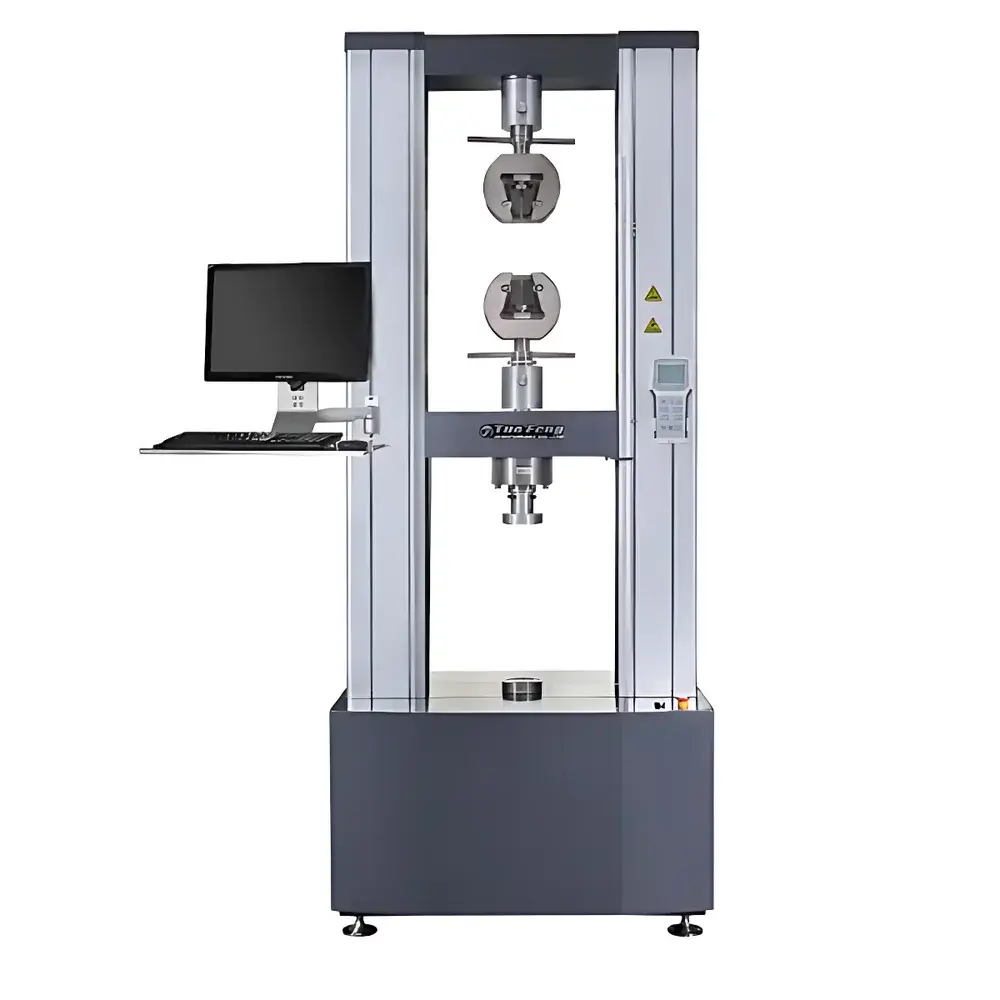
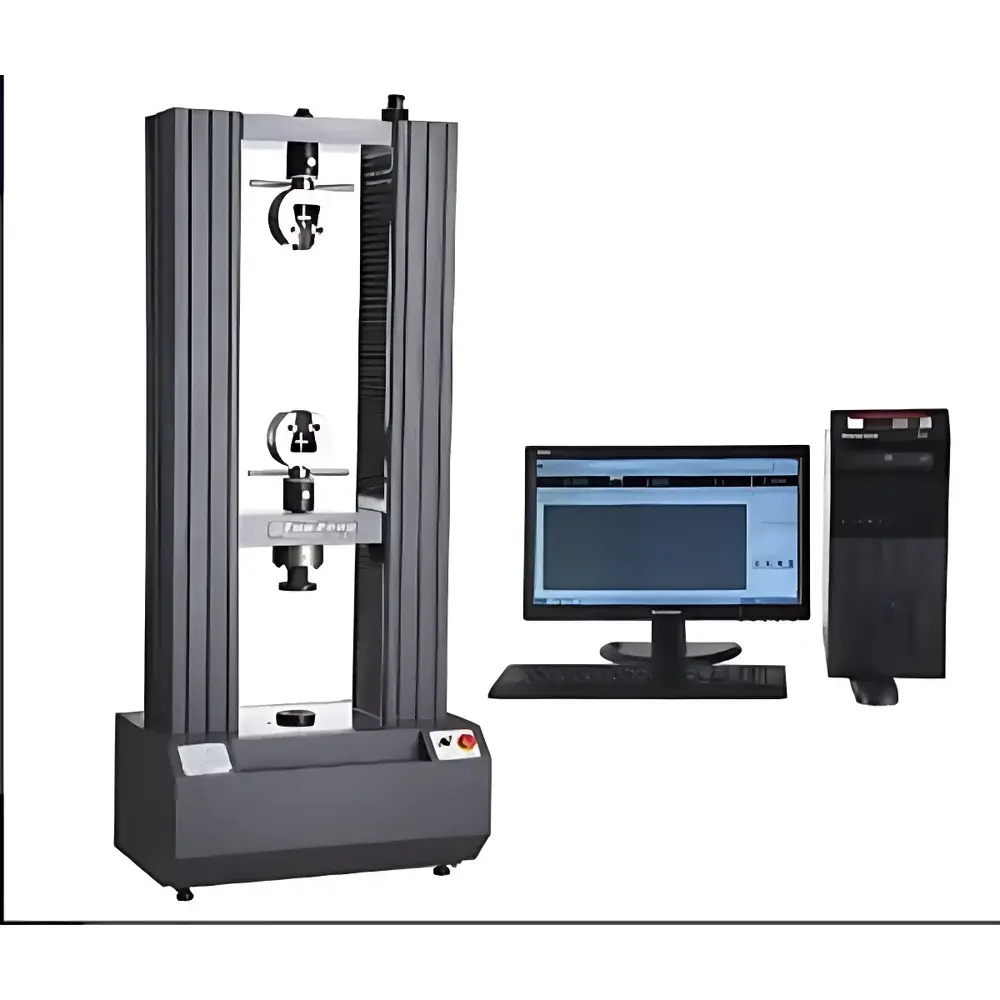
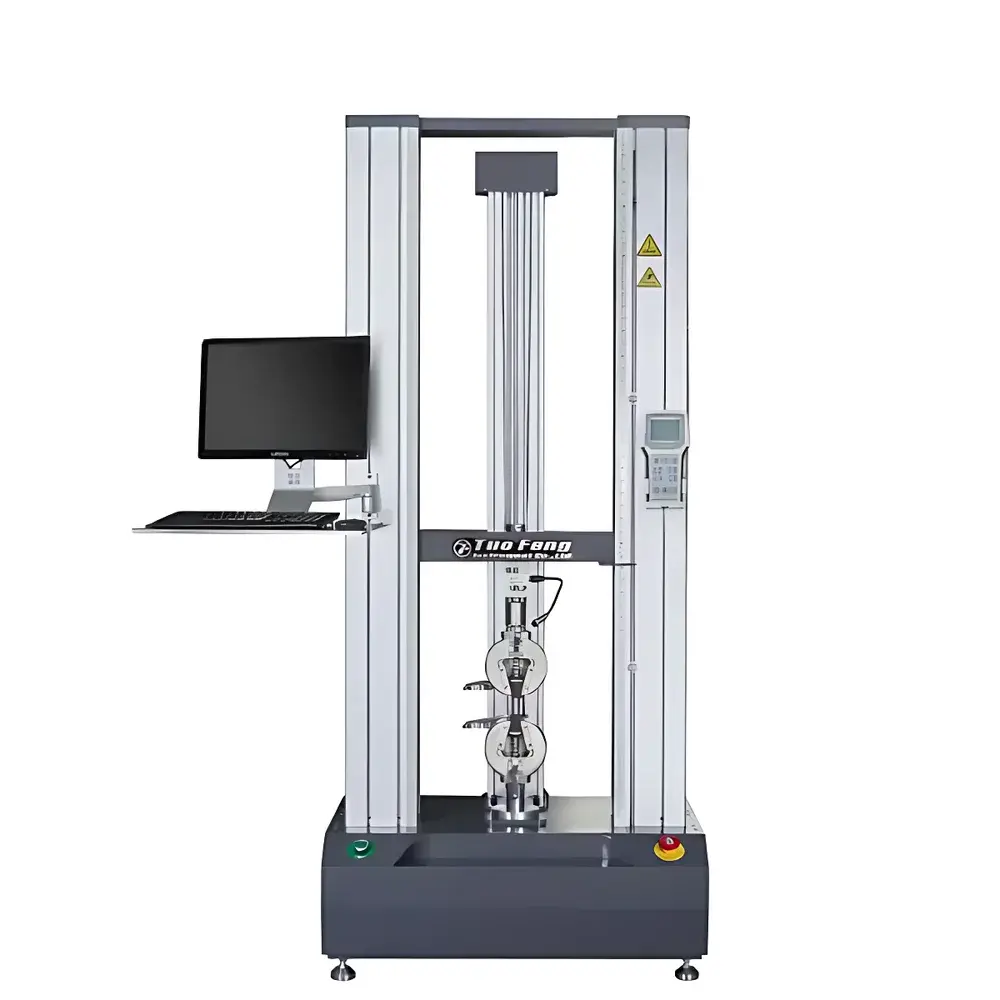
Tuofeng TFW-196 Fully Automated Electromechanical Universal Testing Machine
| Brand | Tuofeng |
|---|---|
| Origin | Shanghai, China |
| Manufacturer Type | Direct Manufacturer |
| Instrument Type | Electromechanical Universal Testing Machine |
| Model | TFW-196 |
| Max Test Load | 196 kN |
| Accuracy Class | 0.5 |
| Effective Force Range | 0.2–100% of Full Scale |
| Force Measurement Accuracy | ±0.005% of Reading |
| Force Resolution | 1/500,000 full-scale codes (no range switching) |
| Drive System | Imported Servo Motor with Worm Gear Reducer |
| Lead Screw | High-Precision Ball Screw |
| Effective Test Width | 600 mm (customizable) |
| Stroke | 800 mm (extendable) |
| Speed Range | 0.001–500 mm/min (infinitely variable) |
| Displacement Measurement | Optical Encoder |
| Displacement Accuracy | ±0.005% of Reading |
| Strain Measurement | Optional Extensometer or Large-Deformation Gauge |
| Safety Protection | Electronic Limit Switches, Emergency Stop, Overload Cut-off (10% above capacity) |
| Power Supply | 220 V, 1.5 kW |
| Approx. Weight | 800 kg |
Overview
The Tuofeng TFW-196 Fully Automated Electromechanical Universal Testing Machine is a high-precision static mechanical testing system engineered for standardized tensile, compression, bending, shear, tear, peel, and puncture testing of metallic, polymeric, composite, ceramic, and elastomeric materials. It operates on the principle of controlled displacement actuation via a servo-driven ball screw mechanism, enabling precise force–displacement–time data acquisition under closed-loop feedback control. Designed in strict compliance with ISO 7500-1:2018 (static calibration of force-proving instruments), ASTM E4, ASTM E8/E8M, and GB/T 16491–2008, the TFW-196 delivers metrologically traceable results suitable for R&D validation, quality assurance, and regulatory submission workflows. Its modular architecture supports integration into GLP- and GMP-compliant laboratories, with audit-ready test records aligned with FDA 21 CFR Part 11 requirements when configured with electronic signature and data integrity modules.
Key Features
- 0.5-class accuracy certified per ISO 7500-1 and JJG 475–2008, ensuring reproducibility across global standards laboratories.
- True dual-range force measurement: 1/500,000 internal resolution with no manual range switching—maintains full resolution from 0.2% to 100% of 196 kN capacity.
- High-stiffness frame with 600 mm effective test width and 800 mm vertical stroke—expandable to accommodate large-section civil engineering specimens or aerospace laminates.
- Infinitely variable speed control (0.001–500 mm/min) with <0.1% speed stability under load, supporting quasi-static creep and strain-rate-sensitive polymer testing.
- Dual safety architecture: hardware-based emergency stop + software-enforced overload cutoff at 110% capacity, plus programmable electronic limit switches.
- Motorized crosshead with fast/slow dual-speed positioning and auto-return function—reduces operator intervention and improves throughput in high-volume QA environments.
Sample Compatibility & Compliance
The TFW-196 accommodates standard and custom specimens per ISO 6892-1 (tensile metals), ISO 527-2 (plastics), ASTM D638 (tensile plastics), ASTM D3039 (composite tensile), ASTM D7264 (flexural composites), and EN 13501-1 (fire-rated building materials). Optional extensometers (contact or non-contact) enable direct strain measurement per ASTM E83 Class B-1 or ISO 9513 Class 0.5. The system supports full compliance with ISO/IEC 17025:2017 for accredited testing laboratories, including documented uncertainty budgets, calibration traceability to NIM (China) or NIST (USA), and periodic verification protocols. All test reports include metadata such as environmental conditions (temperature/humidity), operator ID, calibration certificate numbers, and instrument firmware version.
Software & Data Management
The Windows-based Tuofeng TestSuite v4.2 provides multi-mode control (constant load, constant strain rate, hold, ramp-hold-ramp) and real-time visualization of up to four synchronized curves: force–time, stress–strain, displacement–time, and extension–time. Units are freely convertible between SI, imperial, and legacy systems (e.g., MPa/kpsi, mm/in, N/lbf). Raw data export is supported in CSV, XML, and universal .tdms formats compatible with MATLAB, Python (pandas), and LabVIEW. Built-in report generation complies with ISO 14289-1 (PDF/A-1b) for long-term archival. Audit trails record all user actions—including parameter edits, curve overlays, and result reprocessing—with time stamps and digital signatures. Software updates are delivered via secure HTTPS; lifetime upgrade entitlement includes new standard modules (e.g., ISO 10360-compliant geometric error compensation).
Applications
The TFW-196 serves as a primary mechanical characterization platform in materials science labs, automotive Tier-1 suppliers (e.g., tensile testing of battery housing alloys), aerospace OEMs (compression-after-impact of CFRP panels), medical device manufacturers (ISO 14289-compliant suture strength validation), and construction material certifiers (concrete reinforcement bar yield analysis). Its versatility extends to failure mode analysis—such as ductile-to-brittle transition mapping in cryogenic steels—and process development support, including weld joint qualification per AWS D1.1 and adhesive bond durability assessment per ASTM D1002. Universities utilize it for undergraduate mechanics labs and graduate-level fracture mechanics research due to its open API and scriptable automation interface.
FAQ
Does the TFW-196 support ASTM E21 and ISO 6892-2 high-temperature tensile testing?
Yes—when integrated with optional furnace systems (up to 1100 °C) and high-temperature extensometry, the machine meets all positional and thermal gradient requirements specified in those standards.
Can test data be exported directly to LIMS or ERP systems?
Yes—the software includes ODBC and RESTful API interfaces for bidirectional data exchange with LabWare LIMS, SAP QM, and Oracle Quality.
Is third-party calibration certification available?
Yes—Tuofeng partners with CNAS-accredited calibration labs (e.g., SGS, BV, TÜV Rheinland) to provide ISO/IEC 17025-compliant certificates with uncertainty statements.
What is the recommended maintenance interval for the servo drive and ball screw assembly?
Per manufacturer guidelines: lubrication and backlash verification every 1,000 operating hours; full drive diagnostics and encoder recalibration annually or after 5,000 cycles.
Does the system comply with EU Machinery Directive 2006/42/EC and CE marking requirements?
Yes—the TFW-196 carries CE marking with Declaration of Conformity covering mechanical safety, EMC (EN 61326-1), and low-voltage directive (2014/35/EU).



