
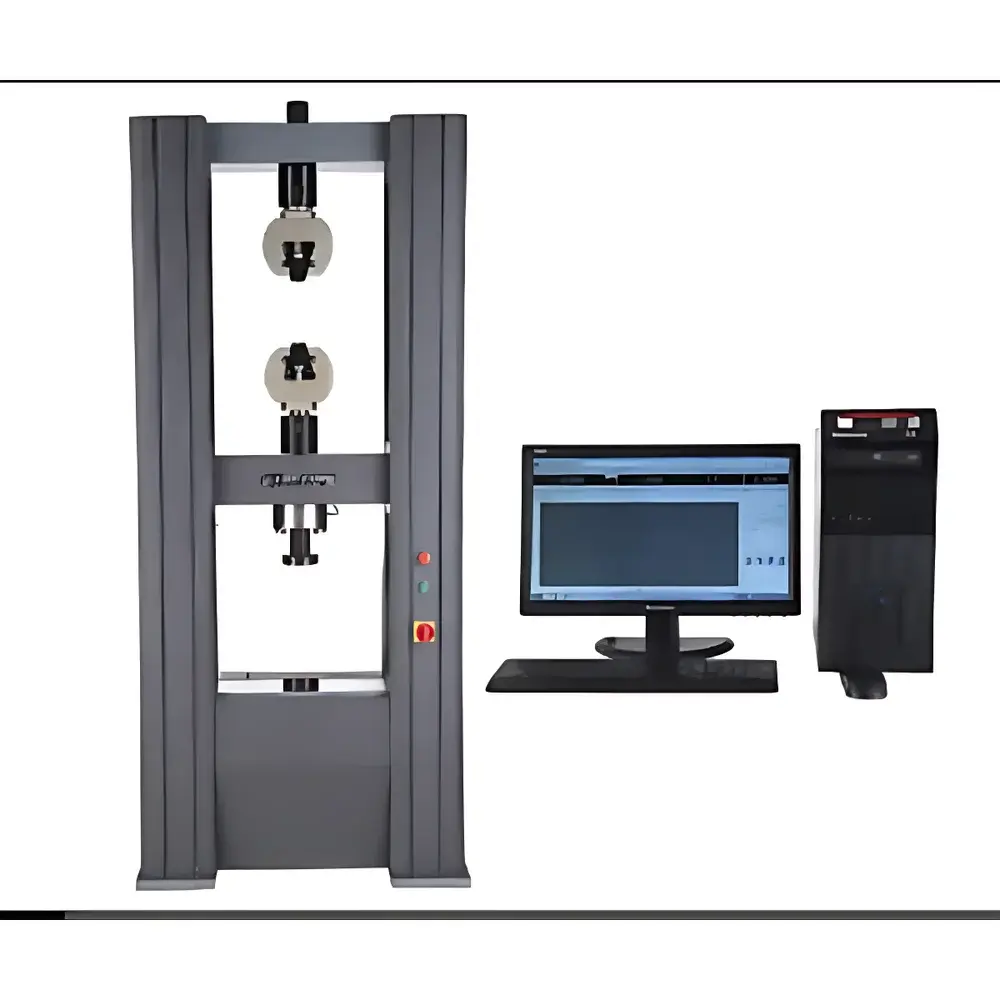
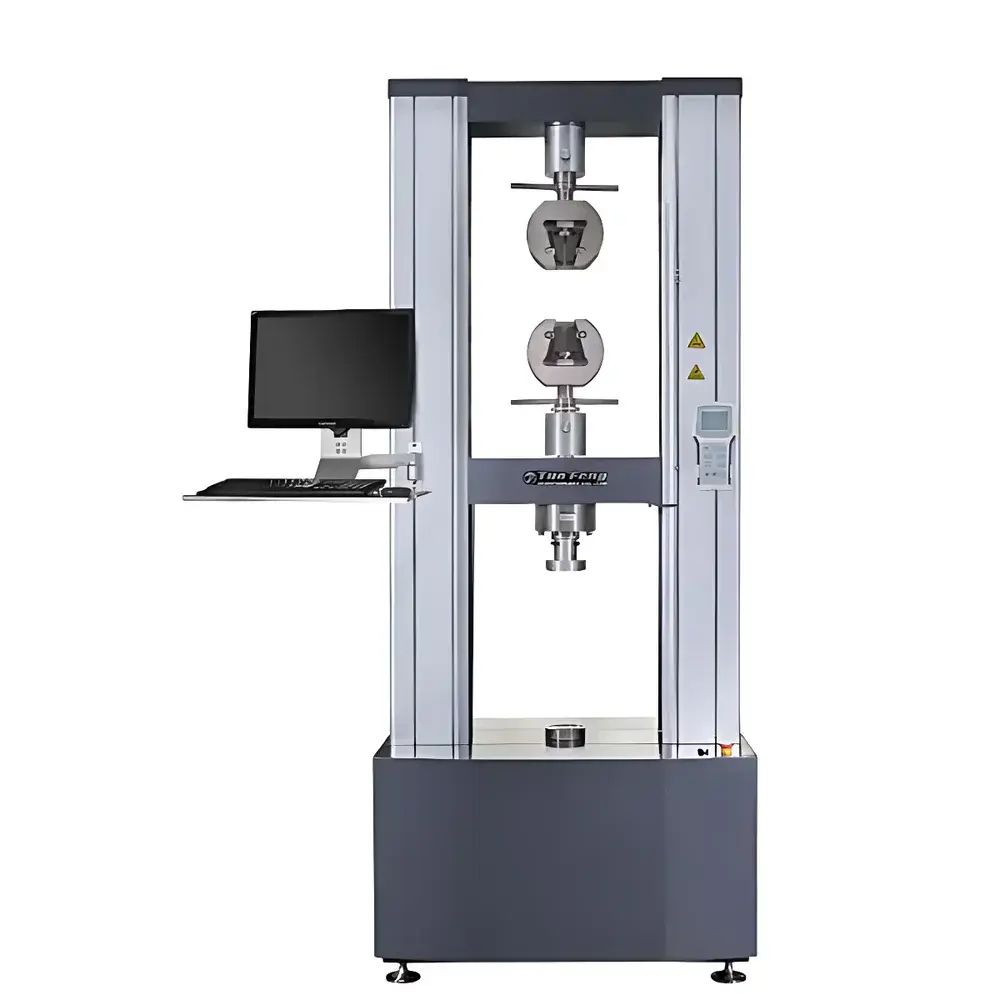
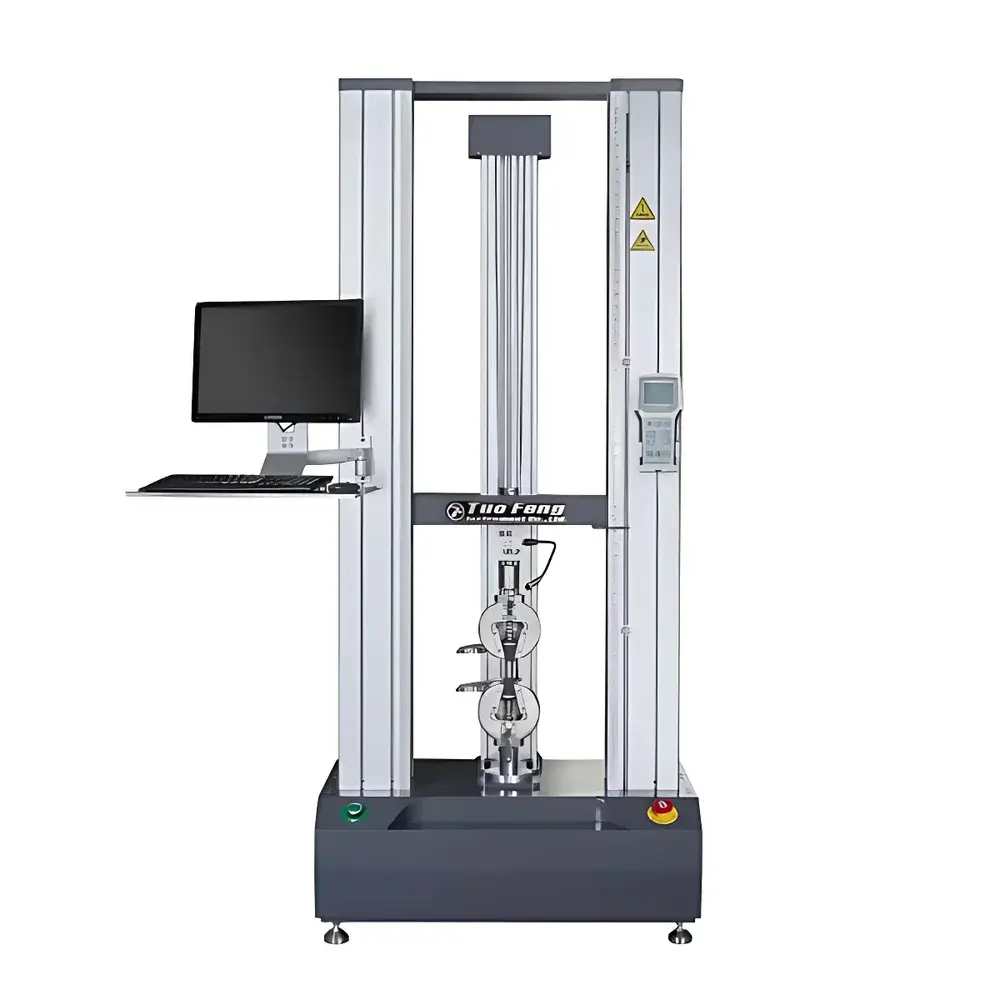
Tuofeng TFW-198 Microcomputer-Controlled Universal Testing Machine for Wire Rope and Structural Materials
| Brand | Tuofeng |
|---|---|
| Origin | Shanghai, China |
| Manufacturer Type | Direct Manufacturer |
| Instrument Type | Electromechanical Universal Testing Machine |
| Model | TFW-198 |
| Max Test Load | 100 kN |
| Accuracy Class | 0.5 |
| Effective Force Range | 0.2–100% of Full Scale |
| Force Measurement Accuracy | ±0.005% of Reading |
| Resolution | 1 part in ±500,000 full-scale codes (no range switching) |
| Drive System | Imported Servo Motor with Worm Gear Reducer |
| Lead Screw | High-Precision Ball Screw |
| Effective Test Width | 600 mm (customizable) |
| Stroke | 800 mm (extendable) |
| Speed Range | 0.001–500 mm/min (infinitely variable) |
| Displacement Measurement | Optical Encoder |
| Displacement Accuracy | ±0.005% of Reading |
| Strain Measurement | Optional Extensometer or Large-Deformation Gauge |
| Safety Protection | Electronic Limit Switches, Emergency Stop, Overload Cut-off (110% FS), Dual-Speed Crosshead Control |
| Power Supply | 220 V, 1.5 kW |
| Approx. Weight | 800 kg |
| Compliance | GB/T 16491–2008, JJG 475–2008, ASTM E4, ISO 7500-1, DIN 51221, JIS B 7721 |
Overview
The Tuofeng TFW-198 is a high-precision, microcomputer-controlled electromechanical universal testing machine engineered for rigorous mechanical property evaluation of wire ropes, metallic alloys, polymers, composites, and structural materials. It operates on the fundamental principle of controlled axial loading—applying precisely regulated tensile, compressive, flexural, shear, tear, peel, and puncture forces to standardized specimens while continuously acquiring synchronized force, displacement, and strain data. Designed to meet the metrological and operational requirements of accredited laboratories and industrial QA/QC departments, the TFW-198 delivers traceable, repeatable results across dynamic and static test protocols. Its robust architecture—including a rigid dual-column frame, high-resolution force transduction system, and thermally stable ball-screw actuation—ensures minimal compliance error and long-term calibration stability under heavy-duty usage cycles typical in cable manufacturing, civil infrastructure validation, and aerospace component certification.
Key Features
- 0.5-class accuracy per GB/T 16491–2008 and ISO 7500-1, verified through third-party calibration certificates.
- Full-scale resolution of 1/±500,000 without range switching—enabling high-fidelity detection of subtle yield transitions and post-yield softening in high-strength steel wire ropes.
- Dual-mode actuation: independent fast (200 mm/min) and fine-adjustment (0.001 mm/min) crosshead speeds for rapid positioning and creep-sensitive quasi-static loading.
- Integrated overload protection triggers at 110% of rated capacity (100 kN), automatically halting motion and preserving load cell integrity.
- Modular extensometry support: compatible with clip-on axial extensometers (ASTM E83 Class B-1) and non-contact video extensometers for ISO 527-2 compliant strain measurement.
- Self-diagnostic firmware with real-time sensor health monitoring and automatic zero-drift compensation.
Sample Compatibility & Compliance
The TFW-198 accommodates standard and custom fixtures for wire rope grips (e.g., wedge-type, swage-end, and hydraulic clamps), flat sheet specimens (up to 600 mm wide), cylindrical rods, and composite laminates. It supports specimen geometries defined in ASTM A1023 (wire rope tensile testing), ISO 3156 (steel cord tensile strength), GB/T 8358 (steel wire rope breaking force), and EN 12385-4 (crane rope qualification). All hardware and software workflows are structured to satisfy GLP and GMP audit requirements, including electronic signature support, audit trail logging (per FDA 21 CFR Part 11), and version-controlled test method templates aligned with ISO/IEC 17025 clause 7.2. Calibration records, uncertainty budgets, and inter-laboratory comparison reports are exportable in PDF/A-1b format.
Software & Data Management
The Windows-based TuofengTest Suite v5.2 provides deterministic real-time control across multiple test modes: load-controlled, displacement-controlled, strain-controlled, hold-to-load, hold-to-displacement, and cyclic ramp-hold sequences. The interface supports multi-language operation (English, Simplified/Traditional Chinese, Spanish, German) and SI/imperial unit conversion without recalibration. During acquisition, users can overlay up to eight concurrent curves—including true stress–strain, engineering stress–strain, load–time, and load–extension—with customizable axis scaling and derivative calculation (e.g., tangent modulus, secant modulus). Raw data is stored in HDF5 format with embedded metadata (operator ID, environmental conditions, calibration date). Batch reporting complies with ASTM E2309 and ISO 10360-5, generating PDF/CSV outputs containing statistical summaries (mean, SD, CV%), outlier detection (Grubbs’ test), and pass/fail flags against user-defined specification limits.
Applications
- Tensile break testing of galvanized, stainless, and phosphated steel wire ropes per ISO 3156 and GB/T 20067.
- Yield strength and elongation-at-break characterization of high-carbon steel wires used in elevator cables and mining hoists.
- Compression testing of concrete-filled steel tubes and polymer-based cable jackets under ASTM D695.
- Bending fatigue simulation via three-point flexure with programmable load reversal and cycle counting.
- Peel adhesion assessment of insulated conductor coatings per UL 1581 Section 1060.
- Quality conformance verification for ISO 9001:2015 Clause 8.5.1 and IATF 16949:2016 Section 8.5.1.2.
FAQ
Does the TFW-198 support ASTM E4-compliant force verification?
Yes—the system includes built-in verification routines for Class 1 and Class 2 deadweight standards, with automatic uncertainty propagation per ISO/IEC 17025 Annex C.
Can the software generate 21 CFR Part 11-compliant audit trails?
Yes—every action (method edit, test start, result approval) is timestamped, user-identified, and immutable once signed.
Is thermal drift compensation available for long-duration creep tests?
Yes—software-enabled auto-zeroing intervals and temperature-compensated transducer coefficients are configurable per test profile.
What is the maximum specimen diameter supported for wire rope testing?
With optional heavy-duty wedge grips, diameters up to 60 mm are accommodated; custom grip designs are available for specialty constructions (e.g., rotation-resistant, compacted-strand ropes).
How frequently must the system be recalibrated to maintain 0.5-class accuracy?
Annual verification against national metrology institute-traceable standards is recommended; intermediate checks using certified reference loads are performed before each shift per ISO 9001 internal audit requirements.
Related Products



