
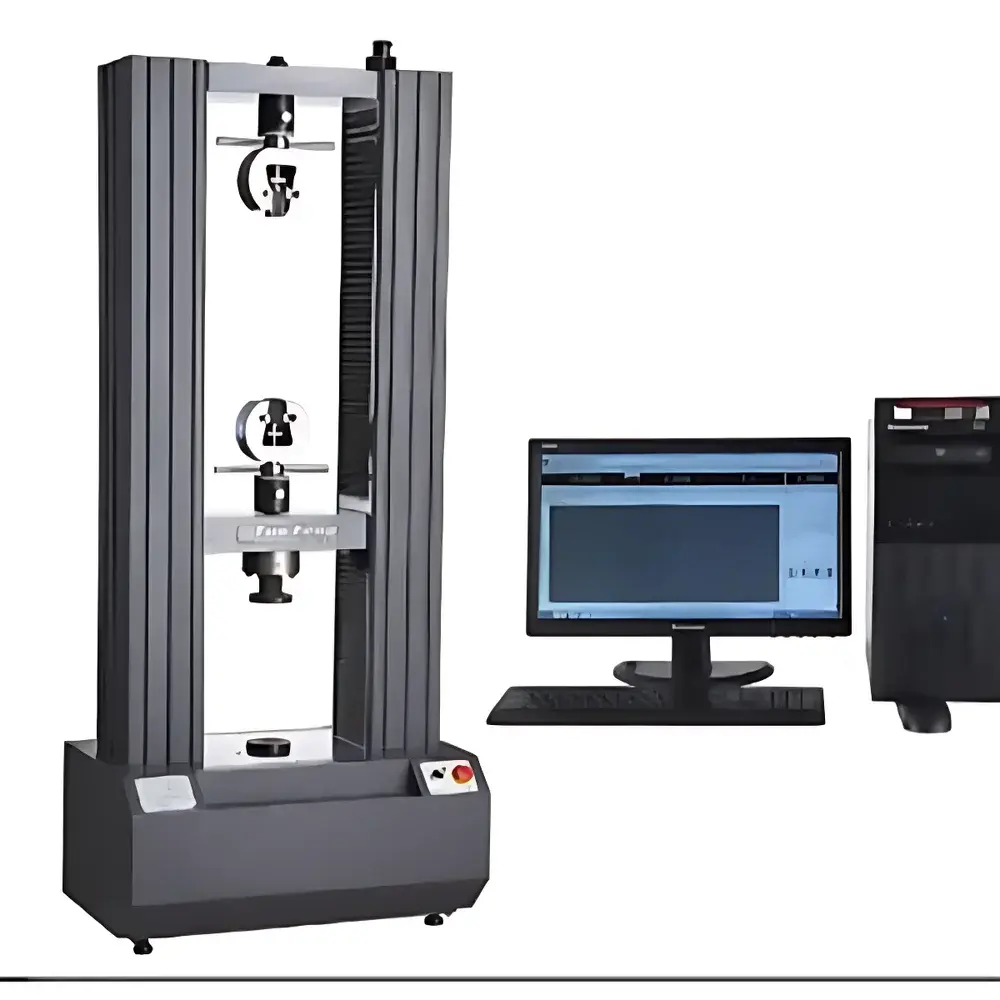
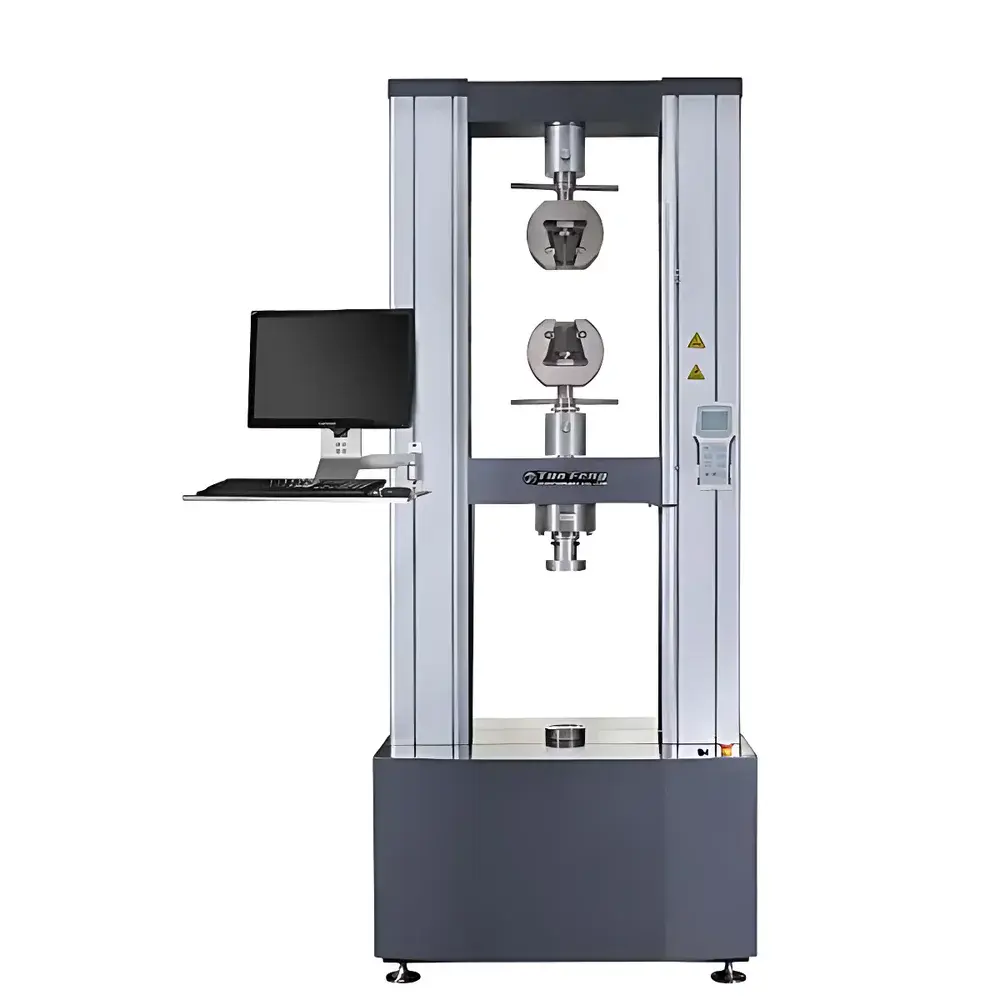
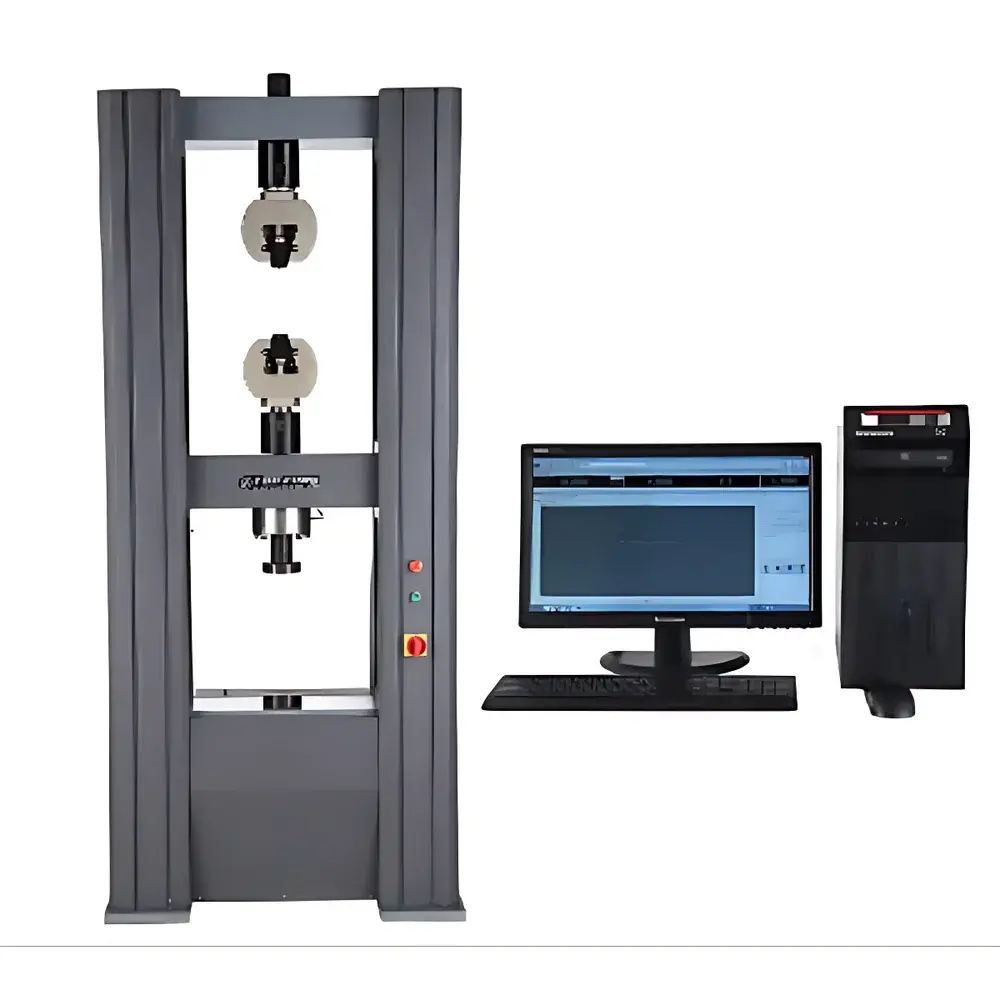
Tuofeng TFW-203 Microcomputer-Controlled Universal Testing Machine
| Brand | Tuofeng |
|---|---|
| Origin | Shanghai, China |
| Manufacturer Type | Direct Manufacturer |
| Instrument Type | Electromechanical Universal Testing Machine |
| Model | TFW-203 |
| Max Test Load | 20 kN |
| Accuracy Class | 0.5 |
| Effective Force Range | 0.2–100% of full scale |
| Force Measurement Accuracy | ±0.005% of reading |
| Resolution | 1/500,000 codes (full-scale, no range switching) |
| Drive System | Imported servo motor with worm gear reducer |
| Lead Screw | High-precision ball screw |
| Effective Test Width | 600 mm (customizable) |
| Stroke | 800 mm (extendable) |
| Speed Range | 0.001–500 mm/min (infinitely variable) |
| Displacement Measurement | Optical encoder, accuracy ±0.005% of reading |
| Strain Measurement | Optional extensometer or large-deformation sensor, accuracy ±0.005% of reading |
| Safety Protection | Electronic limit switches, emergency stop, overload protection (110% FS), dual-speed motorized crosshead return |
| Power Supply | 220 V, 1.0 kW |
| Approx. Weight | 450 kg |
Overview
The Tuofeng TFW-203 is a microcomputer-controlled electromechanical universal testing machine engineered for high-fidelity mechanical property characterization of metals, polymers, composites, elastomers, textiles, and thin films. It operates on the fundamental principle of controlled uniaxial force application—via a precision servo-driven ball-screw actuation system—to measure stress–strain response under tension, compression, bending, shear, tear, peel, and puncture loading modes. Designed to meet stringent metrological requirements, the TFW-203 complies with ISO 7500-1 (Class 0.5 static calibration), ASTM E4, ASTM E8/E8M, ASTM D638/D695/D790/D1708/D3574, ISO 527/604/178/1133, GB/T 16491–2008, and JJG 475–2008. Its rigid frame architecture, thermally stable load cell mounting, and real-time digital signal processing ensure long-term repeatability (<0.5% RSD across 100 repeated tests at 50% FS) and traceable measurement integrity required in GLP-compliant laboratories and ISO/IEC 17025-accredited testing facilities.
Key Features
- High-resolution force transduction: 500,000-count A/D conversion with zero drift compensation, enabling detection of sub-newton load changes during low-force film or fiber testing.
- True dual-speed crosshead control: Independent fast (100 mm/min) and fine-adjustment (0.001 mm/min) positioning for rapid specimen setup and creep/stress-relaxation protocol execution.
- Modular fixture interface: Standard M6 and M8 threaded mounting plates support ASTM D882-compliant film grips, pneumatic clamps, wedge-action jaws, and custom tooling for biaxial extension simulation (e.g., constrained uniaxial pre-stretch prior to transverse testing).
- Real-time multi-curve synchronization: Simultaneous display and export of load–time, load–displacement, stress–strain, and displacement–time plots with user-definable scaling and overlay capability.
- Comprehensive safety architecture: Hardware-level emergency stop circuitry, programmable electronic limits, mechanical overload cutoff, and automatic crosshead return upon test completion or fault detection.
Sample Compatibility & Compliance
The TFW-203 accommodates specimens ranging from ultra-thin polymer films (≥12 µm thickness) to structural metal coupons (up to 25 mm thick). With optional extensometry (clip-on or non-contact video-based), it supports ISO 527-2 Type 1A dumbbell specimens, ASTM D882 film strips (15 mm wide × 150 mm gauge length), and GB/T 1040.3 plastic tensile bars. All test sequences adhere to audit-ready data governance: full metadata tagging (operator ID, environmental conditions, calibration certificate ID), time-stamped raw data logging (≥1 kHz sampling), and built-in compliance reporting templates for ASTM, ISO, GB, DIN, JIS, and BS standards. The system satisfies FDA 21 CFR Part 11 requirements for electronic records and signatures when configured with user role-based access control and audit trail logging enabled.
Software & Data Management
The Windows-based TFW-TestSuite v4.2 software provides deterministic test sequencing, including multi-step protocols (e.g., preconditioning → ramp-to-load → hold → ramp-to-failure), closed-loop strain rate control, and load-hold creep analysis. It supports 12 language interfaces—including English, Simplified/Traditional Chinese, German, French, and Japanese—with unit system switching (N/kN/lbf, mm/in, MPa/psi, %/mm/mm). Raw data exports to CSV, Excel, and XML formats include header metadata compliant with ASTM E1447 and ISO/IEC 17025 Annex A.2. Software modules enable automated calculation of tensile strength, yield point (0.2% offset), modulus (secant/tangent), elongation at break, Poisson’s ratio (with dual-axis extensometry), and energy absorption (area under curve). Version-controlled firmware updates and remote diagnostics are available under lifetime technical support.
Applications
The TFW-203 serves as a primary mechanical validation platform in R&D and QA/QC workflows across regulated and industrial sectors. In polymer science, it quantifies biaxial stretch-induced crystallinity effects in BOPP/BOPET films via sequential orthogonal tensile tests. In aerospace composites, it evaluates interlaminar shear strength (ASTM D2344) and compression-after-impact (CAI) residual strength. Automotive suppliers use it for rubber bushing hysteresis profiling and battery separator tensile integrity under thermal cycling. Medical device manufacturers rely on its precision for suture tensile testing (ISO 10993-12) and hydrogel adhesion peel assessment (ASTM F2255). Academic labs apply it to nanocomposite fracture mechanics, shape-memory alloy superelasticity mapping, and biodegradable scaffold degradation kinetics.
FAQ
Does the TFW-203 support biaxial tensile testing?
No—the TFW-203 is a uniaxial testing system. However, its modular grip design allows sequential orthogonal testing (e.g., MD then TD) on cut specimens to infer biaxial behavior; true planar biaxial testing requires dedicated equipment.
Can I integrate third-party environmental chambers?
Yes—standardized chamber mounting brackets and analog/digital I/O ports enable seamless integration with temperature-humidity chambers (-70°C to +300°C) and liquid immersion fixtures.
Is calibration traceable to national standards?
All factory calibrations are performed using NIST-traceable deadweight machines and certified reference load cells, with certificates issued per ISO/IEC 17025 requirements.
What extensometer options are available?
Standard offerings include clip-on axial extensometers (10–50 mm gauge length, ±0.5% accuracy) and non-contact video extensometers (0.01 mm resolution, up to 200 fps tracking) for brittle or soft materials.
How is data security managed for regulated environments?
With optional 21 CFR Part 11 module: electronic signatures, role-based permissions, immutable audit trails, and encrypted database storage compliant with HIPAA and EU GDPR requirements.



