
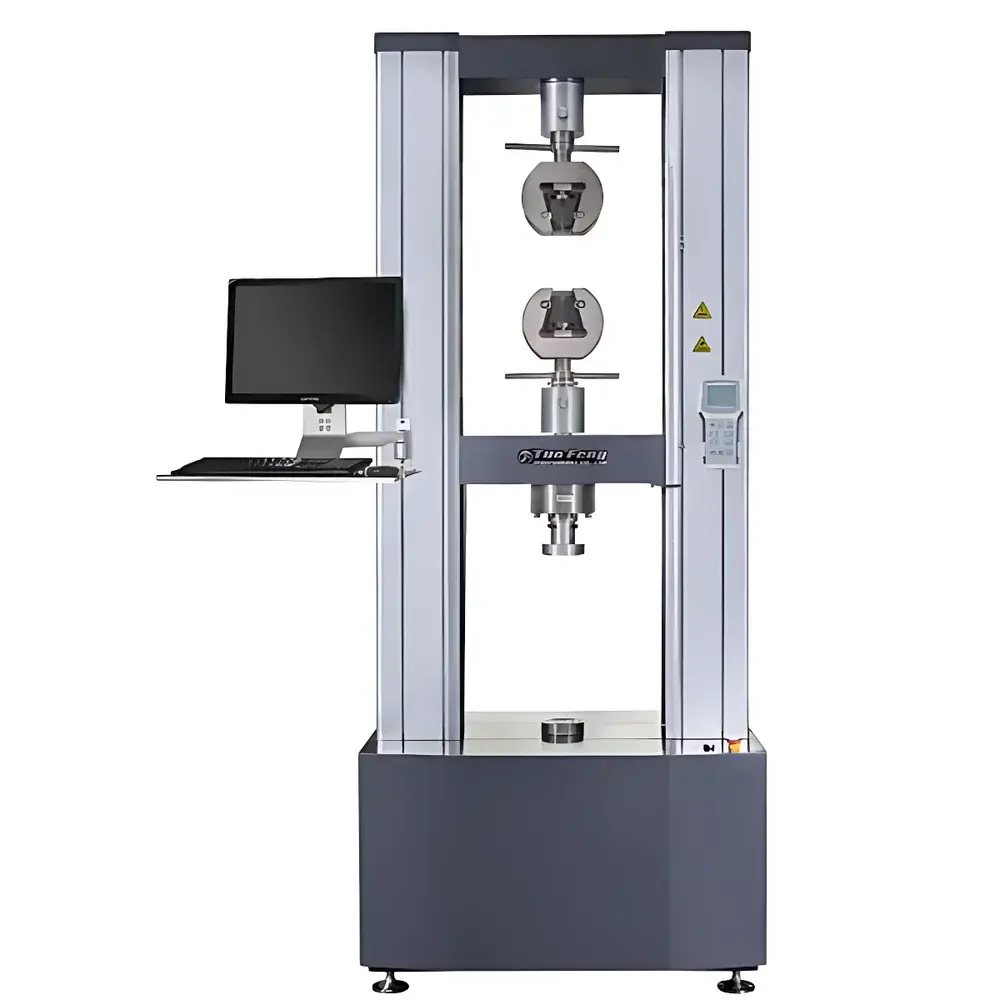
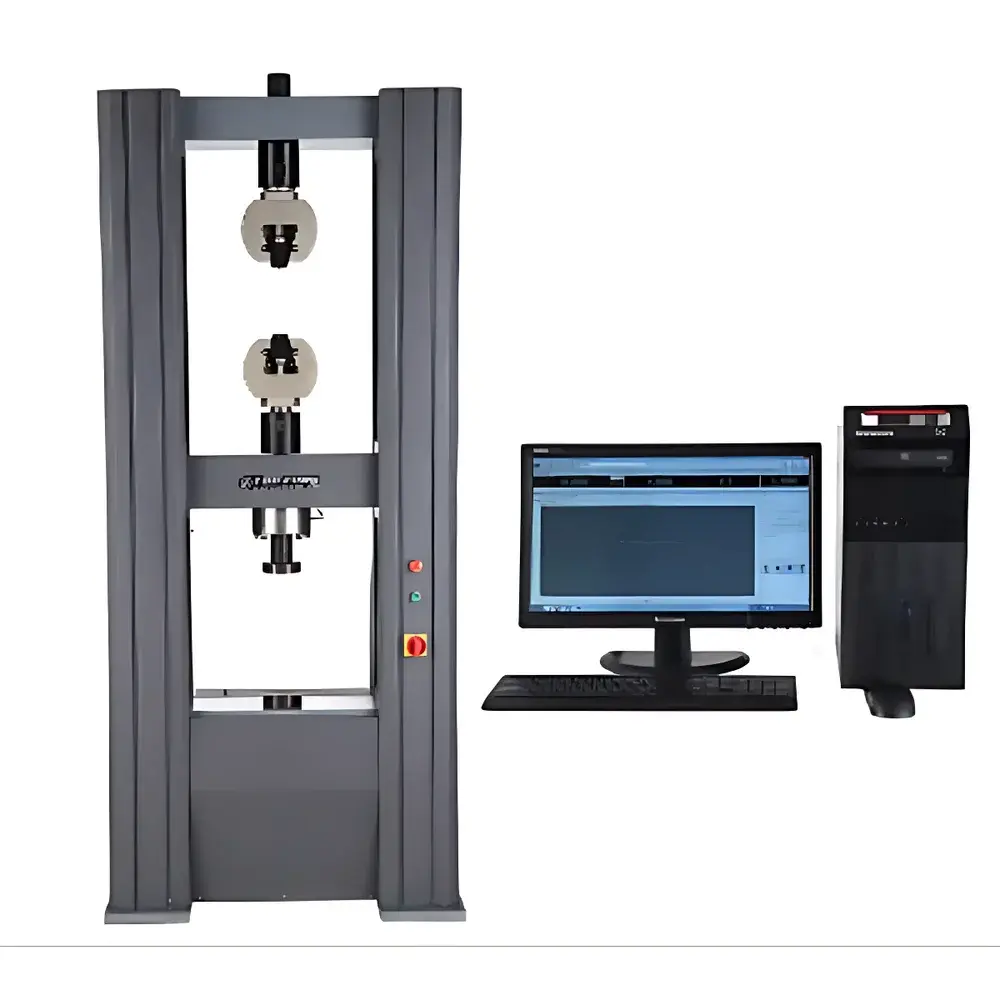
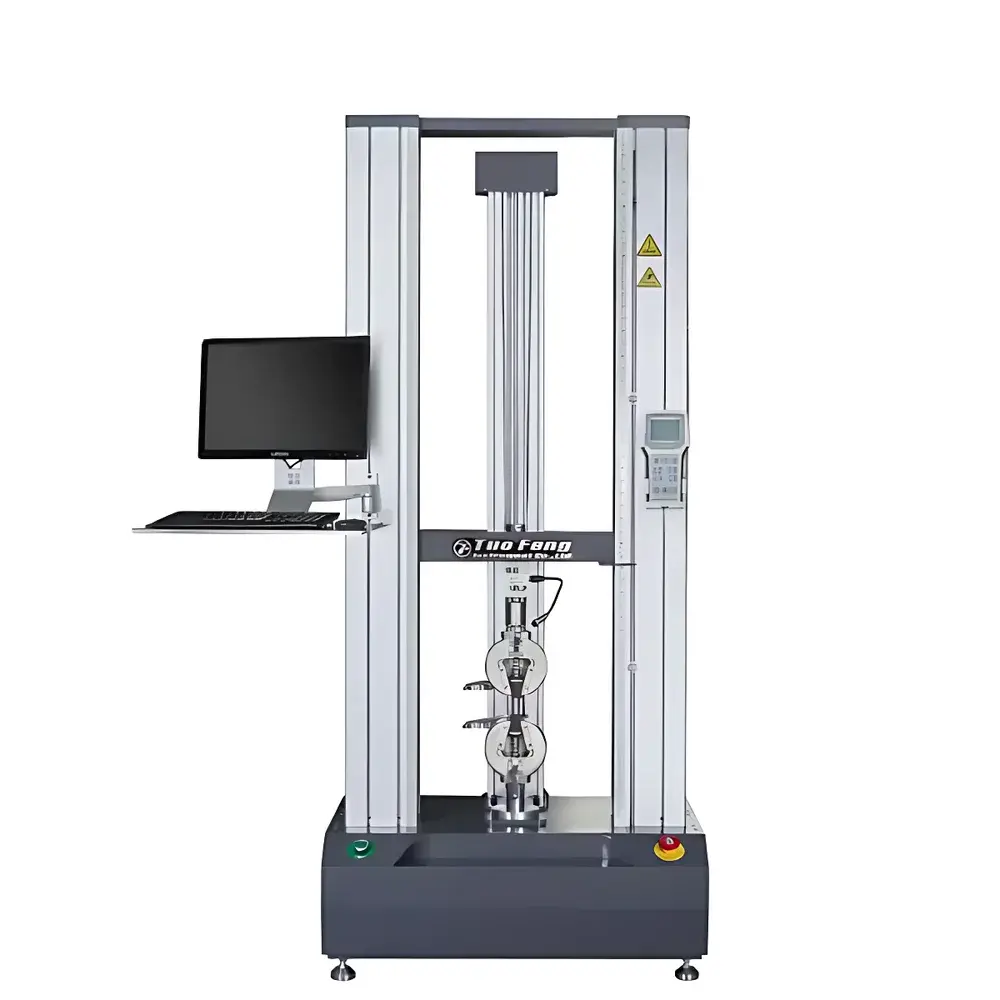
Tuofeng TFW-204 Universal Testing Machine for Refractory Fiber Products
| Brand | Tuofeng |
|---|---|
| Model | TFW-204 |
| Type | Electromechanical Universal Testing Machine |
| Max. Test Load | 20 kN |
| Accuracy Class | 0.5 |
| Effective Force Range | 0.2–100% of Full Scale |
| Force Measurement Accuracy | ±0.005% of Reading |
| Resolution | 1 part in ±500,000 full-scale codes (no range switching) |
| Drive System | Imported Servo Motor + Worm Gear Reducer |
| Lead Screw | High-Precision Ball Screw |
| Effective Test Width | 600 mm (customizable) |
| Stroke | 800 mm (height-adjustable) |
| Speed Range | 0.001–500 mm/min (infinitely variable) |
| Displacement Measurement | Optical Encoder (Accuracy: ±0.005% of Reading) |
| Strain Measurement | Optional Extensometer or Large-Deformation Sensor (Accuracy: ±0.005% of Reading) |
| Safety Protection | Electronic Limit Switches, Emergency Stop, Overload Protection (10% above capacity) |
| Crosshead Control | Dual-Speed Motorized Adjustment (Fast/Slow), Programmable Return |
| Power Supply | 220 V, 1.0 kW |
| Dimensions (W×D×H) | 1000 × 700 × 2000 mm |
| Weight | ~450 kg |
| Compliance | GB/T 16491–2008, JJG 475–2008, ASTM E4, ISO 7500-1, DIN 51221, JIS B 7721 |
Overview
The Tuofeng TFW-204 Universal Testing Machine is an electromechanical static testing system engineered for high-precision mechanical characterization of refractory fiber products—including ceramic fiber blankets, modules, papers, boards, and composite insulation materials—as well as metals, polymers, composites, and elastomers. It operates on the principle of controlled uniaxial force application via a servo-driven ball-screw actuator, enabling accurate measurement of tensile, compressive, flexural, shear, tear, peel, and puncture behavior under standardized loading conditions. Designed to meet international metrological and regulatory requirements, the TFW-204 delivers traceable force measurement with 0.5-class accuracy per GB/T 16491–2008 and ISO 7500-1, making it suitable for GLP-compliant laboratories, quality control departments, and R&D facilities engaged in high-temperature material development.
Key Features
- High-resolution force sensing with ±0.005% reading accuracy and 1:500,000 internal resolution—ensuring reproducible detection of subtle mechanical transitions in low-modulus refractory fibers.
- Wide dynamic speed range (0.001–500 mm/min), supporting both quasi-static creep tests and rapid load-to-failure protocols required for ASTM C1147 (refractory fiber board compression) and ISO 16842 (tensile testing of ceramic fibers).
- Modular extensometry support: Compatible with clip-on axial extensometers (for modulus and yield determination) and non-contact video-based large-deformation systems (for highly compliant or brittle fiber structures).
- Dual-speed motorized crosshead with programmable return function—enabling efficient batch testing and repeatable specimen positioning across multi-cycle thermal-mechanical evaluations.
- Robust mechanical architecture: Precision-ground ball screw transmission, rigid dual-column frame (600 mm test width), and integrated overload protection (10% over capacity) ensure long-term stability during cyclic loading at elevated temperatures (when used with environmental chambers).
- Comprehensive safety suite: Independent electronic limit switches, hardware-triggered emergency stop circuitry, and real-time load monitoring prevent mechanical damage and operator risk during high-force testing of dense fiber composites.
Sample Compatibility & Compliance
The TFW-204 accommodates diverse geometries typical of refractory fiber products—including narrow strips (per ASTM C1351), square specimens (ISO 16842), and cylindrical cores (ASTM C133). Custom fixture sets (e.g., pneumatic grips for low-stiffness felts, wedge-action clamps for high-density boards, compression platens with alignment guides) are available to minimize slippage and stress concentration. The system complies with national and international standards including GB/T 16491–2008 (Chinese metrological verification), JJG 475–2008 (calibration protocol), ASTM E4 (force verification), ISO 7500-1 (static calibration), and DIN 51221 (testing machine classification). Its documented traceability chain supports audit readiness for ISO/IEC 17025-accredited labs and FDA-regulated manufacturing environments where mechanical validation of thermal insulation components is required.
Software & Data Management
Powered by Windows-native testing software, the TFW-204 supports multiple control modes—including constant rate of extension (CRE), constant load hold, displacement-controlled ramping, and closed-loop strain control—essential for evaluating time-dependent behavior such as relaxation in aluminosilicate fibers. The interface provides real-time plotting of up to four synchronized curves (e.g., stress–strain, load–time, displacement–time, % elongation–cycle number) with auto-scaling and overlay capability for comparative analysis of aged vs. virgin samples. All raw data—including timestamped force, displacement, and extensometer readings—are stored in open ASCII format for third-party statistical processing. Audit-trail functionality logs user actions, parameter changes, and calibration events—meeting basic requirements for 21 CFR Part 11 compliance when deployed with supplementary access controls and electronic signature modules. Software localization includes English, Simplified Chinese, and Traditional Chinese; unit systems (N/kN, MPa/psi, mm/in) are fully configurable per test method.
Applications
- Tensile strength and elongation-at-break evaluation of ceramic fiber paper per ASTM C1147 and ISO 16842.
- Compressive modulus and residual thickness recovery testing of fiber modules after thermal cycling (per ASTM C1182).
- Peel strength assessment of laminated fiber-reinforced composites used in furnace linings.
- Creep rupture testing of high-purity alumina fiber cords under sustained load at ambient and elevated temperatures (with optional furnace integration).
- Mechanical screening of next-generation bio-soluble fibers to quantify trade-offs between handling strength and dissolution kinetics.
- Quality assurance of refractory fiber gaskets and seals—validating consistency in compression set and recovery performance.
FAQ
Does the TFW-204 support high-temperature testing?
Yes—when integrated with certified environmental chambers (up to 1200 °C), the system maintains force calibration integrity through active thermal compensation algorithms and high-temperature-rated load cells.
Can it perform cyclic fatigue tests on fiber mats?
Yes—the software supports user-defined waveform profiles (sine, triangle, trapezoidal) with programmable upper/lower load limits, cycle count termination, and hysteresis loop analysis.
Is the system compatible with LIMS or MES platforms?
Yes—via TCP/IP or RS232 communication protocols, raw test data and summary reports can be exported directly to laboratory information management systems using ASTM E1382-compliant structured output formats.
What calibration documentation is provided?
Each unit ships with a factory calibration certificate traceable to NIM (China National Institute of Metrology), plus a full uncertainty budget per ISO/IEC 17025 Annex A. On-site recalibration services are available globally.
How is compliance with ISO/IEC 17025 maintained over time?
The system’s built-in self-diagnostic routines, periodic verification templates (per ISO 17025:2017 Clause 7.7), and automated calibration log archiving enable continuous technical validity tracking without external intervention.



