
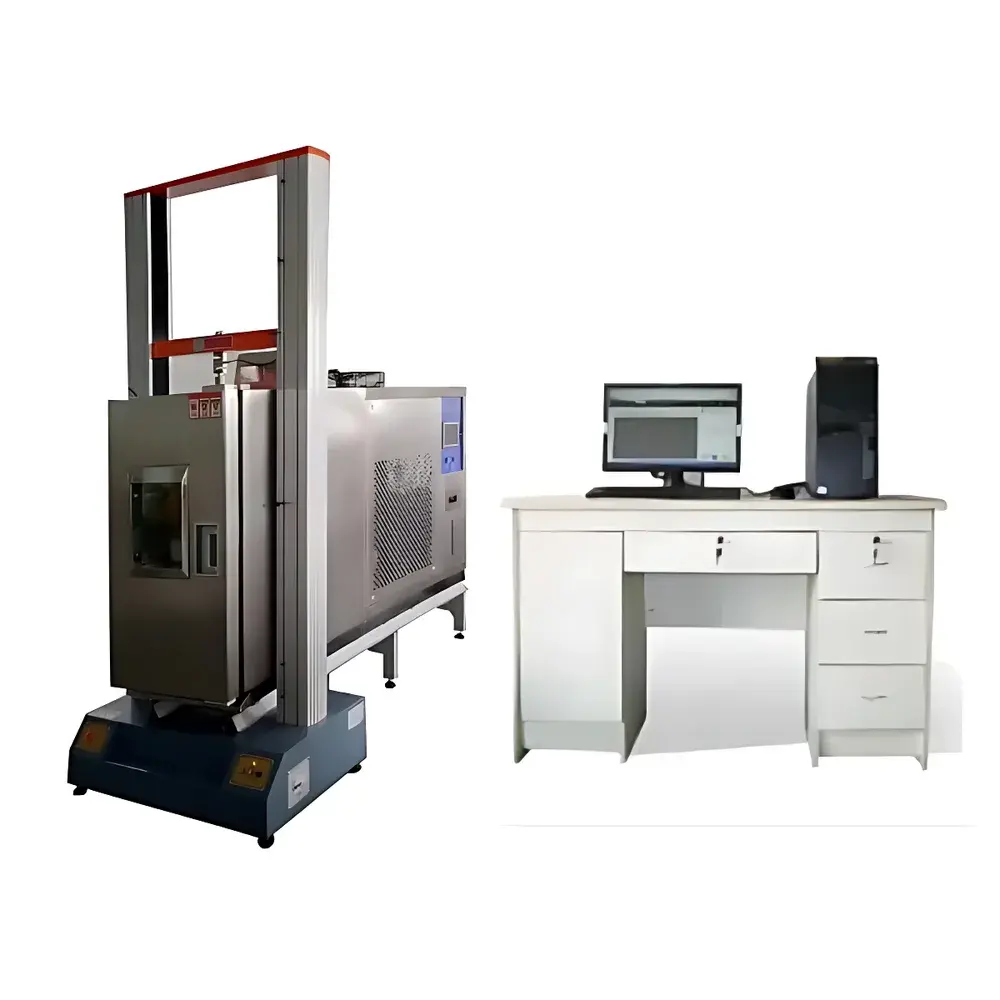
Tuofeng TFW-210 High-Low Temperature Universal Testing Machine
| Brand | Tuofeng |
|---|---|
| Origin | Shanghai, China |
| Manufacturer Type | Direct Manufacturer |
| Product Category | Domestic |
| Model | TFW-210 |
| Instrument Type | Electromechanical Universal Testing Machine |
| Max Test Load | 5–100 kN (configurable) |
| Accuracy Class | 0.5 |
| Force Measurement Range | 0.4–100% FS |
| Force Indication Error | ±0.5% of reading |
| Force Resolution | 1/500,000 of full scale, unbroken range |
| Deformation Measurement Range | 0.2–100% FS |
| Deformation Error | ±0.5% of reading |
| Deformation Resolution | up to 1/300,000 |
| Displacement Error | ±0.5% of reading |
| Column Inner Width | 840 mm |
| Crosshead Travel (standard) | 1000 mm |
| Host Dimensions | 1250 × 560 × 2400 mm (W×D×H) |
| Power Supply | AC 220 V / 50 Hz ±10%, 750 W |
| Host Weight | ~380 kg |
| Environmental Chamber Temp Range | –40 °C to +100 °C |
| Chamber Heating Power | 1500 W |
| Chamber Internal Dimensions | ~360 × 300 × 500 mm (W×D×H) |
| Temp Uniformity (100 mm axial) | ±2 °C |
| Temp Ramp Rate | ≤30 min to +100 °C from ambient |
| Temp Stabilization Time | ≤5 min (both above/below 0 °C) |
| Chamber Construction | 304 stainless steel exterior, 316 mirror-finish interior, ceramic fiber insulation |
| Control System | Programmable PID controller with Pt100 sensors, LCD digital interface |
| Safety Features | Leakage current protection, overcurrent circuit breaker |
| Compliance | GB/T 228.1, ISO 6892-1, ASTM E8/E21, ASTM D638/D790/D1621, JIS Z2241, DIN 50125 |
Overview
The Tuofeng TFW-210 High-Low Temperature Universal Testing Machine is an electromechanical materials testing system engineered for precision mechanical characterization across extreme thermal environments. It integrates a high-stiffness dual-column load frame with a programmable environmental chamber capable of sustained operation from –40 °C to +100 °C. The system operates on the principle of controlled displacement-driven loading, where servo-controlled actuation applies axial force while synchronized transducers measure force, deformation, and crosshead displacement in real time. This architecture enables standardized quasi-static tensile, compression, flexural, shear, peel, and tear testing per internationally recognized protocols—including ISO 6892-1 (metallic tensile), ASTM E8/E21 (high-temperature metal testing), ASTM D638/D790 (polymer mechanical properties), and GB/T 228.1 (Chinese national standard for metallic materials). Its modular design supports seamless transition between ambient and conditioned testing without hardware reconfiguration.
Key Features
- High-accuracy force measurement system compliant with ISO 7500-1 Class 0.5, featuring a resolution of 1 part in 500,000 of full scale across the entire range—no range switching required.
- Integrated environmental chamber with programmable ramp-and-soak capability, precise axial temperature uniformity (±2 °C over 100 mm), and rapid thermal stabilization (≤5 minutes at target setpoint).
- Rigid dual-column frame with 840 mm internal width and 1000 mm crosshead travel—optimized for large specimens and multi-specimen fixtures under thermal constraint.
- Real-time data acquisition at ≥1 kHz sampling rate, supporting synchronized capture of load, extension, displacement, and chamber temperature.
- Modular load cell options (5 kN to 100 kN) calibrated traceably to national metrology institutes; interchangeable extensometers compatible with ASTM E83 Class B-1 requirements.
- Stainless steel chamber construction (304 exterior, 316 mirror-finish interior) with high-efficiency ceramic fiber insulation and dual-mode thermal regulation (compressor cooling + NiCr heating element).
Sample Compatibility & Compliance
The TFW-210 accommodates a broad spectrum of specimen geometries—from metallic rods and sheet coupons to polymer films, elastomeric strips, composite laminates, and ceramic bars—using standardized grips (pneumatic, wedge, hydraulic, or custom-threaded) and fixture sets compliant with ISO 23718 and ASTM E4. Specimen mounting interfaces include through-chamber ports (50 mm diameter) with retractable thermal shielding to minimize heat leakage during high- or low-temperature testing. The system meets mechanical and thermal performance criteria defined in ISO 17025-accredited laboratories and supports audit-ready documentation for GLP and GMP environments. All test sequences can be preconfigured to enforce pass/fail limits per ASTM E2309 or ISO 14727, with automatic flagging of out-of-spec results.
Software & Data Management
The Windows-based control and analysis software provides a validated platform for method development, test execution, and report generation. It supports multi-step test profiles (e.g., preconditioning → ramp → dwell → ramp → failure), real-time curve overlay, and post-test parameter extraction—including ultimate tensile strength, yield offset (0.2%), modulus (secant/tangent), elongation at break, compressive yield stress, flexural modulus, and peel adhesion energy. Data export conforms to ASTM E1434 and ISO/IEC 17025 requirements: CSV, XML, and PDF formats are natively supported, with optional 21 CFR Part 11 compliance modules available (electronic signatures, audit trails, user role management, and immutable data archiving). Raw data files retain full timestamped metadata—including environmental chamber logs, sensor calibration IDs, and operator credentials.
Applications
This system serves as a primary mechanical evaluation tool in R&D, QA/QC, and regulatory submission workflows across multiple sectors. In aerospace and automotive engineering, it characterizes aluminum alloys, titanium grades, and carbon-fiber-reinforced polymers under simulated service temperatures. In polymer science, it quantifies the brittle-to-ductile transition of thermoplastics below Tg, creep resistance of PEEK at elevated temperatures, and interfacial adhesion of laminated composites. In biomedical device development, it validates suture tensile integrity, stent radial strength, and hydrogel compression modulus across physiological temperature ranges. Academic and metrology institutions use the TFW-210 for interlaboratory round-robin studies requiring traceable, temperature-controlled mechanical benchmarking.
FAQ
What temperature stability is guaranteed during extended dwell tests?
The chamber maintains ±2 °C uniformity over a 100 mm axial zone for durations exceeding 2 hours, verified by independent Pt100 probe logging.
Can the system perform strain-controlled cyclic testing at –40 °C?
Yes—when equipped with a high-resolution clip-on extensometer and low-temperature lubricated grips, the system executes ASTM D3479-compliant fatigue protocols down to –40 °C.
Is third-party calibration certification included with delivery?
Each unit ships with factory calibration certificates for load cell, displacement encoder, and chamber temperature sensors, traceable to CNAS-accredited standards.
How is thermal drift compensated during long-duration creep tests?
The software applies real-time thermal expansion correction using material-specific CTE inputs and continuously monitors chamber gradient via dual-axis sensor arrays.
Are custom fixtures for non-standard specimens supported?
Tuofeng provides mechanical drawing review and OEM fixture fabrication services aligned with ISO 1143 and ASTM D638 Annex A3 dimensional tolerances.



