
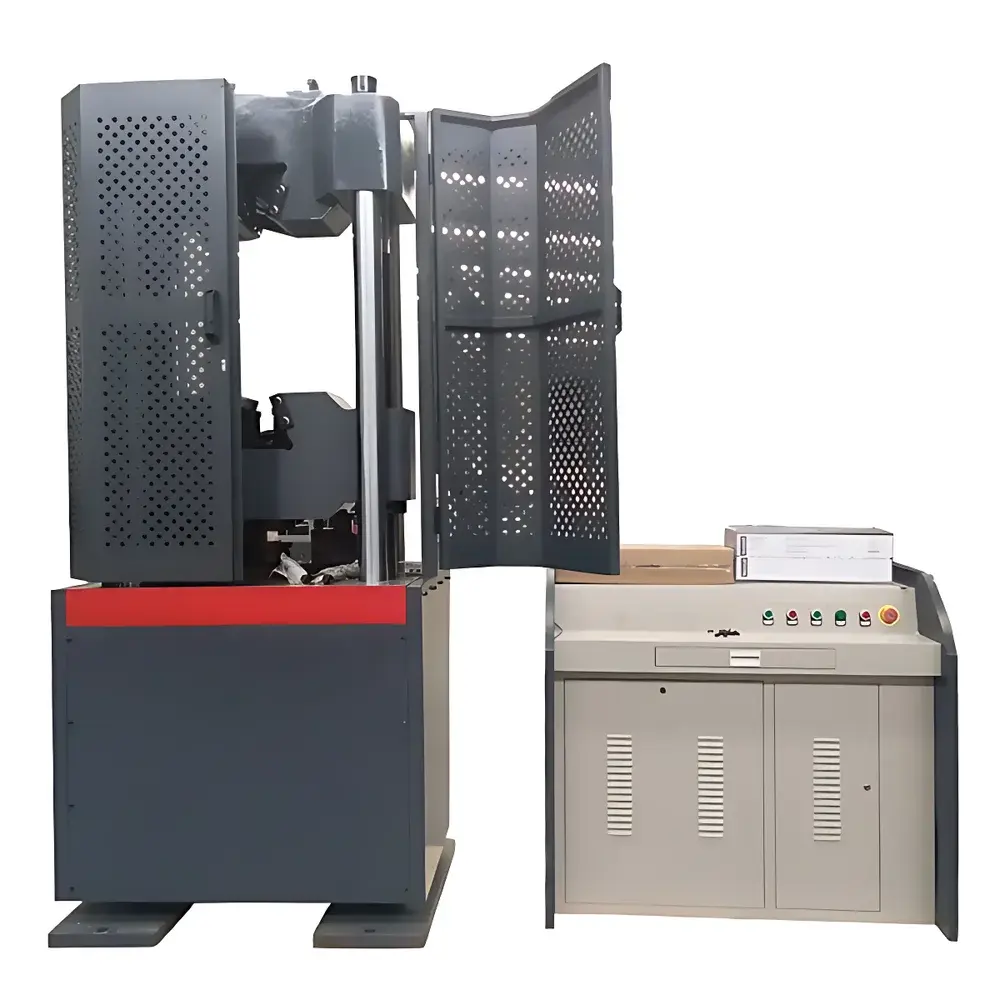
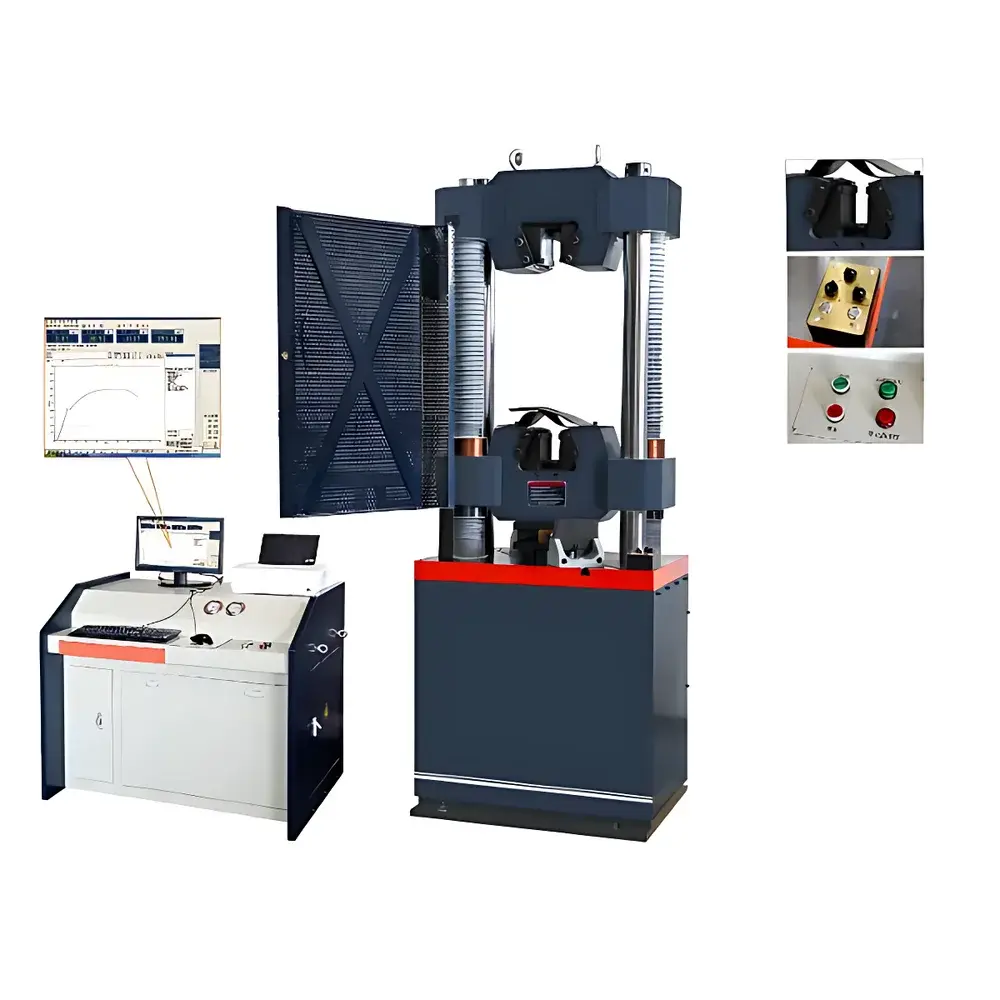
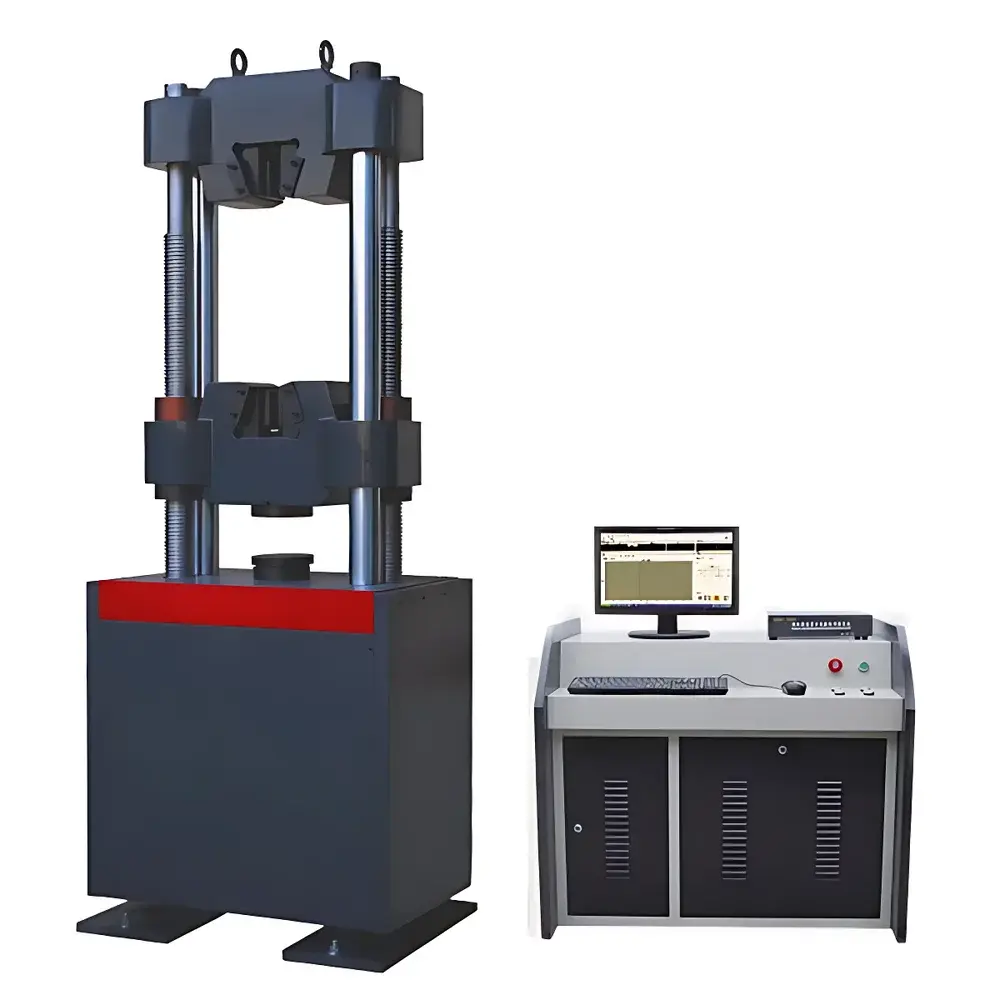
TuoFeng TFW-215 Electro-Hydraulic Servo Universal Testing Machine
| Brand | TuoFeng |
|---|---|
| Origin | Shanghai, China |
| Manufacturer Type | Direct Manufacturer |
| Product Category | Domestic |
| Model | TFW-215 |
| Instrument Type | Electro-Hydraulic Servo Testing Machine |
| Max Load Capacity | 1000 kN |
| Force Measurement Range | 1–100% of full scale |
| Force Resolution | 0.01 kN |
| Force Accuracy | ±1% of indicated value |
| Displacement Measurement | Optical encoder |
| Displacement Accuracy | ±1% of indicated value |
| Displacement Resolution | 0.01 mm |
| Tensile Space | 650 mm |
| Compression Space | 650 mm |
| Round Specimen Clamping Diameter | Φ13–40 mm |
| Flat Specimen Clamping Thickness | 0–15 mm |
| Clamping Method | Automatic hydraulic clamping |
| Piston Stroke | 250 mm |
| Maximum Piston Speed | 70 mm/min |
| Bending Support Roller Spacing | 40–600 mm |
| Bending Support Roller Width | 140 mm |
| Maximum Allowable Deflection | 100 mm |
| Shear Specimen Diameter | Φ10 mm |
| Compression Platen Dimensions | 204 × 204 mm |
| Host Dimensions (W×D×H) | 890 × 660 × 2200 mm |
| Control Cabinet Dimensions | 500 × 400 × 1200 mm |
| Power Supply | 3-phase, 2.2 kW |
| Weight | 3400 kg |
Overview
The TuoFeng TFW-215 Electro-Hydraulic Servo Universal Testing Machine is a high-capacity, dual-configuration mechanical testing system engineered for precision static mechanical characterization of metallic and high-strength non-metallic materials. It operates on the principle of servo-controlled electro-hydraulic actuation, where a high-pressure hydraulic circuit—driven by a variable-speed motor and regulated via a closed-loop proportional servo valve—delivers highly reproducible force output to the test specimen. The machine features a robust four-column, two-screw, oil-below structural architecture: tensile tests are conducted in the upper zone between the moving crosshead and fixed upper beam, while compression, bending, and shear tests occur in the lower zone between the lower crosshead and stationary base plate. This configuration ensures optimal load path alignment, minimal frame deflection, and long-term metrological stability under repeated high-load cycling up to 1000 kN.
Key Features
- Full digital multi-channel closed-loop control system supporting simultaneous stress, strain, and displacement control modes with seamless, impact-free transitions between control types
- Automatic hydraulic clamping mechanism with adjustable jaw geometry for round specimens (Φ13–40 mm) and flat specimens (0–15 mm thickness), ensuring uniform gripping pressure and minimizing slippage or premature failure
- High-resolution optical encoder-based displacement measurement with 0.01 mm resolution and ±1% accuracy across full stroke (250 mm piston travel)
- Force transduction calibrated to ±1% of reading over 1–100% of full-scale capacity (1000 kN), compliant with ISO 7500-1 Class 1 and ASTM E4 verification requirements
- Motor-driven crosshead positioning via precision planetary gearbox, chain drive, and recirculating ball screw assembly—enabling rapid, repeatable adjustment of test space (650 mm tensile/compression clearance)
- Integrated bending fixture with continuously adjustable support roller spacing (40–600 mm), 140 mm roller width, and 100 mm maximum allowable deflection—fully configurable per ISO 7438 and ASTM E290
Sample Compatibility & Compliance
The TFW-215 accommodates standardized metallic coupons per ASTM E8/E8M (tension), ASTM E9 (compression), ASTM E290 (bend), and ASTM F467/F467M (shear), as well as custom geometries within its physical envelope constraints. Its force and displacement metrology traceability aligns with national calibration standards (JJG 139–2014, China) and international benchmarks including ISO 7500-1, ISO 376, and EN 10002-2. The system supports compliance workflows for GLP and GMP environments: audit trails for method edits, user-level access control (administrator vs. operator tiers), and electronic signature-ready test reports generated in open Excel format—facilitating internal validation and external regulatory review (e.g., FDA 21 CFR Part 11 readiness when deployed with validated IT infrastructure).
Software & Data Management
The embedded Windows-based control software provides a modular, scriptable interface for test definition, real-time monitoring, and post-test analysis. Users may create, import, or export test procedures—including custom step sequences, pass/fail criteria, and conditional branching logic—without requiring third-party scripting. All raw data (force, displacement, time, extensometer if connected) are logged at ≥1 kHz sampling rate and stored in structured binary archives with metadata tagging (operator ID, timestamp, environmental notes). Report generation uses native Excel templates; users define column order, units, statistical functions (mean, SD, CV%), and graphical overlays (stress–strain, load–deflection, creep curves). Export formats include .xlsx, .csv, .pdf, and .xml for LIMS integration.
Applications
This system serves metallurgical R&D labs, quality assurance departments in heavy machinery and aerospace component manufacturing, and third-party certification bodies performing mechanical property verification per GB/T 228.1–2021, ISO 6892-1:2019, and EN 10002-1. Typical use cases include tensile yield strength and elongation-at-break evaluation of structural steels; compressive modulus and crushing behavior of cast iron or sintered alloys; three-point bending stiffness and fracture toughness estimation of weldments; and shear strength assessment of fastener materials and joint interfaces. Its 1000 kN capacity and thermal-mechanical stability also support elevated-temperature testing when integrated with optional furnace modules (not included).
FAQ
What standards does the TFW-215 comply with for force calibration?
It meets ISO 7500-1 Class 1 accuracy requirements and is verifiable per ASTM E4 and JJG 139–2014.
Can the system perform cyclic loading or fatigue tests?
No—the TFW-215 is designed exclusively for quasi-static monotonic testing; it lacks dynamic actuation capability and high-frequency control bandwidth required for fatigue or low-cycle endurance protocols.
Is an extensometer supported for strain measurement?
Yes—via optional analog or digital input channels compatible with clip-on, video, or laser extensometers meeting ASTM E83 Class B-1 specifications.
What maintenance intervals are recommended for the hydraulic system?
Oil filtration and level checks every 500 operational hours; full hydraulic oil replacement and servo valve inspection every 2,000 hours or annually, whichever occurs first.
Does the software support automated report generation for ISO/IEC 17025 accredited labs?
Yes—customizable Excel templates, electronic signatures, and full audit logs enable compliance with ISO/IEC 17025 clause 7.8.2 on reporting and clause 8.9 on management reviews.



