
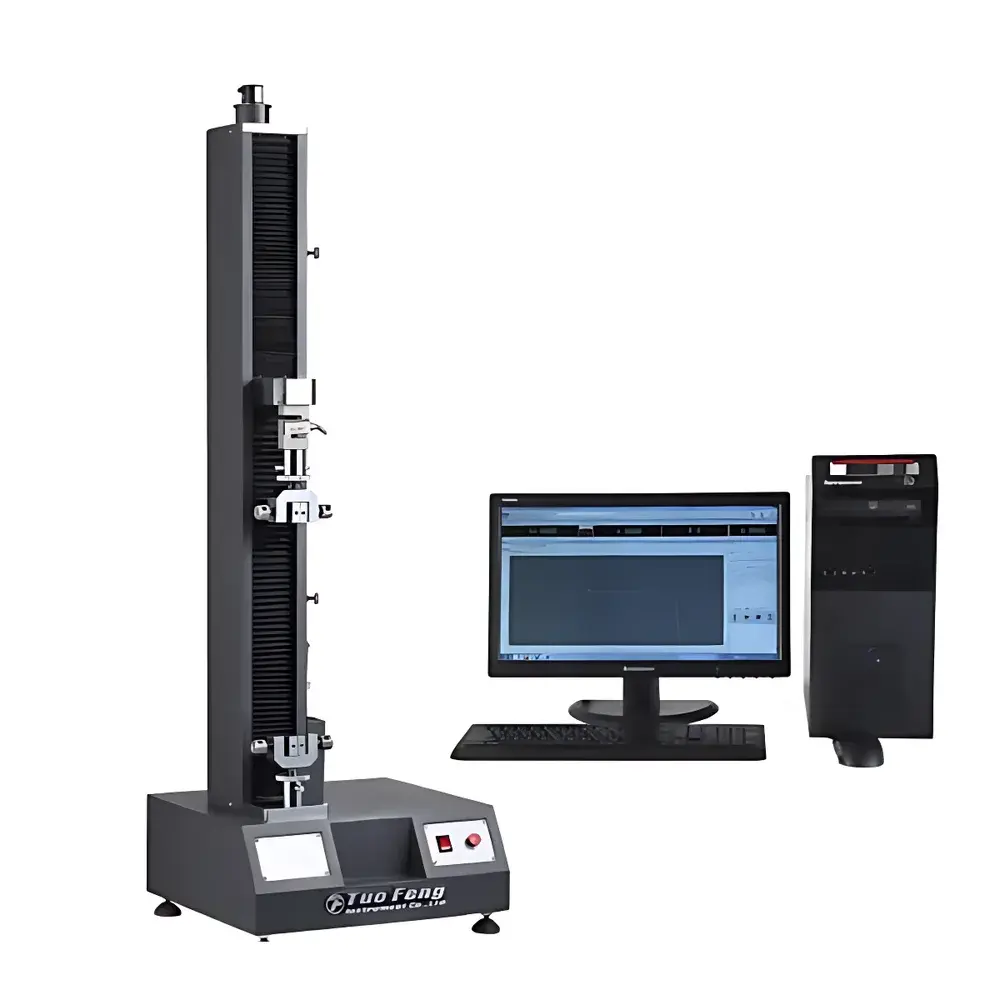
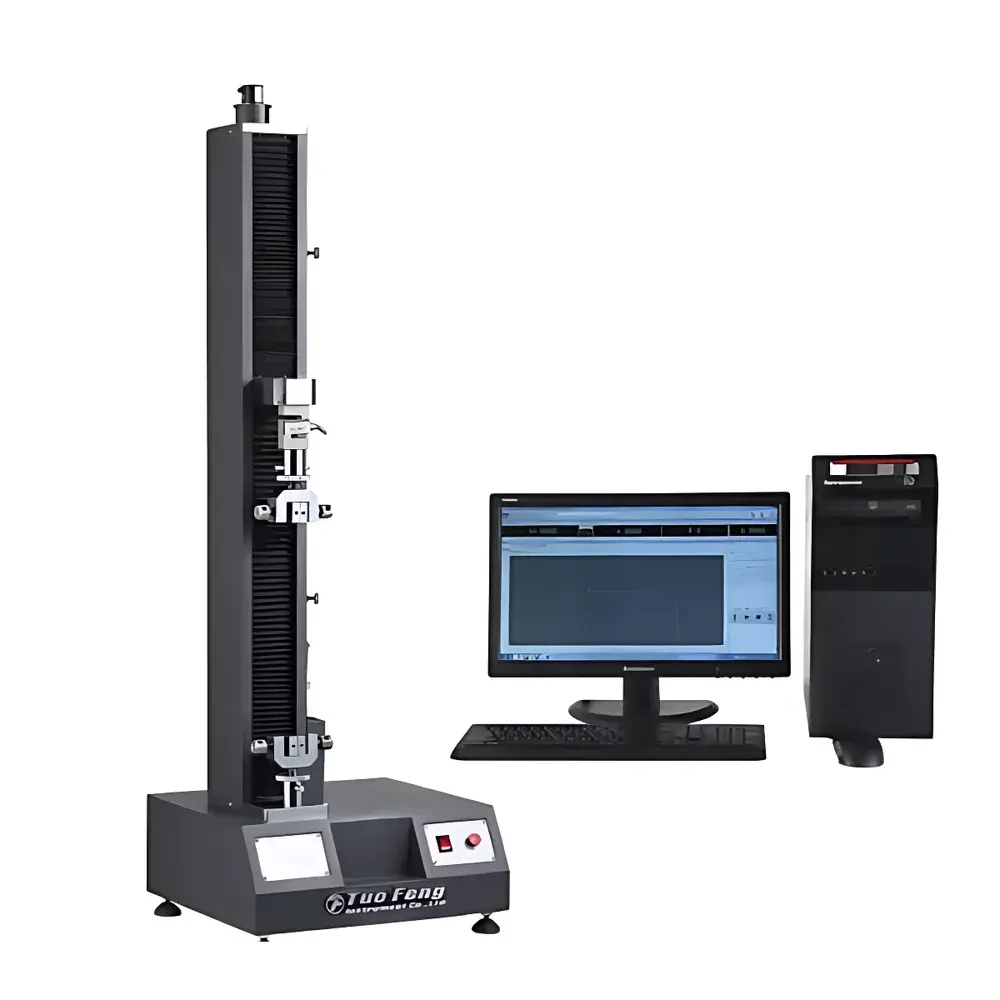
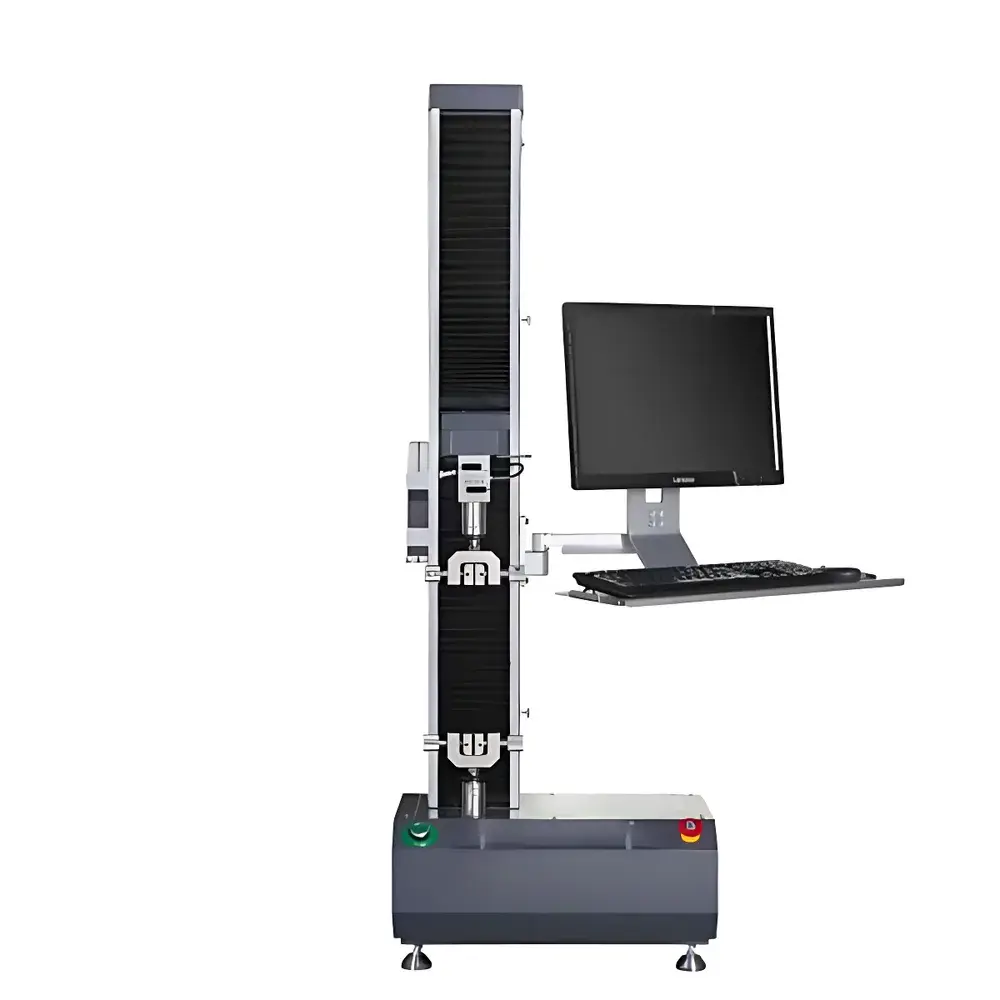
Tuofeng TFW-217 Electronic Tensile Testing Machine for Copper Foil Characterization
| Brand | Tuofeng |
|---|---|
| Origin | Shanghai, China |
| Manufacturer Type | Direct Manufacturer |
| Model | TFW-217 |
| Instrument Type | Electronic Tensile Testing Machine |
| Maximum Test Load | 5 kN |
| Force Measurement Range | 0.4%–100% of Full Scale (FS) |
| Force Accuracy | ±0.5% of reading |
| Crosshead Travel | 700 mm |
| Displacement Resolution | ±0.5% of reading |
Overview
The Tuofeng TFW-217 Electronic Tensile Testing Machine is an engineered solution for high-reproducibility mechanical property evaluation of thin metallic foils—particularly electrolytic copper foil used in flexible printed circuit boards (FPCBs), lithium-ion battery current collectors, and electromagnetic shielding applications. Designed around a servo-controlled electromechanical actuation system, the instrument applies uniaxial tensile loading under closed-loop displacement or load control, measuring force, elongation, and deformation response in accordance with standardized quasi-static testing protocols. Its rigid four-column frame, precision ball-screw transmission, and high-stiffness load cell (5 kN capacity, Class 0.5 per ISO 7500-1) ensure minimal compliance error and consistent data fidelity across low-force regimes typical of ultra-thin copper substrates (6–35 µm thickness). The system complies with fundamental mechanical testing principles defined in ASTM E8/E8M, ISO 6892-1, GB/T 228.1, and JIS Z 2241, enabling traceable generation of stress–strain curves, yield strength (Rp0.2), ultimate tensile strength (UTS), elongation at break (%A), and Young’s modulus for quality assurance and R&D validation.
Key Features
- High-resolution force measurement with ±0.5% accuracy over 0.4–100% FS range—critical for detecting subtle yield transitions in annealed or rolled copper foil
- 700 mm vertical crosshead travel with optical encoder-based displacement feedback (±0.5% accuracy), supporting both standard gauge lengths and extended elongation measurements
- Variable-speed drive (0.01–500 mm/min, infinitely adjustable) optimized for slow-rate creep-sensitive tests and rapid pre-load alignment
- Integrated electronic limit switches and emergency stop circuitry compliant with IEC 61800-5-2 functional safety requirements
- Three-speed motorized crosshead positioning (fast/medium/slow) with programmable return-to-start functionality for batch testing efficiency
- Overload protection set at 110% of full-scale load to prevent transducer damage during specimen rupture or fixture misalignment
- Modular fixture interface accommodating custom-designed clamping jaws for copper foil—e.g., pneumatic vise grips with serrated tungsten-carbide faces and low-pressure contact surfaces to avoid edge slippage or indentation
Sample Compatibility & Compliance
The TFW-217 is validated for testing specimens conforming to ISO 4047 (copper foil tensile test strips), ASTM B490 (standard dimensions for electrodeposited copper foil), and IPC-4562A (performance specifications for copper-clad laminates). It accommodates strip widths from 10 mm to 25 mm and thicknesses from 6 µm to 125 µm. Specimen mounting follows strict edge-alignment protocols to minimize bending moments; optional extensometer integration (contact or non-contact) supports strain measurement independent of crosshead displacement for enhanced modulus determination. All hardware and firmware meet CE marking requirements for machinery safety (2006/42/EC), and software architecture supports audit-ready operation per GLP and GMP environments—including user access levels, electronic signature capability, and 21 CFR Part 11–compliant data integrity controls when configured with optional validation packages.
Software & Data Management
The Windows-based control and analysis suite (compatible with Windows 10/11, 64-bit) provides deterministic real-time acquisition at ≥1 kHz sampling rate. Users select from multiple control modes: constant rate of extension (CRE), constant rate of loading (CRL), or load-hold sequences for relaxation studies. The interface supports multi-language switching (English, Simplified/Traditional Chinese), customizable unit systems (N/kN/lbf, mm/in, MPa/psi), and synchronized dual-axis plotting (e.g., stress–strain, load–displacement, or time–elongation). Automated calculations include tensile strength, yield point offset (Rp0.2), uniform elongation (Ag), total elongation (A50mm), and secant modulus. Raw data exports to CSV, Excel, or XML formats; graphical reports embed metadata (operator ID, timestamp, environmental conditions, calibration certificate ID). Built-in curve overlay tools enable comparative analysis across production lots or material grades, while password-protected administrator mode ensures configuration stability across shifts.
Applications
- Quality control of rolled-annealed (RA) and electrodeposited (ED) copper foil for tensile strength consistency across width and length
- Evaluation of thermal aging effects on foil ductility after lamination or solder reflow simulation
- Interfacial adhesion assessment via peel or pull-off tests using specialized fixtures (e.g., 90° peel jigs per ASTM D903)
- Mechanical benchmarking of surface-treated foils (e.g., brown oxide, black oxide, or silane coatings) for flex-circuit reliability
- Supporting DOE studies in foil manufacturing—correlating rolling reduction ratio, annealing temperature, and final mechanical performance
- Pre-compliance verification for UL 746E (polymeric materials in electrical equipment) and IPC-TM-650 (test methods manual) Section 2.4.1
FAQ
What standards does the TFW-217 support out-of-the-box?
It natively executes test routines aligned with ASTM E8/E8M, ISO 6892-1, GB/T 228.1, JIS Z 2241, and IPC-4562A—with method templates preloaded for copper foil geometry and loading conditions.
Can the system be calibrated to national metrology institute (NMI) traceability?
Yes. The load cell and displacement encoder are supplied with UKAS-accredited calibration certificates (or equivalent NMI documentation upon request), and the software supports user-initiated calibration verification using certified reference standards.
Is extensometer compatibility available as a factory option?
Yes. Both clip-on axial extensometers (for 10–50 mm gauge lengths) and non-contact video extensometers (for strain mapping on patterned foil) can be integrated at time of order or retrofitted post-delivery.
How is data integrity maintained during long-duration tests (e.g., 72-hour creep)?
The embedded controller features non-volatile memory buffering and automatic failover to local SSD storage if network interruption occurs; all timestamps are synchronized to UTC via NTP and logged with cryptographic hash signatures.
Does the machine support automated batch testing with barcode-triggered parameter recall?
When equipped with the optional AutoBatch module, the system reads specimen barcodes to auto-load test methods, fixture configurations, and pass/fail limits—reducing operator dependency and transcription errors.
Related Products



