
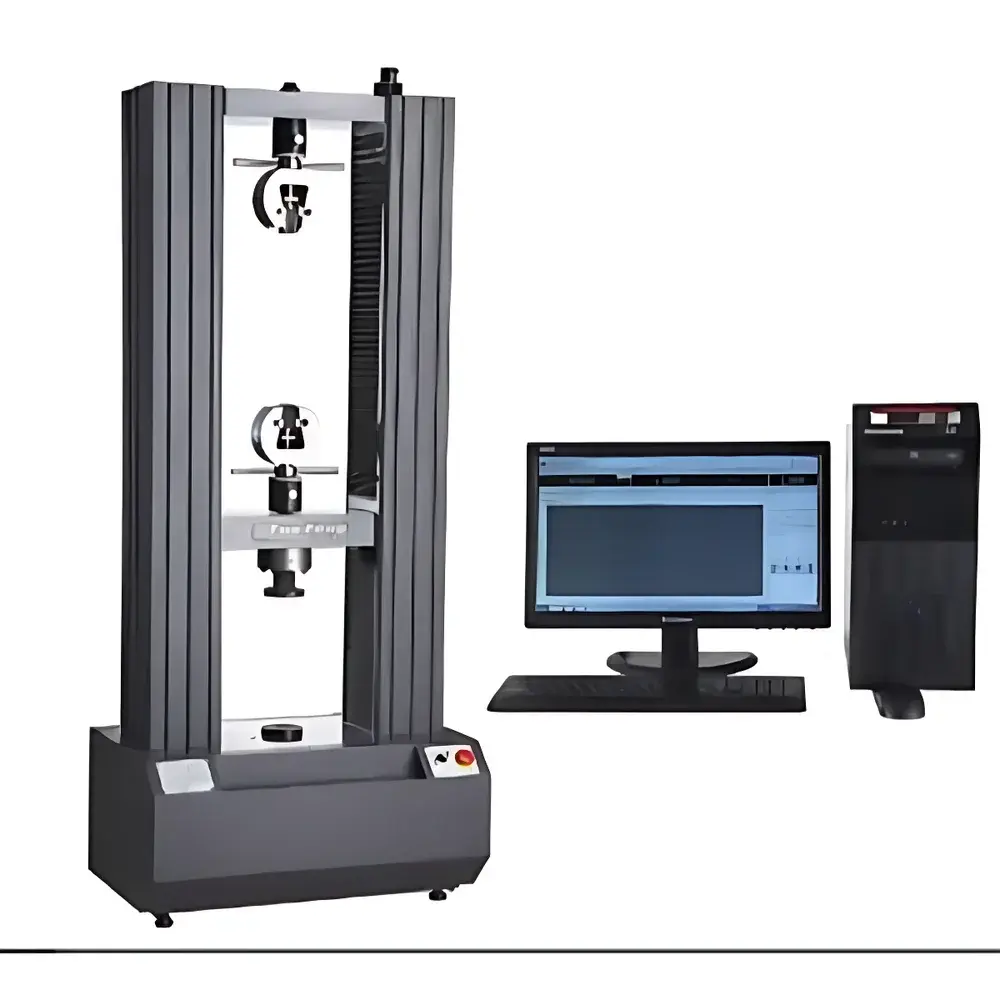
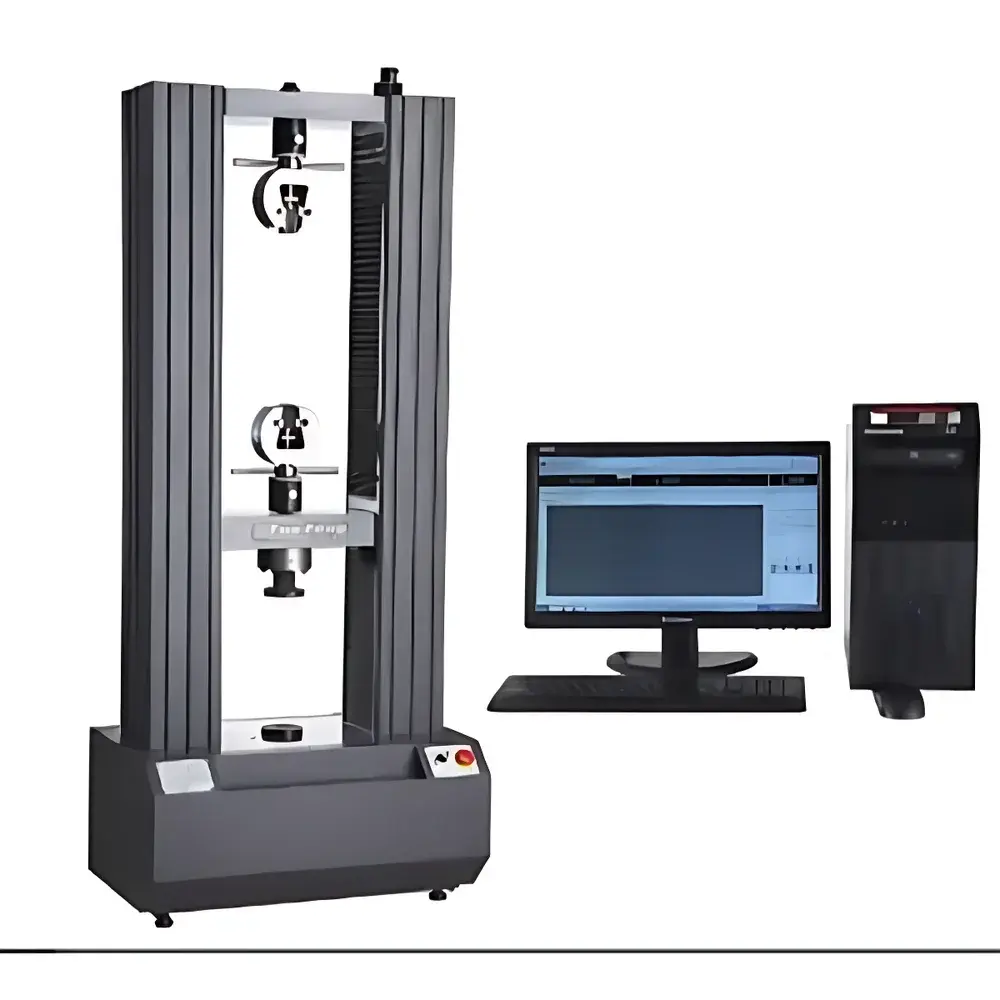
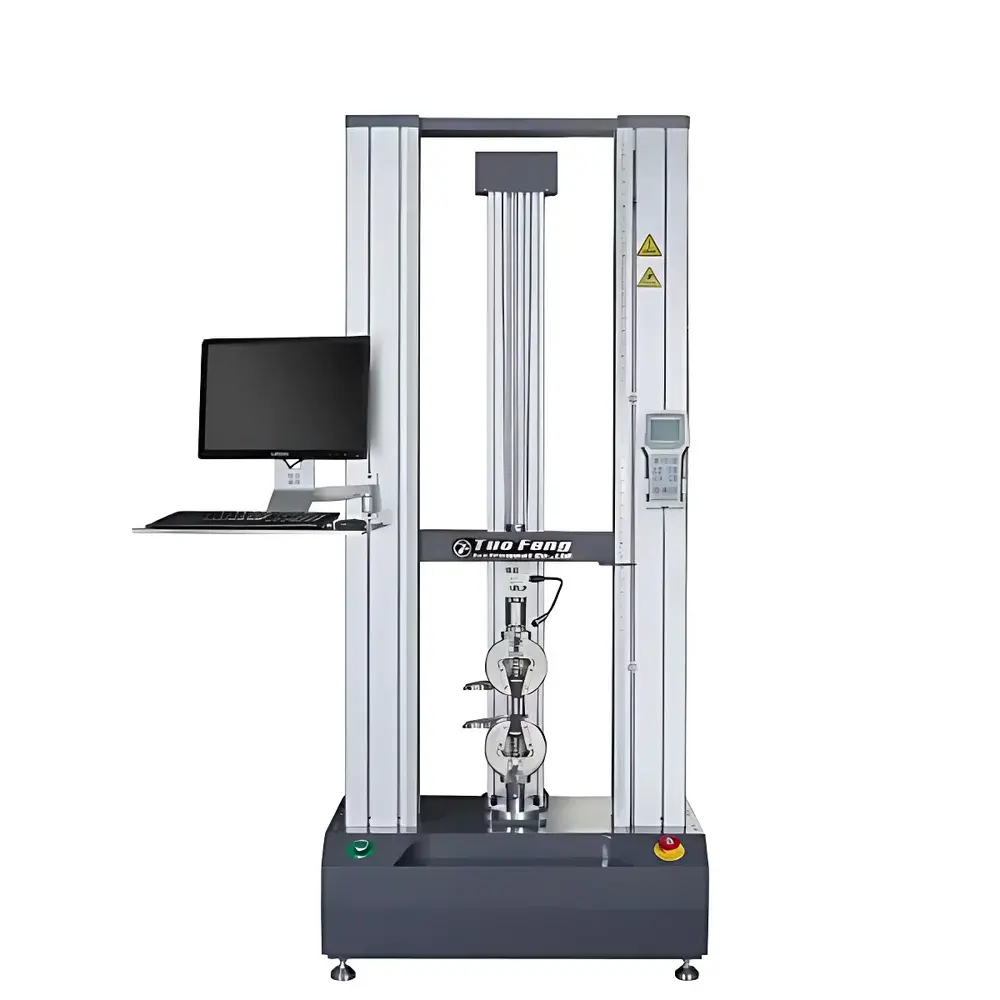
Tuofeng TFW-220 Microcomputer-Controlled Electromechanical Universal Testing Machine for Optical Fiber Cable Tensile Testing
| Brand | Tuofeng |
|---|---|
| Origin | Shanghai, China |
| Manufacturer Type | Direct Manufacturer |
| Instrument Type | Electromechanical Universal Testing Machine |
| Model | TFW-220 |
| Max Test Load | 200 kN |
| Accuracy Class | 0.5 |
| Effective Force Range | 0.2–100% of full scale |
| Force Measurement Accuracy | ±0.005% of reading |
| Force Resolution | 1/±500,000 counts (no range switching, constant resolution) |
| Drive System | Imported servo motor with worm gear reducer |
| Lead Screw | High-precision ball screw |
| Effective Test Width | 600 mm (customizable) |
| Tensile Stroke | 800 mm (extendable) |
| Speed Range | 0.001–500 mm/min (infinitely variable) |
| Displacement Measurement | Optical encoder |
| Displacement Accuracy | ±0.005% of reading |
| Strain Measurement | Optional electronic extensometer or large-deformation extensometer |
| Strain Accuracy | ±0.005% of reading |
| Safety Protection | Electronic limit switches, emergency stop button, overload protection (10% over capacity) |
| Crosshead Control | Dual-speed (fast/slow) automatic up/down with jog function |
| Return Mode | Automatic or manual high-speed return to initial position |
| Fixture Customization | Application-specific clamping solutions available |
| Compliance | GB/T 16491–2008, JJG 475–2008, ASTM E4, ISO 7500-1, DIN 51221, JIS B 7721 |
Overview
The Tuofeng TFW-220 is a microcomputer-controlled electromechanical universal testing machine engineered for high-precision tensile evaluation of optical fiber cables and related structural components. It operates on the principle of controlled axial force application via a servo-driven ball-screw actuation system, enabling accurate measurement of mechanical response under quasi-static loading conditions. Designed in accordance with international metrological and structural testing standards—including GB/T 16491–2008, JJG 475–2008, ASTM E4, and ISO 7500-1—the TFW-220 delivers traceable force measurement with 0.5-class accuracy and a force resolution of 1 part in ±500,000 full-scale counts. Its closed-loop control architecture ensures stable load ramping, dwell, and displacement tracking—critical for evaluating cable jacket integrity, fiber strain limits, sheath adhesion, and tensile failure modes per IEC 60794-1-2, Telcordia GR-20, and ITU-T L.35 specifications.
Key Features
- High-stiffness frame with precision-machined crosshead guidance and zero-backlash ball-screw transmission for minimal deflection and repeatable alignment.
- Imported servo motor coupled with a self-locking worm gear reducer, delivering smooth low-speed operation (0.001 mm/min) and rapid repositioning (up to 500 mm/min).
- Constant-resolution force transduction across the entire 200 kN range—no range switching required—ensuring linearity and repeatability from 0.2% to 100% FS.
- Dual-mode displacement feedback: high-resolution optical encoder for gross motion and optional calibrated electronic extensometers for localized strain measurement (e.g., fiber elongation within buffer tubes).
- Integrated safety architecture including programmable electronic limit switches, hardware-based emergency stop circuitry, and automatic overload cutoff at 110% of rated capacity.
- Motorized crosshead with dual-speed jog control and auto-return functionality—reducing operator intervention and minimizing test cycle time.
Sample Compatibility & Compliance
The TFW-220 accommodates optical fiber cables ranging from simplex drop cables (≤3 mm OD) to armored trunk cables (≤35 mm OD) using customizable jaw geometries—including pneumatic, wedge-action, and hydraulic clamping fixtures with serrated or lined contact surfaces to prevent slippage during high-force tensile tests. It supports standardized test configurations per IEC 60794-1-2 E1 (tensile), E3 (crush), and E11 (impact), as well as proprietary OEM qualification protocols. All force and displacement data are traceable to national standards through factory calibration certificates compliant with ISO/IEC 17025 requirements. The system meets GLP audit readiness criteria with configurable user access levels, electronic signature support, and full audit trail logging for test parameters, results, and operator actions.
Software & Data Management
The Windows-based testing software provides multi-mode control—including force-controlled, displacement-controlled, and time-controlled profiles—with real-time switching between load–time, stress–strain, and extension–time plots. Units for force (N, kN, lbf), displacement (mm, in), and strain (%) are freely convertible. Raw data streams are logged at ≥1 kHz sampling rate and stored in open CSV/Excel-compatible formats. The software supports batch analysis, curve superposition, statistical reporting (max/min/mean), and automated calculation of tensile strength, yield point, elongation at break, modulus of elasticity, and proof load retention. For regulated environments, optional 21 CFR Part 11 compliance modules provide electronic signatures, role-based permissions, and immutable audit trails—fully compatible with FDA-submission workflows and internal quality management systems.
Applications
- Tensile strength and elongation testing of optical fiber cables under ambient and elevated temperature conditions.
- Evaluation of cable jacket–buffer tube adhesion and fiber–coating interface integrity via peel and pull-out tests.
- Proof load verification for installation-rated cables (e.g., 600 N, 1500 N, 3000 N pre-installation validation).
- Mechanical qualification of splice closures, termination kits, and aerial messenger assemblies.
- Comparative fatigue assessment using cyclic tension protocols (e.g., 10⁴ cycles at 50% UTS).
- Support for R&D of bend-insensitive fibers, polymer-coated ribbons, and composite strength members (aramid, FRP, steel wire).
FAQ
Does the TFW-220 comply with IEC 60794-1-2 for optical cable qualification?
Yes—the system implements all mechanical test sequences defined in Clause E1 (tensile), E2 (torsion), and E11 (impact), with configurable load ramps, dwell times, and displacement thresholds aligned to standard requirements.
Can the software generate reports compliant with ISO/IEC 17025 or ASTM D638?
Yes—test reports include instrument identification, calibration status, environmental conditions, raw data traces, derived parameters, uncertainty estimates, and digital signatures when enabled.
Is it possible to integrate third-party extensometers or environmental chambers?
Yes—the system features analog and digital I/O ports supporting industry-standard LVDTs, video extensometers, and chamber communication protocols (Modbus RTU, RS-485).
What maintenance intervals are recommended for long-term metrological stability?
Annual recalibration against certified deadweight standards is advised; biannual verification of encoder linearity and force transducer zero drift is recommended for GMP/GLP applications.
Are custom fixture designs supported for non-standard cable geometries?
Yes—Tuofeng’s engineering team provides CAD-supported fixture co-design services, including finite element analysis of jaw contact stress distribution to prevent premature specimen damage.
Related Products



