
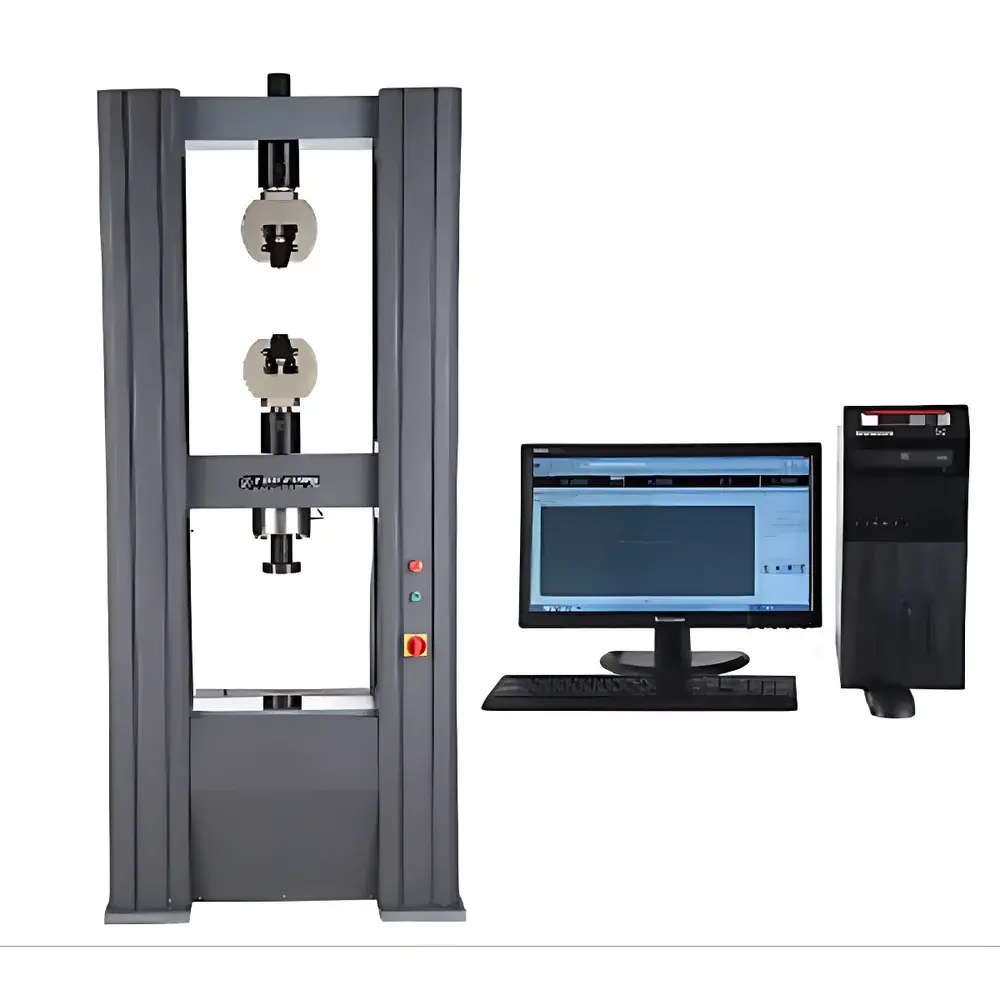
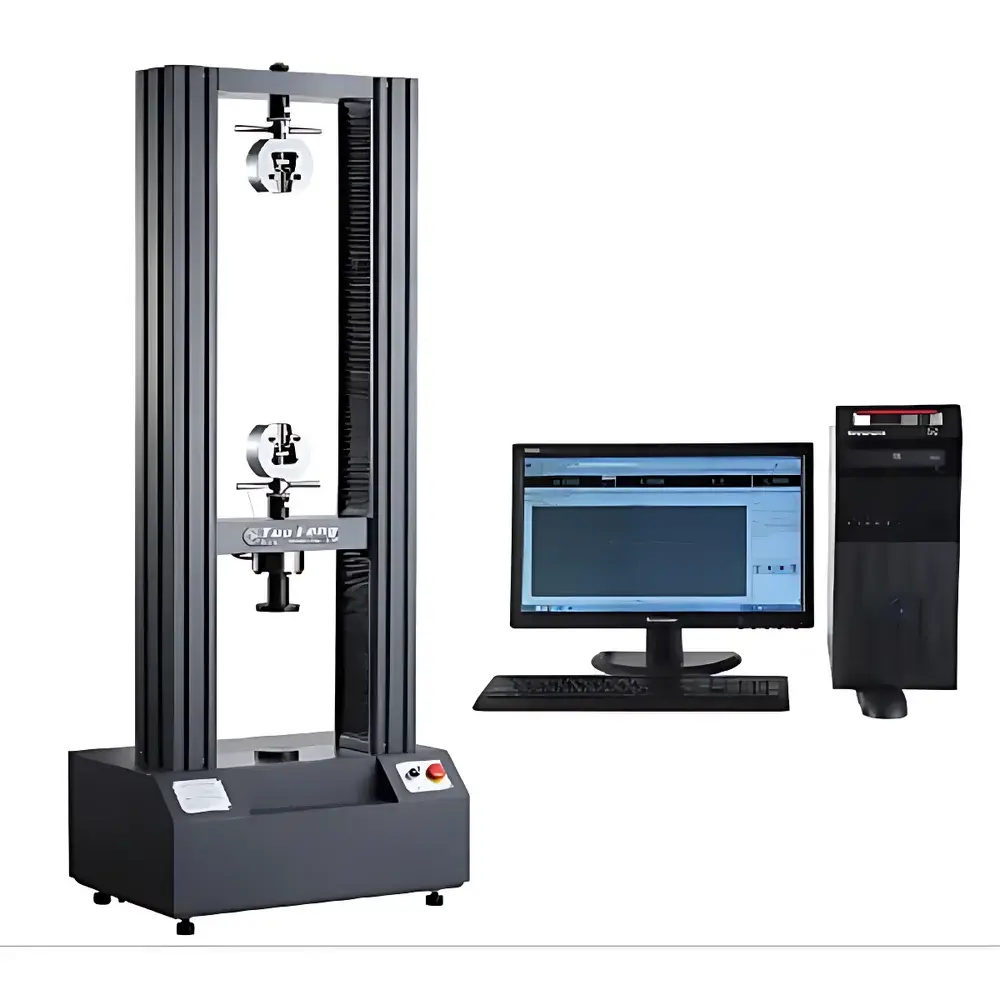
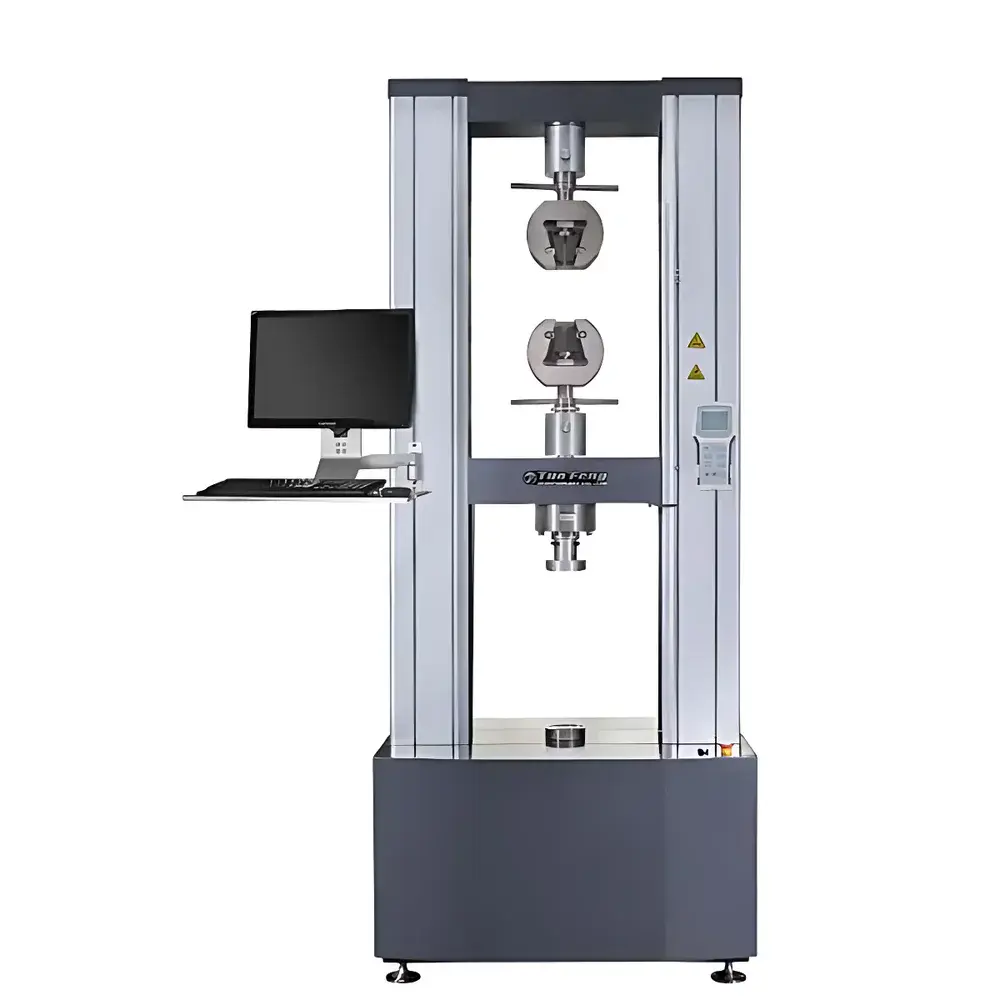
Tuofeng TFW-221 Microcomputer-Controlled Electronic Universal Testing Machine
| Brand | Tuofeng |
|---|---|
| Origin | Shanghai, China |
| Manufacturer Type | Direct Manufacturer |
| Instrument Type | Electronic Universal Testing Machine |
| Model | TFW-221 |
| Max Test Load | 20 kN |
| Accuracy Class | Class 0.5 |
| Effective Force Range | 0.2–100% of full scale |
| Force Measurement Accuracy | ±0.005% of reading |
| Resolution | 1 part in ±500,000 full-scale codes (no range switching) |
| Drive System | Imported servo motor with worm gear reducer |
| Lead Screw | High-precision ball screw |
| Effective Test Width | 600 mm (customizable) |
| Stroke | 800 mm (extendable) |
| Speed Range | 0.001–500 mm/min (infinitely variable) |
| Displacement Measurement | Optical encoder |
| Displacement Accuracy | ±0.005% of reading |
| Strain Measurement | Optional electronic extensometer or large-deformation extensometer |
| Safety Protection | Electronic limit switches, emergency stop, overload protection (110% FS), dual-speed motorized crosshead return |
| Power Supply | 220 V, 1.0 kW |
| Dimensions (W×D×H) | 1000 × 700 × 2000 mm |
| Approx. Weight | 450 kg |
Overview
The Tuofeng TFW-221 Microcomputer-Controlled Electronic Universal Testing Machine is an ISO/IEC 17025-aligned static mechanical testing system engineered for high-reproducibility tensile, compression, bending, shear, tear, peel, and burst testing of metallic, polymeric, composite, and elastomeric materials. Based on the fundamental principles of Hooke’s law and axial load–deformation response, the machine delivers traceable force measurement via a high-stability load cell and closed-loop servo control architecture. Its rigid frame design, precision-ground ball screws, and zero-backlash transmission ensure minimal deflection under load—critical for ASTM E4-compliant calibration verification and GB/T 16491-2008 conformance. The system meets JJG 475-2008 metrological verification requirements and supports full compliance with international standards including ASTM D638, ASTM D790, ISO 527, ISO 178, ISO 37, ISO 1133, JIS K7113, and BS EN 10002-1. Designed for integration into GLP/GMP environments, it provides audit-ready data integrity through timestamped test logs and user-access-controlled parameter settings.
Key Features
- Class 0.5 force accuracy per ISO 7500-1, validated across 0.2–100% of full-scale capacity (20 kN)
- High-resolution displacement sensing (±0.005% reading) using industrial-grade optical encoders
- True dual-speed crosshead actuation: rapid positioning (up to 500 mm/min) and precision testing (0.001 mm/min minimum)
- Modular extensometry support—including clip-on electronic extensometers (ASTM E83 Class B-1) and non-contact video extensometers (optional)
- Integrated safety triad: programmable electronic limits, hardware-based emergency stop circuitry, and automatic overload cutoff at 110% FS
- Thermally stable load cell with temperature-compensated signal conditioning and digital filtering
- Self-aligning, low-friction grip systems with customizable jaw profiles (flat, serrated, pneumatic, wedge-action)
Sample Compatibility & Compliance
The TFW-221 accommodates specimens ranging from thin films (<0.1 mm thickness) to structural metal coupons (up to 25 mm thick), with standard test widths up to 600 mm and extendable stroke (800 mm baseline). It supports standardized specimen geometries per ASTM E8, ISO 6892-1, and GB/T 228.1, and enables non-standard configurations via user-defined fixture mounting interfaces. All mechanical and electrical components comply with CE Machinery Directive 2006/42/EC and EMC Directive 2014/30/EU. Software operation adheres to FDA 21 CFR Part 11 requirements for electronic records and signatures when configured with audit trail, role-based access control, and electronic signature modules. Calibration certificates are NIST-traceable and include uncertainty budgets per ISO/IEC 17025 Annex A.5.
Software & Data Management
The Windows-based testing software offers six primary control modes: constant rate of extension (CRE), constant rate of loading (CRL), constant stress, constant strain, hold-to-load, and hold-to-strain. Real-time plotting includes synchronized force–time, force–displacement, stress–strain, and displacement–time curves, with on-screen dynamic readouts of peak load, yield point, modulus, elongation at break, and energy absorption. Data export supports CSV, XML, and PDF formats; reports embed metadata such as operator ID, environmental conditions (optional sensor input), calibration status, and test standard references. Multi-sample statistical overlays enable comparative analysis across batches or material lots. All raw data files are immutable upon generation, and system-generated audit trails record every parameter change, test execution, and user login event. Software updates are delivered via secure HTTPS channel with cryptographic signature verification.
Applications
This system serves as a core mechanical characterization platform in quality control laboratories and R&D centers across multiple sectors:
- Aerospace: tensile strength and elongation testing of aluminum alloys (e.g., 2024-T3, 7075-T6) and carbon-fiber prepregs per AMS 2750 and ASTM D3039
- Automotive: peel strength evaluation of adhesive-bonded joints (ISO 11339), rubber hysteresis testing (ISO 4664), and brake pad compressive modulus
- Medical devices: puncture resistance of packaging films (ASTM F1306), suture tensile strength (ISO 10555-1), and balloon burst pressure validation
- Electronics: bond pull testing of wire leads (MIL-STD-883 Method 2011), flex circuit fatigue cycling, and PCB substrate bending stiffness
- Construction materials: compressive strength of concrete cylinders (ASTM C39), flexural modulus of fiber-reinforced polymers (ASTM D7264)
FAQ
Does the TFW-221 support ASTM E23 for impact testing?
No—this is a quasi-static universal testing machine optimized for controlled-rate mechanical testing. Impact testing requires dedicated pendulum or drop-weight systems compliant with ASTM E23 or ISO 148.
Can third-party extensometers be integrated?
Yes—the system provides analog voltage (±10 V) and digital TTL trigger interfaces compatible with major OEM extensometers (e.g., MTS, Instron, Zwick), subject to firmware configuration.
Is remote diagnostics supported?
Yes—via optional secure VPN tunneling and encrypted remote desktop access, enabling real-time technical support without compromising network security.
What documentation is provided for regulatory submissions?
A complete IQ/OQ package—including installation checklist, operational qualification protocols, calibration certificates, and software validation summary—is available upon request for FDA, CE, or NMPA submissions.
How often does the system require recalibration?
Annual calibration is recommended per ISO/IEC 17025; however, internal verification using certified reference standards (e.g., NIST SRM 2241) should be performed before each test series in regulated environments.



