
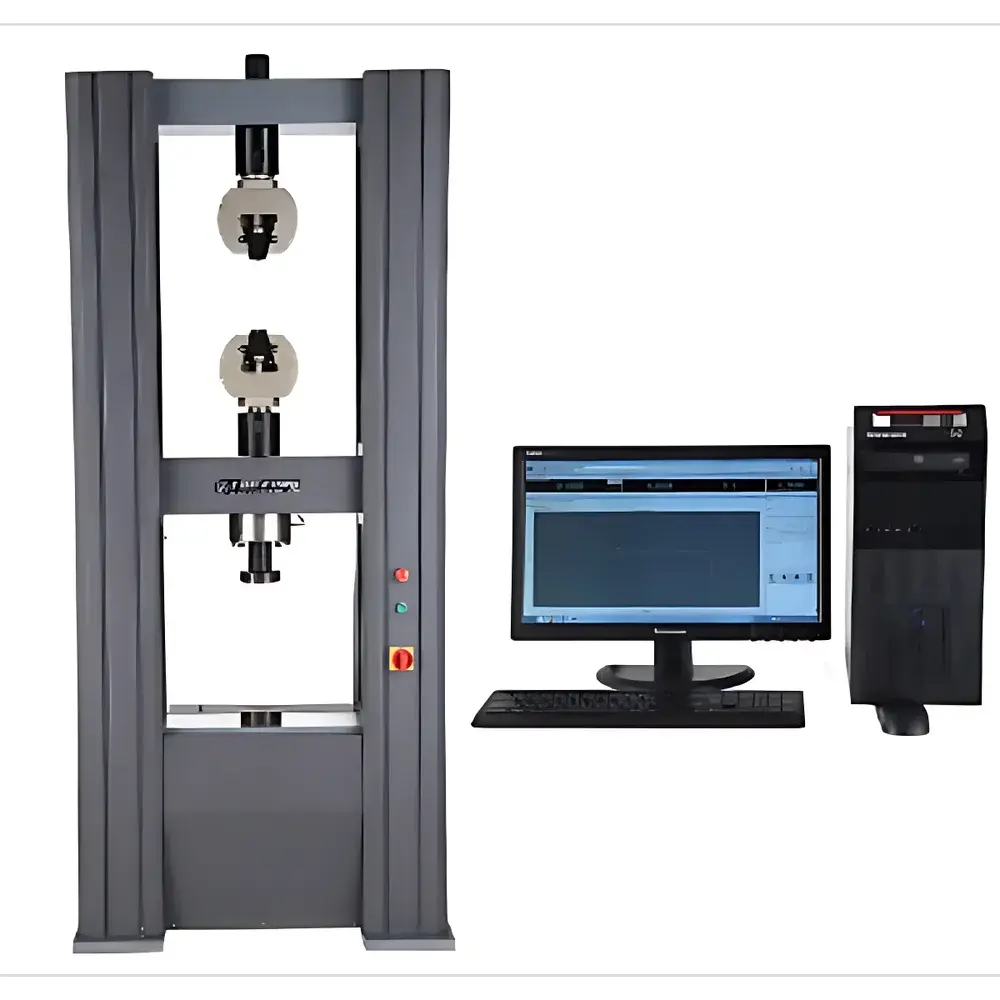
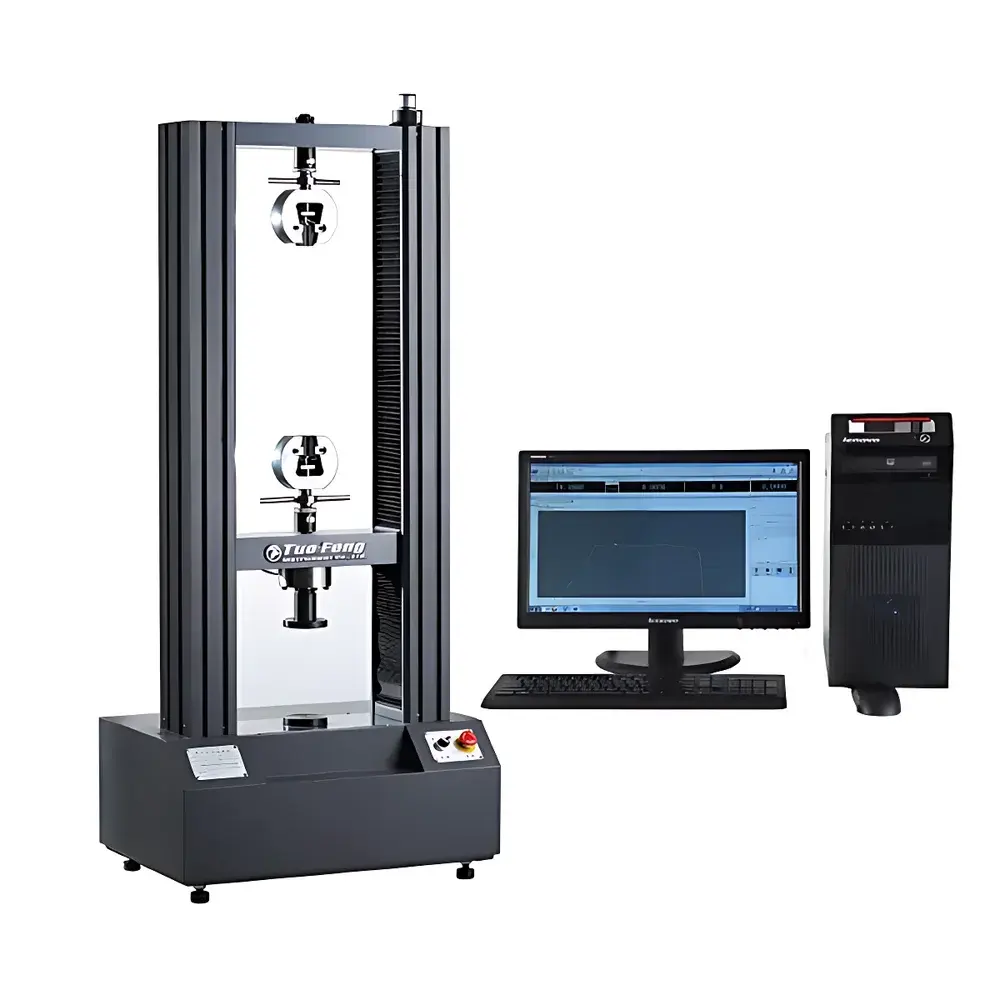
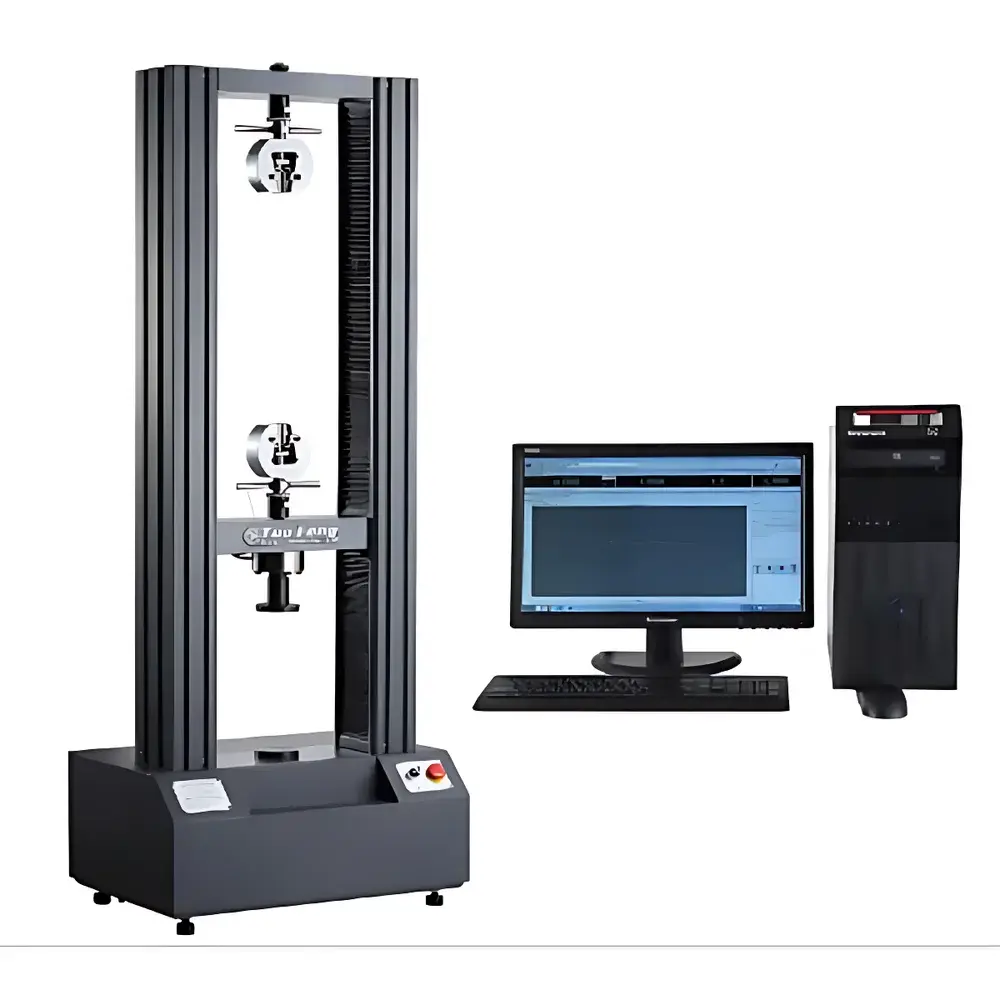
Tuofeng TFW-222 Microcomputer-Controlled Electronic Universal Testing Machine
| Brand | Tuofeng |
|---|---|
| Origin | Shanghai, China |
| Manufacturer Type | Direct Manufacturer |
| Instrument Type | Electromechanical Universal Testing Machine |
| Model | TFW-222 |
| Max Test Load | 20 kN |
| Accuracy Class | 0.5 |
| Effective Force Range | 0.2–100% of Full Scale |
| Force Measurement Accuracy | ±0.005% of Reading |
| Force Resolution | 1/500,000 Full Scale (Single Range, No Auto-Ranging) |
| Drive System | Imported Servo Motor + Worm Gear Reducer |
| Lead Screw | High-Precision Ball Screw |
| Effective Test Width | 600 mm (Customizable) |
| Stroke | 800 mm (Extendable) |
| Speed Range | 0.001–500 mm/min (Infinitely Variable) |
| Displacement Measurement | Optical Encoder |
| Displacement Accuracy | ±0.005% of Reading |
| Strain Measurement | Optional Extensometer or Large-Deformation Sensor |
| Strain Accuracy | ±0.005% of Reading |
| Safety Protection | Electronic Limit Switches, Emergency Stop, Overload Protection (110% FS), Dual-Speed Motorized Crosshead Control |
| Software | Windows-Based, Multi-Language (EN/ZH-T/ZH-S), ASTM/ISO/GB/JIS/DIN/BS Compliant Data Acquisition & Reporting Engine |
| Standards Compliance | GB/T 16491–2008, JJG 475–2008, ISO 6892-1, ASTM E4, ASTM E8, ASTM D638, ASTM D790, ASTM D3039 |
Overview
The Tuofeng TFW-222 is a microcomputer-controlled electromechanical universal testing machine engineered for high-fidelity mechanical property characterization of metallic, polymeric, composite, and ceramic materials. It operates on the principle of controlled axial force application via a precision servo-driven ball-screw actuation system, enabling static tensile, compressive, flexural, shear, tear, peel, and puncture testing in accordance with internationally recognized mechanical testing standards. Designed to meet the metrological and operational requirements of ISO/IEC 17025-accredited laboratories, the TFW-222 delivers traceable force measurement with 0.5-class accuracy per GB/T 16491–2008 and JJG 475–2008, ensuring data integrity for R&D validation, quality control, and regulatory submissions.
Key Features
- High-resolution force measurement system with 1/500,000 full-scale resolution and ±0.005% reading accuracy — no range switching required across the entire 0.2–100% test load span.
- Imported servo motor coupled with a low-backlash worm gear reducer and preloaded high-precision ball screw, enabling smooth, low-noise motion control from 0.001 to 500 mm/min.
- Dual-speed crosshead drive with programmable jog functionality and automatic return-to-initial-position post-test, reducing operator intervention and cycle time.
- Integrated electronic limit switches, emergency stop circuitry, and hardware-based overload cutoff (triggered at 110% of rated capacity) for fail-safe operation.
- Modular extensometry support: compatible with both clip-on axial extensometers (for modulus and yield determination) and large-deformation sensors (for elongation-at-break in elastomers and plastics).
- Robust structural frame with reinforced steel base and column assembly, designed to minimize deflection under peak loads up to 20 kN.
Sample Compatibility & Compliance
The TFW-222 accommodates specimens ranging from thin polymer films (<0.1 mm thick) to structural metal coupons (up to 25 mm thick), with standard grip widths of 600 mm and customizable options for wider or taller configurations. Its modular fixture interface supports standardized grips (e.g., wedge-action, pneumatic, hydraulic) as well as application-specific tooling for ASTM D638 tensile bars, ISO 527 specimens, ASTM D790 three-point bend fixtures, and ISO 1133 melt flow index sample holders. The system complies with calibration and verification protocols defined in JJG 475–2008 (China), ISO 7500-1:2018 (force calibration), and ASTM E4 (load verification). All test methods executed through the software are traceable to GB, ASTM, ISO, DIN, JIS, and BS standards — including but not limited to ASTM E8/E8M (tensile testing of metals), ASTM D3039 (composite tensile), and ISO 6892-1 (metallic materials tensile testing at ambient temperature).
Software & Data Management
The embedded Windows-based testing platform provides full GLP/GMP-aligned data governance. It supports multi-language UI (English, Simplified Chinese, Traditional Chinese), unit conversion (N/kN/lbf, mm/in, MPa/psi), and real-time display of up to four synchronized curves: load–time, load–displacement, displacement–time, stress–strain, and load–extension. Raw data streams are timestamped and stored in encrypted binary format with embedded metadata (operator ID, sample ID, environmental conditions, calibration certificate IDs). Audit trail functionality records all user actions—including method edits, result overrides, and report generation—satisfying FDA 21 CFR Part 11 requirements when configured with digital signature and role-based access control. Reports export to PDF, Excel, and XML; batch analysis tools enable statistical comparison (max/min/mean/stdev) across multiple specimens or material lots. Custom test modules can be integrated via documented API for specialized protocols such as creep, relaxation, or cyclic loading.
Applications
The TFW-222 serves as a primary mechanical characterization instrument across industrial and academic domains. In aerospace manufacturing, it validates tensile strength and elongation of aluminum alloys (e.g., 7075-T6) and carbon fiber-reinforced polymer (CFRP) laminates per ASTM D3039. In automotive R&D, it quantifies peel strength of adhesive bonds (ASTM D1876), puncture resistance of seat fabrics (ISO 13934-1), and compression behavior of foam components (ISO 3386-1). For wire and cable producers, it performs tensile testing of copper conductors (IEC 60851-1) and insulation jacket materials (UL 1581). In construction materials labs, it determines compressive strength of concrete cylinders (ASTM C39) and flexural strength of rebar-reinforced beams (ASTM C78). Universities utilize its open architecture for student experiments in solid mechanics, viscoelasticity, and fracture mechanics — supported by built-in calculation modules for Young’s modulus, Poisson’s ratio, yield offset (0.2%), and strain hardening exponent.
FAQ
What is the maximum allowable specimen height for compression testing?
The standard stroke is 800 mm, permitting compression tests on specimens up to ~750 mm tall when accounting for fixture clearance and safety margin. Extended-height columns are available upon request.
Does the system support closed-loop strain control?
Yes — when equipped with a calibrated extensometer, the controller enables closed-loop strain-rate control per ISO 6892-1 Annex A2 and ASTM E8 Annex A3.
Can test data be exported directly to LIMS or ERP systems?
Yes — the software supports ODBC-compliant database output and configurable CSV/XML templates for seamless integration with laboratory information management systems (LIMS) and enterprise resource planning (ERP) platforms.
Is third-party calibration certification included with delivery?
A factory-issued calibration certificate traceable to NIM (National Institute of Metrology, China) is provided. Optional UKAS or DAkkS-accredited calibration services are available prior to shipment.
What maintenance intervals are recommended for long-term accuracy retention?
Biannual verification of force transducer linearity and crosshead alignment is recommended. Annual recalibration of the displacement encoder and extensometer (if installed) ensures continued compliance with ISO 7500-1 and ISO 9513.



