
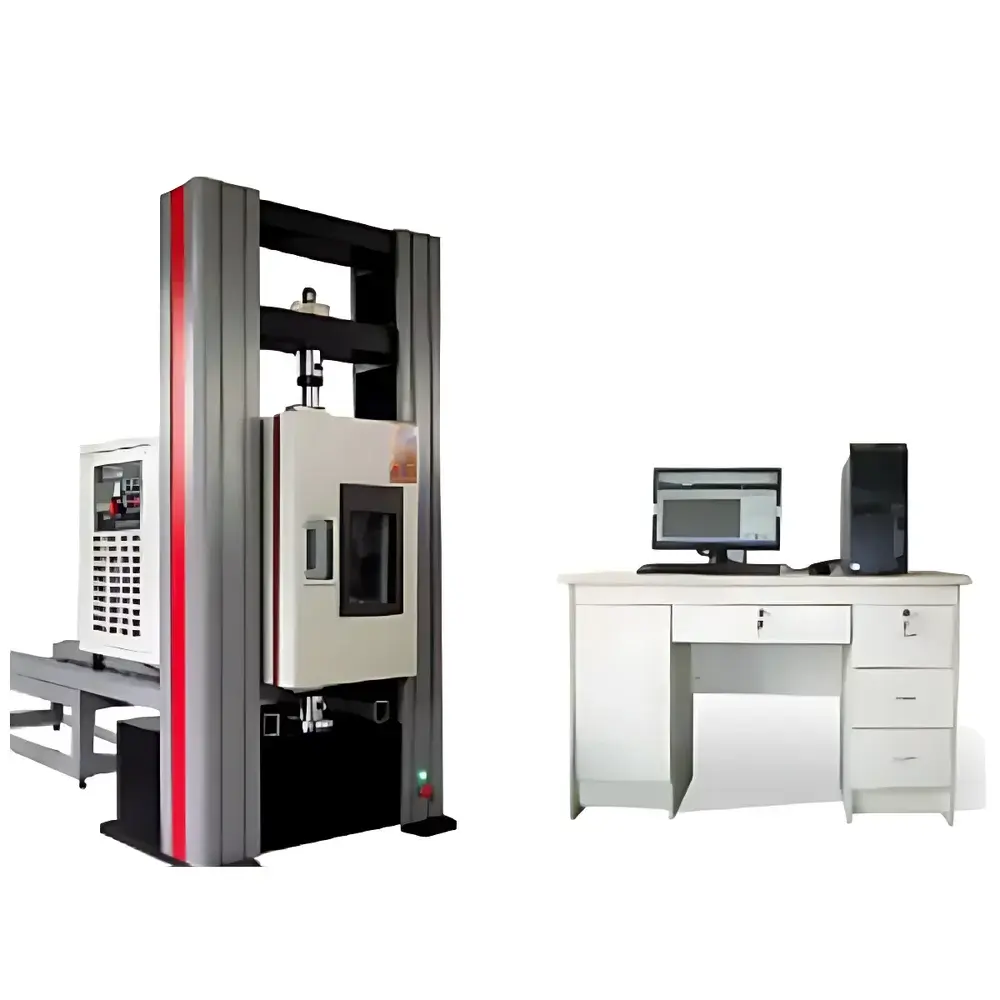
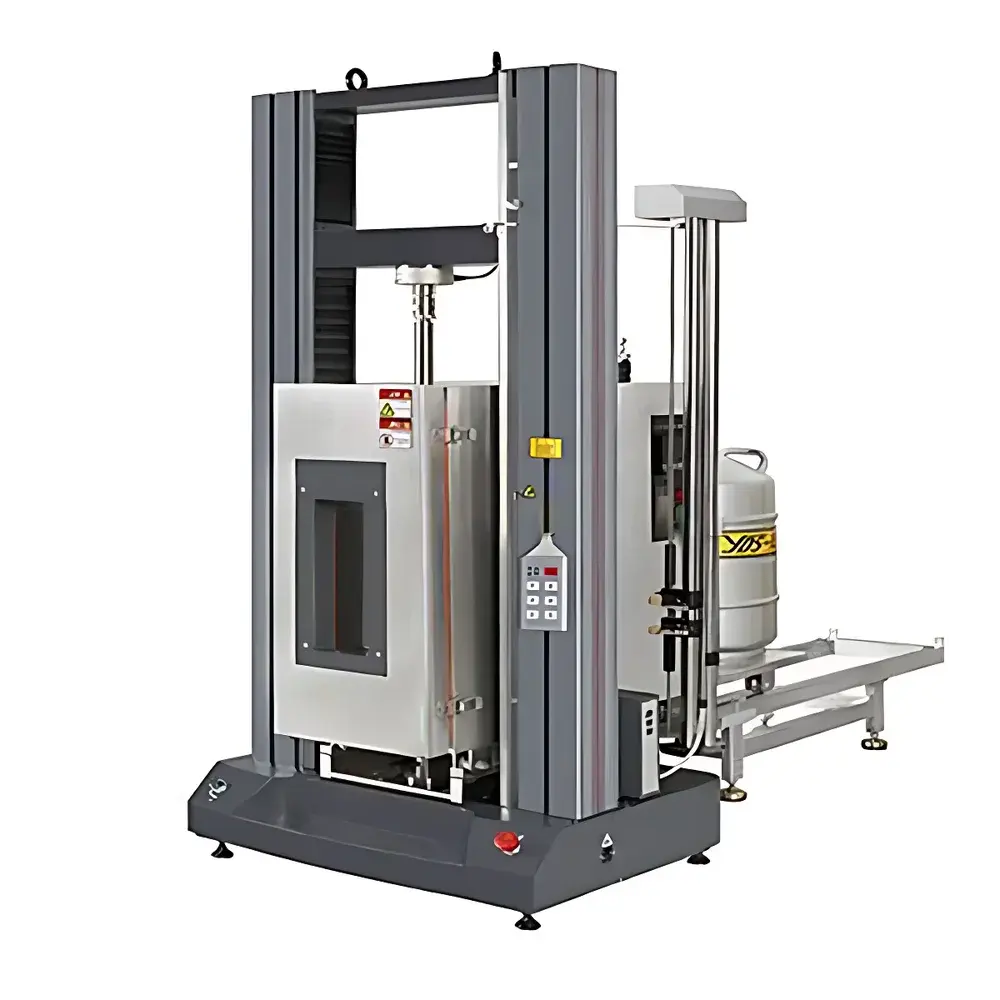
Tuofeng TFW-223 High-Temperature Electronic Universal Testing Machine
| Brand | Tuofeng |
|---|---|
| Model | TFW-223 |
| Type | Electromechanical Universal Testing Machine |
| Max Test Load | 5–100 kN (configurable) |
| Accuracy Class | 0.5 |
| Force Measurement Range | 0.4–100% FS |
| Force Resolution | 1/500,000 of Full Scale |
| Deformation Measurement Range | 0.2–100% FS |
| Deformation Resolution | up to 1/300,000 |
| Displacement Error | ±0.5% of reading |
| Column Spacing | 840 mm |
| Vertical Travel (within high-temp chamber) | 1000 mm |
| Host Dimensions | 1250 × 560 × 2400 mm |
| Weight | ~380 kg |
| Power Supply | AC 220 V / 50 Hz ±10%, 750 W |
| Environmental Operating Range | +5 °C to +35 °C |
| Temperature Chamber Range | –40 °C to +100 °C |
| Chamber Internal Dimensions | 360 × 300 × 500 mm (W×D×H) |
| Heating Power | 1.5 kW |
| Temperature Uniformity | ±2 °C over 100 mm vertical zone |
| Temperature Stabilization Time | ≤5 min (both above/below 0 °C) |
| Chamber Construction | 304 stainless steel exterior, 316 mirror-finish stainless interior, ceramic fiber insulation |
| Control System | Programmable PID with Pt100 sensors, LCD digital controller, dual-port (50 mm diameter) access with sliding thermal barrier blocks |
Overview
The Tuofeng TFW-223 High-Temperature Electronic Universal Testing Machine is an electromechanical force-testing platform engineered for precision mechanical characterization of metallic and non-metallic materials under controlled thermal conditions. It integrates a high-stiffness dual-column load frame with a programmable environmental chamber capable of stable operation from –40 °C to +100 °C, enabling standardized tensile, compression, flexural, peel, tear, and shear testing per ISO 6892-1, ASTM E8/E21, GB/T 228.1, JIS Z 2241, and DIN 50125. Unlike ambient-only systems, the TFW-223 maintains metrological integrity across temperature gradients through thermally compensated load cell mounting, low-drift displacement transduction, and real-time thermal drift compensation algorithms embedded in its control firmware. The system operates on servo-controlled ball-screw actuation with closed-loop position and load regulation, delivering repeatable strain rates from 0.001 to 500 mm/min—critical for creep, stress-relaxation, and rate-dependent property evaluation at elevated temperatures.
Key Features
- Modular high-temperature chamber with dual 50 mm-diameter access ports, sliding ceramic-fiber thermal barriers, and Pt100 sensor arrays for spatial temperature verification
- 0.5-class accuracy load measurement system with 1/500,000 full-scale resolution, validated per ISO 7500-1 and ASTM E4
- Force transducer mounted on thermally isolated subframe to minimize conduction-induced zero drift during prolonged high-temperature holds
- High-resolution extensometry support (optional clip-on or video-based) compliant with ISO 9513 Class 0.5 requirements
- Programmable temperature ramping (up to 100 °C in <30 min) and stabilization (≤5 min at target setpoint), verified per IEC 60068-3-5
- Rigid load frame with 840 mm column spacing and 1000 mm usable vertical travel—optimized for ASTM D638 dog-bone specimens and ISO 527 multipurpose bars
- AC servo motor drive with regenerative braking, enabling precise low-speed loading (e.g., 0.001 mm/min for creep protocols)
Sample Compatibility & Compliance
The TFW-223 accommodates standard test specimens per ASTM E8 (metals), ISO 527 (plastics), ASTM D3039 (composites), and GB/T 1040 (polymer films), including flat, round, and notched geometries up to 300 mm gauge length. Its chamber design permits in-situ gripping with pneumatic or wedge-action fixtures rated to 100 kN at 100 °C. All mechanical and thermal performance data are traceable to national standards via factory calibration certificates (ISO/IEC 17025-accredited). The system supports GLP-compliant audit trails, electronic signatures, and 21 CFR Part 11–ready software configuration when deployed in regulated environments such as pharmaceutical excipient qualification or aerospace material certification labs.
Software & Data Management
The Windows-based Tuofeng TestSuite v4.2 provides real-time multi-channel acquisition (load, displacement, temperature, extensometer), automatic parameter derivation (UTS, yield strength, modulus, elongation, reduction of area), and dynamic curve overlay for comparative thermal-series analysis. Raw data exports to CSV, Excel, and universal HDF5 formats; report templates comply with ISO/IEC 17025 documentation requirements—including operator ID, calibration status, environmental logs, and uncertainty budgets. Software modules support custom test sequences (e.g., “hold-at-load → ramp-temperature → retest”), statistical process control (SPC) charting, and automated pass/fail evaluation against user-defined specification limits. Audit trail records all parameter changes, test executions, and data exports with time-stamped, immutable entries.
Applications
- Thermal-mechanical property mapping of high-performance alloys (Inconel, Ti-6Al-4V) for turbine component validation
- Creep rupture life prediction of polymer composites used in automotive under-hood applications
- Low-temperature embrittlement assessment of cryogenic piping materials per ASME B31.3
- Adhesive bond strength degradation studies at service-relevant thermal cycles (e.g., –40 °C ↔ +85 °C)
- Quality assurance of ceramic matrix composites (CMCs) in aerospace structural components
- Academic research on viscoelastic transition behavior of shape-memory polymers and thermoplastic elastomers
FAQ
Does the TFW-223 meet ISO 17025 calibration requirements for accredited laboratories?
Yes—the base system includes NIST-traceable factory calibration reports for force, displacement, and temperature channels. Optional on-site recalibration services are available with full uncertainty budgets per ISO/IEC 17025 Annex A.
Can the system perform constant-load creep tests at 100 °C for 1,000 hours?
Yes—its thermally stabilized load train, low-drift amplifier architecture, and active thermal management enable extended-duration static load holds with ≤0.2% load deviation over 1,000 h at 100 °C.
Is the environmental chamber compatible with ASTM D618 conditioning protocols?
Yes—the chamber meets ASTM D618’s specified humidity exclusion and temperature uniformity criteria when operated in dry-air mode; optional purge gas inlet supports inert-atmosphere testing.
What extensometer options are supported for high-temperature strain measurement?
Standard support for contact-type high-temp extensometers (up to 1000 °C) and non-contact digital image correlation (DIC) systems with thermal lens correction; all interfaces comply with ASTM E83 Class B requirements.
How is thermal expansion of the load frame compensated during high-temperature testing?
The system applies real-time frame-thermal-expansion correction using embedded thermistor networks and pre-characterized CTE coefficients, ensuring displacement readings reflect true specimen deformation—not structural growth.



