
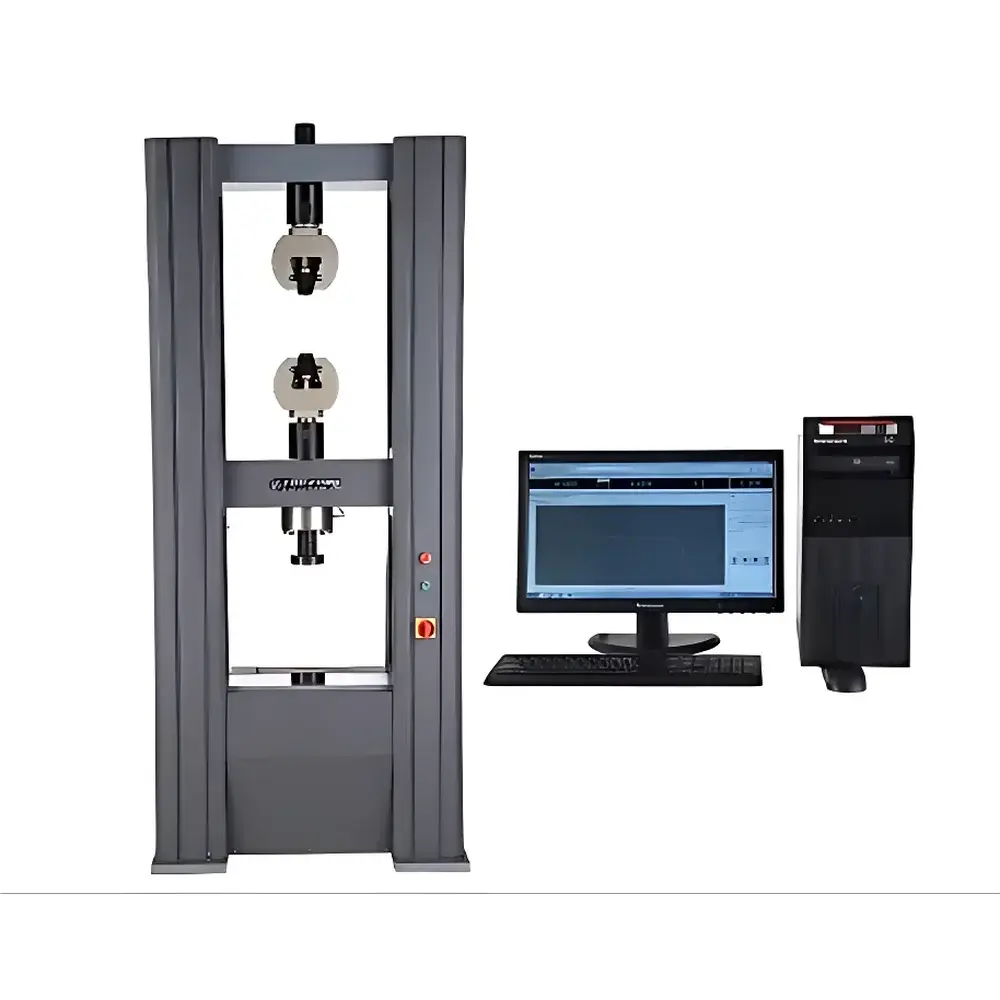
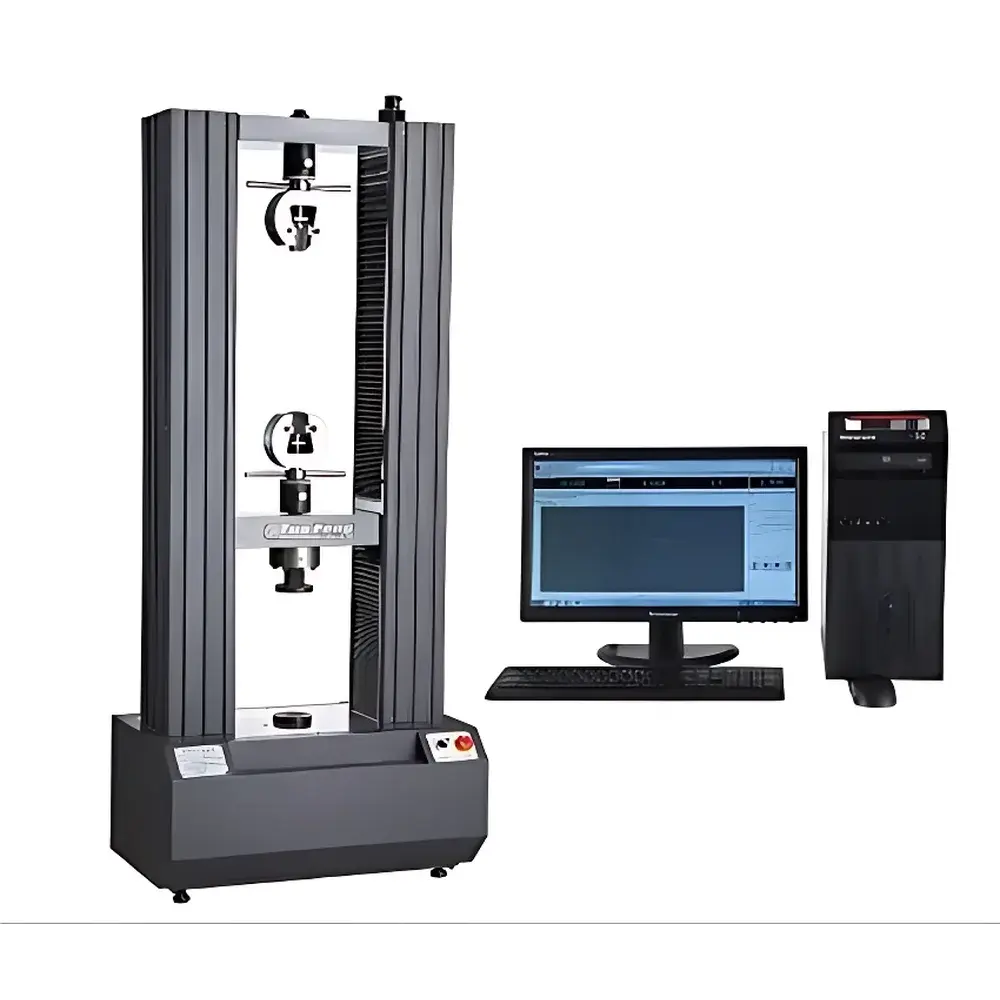
Tuofeng TFW-23 Dual-Column Microcomputer-Controlled Electronic Universal Testing Machine for Optical Fiber and Cable Tensile Testing
| Brand | Tuofeng |
|---|---|
| Origin | Shanghai, China |
| Manufacturer Type | Direct Manufacturer |
| Product Category | Domestic |
| Model | TFW-23 |
| Instrument Type | Electromechanical Universal Testing Machine |
| Standards Compliance | GB/T 16491-2008, JJG 475-2008, ASTM E4, ISO 7500-1, DIN 51221, JIS B 7721 |
| Maximum Test Load | 20 kN |
| Accuracy Class | 0.5 |
| Effective Force Range | 0.2–100% of full scale |
| Force Measurement Accuracy | ±0.005% of reading |
| Resolution | 1 part in ±500,000 full-scale counts (no range switching) |
| Drive System | Imported servo motor with precision worm gear reducer |
| Lead Screw | High-precision preloaded ball screw |
| Effective Test Width | 600 mm (customizable) |
| Stroke | 800 mm (extendable) |
| Speed Range | 0.001–500 mm/min (infinitely variable) |
| Displacement Measurement | Optical encoder |
| Displacement Accuracy | ±0.005% of reading |
| Strain Measurement | Optional electronic extensometer or large-deformation extensometer |
| Strain Accuracy | ±0.005% of reading |
| Safety Protection | Electronic limit switches, emergency stop button, overload protection (10% over capacity), dual-speed motorized crosshead control |
| Software | Windows-based, multilingual (English/Chinese), compliant with FDA 21 CFR Part 11 audit trail requirements (optional configuration), GLP/GMP-ready data logging |
| Power Supply | 220 V, 1.0 kW |
| Approx. Weight | 450 kg |
| Dimensions (W×D×H) | 1000 × 700 × 2000 mm |
Overview
The Tuofeng TFW-23 Dual-Column Microcomputer-Controlled Electronic Universal Testing Machine is a high-precision electromechanical system engineered for standardized tensile evaluation of optical fiber cables, including single-mode and multimode fibers, armored and loose-tube cable assemblies, and jacketed fiber optic ribbons. It operates on the fundamental principle of controlled uniaxial force application via a servo-driven ball-screw actuator, enabling precise load–displacement acquisition under ISO 527-1, IEC 60794-1-2, GR-206-CORE, and Telcordia GR-409-CORE test protocols. Designed to meet the mechanical validation requirements of fiber optic component manufacturers, cable producers, and third-party certification laboratories, the TFW-23 delivers traceable, repeatable results across critical parameters—including tensile strength, elongation at break, proof-test load retention, and creep behavior—under both static and dynamic loading conditions. Its rigid dual-column architecture minimizes lateral deflection during high-force testing, ensuring measurement integrity up to 20 kN with ≤0.5% uncertainty per ISO 7500-1 Class 0.5 verification.
Key Features
- Dual-column structural frame with reinforced aluminum alloy uprights and cast-iron base for minimal frame compliance and long-term dimensional stability
- Imported high-torque servo motor coupled with a self-locking worm gear reducer ensures zero-backlash motion control and consistent speed fidelity across the full 0.001–500 mm/min range
- Precision-ground preloaded ball screw assembly provides axial positioning repeatability within ±0.002 mm over 800 mm stroke
- Integrated electronic load cell with digital signal conditioning achieves 1:500,000 internal resolution and maintains linearity without range switching
- Real-time dual-channel acquisition: simultaneous sampling of load (1 kHz), displacement (1 kHz), and optional strain (via ASTM E83-compliant extensometers)
- Hardware-level safety interlocks: programmable electronic limit switches, hardware-triggered emergency stop circuitry, and automatic 110% overload cut-off
- Motorized crosshead with independent fast/slow mode enables rapid specimen setup and precise alignment prior to test initiation
Sample Compatibility & Compliance
The TFW-23 accommodates standardized fiber optic test specimens per IEC 60794-1-2 Method E1 (tensile), E3 (repeated bending), and E11 (crush resistance), as well as custom fixtures for ribbon fan-out, connectorized patch cords, and armored drop cables. Standard configurations include pneumatic wedge grips for bare fiber (125 µm cladding), serrated jaw sets for jacketed cables (up to Ø15 mm), and low-force micro-grips for coated fiber (250 µm acrylate). All mechanical interfaces are designed to minimize stress concentration and slippage—critical for accurate yield point detection in polymer-coated glass fibers. The system complies with national and international metrological standards: verified per GB/T 16491-2008 (China), JJG 475-2008 (China National Metrology Verification Regulation), ASTM E4 (Standard Practices for Force Verification), and ISO 7500-1 (Metallic Materials – Calibration of Force-Testing Machines). Optional calibration certificates are NIST-traceable and include uncertainty budgets.
Software & Data Management
The embedded Windows-based control and analysis software supports full lifecycle test management—from method definition to regulatory reporting. Users define test sequences using ISO/IEC 17025-aligned templates, including hold steps for proof-load verification (e.g., 100 N for 60 s), ramp-to-failure profiles, and cyclic loading per GR-206-CORE Annex A. Data acquisition meets FDA 21 CFR Part 11 requirements when configured with electronic signatures, audit trails, and role-based access control. Raw data (load, displacement, time, strain) are stored in vendor-neutral CSV and XML formats; processed results—including tensile modulus, breaking load, elongation %, and energy absorption—are exportable to LIMS or ERP systems. Curve overlay functionality enables comparative analysis across production lots or material batches. All reports embed instrument ID, operator credentials, environmental metadata (optional temperature/humidity input), and calibration status flags—ensuring full traceability for GLP, GMP, and ISO/IEC 17025 audits.
Applications
- Tensile proof testing of optical fiber preforms and finished draw towers per ITU-T G.652.D specification
- Mechanical qualification of indoor/outdoor fiber optic cables under IEC 60794-2 and EN 187000
- Evaluation of jacket adhesion strength in tight-buffered and loose-tube constructions
- Creep and stress-relaxation characterization of aramid yarn strength members (e.g., Kevlar®)
- Validation of splice closure housing integrity under longitudinal tension
- R&D testing of novel polymer coatings (e.g., nano-filled acrylates) for enhanced fracture toughness
- Third-party conformance testing for CE marking, RoHS, and UL listing submissions
FAQ
Does the TFW-23 support automated pass/fail judgment based on user-defined acceptance criteria?
Yes—the software allows configurable pass/fail thresholds for each measured parameter (e.g., “Breaking Load ≥ 600 N”, “Elongation ≤ 1.5%”), with real-time visual alerts and automatic report flagging.
Can the system be integrated with existing factory MES or SCADA infrastructure?
Yes—OPC UA and Modbus TCP communication protocols are supported; custom API endpoints can be enabled for bidirectional data exchange with enterprise systems.
Is thermal expansion compensation available for high-precision strain measurement?
Yes—when used with a calibrated extensometer and ambient temperature sensor, the software applies ISO 6892-1 Annex D corrections to reported strain values.
What is the recommended recalibration interval for routine QC use?
Per ISO/IEC 17025, annual verification against certified reference standards is required; interim checks using traceable load cells are advised before each shift.
Are test method templates available for specific telecom standards like Telcordia GR-409?
Yes—preloaded templates for GR-409-CORE, GR-206-CORE, and IEC 60794-1-2 are included; additional templates can be imported via XML schema.



