
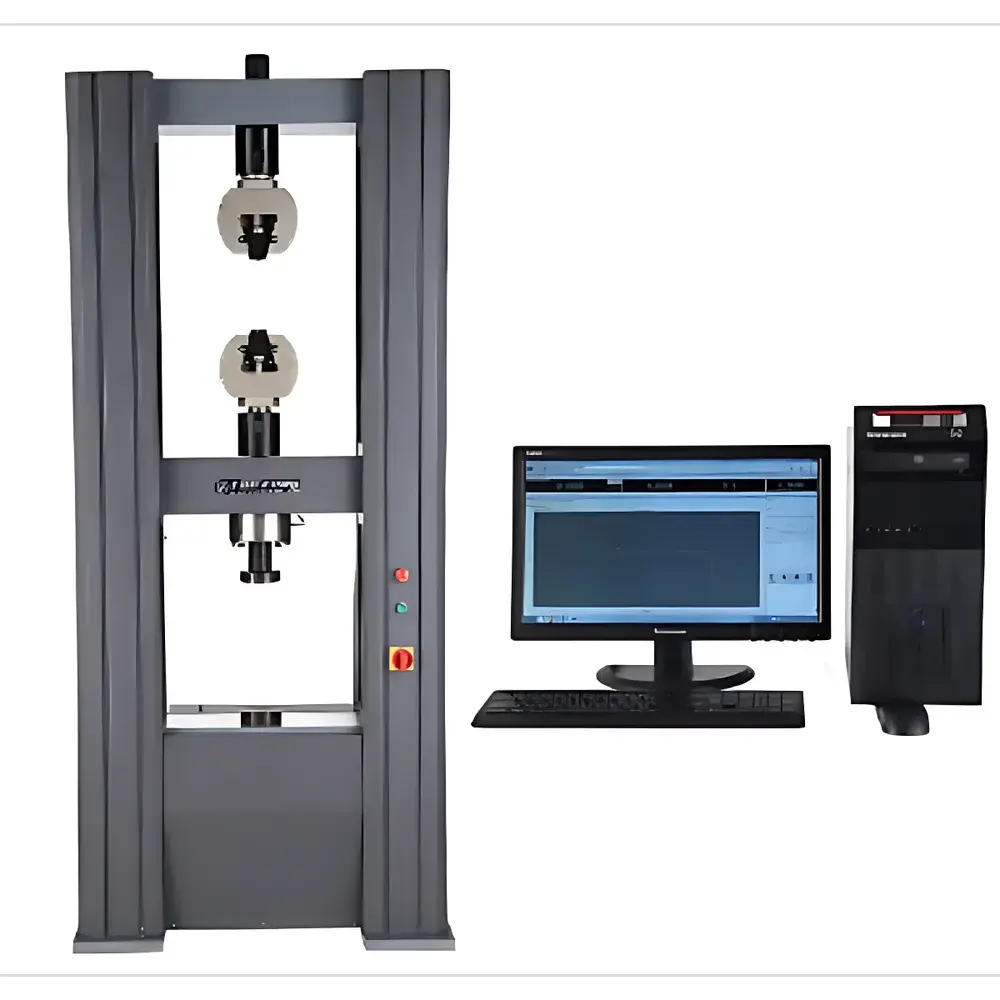
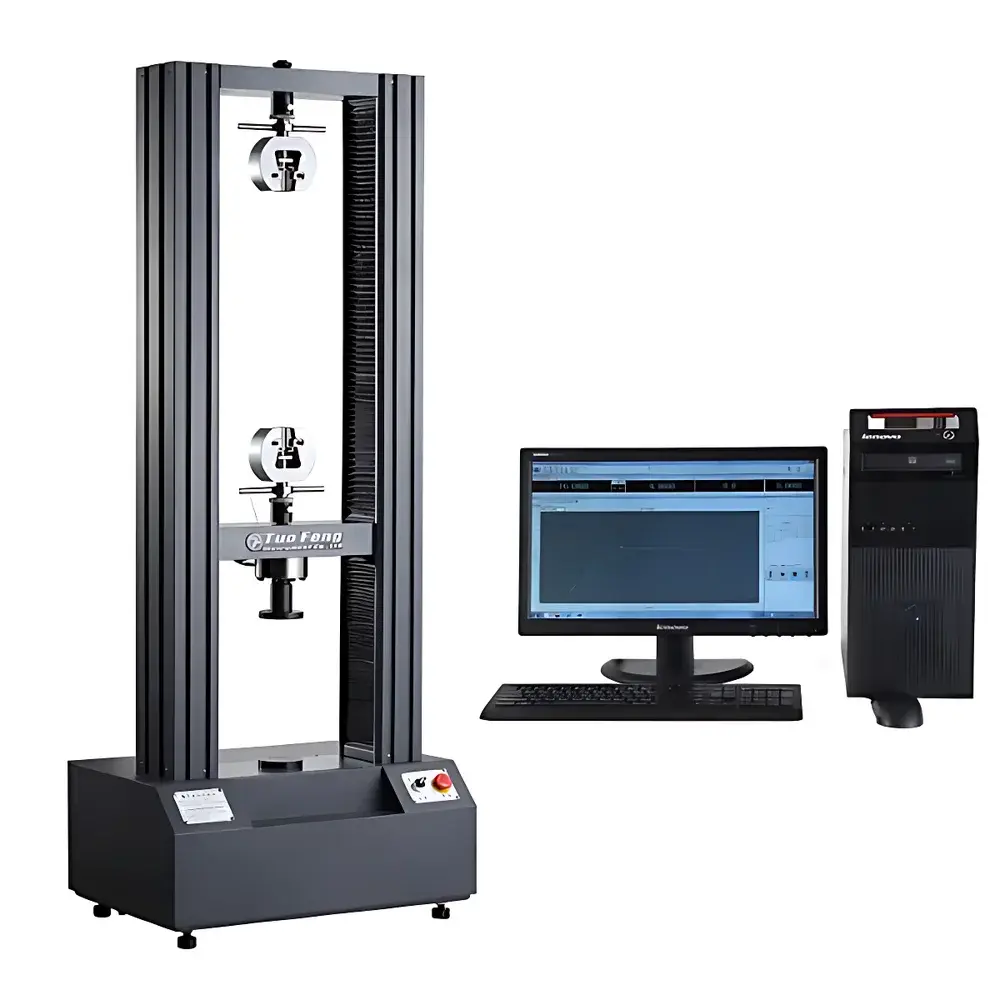
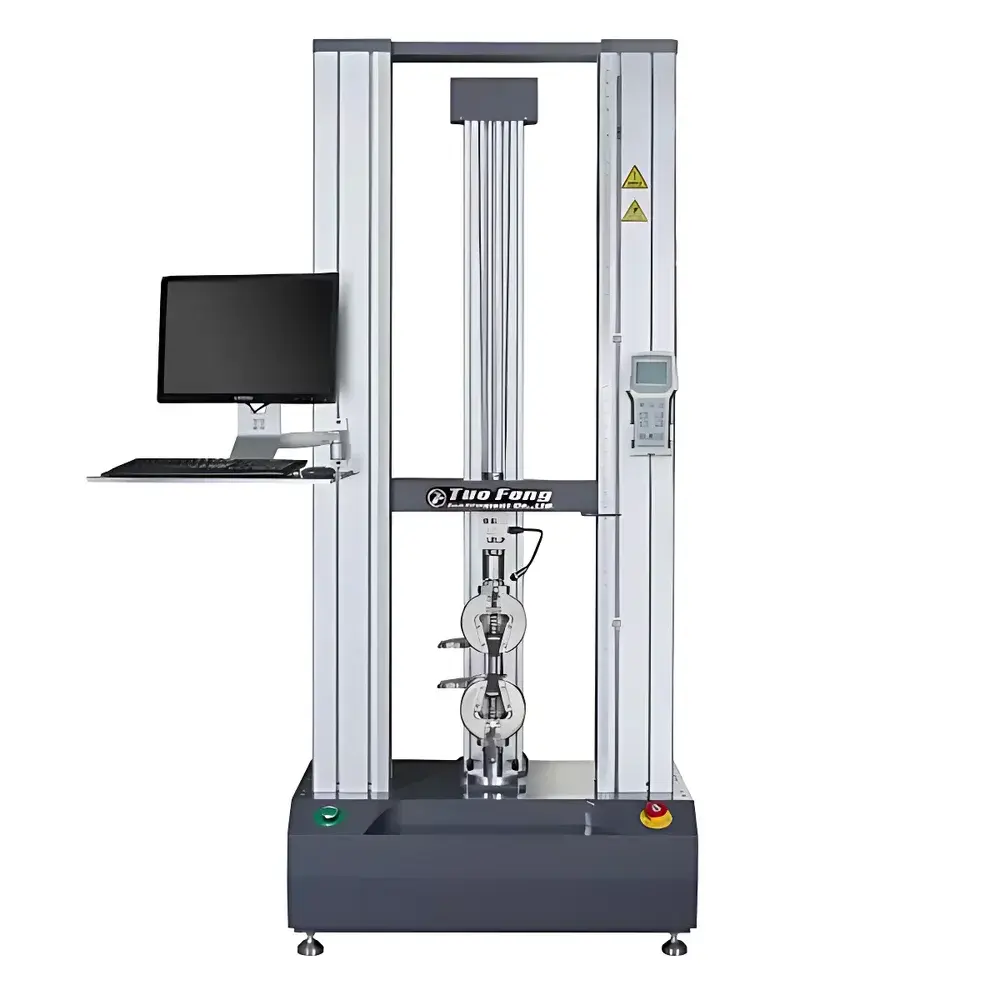
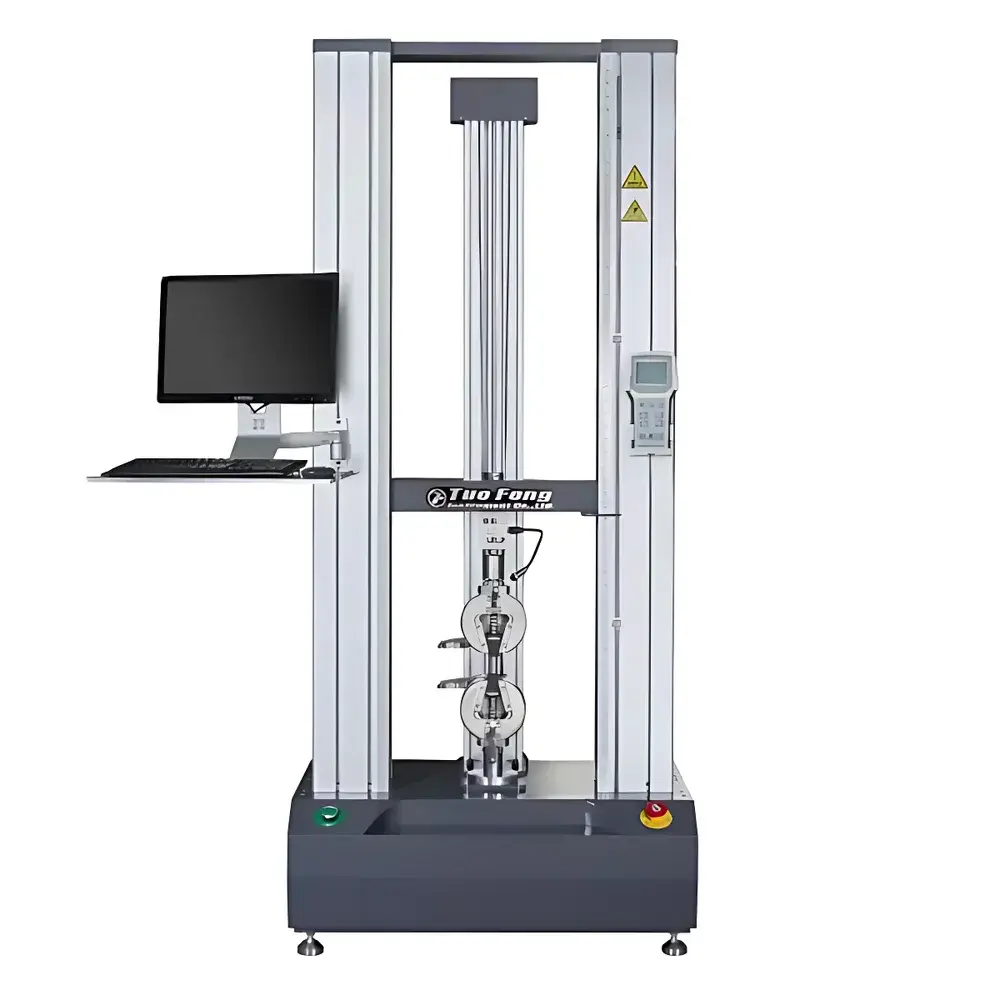
Tuofeng TFW-233 Automatic Terminal Pull-Off Tester
| Brand | Tuofeng |
|---|---|
| Origin | Shanghai, China |
| Manufacturer Type | Direct Manufacturer |
| Product Category | Domestic |
| Model | TFW-233 |
| Instrument Type | Electromechanical Universal Testing Machine |
| Standard Compliance | GB/T 16491-2008, JJG 475-2008, ASTM E4, ISO 7500-1, DIN 51221, JIS B 7721 |
| Maximum Test Load | 23.3 kN |
| Accuracy Class | 0.5 |
| Effective Force Range | 0.2–100% of full scale |
| Force Measurement Accuracy | ±0.005% of reading |
| Load Cell Resolution | 1 part in ±500,000 (full-scale, single-range, no auto-ranging) |
| Drive System | Imported servo motor with precision worm gear reducer |
| Lead Screw | High-precision preloaded ball screw |
| Effective Test Width | 400 mm (customizable up to 600 mm) |
| Stroke | 800 mm (extendable) |
| Speed Range | 0.001–500 mm/min (infinitely variable, programmable) |
| Displacement Measurement | Optical encoder |
| Displacement Accuracy | ±0.005% of reading |
| Strain Measurement | Optional extensometer or large-deformation transducer |
| Safety Protection | Dual electronic limit switches, emergency stop button, overload cutoff (>110% FS), mechanical hard stops |
| Crosshead Control | Dual-speed motorized lift (fast/slow), manual jog, automatic return-to-start |
| Power Supply | 220 V AC, 1.0 kW |
| Approx. Weight | 450 kg |
| Dimensions (W×D×H) | 1000 × 700 × 2000 mm |
Overview
The Tuofeng TFW-233 Automatic Terminal Pull-Off Tester is a high-precision electromechanical universal testing system engineered specifically for quantitative mechanical evaluation of electrical terminals, crimped connectors, solder joints, and wire harness assemblies. Unlike general-purpose tensile testers, the TFW-233 integrates purpose-built gripping fixtures, real-time load-displacement synchronization, and terminal-specific test protocols compliant with IPC-TM-650, UL 486A-B, IEC 60352-2, and SAE J1703. Its closed-loop servo control architecture ensures stable force ramping, precise dwell control, and repeatable separation initiation detection—critical for distinguishing between acceptable crimp deformation and catastrophic interfacial failure. The system operates on fundamental principles of axial force application under displacement-controlled or load-controlled boundary conditions, enabling direct measurement of pull-off strength, crimp retention force, yield onset, and post-yield displacement behavior. Designed for integration into production line QA/QC labs and R&D validation environments, it delivers metrologically traceable results aligned with GLP and ISO/IEC 17025 documentation requirements.
Key Features
- Terminal-optimized mechanical architecture: Reinforced crosshead assembly with zero-backlash ball screw drive and dual-position optical encoders for sub-micron displacement resolution.
- Modular fixture interface: Quick-change tooling plate supporting standardized terminal grips (e.g., MIL-STD-1344A compliant jaws), wire clamps, and PCB-mounted test adapters.
- Real-time failure detection algorithm: Embedded logic identifies first-load deviation, peak-force inflection, and sudden load drop (≥5% within 10 ms) to auto-truncate tests and flag marginal crimps.
- Dual-mode operation: Supports both constant-rate-of-travel (CRT) and constant-rate-of-load (CRL) control modes—essential for simulating in-service thermal cycling stress or connector mating forces.
- Integrated safety redundancy: Triple-layer protection including hardware-based emergency stop circuitry, software-enforced force ceiling (configurable up to 110% FS), and mechanical end-stop buffers.
- Thermal-stable load cell: Temperature-compensated 23.3 kN capacity sensor with drift <0.02% FS/°C over 10–40°C ambient range.
Sample Compatibility & Compliance
The TFW-233 accommodates terminals ranging from 20 AWG discrete wires to 0.5 mm² multi-strand harnesses, including insulated and bare copper/aluminum variants, tin-plated, nickel-coated, and gold-flashed contacts. Compatible with standard automotive (USCAR-21), aerospace (SAE AS7928), and telecom (Telcordia GR-1089) terminal geometries. All test sequences adhere to mandatory clauses in IPC-A-610 (Acceptability of Electronic Assemblies), IPC/WHMA-A-620 (Requirements and Acceptance for Cable and Wire Harness Assemblies), and UL 1977 (Component Connectors). Calibration certificates include NIST-traceable verification per ISO/IEC 17025 Annex A.2, with documented uncertainty budgets for force (<0.012% FS) and displacement (<0.008 mm).
Software & Data Management
The Windows-based TuofengTest Suite v4.2 supports 21 CFR Part 11-compliant user access control, electronic signatures, and full audit trail logging—including parameter changes, calibration events, and result modifications. Software modules include: (1) Predefined test templates for IPC 2.4.1 pull-off, UL 486 crimp validation, and custom multi-step sequences; (2) Real-time overlay of up to six concurrent curves (e.g., load vs. time, displacement vs. strain); (3) Automated pass/fail classification against user-defined limits (e.g., min. 120 N retention at 5 mm displacement); (4) Batch reporting with CSV/Excel export, PDF certificate generation, and SQL database connectivity for LIMS integration. All raw data files are stored in vendor-neutral HDF5 format with embedded metadata (operator ID, environmental temp/humidity, calibration date).
Applications
Primary use cases include crimp integrity validation for EV battery busbars, aerospace wire termination qualification per MIL-DTL-22520, medical device cable assembly release testing (ISO 10993-18), and consumer electronics connector reliability screening. Secondary applications cover tensile strength of solder joints (IPC-J-STD-001), peel adhesion of insulation sleeves, and shear resistance of press-fit pins. The system serves as a reference platform for internal method development aligned with ASTM F1527 (Standard Guide for Evaluating Electrical Connector Performance) and supports root-cause analysis via synchronized high-speed imaging (optional camera module).
FAQ
What standards does the TFW-233 natively support for terminal pull-off testing?
The system includes built-in test methods for IPC-TM-650 2.4.1, UL 486A-B Section 12, IEC 60352-2, and SAE J1703, with configurable parameters for force ramp rate, dwell duration, and acceptance thresholds.
Can the TFW-233 be integrated into an automated production line?
Yes—it features Ethernet/IP and Modbus TCP interfaces for PLC synchronization, digital I/O signals for start/stop/OK/NG feedback, and recipe-driven operation via external MES systems.
Is third-party calibration documentation included upon delivery?
Each unit ships with a factory calibration certificate traceable to NIST, covering force (0.5–100% FS), displacement (0–800 mm), and speed (0.001–500 mm/min), validated per ISO 7500-1 and JJG 475-2008.
How is software validation handled for regulated industries?
Tuofeng provides IQ/OQ documentation packages, installation qualification checklists, and operational qualification test scripts compliant with FDA guidance for computerized system validation (CSV).
What maintenance intervals are recommended for long-term accuracy?
Annual recalibration is advised; biannual verification of load cell linearity and encoder resolution using certified reference standards is required under ISO/IEC 17025-accredited quality systems.



