
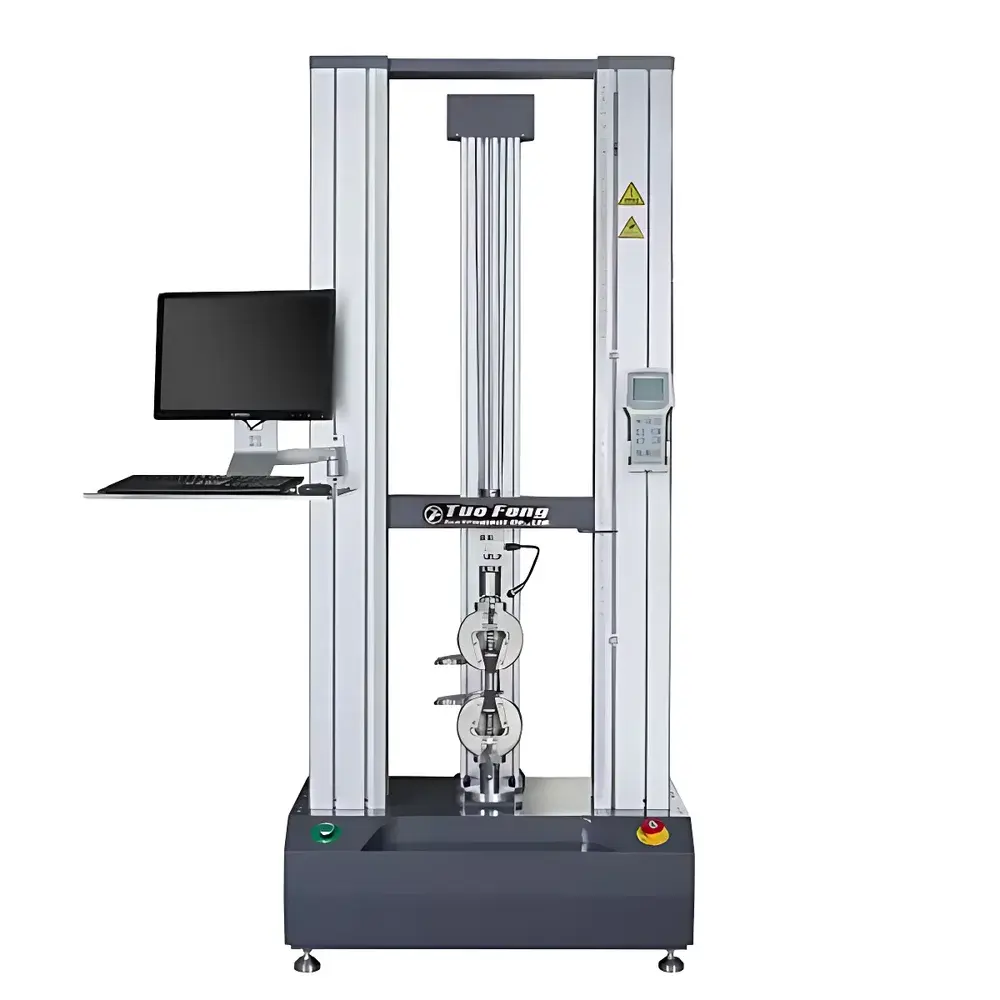
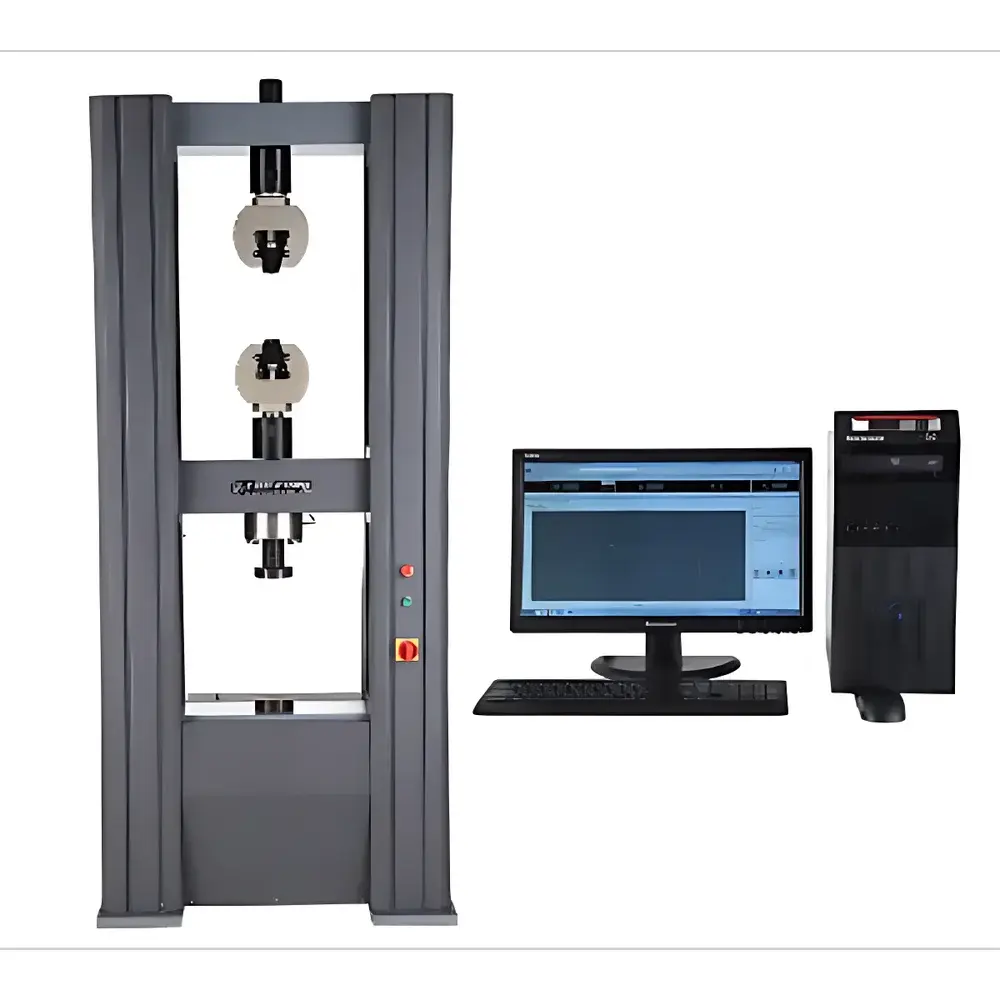
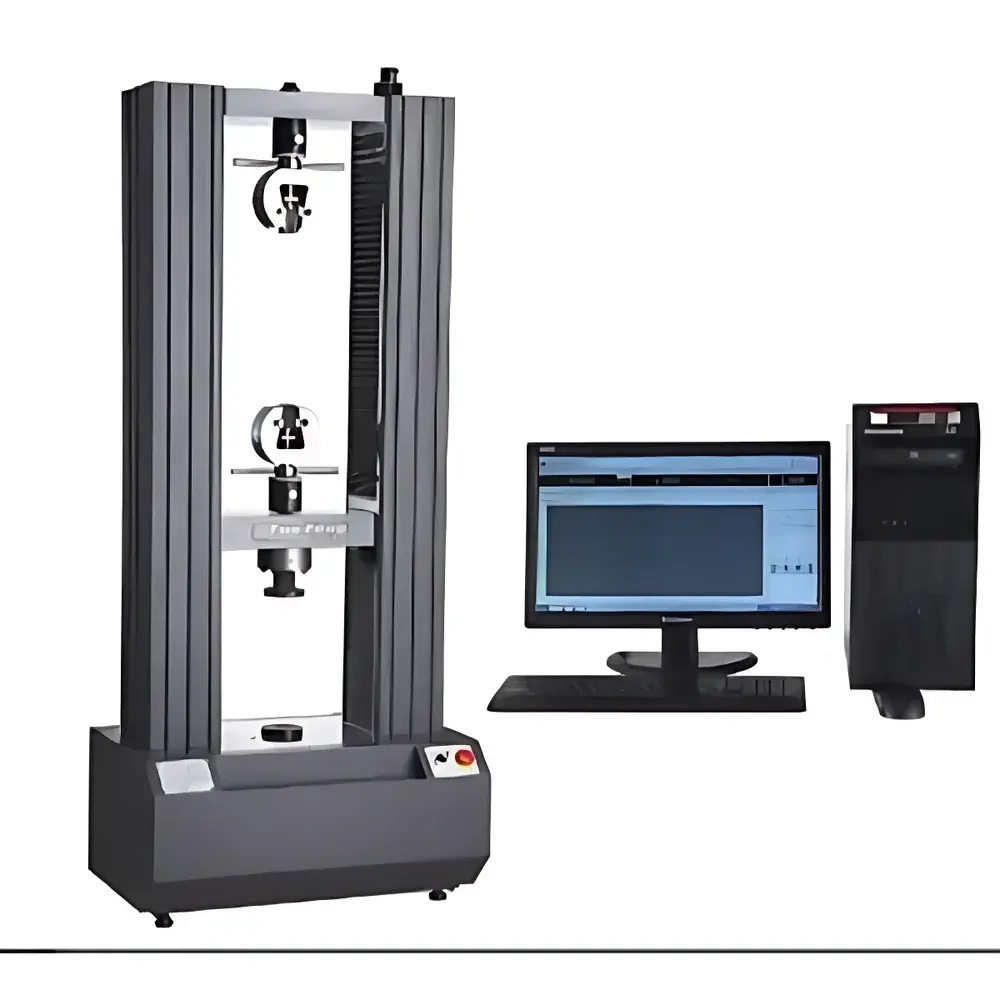
Tuofeng TFW-242 Electronic Universal Testing Machine
| Brand | Tuofeng |
|---|---|
| Model | TFW-242 |
| Type | Electromechanical Universal Testing Machine |
| Max. Test Load | 20 kN |
| Accuracy Class | 0.5 |
| Effective Force Range | 0.2–100% of Full Scale |
| Force Measurement Accuracy | ±0.005% of reading |
| Resolution | 1 part in ±500,000 full-scale load (fixed resolution, no range switching) |
| Drive System | Imported servo motor with precision worm gear reducer |
| Lead Screw | High-precision preloaded ball screw |
| Effective Test Width | 600 mm (customizable) |
| Traverse Stroke | 800 mm (height-adjustable) |
| Speed Range | 0.001–500 mm/min (infinitely variable, programmable) |
| Displacement Measurement | Optical encoder |
| Displacement Accuracy | ±0.005% of reading |
| Strain Measurement | Optional extensometer or large-deformation sensor |
| Strain Accuracy | ±0.005% of reading |
| Safety Protection | Dual electronic limit switches, emergency stop button, overload protection (>110% FS), automatic return after test |
| Crosshead Control | Dual-speed (fast/slow) motorized adjustment with jog function |
| Power Supply | 220 V AC, 1.0 kW |
| Dimensions (W×D×H) | 1000 × 700 × 2000 mm |
| Approx. Weight | 450 kg |
| Compliance | GB/T 16491–2008, JJG 475–2008, ASTM E4, ASTM E8, ISO 6892-1, ISO 7500-1, DIN 51221, JIS Z 2241, BS EN ISO 6892-1 |
Overview
The Tuofeng TFW-242 Electronic Universal Testing Machine is a high-precision, microprocessor-controlled electromechanical system engineered for static mechanical property characterization of metallic materials, polymers, composites, and ceramics. It operates on the principle of controlled displacement actuation via a servo-driven ball-screw mechanism, enabling precise application of axial tensile, compressive, flexural, shear, peel, tear, and puncture loads. The machine conforms to international metrological and performance standards including ISO 7500-1 (Class 0.5 verification), ASTM E4 (load cell calibration), and ASTM E8/E8M (tensile testing of metals). Its closed-loop control architecture ensures traceable force and displacement linearity across the entire measurement range — from 0.2% to 100% of full scale — without range switching or resolution degradation.
Key Features
- High-fidelity force measurement system with ±0.005% reading accuracy and 1/500,000 internal resolution, certified per ISO 7500-1 Class 0.5 requirements
- Preloaded high-precision ball screw transmission paired with an imported servo motor and low-backlash worm gear reducer for smooth, noise-free motion and exceptional positional repeatability
- Dual-speed crosshead drive (fast positioning + fine adjustment) with jog functionality and programmable return-to-start sequence post-test
- Integrated multi-level safety architecture: hardware-based electronic limit switches, redundant emergency stop circuitry, real-time overload detection (>110% FS), and automatic shutdown protocol
- Modular extensometry support — compatible with clip-on axial extensometers (for modulus and yield determination) and large-deformation sensors (for elongation at break in ductile materials)
- Rugged welded steel frame with vibration-damped base, designed for long-term dimensional stability under cyclic loading conditions
Sample Compatibility & Compliance
The TFW-242 accommodates standardized and custom specimens per ASTM E8, ISO 6892-1, GB/T 228.1, and JIS Z 2241. With a 600 mm effective test width and 800 mm vertical stroke (extendable upon request), it supports flat tensile coupons (e.g., 12.5 mm wide × 200 mm gauge length), cylindrical rods (up to Ø25 mm), compression blocks (up to 150 mm² face area), three-point bend fixtures (span up to 200 mm), and peel/tear test configurations. All mechanical and software functions comply with GLP documentation requirements, supporting audit-ready test records. Calibration certificates are traceable to national metrology institutes (NIM, NIST, PTB equivalents) and include uncertainty budgets per ISO/IEC 17025.
Software & Data Management
The Windows-based TFW-TestSuite v4.2 software provides full compliance with FDA 21 CFR Part 11 for electronic records and signatures, featuring role-based access control, audit trail logging (user actions, parameter changes, result modifications), and secure data encryption. It supports multiple test modes: constant rate of extension (CRE), constant load ramping, hold-at-load/stress, hold-at-strain, and cyclic loading profiles. Real-time plotting includes stress–strain, load–displacement, load–time, and strain–time curves, with on-the-fly unit conversion (N/kN/lbf, MPa/psi, mm/inch, %). Results export to CSV, XML, and PDF formats; batch reporting includes statistical summaries (mean, SD, min/max) and overlaid curve comparison for material lot qualification. Software updates are delivered remotely with version-controlled release notes and validation documentation.
Applications
This system serves as a primary mechanical characterization tool in quality control laboratories and R&D centers across aerospace (e.g., aluminum alloy sheet tensile verification per AMS 2355), automotive (high-strength steel stamping validation), wire & cable (conductor tensile strength per ASTM B33), powder metallurgy (green strength and sintered density correlation), and construction materials (rebar yield point confirmation per ASTM A615). It is routinely employed for supplier qualification audits, process capability studies (Cp/Cpk), failure analysis root cause investigations, and regulatory submission packages requiring ISO 17025-accredited test data.
FAQ
Does the TFW-242 meet ISO/IEC 17025 accreditation requirements for accredited testing laboratories?
Yes — its metrological traceability, documented uncertainty budgets, calibration interval management, and software audit trail functionality align with ISO/IEC 17025:2017 Clause 6.4 and 6.6.
Can the system perform ASTM E21 high-temperature tensile tests?
Not natively — it requires integration with externally mounted environmental chambers (furnace or cryo) and high-temperature extensometers, which are supported via analog I/O and digital trigger interfaces.
Is third-party calibration certification included with delivery?
A factory-issued calibration certificate traceable to NIM is provided; optional UKAS/NIST-traceable certification is available upon request.
What is the recommended maintenance schedule?
Lubrication of ball screws and gear reducers every 1,000 operating hours; annual verification of load cell linearity and encoder resolution by authorized service engineers.
Are custom夹具 (fixtures) supplied with validated installation procedures?
Yes — all fixture designs undergo FEA-based stress analysis and are supplied with dimensional inspection reports, torque specifications, and alignment verification protocols.



