
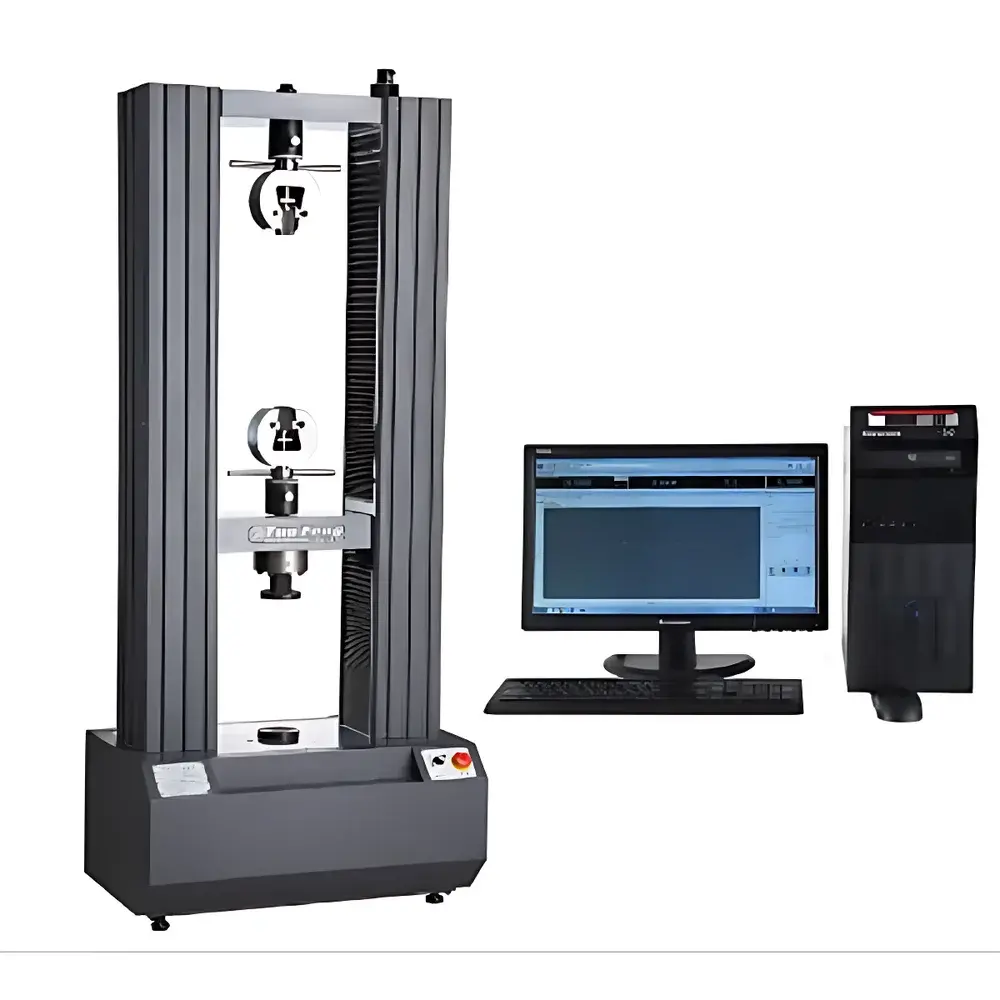
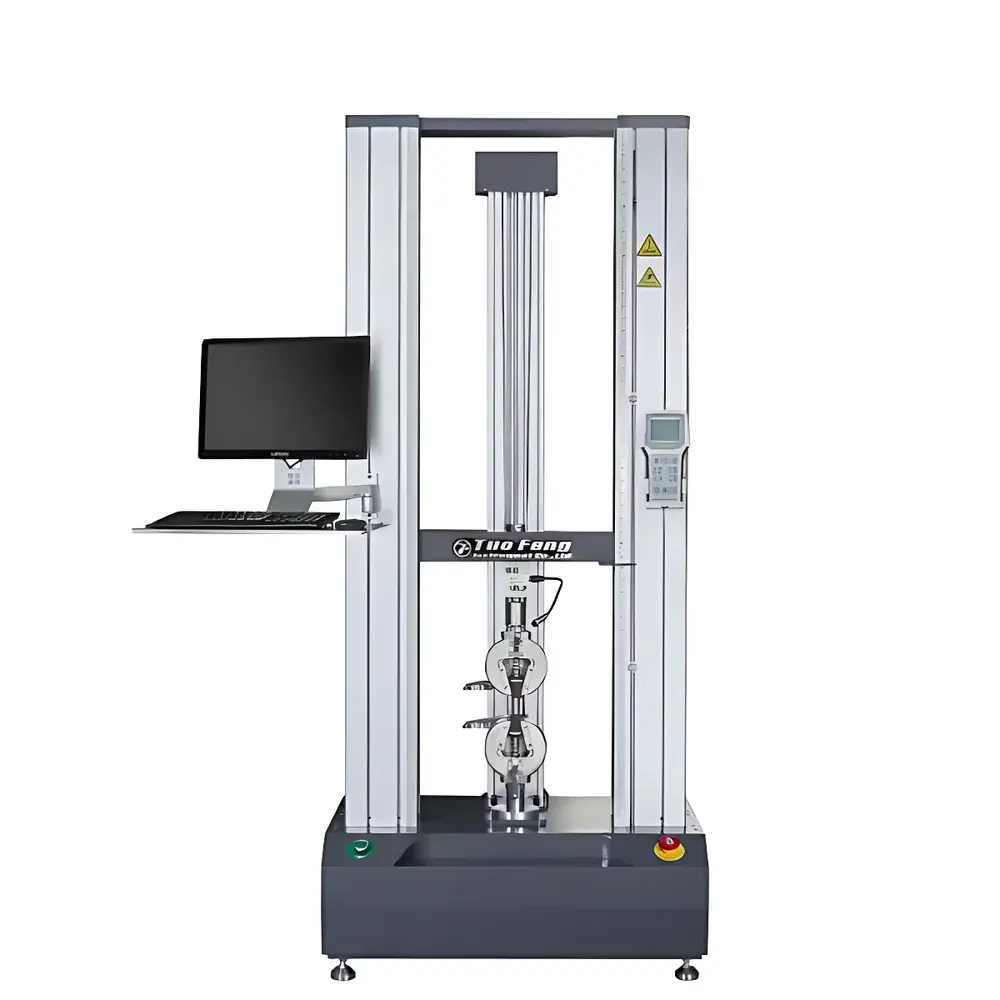
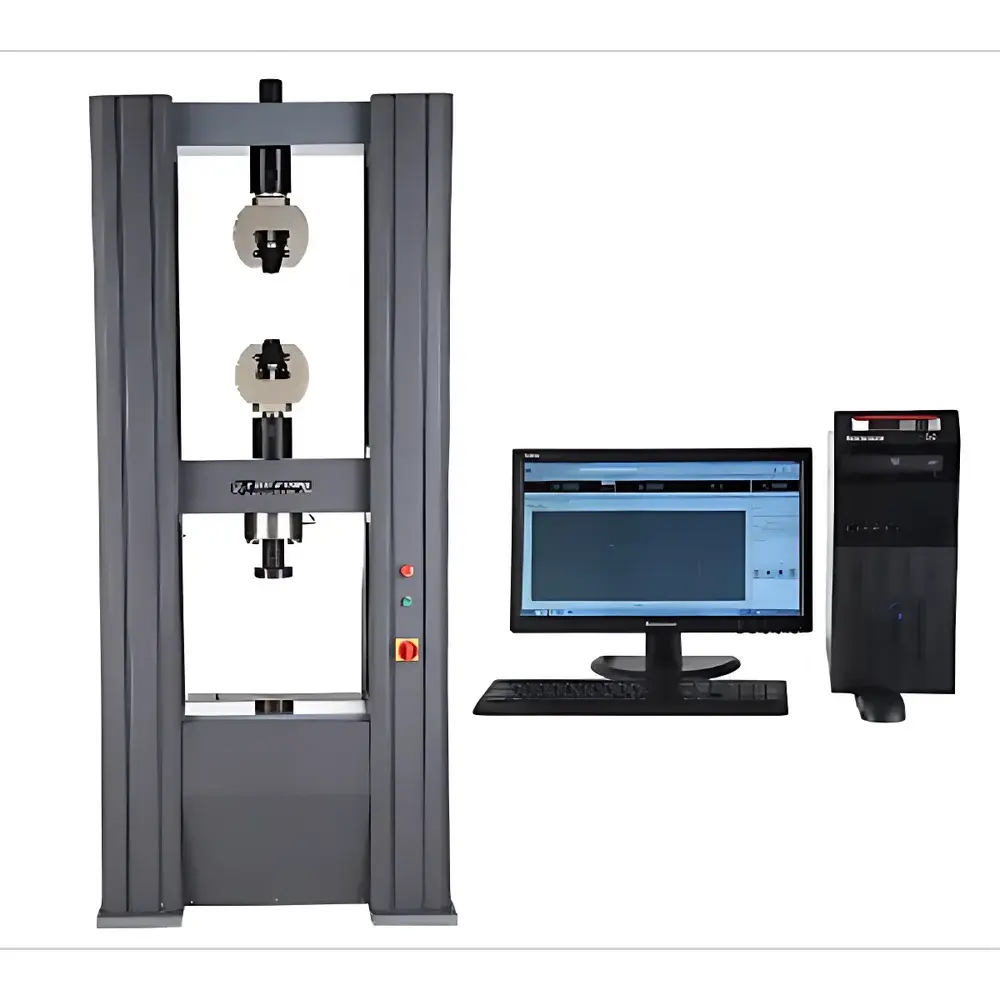
Tuofeng TFW-254 Microcomputer-Controlled Electronic Universal Testing Machine
| Brand | Tuofeng |
|---|---|
| Origin | Shanghai, China |
| Manufacturer Type | Direct Manufacturer |
| Equipment Type | Electromechanical Universal Testing Machine |
| Model | TFW-254 |
| Max Test Load | 25 kN |
| Accuracy Class | 0.5 |
| Effective Force Range | 0.2–100% of Full Scale |
| Force Measurement Accuracy | ±0.005% of Reading |
| Force Resolution | 1 part in 500,000 full-scale counts (no range switching) |
| Drive System | Imported Servo Motor + Precision Worm Gear Reducer |
| Lead Screw | High-Accuracy Ball Screw |
| Effective Test Width | 400 mm (customizable up to 600 mm) |
| Max Travel Distance | 800 mm (extendable) |
| Speed Range | 0.001–500 mm/min (infinitely variable) |
| Displacement Measurement | Optical Encoder |
| Displacement Accuracy | ±0.005% of Reading |
| Strain Measurement | Optional Extensometer or Large-Deformation Clip Gauge |
| Safety Protection | Dual-limit electronic positioning, emergency stop button, overload cutoff (>110% FS) |
| Return Mode | Programmable high-speed return or manual jog control |
| Power Supply | 220 V AC, 1.0 kW |
| Approx. Weight | 450 kg |
| Compliance | GB/T 16491–2008, JJG 475–2008, ASTM E4, ISO 7500-1, DIN 51221 |
Overview
The Tuofeng TFW-254 Microcomputer-Controlled Electronic Universal Testing Machine is an electromechanical force-testing platform engineered for high-reproducibility static mechanical characterization of polymeric, metallic, ceramic, and composite materials. Based on a closed-loop servo-controlled load frame architecture, it applies precisely regulated axial tension, compression, bending, shear, tear, peel, and puncture loads—enabling quantitative determination of fundamental mechanical properties including tensile strength, yield strength, modulus of elasticity, elongation at break, compressive strength, flexural modulus, and fracture toughness. Its modular design supports standardized test configurations per ISO 527, ASTM D638 (plastics), ASTM D3039 (composites), ASTM D790 (flexure), ISO 178, GB/T 1040, and other internationally recognized material testing protocols. The system integrates real-time load-cell feedback, high-resolution displacement tracking, and programmable actuator motion profiles to ensure traceable, repeatable, and auditable mechanical data acquisition under GLP/GMP-aligned operational conditions.
Key Features
- 0.5-class accuracy certified per GB/T 16491–2008 and ISO 7500-1, with force resolution of 1:500,000 full-scale counts and no range switching required across the entire measurement span.
- Imported servo motor coupled with a precision worm gear reducer and preloaded ball screw drive ensures smooth, low-noise, backlash-free motion control from 0.001 to 500 mm/min.
- Dual-speed automatic crosshead adjustment (fast/slow modes) with jog functionality enables precise specimen alignment and rapid return to home position post-test.
- Comprehensive safety architecture includes electronic upper/lower limit switches, hardware-based emergency stop circuitry, and automatic overload shutdown at >110% of rated capacity.
- Modular extensometry support: compatible with both clip-on electronic extensometers (for high-precision strain measurement) and large-deformation video or clip gauges for ductile polymer testing.
- Robust structural frame (450 kg mass) minimizes vibration-induced signal noise and ensures long-term dimensional stability during extended test sequences.
Sample Compatibility & Compliance
The TFW-254 accommodates standard and custom-configured specimens ranging from thin plastic films (per ASTM D882) to rigid PVC pipes (per ISO 1167), rubber hoses, composite laminates, and metal coupons. Fixture adaptability includes wedge-action tensile grips, compression platens, three/four-point bending fixtures, peel test jigs, and puncture anvils—all designed for quick tool-free interchange. The system complies with national and international metrological standards: JJG 475–2008 verification regulation, GB/T 16491–2008 manufacturing specification, ASTM E4 (load verification), ISO 7500-1 (static calibration), and DIN 51221 (testing machine classification). Data integrity meets requirements for regulated environments: audit trail logging, user access controls, and electronic signature readiness align with FDA 21 CFR Part 11 principles when deployed with validated software configurations.
Software & Data Management
The Windows-based control and analysis suite provides ISO/IEC 17025-aligned test execution and reporting capabilities. It supports multiple control modes—including constant rate of extension (CRE), constant load ramping, hold-to-load, hold-to-strain, and cyclic loading profiles—with fully programmable step sequences. Real-time visualization includes synchronized load–time, load–displacement, stress–strain, and strain–time curves, with on-screen display of instantaneous and peak values. Units are freely convertible between SI, imperial, and legacy systems (e.g., N/kN, MPa/psi, mm/in). Post-test analysis delivers automated calculations of tensile strength, Young’s modulus, yield offset (0.2%), elongation, Poisson’s ratio, and energy absorption (area under curve). Data export supports CSV, Excel, PDF, and XML formats; batch comparison overlays up to 12 curves with statistical summary (mean, min, max, SD). All test files include embedded metadata (operator ID, timestamp, calibration status, environmental notes) and support secure network archiving.
Applications
This system serves as a core mechanical characterization instrument in R&D laboratories, QC/QA departments, and third-party certification bodies. Key use cases include: mechanical validation of PE/PP/PVC pipe extrusion batches per ISO 1167-1; creep and stress-relaxation analysis of thermoplastic elastomers; interlaminar shear strength (ILSS) evaluation of fiber-reinforced composites; adhesion strength quantification of coated cable jackets; tensile property benchmarking of biodegradable packaging films; and qualification testing of automotive gaskets and seals per SAE J2236. It is routinely deployed in accreditation-ready workflows supporting CNAS, UKAS, and A2LA assessments, particularly where traceability to national standards (NIM, NIST, PTB) is mandated.
FAQ
What standards does the TFW-254 support out-of-the-box?
It natively executes test methods per GB/T 1040, ISO 527, ASTM D638, ASTM D790, ISO 178, and EN ISO 6892-1, with customizable templates for proprietary or industry-specific protocols.
Can the system be integrated into a LIMS or MES environment?
Yes—the software exposes COM/DCOM interfaces and supports OPC UA connectivity for bidirectional data exchange with laboratory information management systems and enterprise manufacturing execution platforms.
Is third-party calibration and certification available?
Tuofeng provides factory calibration certificates traceable to NIM (China National Institute of Metrology); optional on-site verification and ISO/IEC 17025-accredited calibration services are available through authorized partners.
What is the warranty and service coverage?
Standard 24-month parts-and-labor warranty; lifetime software updates included; on-site technical support and preventive maintenance contracts offered globally.
Does the system meet regulatory requirements for pharmaceutical or medical device testing?
When configured with 21 CFR Part 11-compliant software modules (electronic signatures, audit trails, role-based permissions), it satisfies documentation and data integrity requirements for USP , ISO 13485, and ICH Q5E compliance testing.
Related Products



