
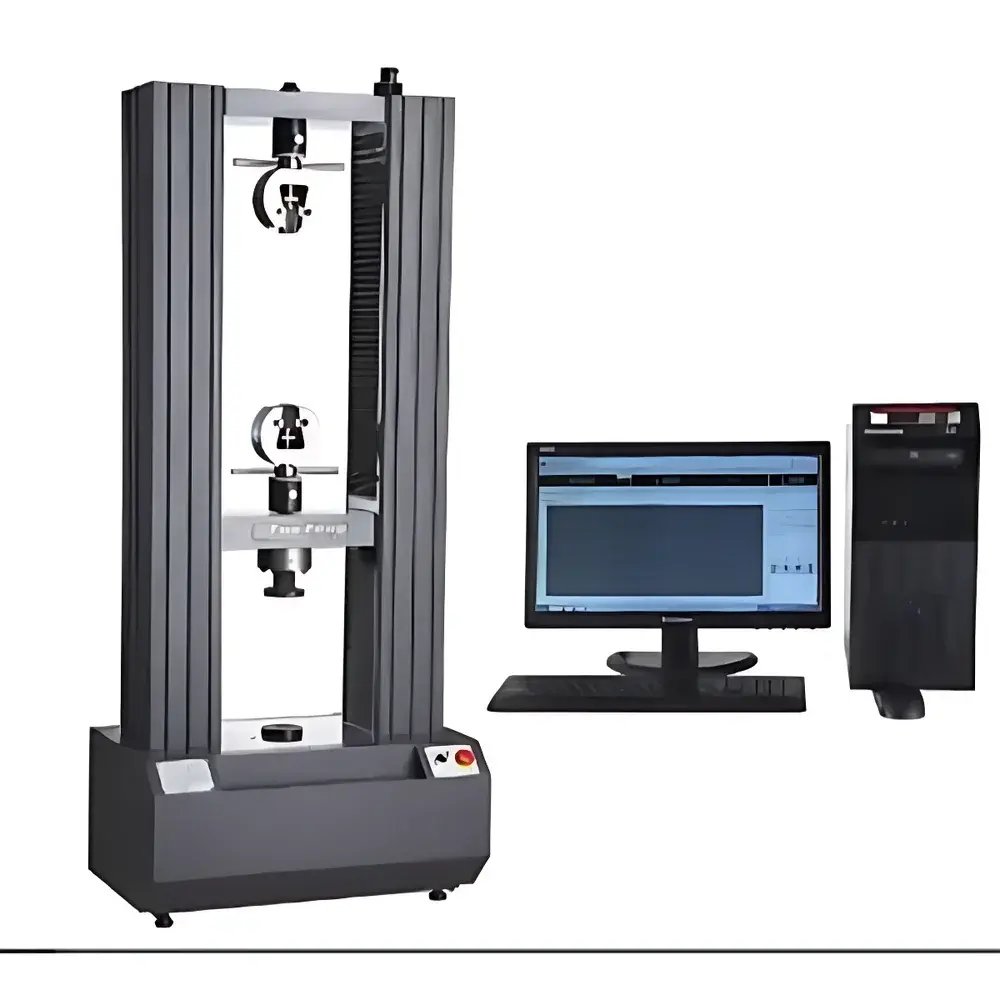
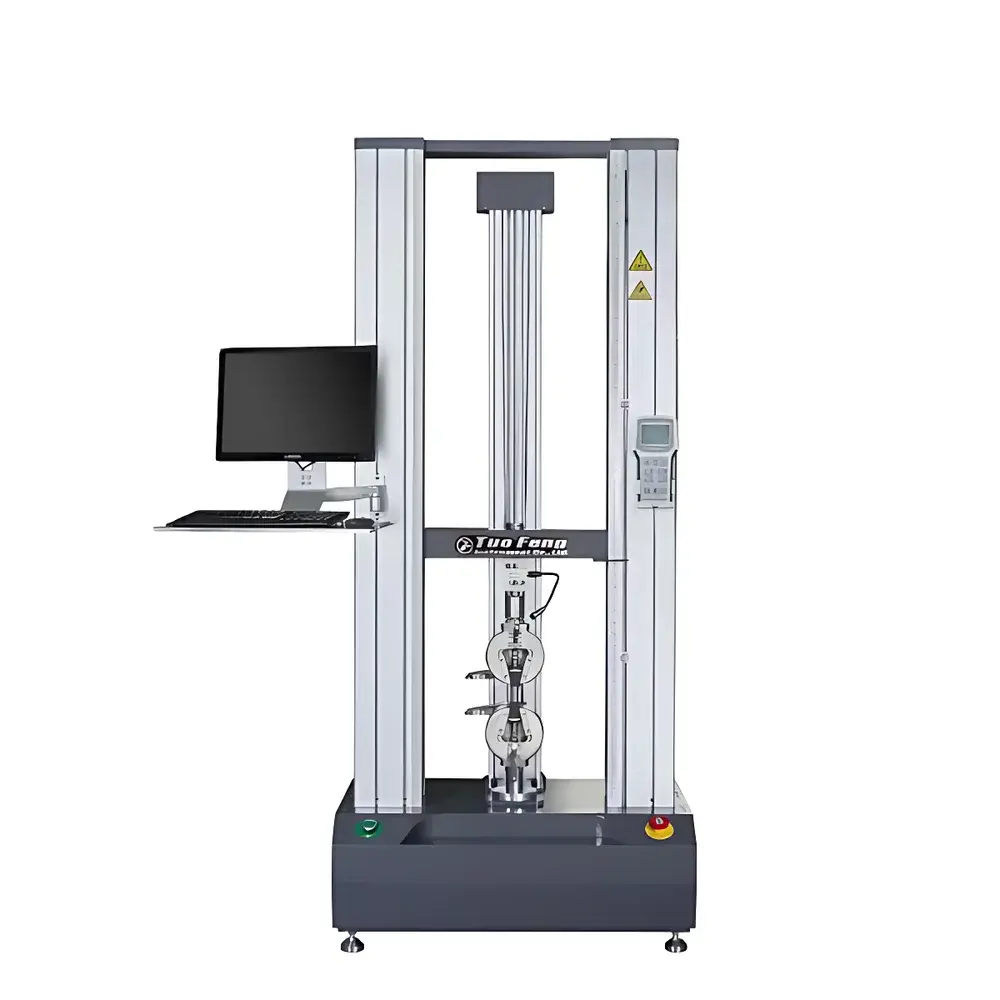
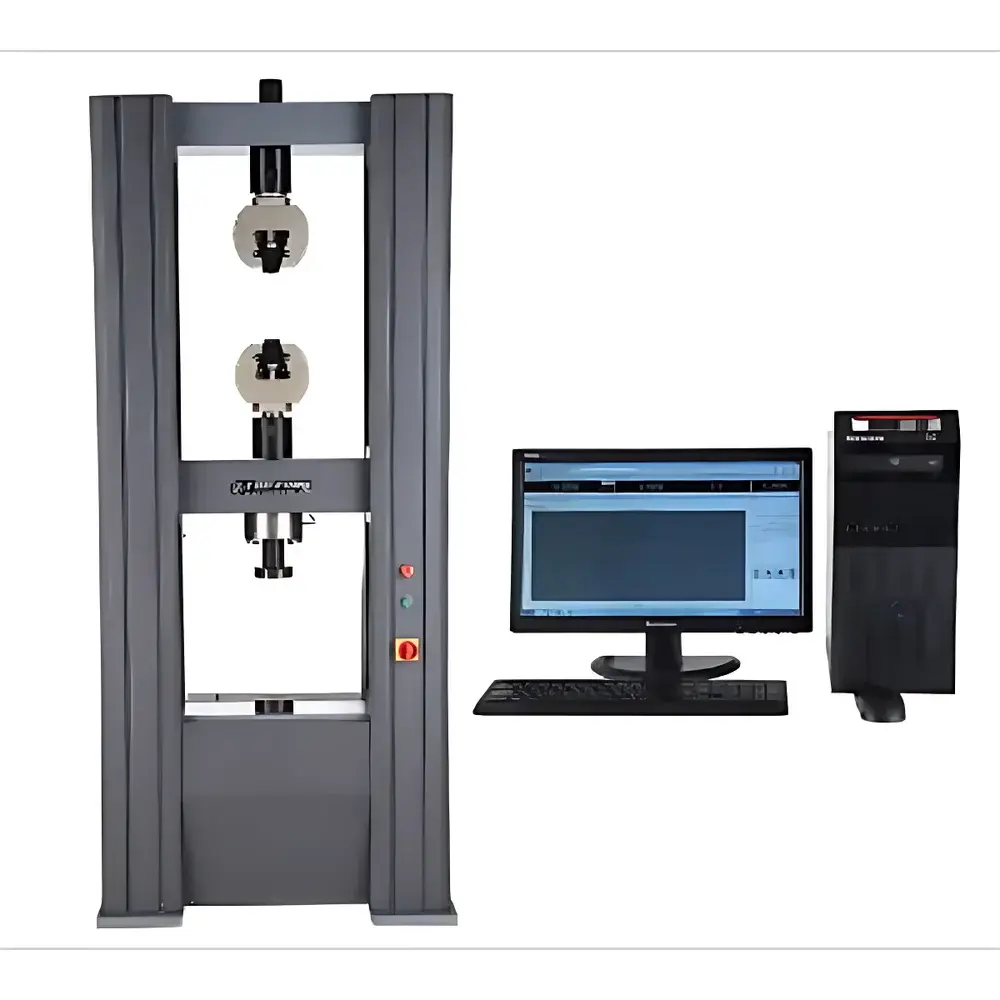
Tuofeng TFW-263 Advanced Microcomputer-Controlled Universal Testing Machine
| Brand | Tuofeng |
|---|---|
| Origin | Shanghai, China |
| Manufacturer Type | Direct Manufacturer |
| Instrument Type | Electromechanical Universal Testing Machine |
| Model | TFW-263 |
| Force Capacity | 20 kN |
| Accuracy Class | 0.5 |
| Effective Force Range | 0.2–100% of Full Scale |
| Force Measurement Accuracy | ±0.005% of reading |
| Load Cell Resolution | 1 part in ±500,000 (full-scale, no range switching) |
| Drive System | Imported servo motor with precision worm-gear reducer |
| Lead Screw | High-accuracy preloaded ball screw |
| Effective Test Width | 600 mm (customizable) |
| Max Stroke | 800 mm (extendable) |
| Speed Range | 0.001–500 mm/min (infinitely variable) |
| Displacement Measurement | Optical encoder, accuracy ±0.005% of reading |
| Strain Measurement | Optional extensometer or large-deformation sensor, accuracy ±0.005% of reading |
| Safety Protection | Dual electronic limit switches, emergency stop, overload cutoff (>110% FS), automatic return after test |
| Control Mode | Constant load, constant displacement, constant strain rate, hold loading |
| Software | Multi-language (EN/CN/TC), compliant with ASTM E4, ISO 7500-1, GB/T 16491–2008, JJG 475–2008, supports GLP audit trail and 21 CFR Part 11 optional modules |
Overview
The Tuofeng TFW-263 Advanced Microcomputer-Controlled Universal Testing Machine is a high-precision electromechanical system engineered for static mechanical property characterization of metallic, polymeric, ceramic, composite, and elastomeric materials. Based on the fundamental principles of uniaxial force–displacement transduction, it applies controlled tensile, compressive, flexural, shear, tear, peel, and puncture loads to standardized specimens while capturing real-time load, displacement, and (with optional sensors) strain data. Its dual-loop closed-loop control architecture ensures stable actuation across the full speed range—from quasi-static creep testing at 0.001 mm/min to dynamic ramping at 500 mm/min—enabling compliance with international material qualification protocols used in structural validation, quality assurance, and R&D environments.
Key Features
- 0.5-class accuracy per ISO 7500-1 and GB/T 16491–2008, verified traceable to national metrological standards
- Full-scale resolution of 1 part in ±500,000 without range switching—maintains consistent sensitivity from 0.2% to 100% of 20 kN capacity
- Imported servo motor coupled with hardened worm-gear reduction and preloaded recirculating ball screw for minimal backlash and thermal drift
- Dual-speed automated crosshead positioning (fast/slow modes) with programmable point-to-point movement and post-test auto-return
- Triple-layer safety architecture: hardware-based emergency stop, software-monitored electronic limits, and mechanical overload cutoff at 110% FS
- Modular sensor interface supporting ASTM E83-compliant extensometers (for modulus and yield determination) and large-deformation clip-on gauges
Sample Compatibility & Compliance
The TFW-263 accommodates specimens ranging from thin films (≥0.1 mm thickness) to structural metal coupons (up to 600 mm wide × 800 mm gage length). Standardized grips include wedge-action tensile jaws, compression platens, three/four-point bend fixtures, and pneumatic peel clamps—all customizable per ASTM D638, ISO 527, GB/T 228.1, ASTM D790, ISO 178, ASTM D624, ISO 37, and ASTM D903 requirements. The system meets regulatory design criteria outlined in JJG 475–2008 (verification regulation for electromechanical UTM) and conforms to essential performance clauses of ISO/IEC 17025 for accredited testing laboratories. Optional validation packages support IQ/OQ documentation for GMP/GLP environments.
Software & Data Management
Tuofeng’s proprietary UTMSuite v5.2 operates natively under Windows 10/11 and provides fully configurable test sequencing, real-time multi-curve visualization (load–time, stress–strain, displacement–time), and automated parameter derivation—including tensile strength, yield offset (0.2%), Young’s modulus, elongation at break, compressive yield, flexural modulus, tear propagation resistance, and peel adhesion energy. All raw data are stored in encrypted binary format with embedded metadata (operator ID, timestamp, calibration certificate ID, environmental conditions). Audit-trail logging—compliant with FDA 21 CFR Part 11 when enabled—records every user action, parameter change, and result export event. Export formats include CSV, PDF reports (with embedded graphs), and XML for LIMS integration. Software updates are delivered remotely with version-controlled release notes and backward-compatible file handling.
Applications
This system serves as a primary mechanical characterization platform across sectors requiring quantitative material verification: aerospace component suppliers validating titanium alloy sheet formability per AMS 2355; automotive Tier-1 manufacturers assessing thermoplastic composite weld integrity per SAE J2971; medical device firms evaluating polymer suture tensile fatigue per ISO 10993-12; construction labs certifying rebar ductility per ASTM A615; and academic researchers quantifying hydrogel viscoelastic hysteresis under cyclic loading. Its repeatability (RSD < 0.8% across ≥10 replicate tests on certified reference materials) supports both routine QC screening and advanced constitutive modeling input generation.
FAQ
What international standards does the TFW-263 support out-of-the-box?
ASTM E4, ASTM D638, ASTM D790, ASTM D624, ISO 7500-1, ISO 527, ISO 178, ISO 37, GB/T 228.1, GB/T 16491–2008, and JJG 475–2008. Custom test methods can be scripted via the software’s macro engine.
Is third-party calibration certification included?
Yes—each unit ships with a factory-issued NIST-traceable calibration certificate covering force, displacement, and speed axes, valid for 12 months under normal operating conditions.
Can the system integrate with existing laboratory information management systems (LIMS)?
Yes—UTMSuite supports configurable ODBC and REST API interfaces for bidirectional data exchange with major LIMS platforms, including LabVantage, Thermo Fisher SampleManager, and LabWare.
What maintenance intervals are recommended?
Preventive maintenance is advised every 12 months or after 2,000 test cycles—covering lead screw lubrication, encoder alignment verification, load cell zero-drift check, and safety circuit functional testing.
Are extended warranties and service contracts available?
Tuofeng offers 3-year comprehensive warranty coverage and annual service contracts including remote diagnostics, priority spare parts dispatch, and on-site technician support within 48 hours in Tier-1 industrial zones.



