
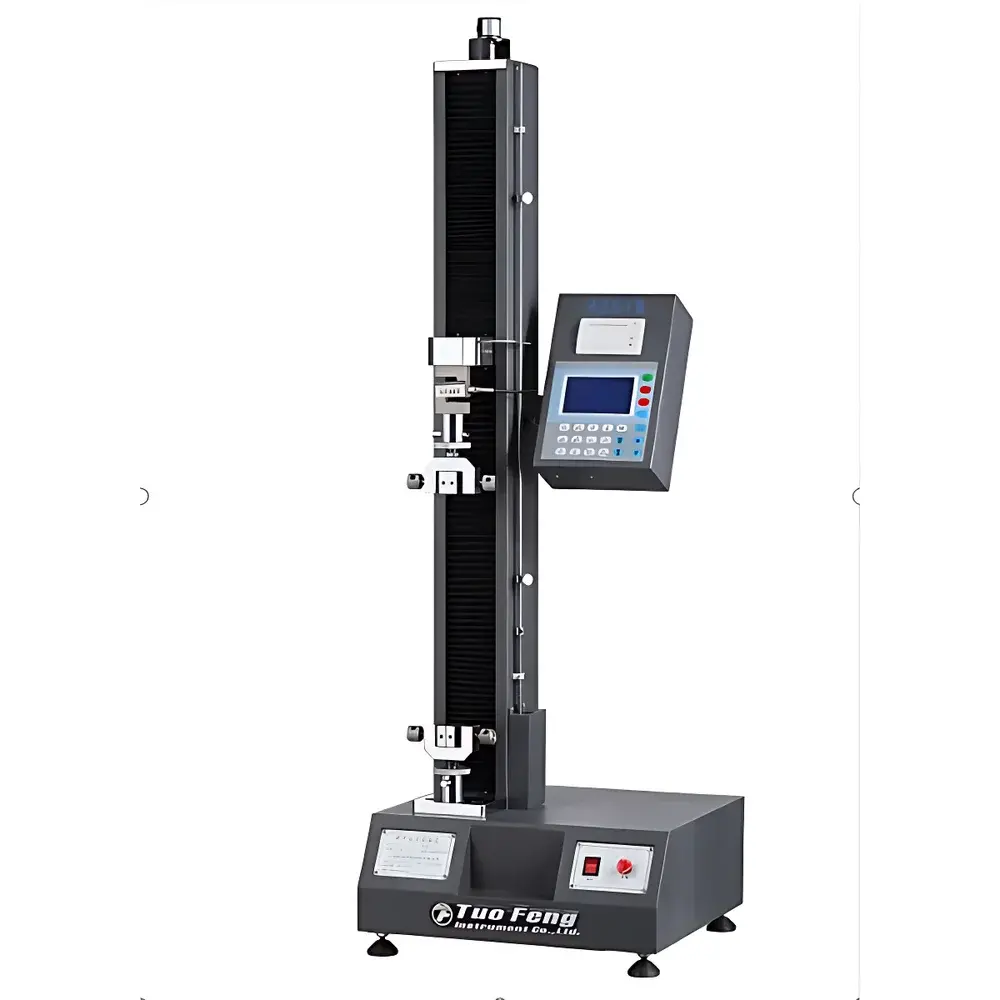
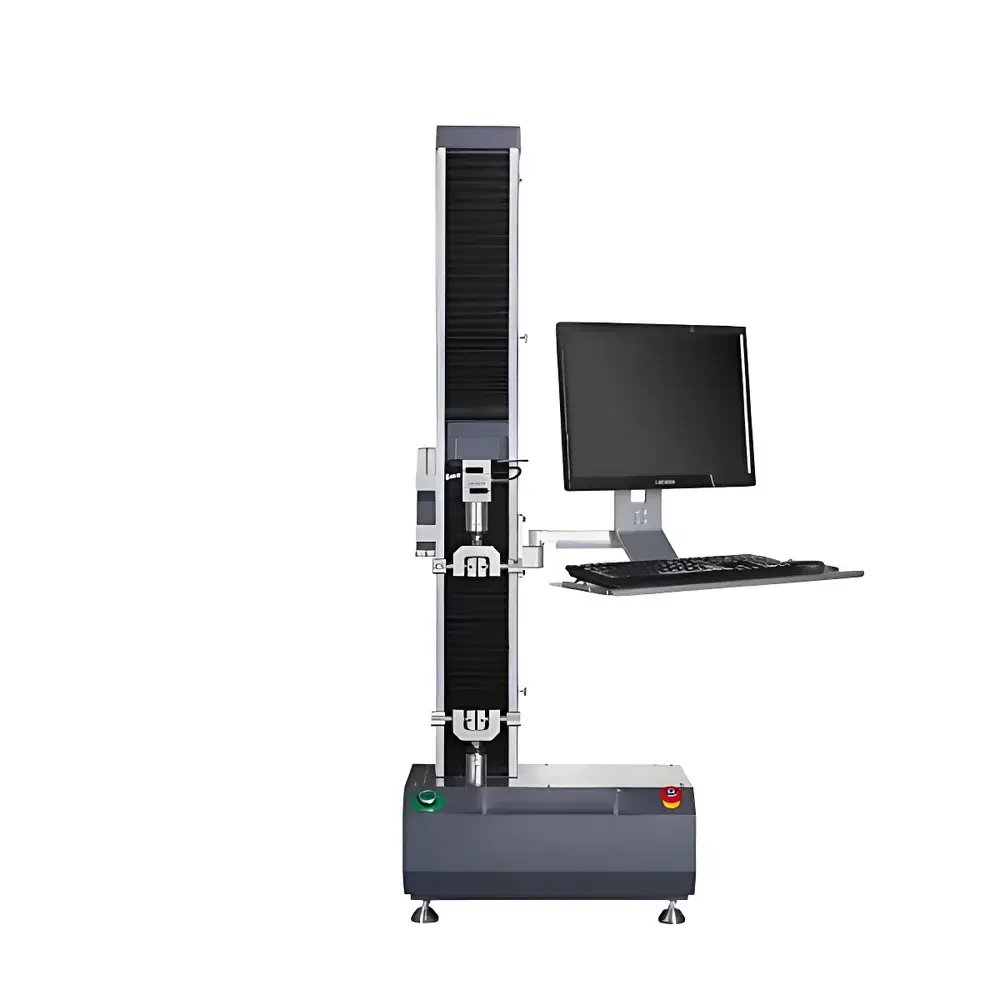
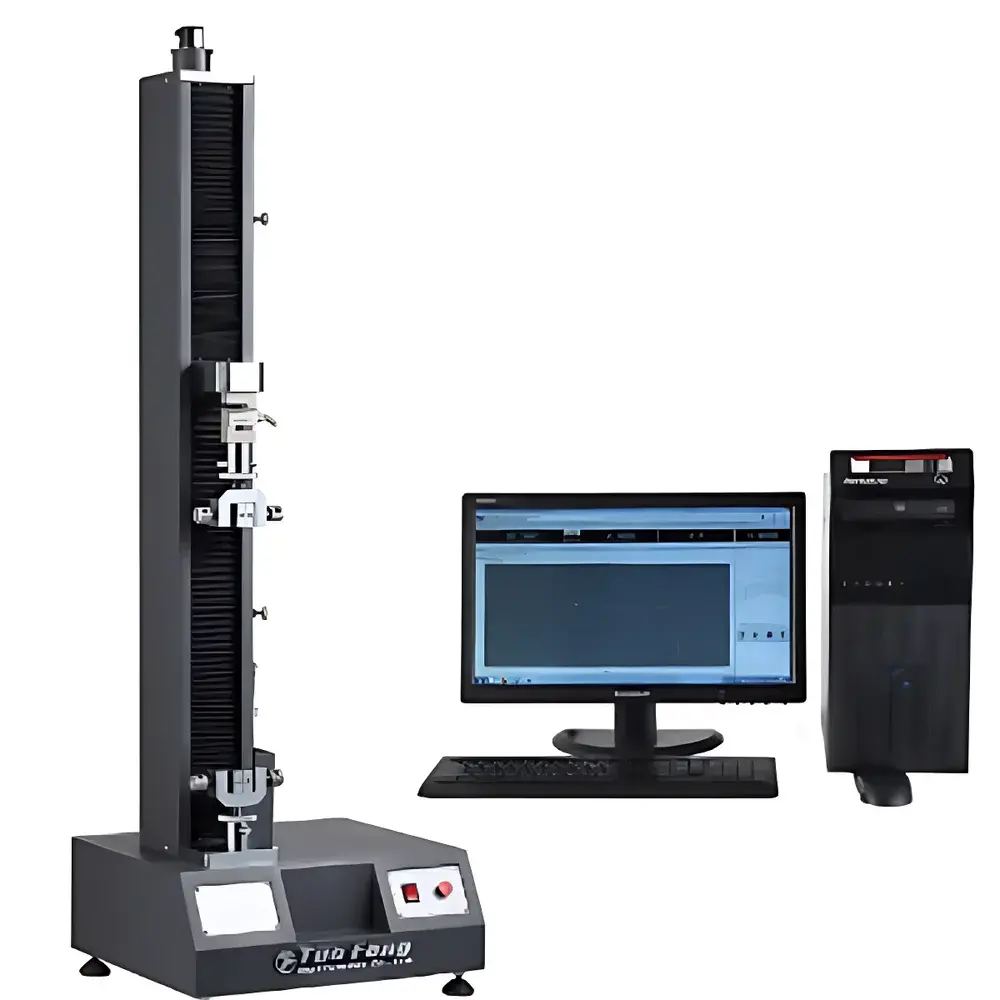
Tuofeng TFW-276 Computer-Controlled Electronic Tensile Testing Machine
| Brand | Tuofeng |
|---|---|
| Origin | Shanghai, China |
| Manufacturer Type | Direct Manufacturer |
| Model | TFW-276 |
| Instrument Type | Electronic Tensile Testing Machine |
| Maximum Test Load | 5 kN |
| Force Measurement Range | 0.4%–100% of Full Scale (FS) |
| Force Accuracy | ±0.5% of reading |
| Crosshead Travel | 700 mm |
| Displacement Resolution | ±0.5% of reading |
Overview
The Tuofeng TFW-276 is a microprocessor-controlled electronic tensile testing machine engineered for precision mechanical property evaluation of flexible and quasi-ductile materials. It operates on the principle of controlled uniaxial force application via a servo-driven crosshead, with real-time acquisition of load, displacement, and derived mechanical parameters—including tensile strength, elongation at break, Young’s modulus, peel strength, tear resistance, and bond adhesion. Designed for laboratory and quality control environments, the system complies with standardized test methodologies defined in ISO 13934-1, ISO 13934-2, ASTM D5034, ASTM D882, ASTM D3330, GB/T 3923.1, and JIS L1096. Its rigid dual-column frame, high-resolution load cell, and optical encoder-based displacement feedback ensure high reproducibility across repeated measurements—critical for textile, polymer, packaging, and thin-film material qualification.
Key Features
- Load capacity of 5 kN with force measurement accuracy better than ±0.5% of reading across 0.4%–100% FS—enabling reliable characterization of both low-force textile yarns and higher-strength composite laminates.
- Adjustable crosshead travel of 700 mm (extendable upon request), accommodating standard specimen lengths per ISO 5084 and ASTM D638 while supporting custom gauge lengths up to 500 mm.
- Variable speed control from 0.01 to 500 mm/min, offering fine resolution for slow-strain-rate creep tests and rapid pull-off assessments without mechanical gear shifting.
- Dual-mode operation: manual jog control for fixture alignment and programmable automatic test sequences for batch processing under predefined load/displacement/time conditions.
- Integrated safety architecture including electronic limit switches, emergency stop circuitry, overload protection (>110% FS), and software-enforced operational boundaries compliant with IEC 61000-6-2 and ISO 12100.
- Modular fixture interface supporting standardized pneumatic, wedge, and roller grips—compatible with ASTM D2256-compliant clamping for filament tensile testing and ISO 11339-compliant peel fixtures for adhesive-backed textiles.
Sample Compatibility & Compliance
The TFW-276 accommodates a broad spectrum of specimen geometries and mechanical behaviors: single-filament yarns (denier ≥ 10), woven/knitted fabric strips (width 25–50 mm), nonwovens, elastomeric films, coated papers, laminated packaging substrates, and thermoplastic extrusions. All test configurations adhere to international regulatory expectations for method validation and data integrity. The system supports GLP/GMP-aligned workflows through audit-trail-enabled software logging, user-access controls, and electronic signature capability—fully compatible with FDA 21 CFR Part 11 requirements when deployed with validated software configuration. Calibration traceability follows ISO/IEC 17025 guidelines, with optional NIST-traceable load cell certification available.
Software & Data Management
The Windows-based testing software (compatible with Windows 10/11, 64-bit) provides multi-language UI (English, Simplified Chinese, Traditional Chinese), unit flexibility (N, kN, lbf, MPa, psi, %, mm, inch), and real-time visualization of six independent curve types: Load vs. Time, Load vs. Displacement, Displacement vs. Time, Stress vs. Strain, Load vs. Extension, and Two-Point Elongation. Raw data streams are recorded at ≥100 Hz, with internal storage supporting ≥10,000 test records per session. Export formats include CSV, XLSX, PDF, and XML for integration into LIMS or statistical process control platforms. Batch analysis tools enable comparative overlay of up to 12 curves, automatic calculation of mean/median/min/max values, and customizable reporting templates meeting ISO 5893 and ASTM E4 documentation standards. Software updates are provided free of charge throughout product lifecycle.
Applications
- Textile industry: breaking strength and elongation of warp/weft yarns, seam slippage resistance, pilling resistance substrate evaluation.
- Packaging R&D: seal strength of heat-sealed pouches, peel adhesion of pressure-sensitive labels, puncture resistance of blister foils.
- Medical device manufacturing: tensile integrity of suture threads, burst strength of surgical drapes, delamination resistance of multilayer catheter tubing.
- Automotive interiors: tear propagation resistance of seat fabrics, shear strength of bonded trim layers, fatigue performance of airbag webbing.
- Electronics: pull strength of soldered wire terminations, peel adhesion of flex circuit laminates, bond durability of conformal coatings.
FAQ
What standards does the TFW-276 support out-of-the-box?
The system includes preconfigured test methods for ISO 13934-1 (tensile properties of fabrics), ASTM D5034 (grab test), ASTM D882 (thin plastic sheeting), and GB/T 3923.1 (Chinese textile standard). Custom method creation is fully supported.
Can the machine perform cyclic loading or stress-relaxation tests?
Yes—the software supports multi-step programmed profiles, enabling tension-hold, ramp-hold-ramp, and stepwise strain-controlled protocols required for viscoelastic characterization.
Is third-party calibration certification included?
A factory calibration certificate is supplied; ISO/IEC 17025-accredited calibration with NIST-traceable reference standards is available as an optional service.
How is data security ensured during long-term deployment?
Role-based access control, encrypted local database storage, automated daily backups, and configurable audit trail retention (≥36 months) meet ISO 27001-aligned data governance requirements.
What maintenance intervals are recommended?
Biannual verification of load cell linearity and encoder resolution is advised; annual mechanical inspection of guide rails, drive belt tension, and grip alignment ensures continued compliance with ISO 7500-1 Class 0.5 accuracy class.



