
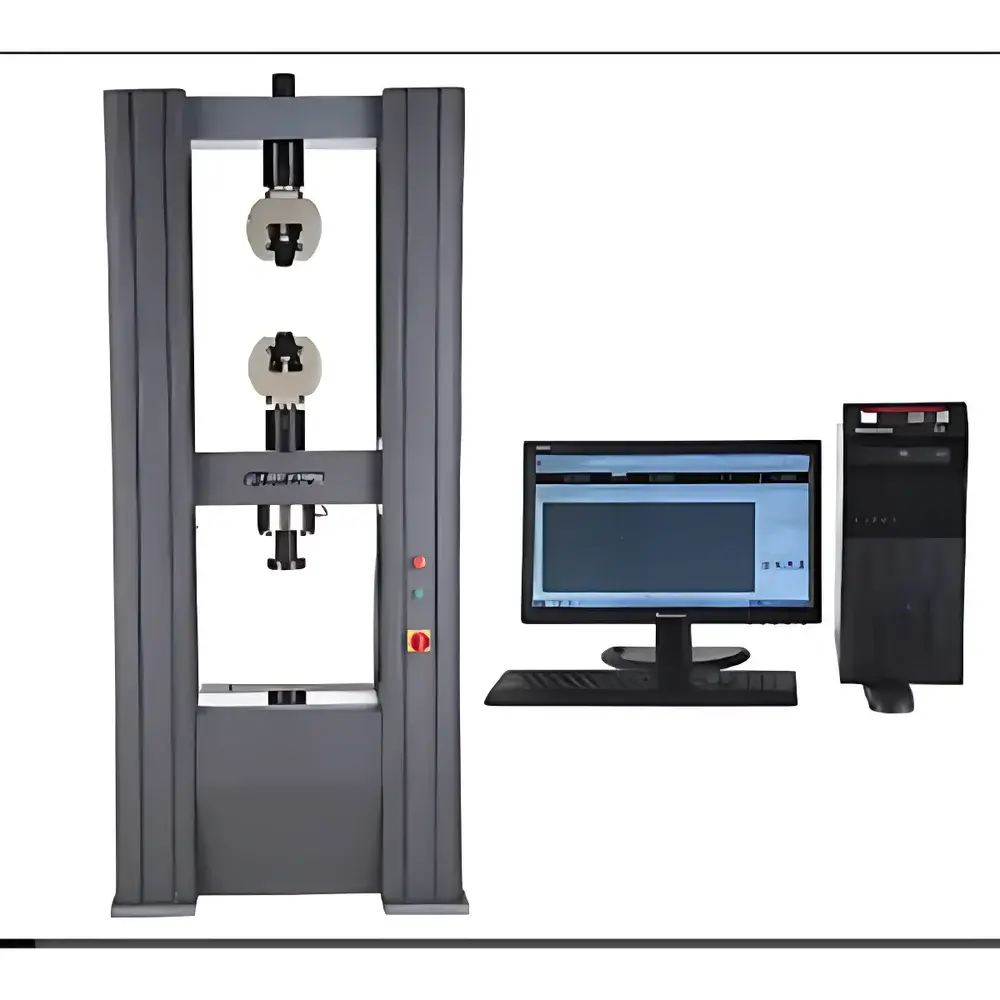
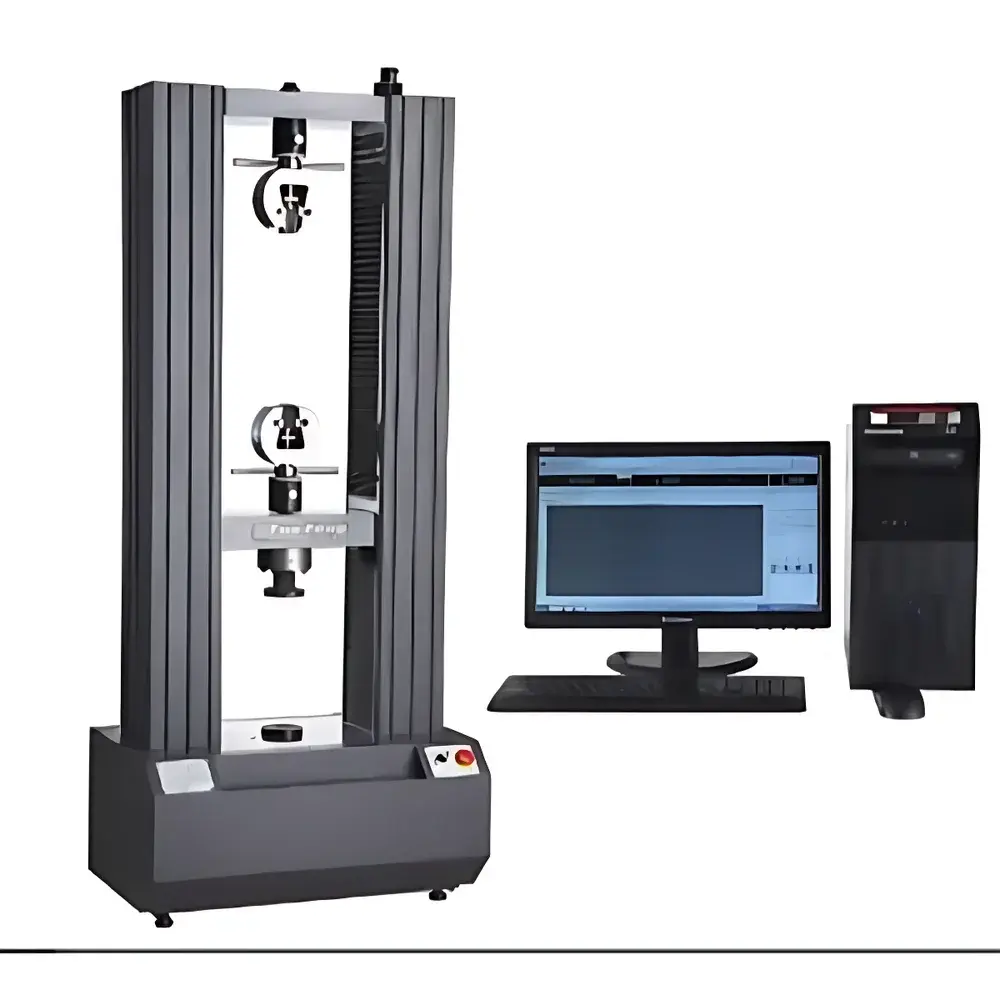
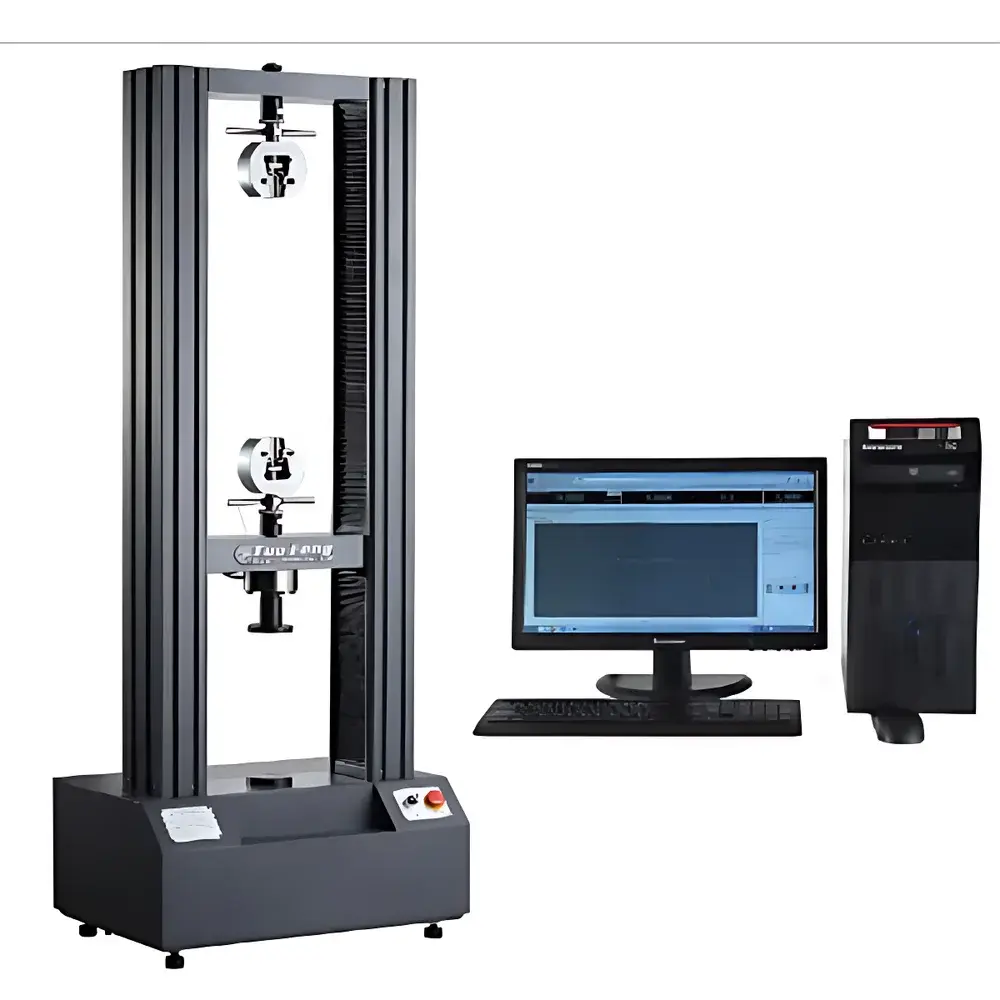
Tuofeng TFW-296 Microcomputer-Controlled Universal Testing Machine
| Brand | Tuofeng |
|---|---|
| Origin | Shanghai, China |
| Manufacturer Type | Direct Manufacturer |
| Product Category | Domestic |
| Model | TFW-296 |
| Price Range | USD 1,400 – 14,000 |
| Instrument Type | Electromechanical Universal Testing Machine |
| Load Capacity | 300 kN |
| Load Accuracy | ±0.5% |
| Accuracy Class | 0.5 |
| Effective Force Measurement Range | 0.2%–100% of Full Scale |
| Force Resolution | 1 part in ±500,000 codes (no range switching, constant resolution) |
| Drive System | Imported Servo Motor with Worm Gear Reducer |
| Lead Screw | High-Precision Ball Screw |
| Effective Test Width | 600 mm (customizable) |
| Stroke | 800 mm (extendable) |
| Speed Range | 0.001–500 mm/min (infinitely variable) |
| Displacement Measurement | Optical Encoder |
| Displacement Accuracy | ±0.005% of reading |
| Strain Measurement | Optional Extensometer or Large-Deformation Gauge |
| Strain Accuracy | ±0.005% of reading |
| Safety Protection | Electronic Limit Switches, Emergency Stop, Overload Protection (10% above rated capacity) |
| Crosshead Control | Dual-Speed (Fast/Slow) Motorized Adjustment with Return-to-Home Function |
| Fixture Customization | Application-Specific Grips Available |
| Power Supply | 220 V, 3.0 kW |
| Approx. Weight | 1,500 kg |
| Compliance | GB/T 16491–2008, JJG 475–2008, ASTM E4, ASTM E8, ISO 6892-1, ISO 7500-1, DIN 51221, JIS Z2241, BS EN 10002-1 |
Overview
The Tuofeng TFW-296 Microcomputer-Controlled Universal Testing Machine is a high-precision electromechanical system engineered for static mechanical property evaluation of metallic, polymeric, composite, and ceramic materials under tension, compression, bending, shear, peel, tear, and puncture loading conditions. Based on servo-controlled force actuation and closed-loop displacement feedback, the machine implements dual-servo control architecture to maintain consistent strain rate, load ramping, or hold profiles per ISO 6892-1 Annex C and ASTM E2309 guidelines. Its 300 kN load frame features rigid four-column construction, preloaded ball screws, and high-stiffness crosshead guidance—designed to minimize deflection-induced measurement error during high-force testing. The system meets Class 0.5 accuracy per ISO 7500-1 and GB/T 16491–2008, ensuring traceable force calibration across the full 0.2–100% measurement range without range-switching artifacts.
Key Features
- High-resolution force transduction with ±0.5% full-scale accuracy and 1:500,000 internal resolution—enabling detection of sub-newton load changes even at maximum capacity.
- Infinitely variable crosshead speed from 0.001 to 500 mm/min, programmable via software-defined ramps, holds, and step functions per ASTM E2309 Annex A2.
- Dual-mode motion control: fast positioning (up to 200 mm/min) and precision testing speed (0.001–50 mm/min), both governed by real-time PID algorithms.
- Integrated safety architecture including hardware-based emergency stop, electronic travel limits, and automatic overload cutoff at 110% of rated capacity.
- Modular extensometry support: compatibility with clip-on axial extensometers (ASTM E83 Class B-1) and non-contact video extensometers (ISO 9513 Class 1) for strain measurement down to 0.005% accuracy.
- Thermally stable load cell housing and low-drift signal conditioning circuitry—validated for ambient temperature operation between 10–35°C per JJG 475–2008 environmental requirements.
Sample Compatibility & Compliance
The TFW-296 accommodates specimens ranging from thin polymer films (via pneumatic peel grips) to structural steel coupons (via wedge-action tensile grips) and concrete cylinders (via compression platens with spheric seating). Standard configurations include flat-faced, serrated, and V-notched grips; custom fixtures are available for ISO 178 flexural bars, ASTM D638 dog-bone tensiles, or ISO 1133 melt flow index adapters. All test protocols comply with internationally recognized standards including ASTM E4 (force verification), ASTM E8/E21 (tensile testing of metals), ASTM D695 (compressive properties of plastics), ISO 527-2 (plastic tensile testing), ISO 178 (flexural testing), and GB/T 228.1–2021 (metallic materials tensile testing). Calibration certificates are issued traceable to NIM (National Institute of Metrology, China) and support GLP/GMP audit readiness.
Software & Data Management
The Windows-based TuofengTest Suite v5.x supports multi-language UI (English, Simplified/Traditional Chinese), unit conversion (N/kN/lbf, mm/in, MPa/psi), and synchronized acquisition of force, displacement, and strain channels at up to 1 kHz sampling rate. Real-time plotting includes stress–strain, load–displacement, load–time, and strain–time curves—with overlay capability for comparative analysis of up to 32 test records. Automated calculations conform to ASTM E111 (modulus), ASTM D882 (tensile strength of thin films), and ISO 527-1 (yield point determination). Raw data exports to CSV, XML, or PDF report formats; audit trails log user actions, parameter changes, and calibration events in compliance with FDA 21 CFR Part 11 requirements. Software updates are delivered remotely with version-controlled release notes and validation documentation.
Applications
This system serves as a primary mechanical characterization platform in R&D laboratories and QC environments across aerospace (e.g., titanium alloy tensile qualification per AMS 2300), automotive (composite crash simulation validation), medical device manufacturing (ISO 14243-1 hip implant wear testing), civil engineering (rebar yield verification per ASTM A615), and advanced materials development (graphene-reinforced polymer modulus mapping). It supports cyclic loading sequences for fatigue pre-conditioning, creep tests under constant load (per ISO 899-1), and fracture toughness assessments using single-edge notched bend (SENB) fixtures. Universities utilize it for undergraduate mechanics labs and graduate-level constitutive modeling validation where repeatability ≤0.8% CV across five replicate tests is routinely achieved.
FAQ
What standards does the TFW-296 comply with for force calibration?
It conforms to ISO 7500-1 Class 0.5, GB/T 16491–2008, and JJG 475–2008, with optional third-party certification to ASTM E4.
Can the system perform strain-controlled testing?
Yes—when equipped with an ASTM E83-compliant extensometer, it executes closed-loop strain-rate control per ISO 6892-1 Annex C.
Is remote software support and updates included?
Yes—lifetime software maintenance, version upgrades, and remote diagnostic assistance are provided at no additional cost.
What is the minimum resolvable force increment at full scale?
With 1:500,000 internal resolution and 300 kN capacity, the system resolves forces down to 0.6 N.
Are test reports compliant with ISO/IEC 17025 documentation requirements?
Yes—the software generates timestamped, user-locked reports with embedded calibration metadata, operator ID, and instrument serial traceability.



