
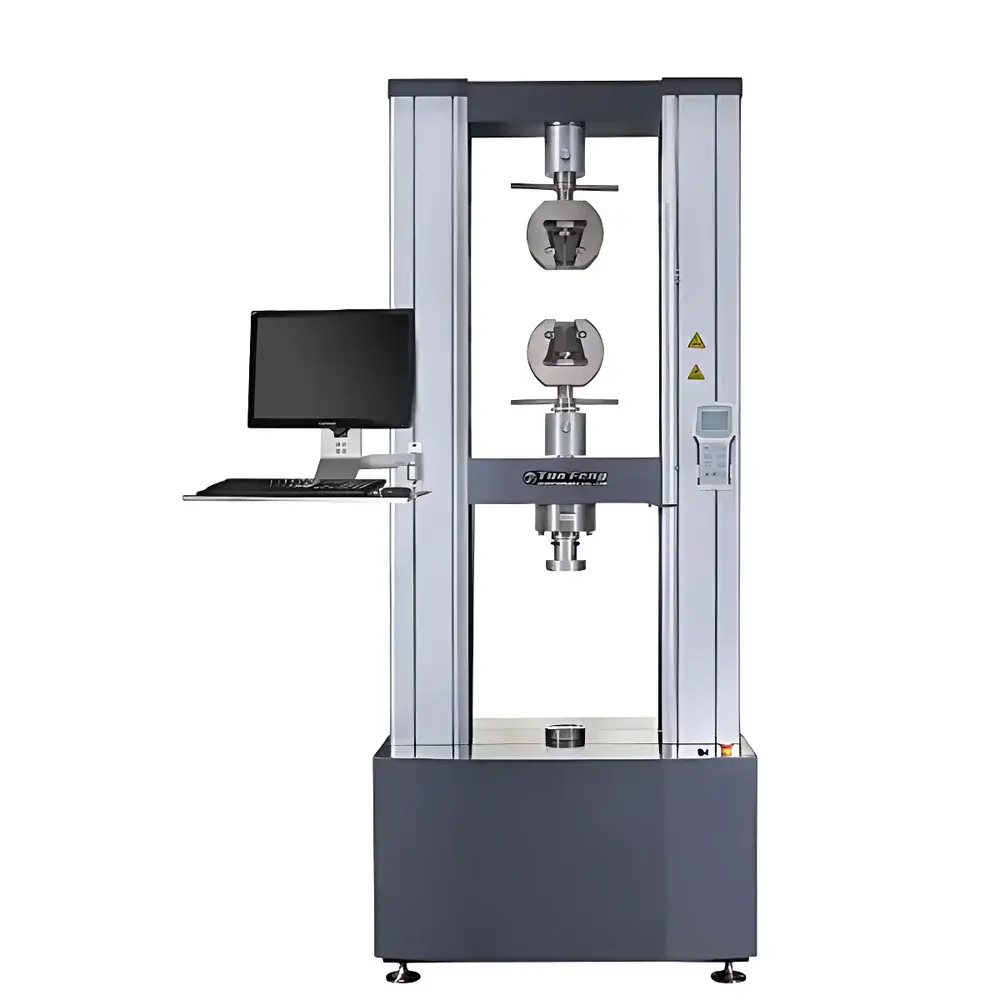
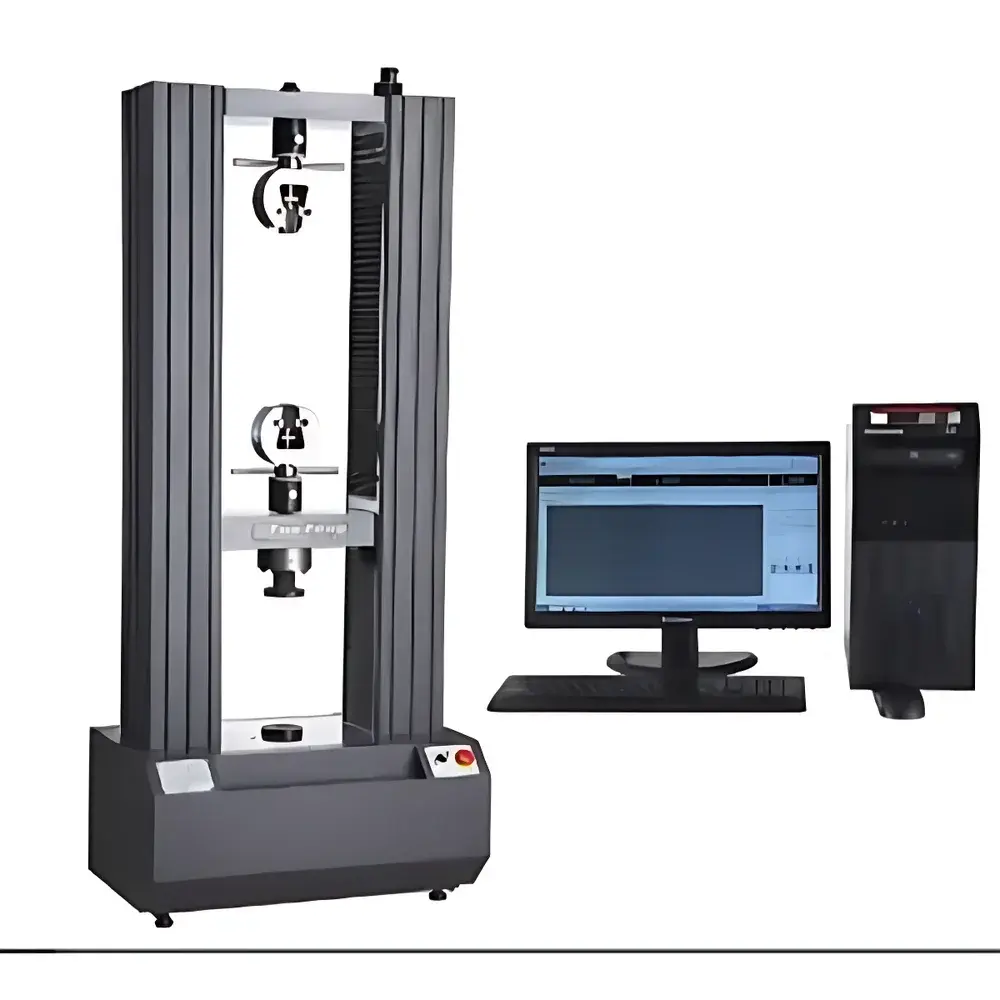
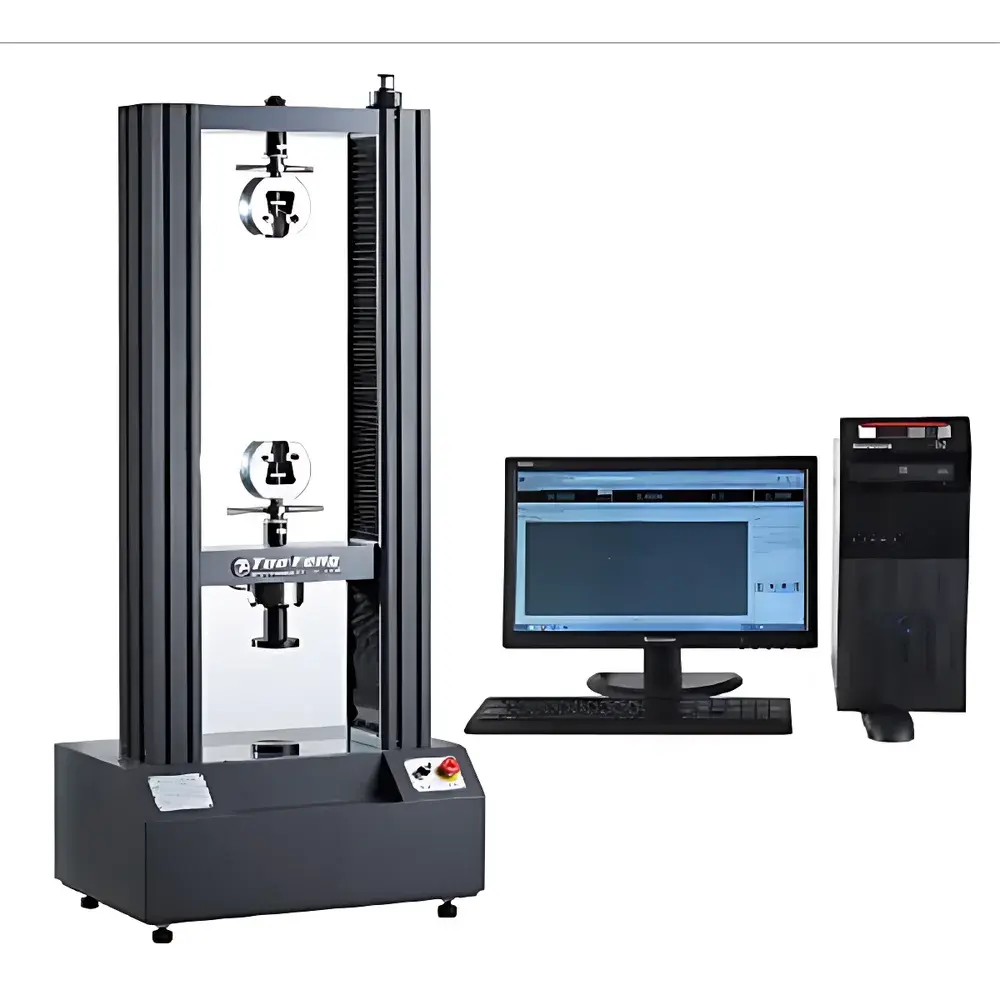
Tuofeng TFW-300 Microcomputer-Controlled Electronic Universal Testing Machine
| Brand | Tuofeng |
|---|---|
| Origin | Shanghai, China |
| Manufacturer Type | Direct Manufacturer |
| Model | TFW-300 |
| Maximum Load Capacity | 300 kN |
| Load Accuracy | ±0.5% |
| Control System | PC-Based Closed-Loop Servo Control |
| Test Modes | Tensile, Compression, Bending, Shear, Tear, Peel, Burst |
| Standards Compliance | GB/T 16491–2008, JJG 475–2008, ASTM E4, ASTM E8, ISO 6892-1, ISO 7500-1, DIN 51221, JIS Z2241 |
| Load Cell Resolution | 1 part in 500,000 full scale (no range switching) |
| Crosshead Speed Range | 0.001–500 mm/min (infinitely variable) |
| Displacement Measurement Accuracy | ±0.005% of reading |
| Strain Measurement Options | Clip-on extensometer or large-deformation extensometer (optional) |
| Safety Features | Dual electronic limit switches, emergency stop button, overload protection (110% F.S.), automatic return after test |
| Power Supply | 220 V AC, 3.0 kW |
| Approximate Weight | 1500 kg |
| Effective Test Width | 600 mm (customizable) |
| Max Stroke | 800 mm (extendable) |
| Precision Class | Class 0.5 per ISO 7500-1 |
Overview
The Tuofeng TFW-300 is a high-capacity, microcomputer-controlled electronic universal testing machine engineered for precision mechanical property evaluation of metallic, polymeric, composite, and ceramic materials under static loading conditions. It operates on the principle of closed-loop servo control, where load, displacement, and strain are continuously monitored and regulated via high-resolution load cells, optical encoders, and optional extensometry systems. Designed to meet international metrological and structural integrity requirements, the TFW-300 delivers traceable force measurement with ±0.5% accuracy across its full 300 kN range—validated per ISO 7500-1 and JJG 475–2008 calibration protocols. Its rigid C-frame architecture, preloaded ball-screw drive system, and low-backlash gearmotor assembly ensure minimal deflection, high repeatability (<0.5% RSD), and long-term stability during extended cyclic or creep testing sequences.
Key Features
- Class 0.5 force measurement accuracy per ISO 7500-1, with 1:500,000 internal resolution and no auto-ranging—ensuring consistent sensitivity from 0.2% to 100% of full scale
- Infinitely variable crosshead speed (0.001–500 mm/min), programmable via software-defined ramp/hold profiles for ISO 6892-1 tensile rate compliance
- Dual-mode motion control: fast positioning (up to 300 mm/min) and precision testing speed (down to 0.001 mm/min), both independently adjustable
- Integrated safety architecture including dual electronic end-limit switches, hardware-based emergency stop circuitry, and automatic overload cutoff at 110% F.S.
- Modular extensometry support: compatibility with clip-on axial extensometers (ASTM E83 Class B-1) and large-deformation video or contact-type systems for strain measurement up to 1000% elongation
- Thermally stable load frame with reinforced cast-iron base and hardened steel columns—designed to minimize thermal drift and lateral deflection during high-load compression tests
Sample Compatibility & Compliance
The TFW-300 accommodates standardized specimens per ASTM E8/E21 (metals), ISO 527 (plastics), ISO 37 (rubber), and EN 10002-1 (structural steels), with customizable grips for flat, round, threaded, or irregular geometries. Its 600 mm effective test width and 800 mm vertical stroke enable testing of full-scale structural components—including rebar couplers, welded joints, and extruded profiles—as well as miniature specimens using micro-grip adapters. The system complies with regulatory documentation requirements for GLP and GMP environments: audit trails, user access levels, electronic signatures, and 21 CFR Part 11–compliant data integrity features are embedded in firmware and software. All calibration certificates are NIST-traceable and include uncertainty budgets per ISO/IEC 17025.
Software & Data Management
The proprietary Windows-based testing platform supports multilingual UI (English, Simplified/Traditional Chinese), SI/imperial unit conversion, and real-time plotting of up to four synchronized axes (e.g., stress–strain, load–time, displacement–time). It implements ASTM E2309-compliant test method templates for tensile, compression, bend, and shear protocols—including modulus calculation via secant/tangent methods and yield point determination per offset (0.2%) or total extension criteria. Raw data is stored in encrypted binary format with metadata tagging (operator ID, environmental conditions, calibration timestamp). Export options include CSV, XML, PDF reports (with embedded graphs and statistical summaries), and direct integration with LIMS via ODBC or REST API. Software updates are delivered remotely with version-controlled release notes and backward-compatible data migration.
Applications
This system serves as a primary mechanical characterization tool in quality control laboratories for steel mills (rebar, structural sections, fasteners), aerospace OEMs (titanium alloys, aluminum composites), automotive Tier-1 suppliers (crash-relevant polymers, adhesives), and civil engineering material certification bodies (concrete reinforcement, geosynthetics). Typical use cases include: determination of ultimate tensile strength (UTS), yield strength (Rp0.2), Young’s modulus, fracture toughness (via J-integral approximation), compressive strength of sintered metal powders, flexural modulus of fiber-reinforced laminates, and peel strength of coated foils per ASTM D903. It is routinely deployed in third-party accreditation audits against CNAS, UKAS, and A2LA scopes.
FAQ
What standards does the TFW-300 comply with for force calibration?
It conforms to ISO 7500-1:2018 (static calibration of uniaxial testing machines) and JJG 475–2008 (Chinese national verification regulation), with factory calibration traceable to NIM (National Institute of Metrology, China).
Can the system perform cyclic fatigue testing?
No—the TFW-300 is optimized for quasi-static loading only; for dynamic or high-cycle fatigue applications, a dedicated servo-hydraulic or electromagnetic fatigue tester is recommended.
Is remote diagnostics and software update supported?
Yes—firmware and application software updates are delivered via secure HTTPS channel with digital signature verification; remote troubleshooting is enabled via TLS-encrypted VNC session with operator consent.
What is the warranty coverage and service response time?
Standard warranty is 24 months parts-and-labor; on-site technical support is available within 72 business hours in major industrial zones across Asia-Pacific, subject to service contract terms.
How is data integrity ensured for regulated industries?
The system enforces ALCOA+ principles: attributable, legible, contemporaneous, original, accurate, complete, consistent, enduring, and available—with immutable audit logs, role-based permissions, and electronic signature workflows compliant with FDA 21 CFR Part 11 and EU Annex 11.



