
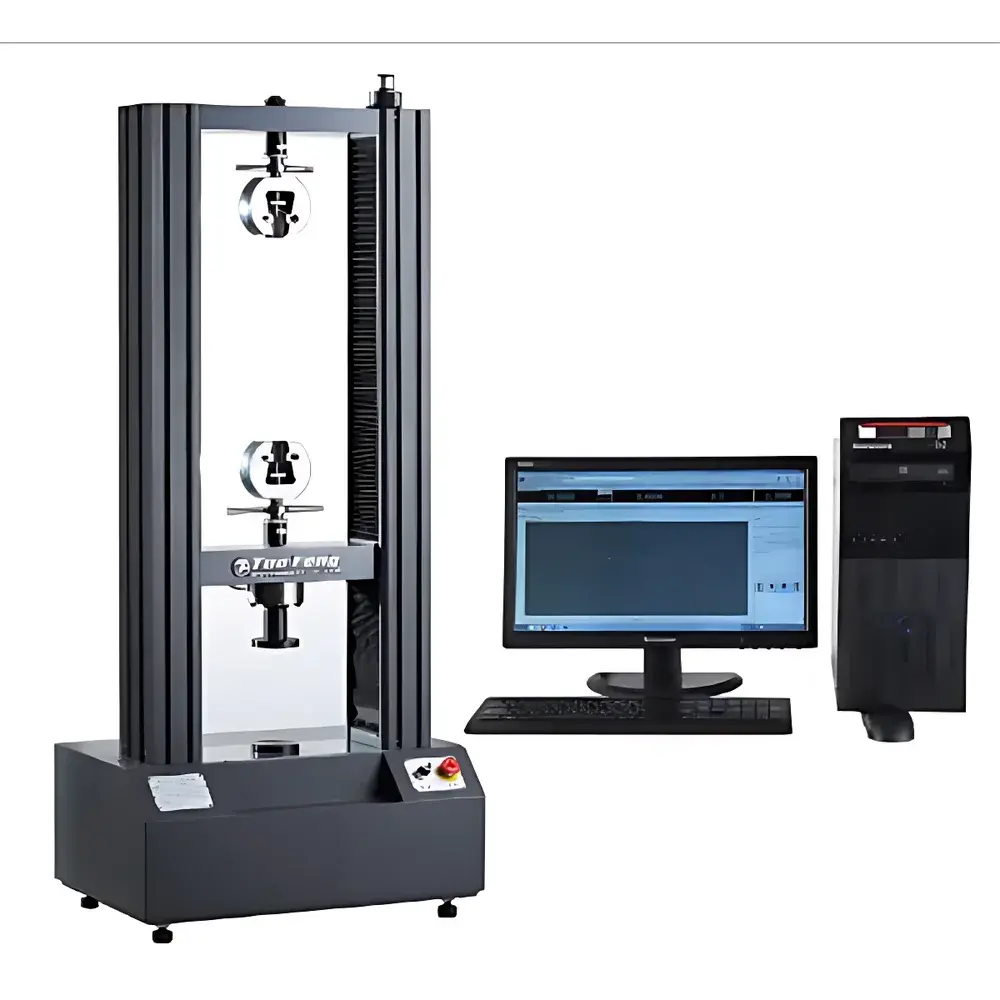
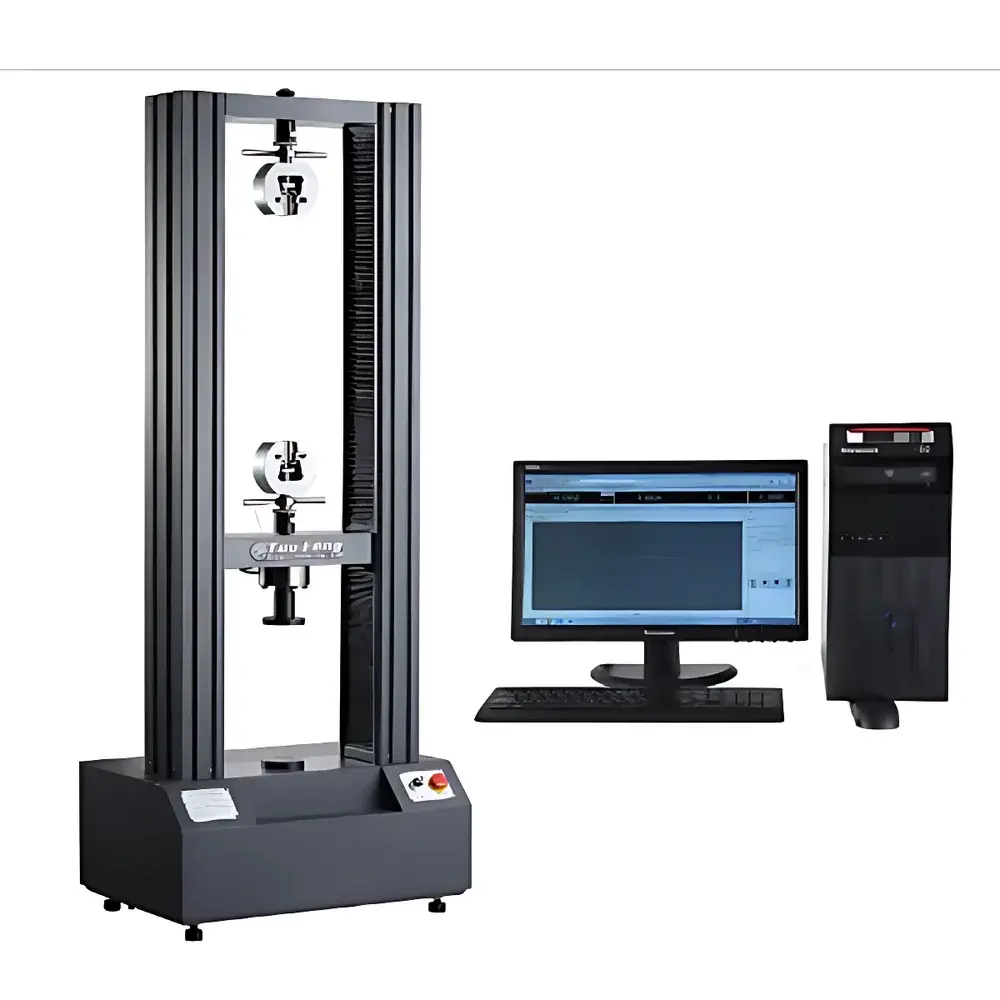
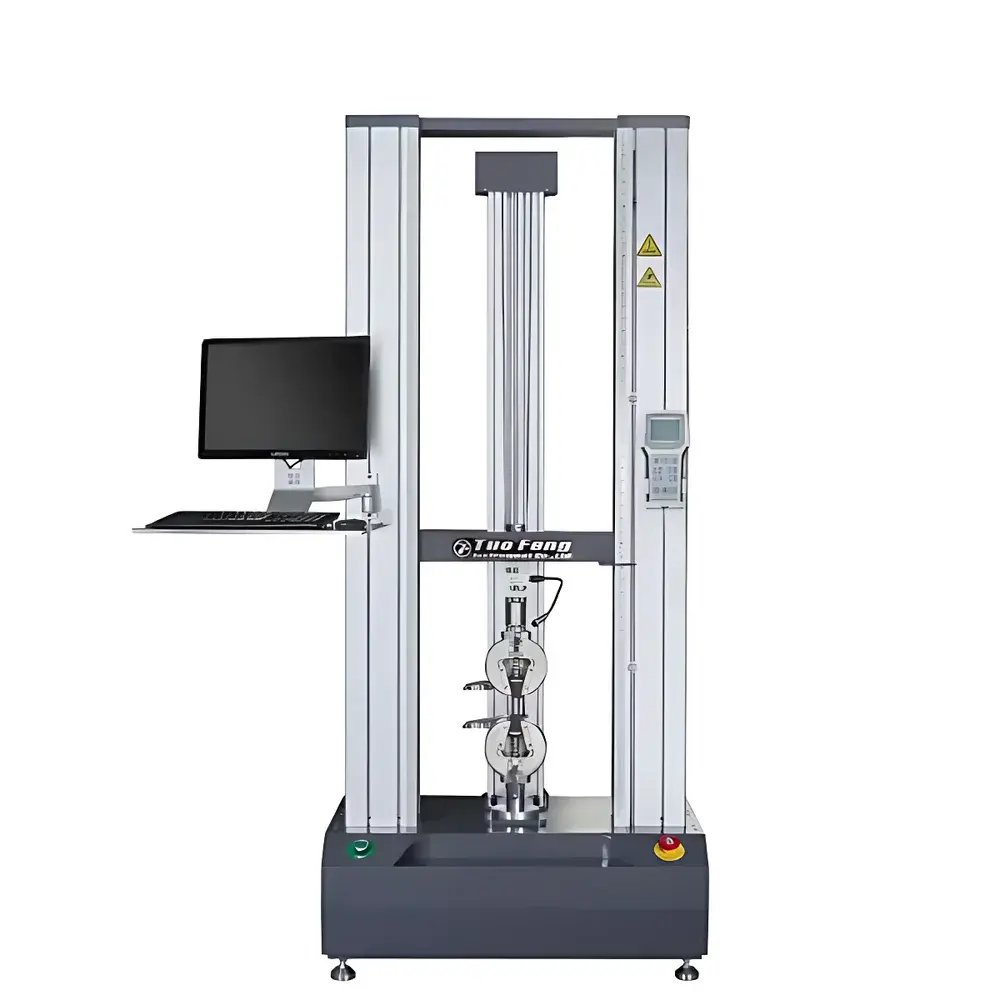
Tuofeng TFW-309 Microcomputer-Controlled Electronic Universal Testing Machine
| Brand | Tuofeng |
|---|---|
| Origin | Shanghai, China |
| Manufacturer Type | Direct Manufacturer |
| Model | TFW-309 |
| Load Capacity | 300 kN |
| Load Accuracy | ±0.5% |
| Instrument Type | Electromechanical Universal Testing Machine |
| Compliance | GB/T 16491–2008, JJG 475–2008 |
| Standards Supported | GB, ASTM, ISO, DIN, JIS, BS |
Overview
The Tuofeng TFW-309 is a high-precision electromechanical universal testing machine engineered for static mechanical property evaluation of metallic, non-metallic, and composite materials under controlled uniaxial loading conditions. It operates on the principle of servo-controlled force application via a precision ball-screw drive system, coupled with real-time closed-loop feedback from high-stability load cells and optical encoder-based displacement measurement. Designed to meet Class 0.5 accuracy per GB/T 16491–2008 and calibrated in accordance with JJG 475–2008 metrological verification requirements, the TFW-309 delivers traceable, repeatable, and reproducible results across tensile, compressive, flexural, shear, tear, peel, and puncture test modes. Its architecture supports full-range force measurement from 0.2% to 100% of full scale without range switching, ensuring linearity and resolution consistency throughout the entire 300 kN capacity.
Key Features
- High-resolution force measurement system with ±0.5% load accuracy and internal resolution of 1 part in 500,000 full-scale codes
- Dual-speed motorized crosshead control (fast/slow) with programmable return-to-start functionality post-test
- Precision ground ball-screw transmission system paired with imported servo motor and worm-gear reducer for low-noise, high-torque operation
- Integrated safety architecture including electronic limit switches, emergency stop circuitry, and automatic overload protection (>110% FS)
- Modular fixture interface accommodating standardized and custom-designed grips for wires, cables, rods, sheets, and molded specimens
- Adjustable test width (standard 400 mm, extendable up to 1100 mm) and vertical travel (standard 800 mm, extendable)
- Test speed range: 0.001–500 mm/min, continuously variable and programmable via software-defined ramp profiles
Sample Compatibility & Compliance
The TFW-309 accommodates specimens ranging from fine-diameter copper/aluminum conductors (e.g., 0.1–10 mm Ø) to armored power cables and fiber-reinforced polymer (FRP) sheaths. With optional extensometry—either clip-on axial extensometers or non-contact video-based systems—it supports strain-controlled protocols required by ASTM D412, ISO 37, IEC 60811-501, and GB/T 2951.12 for cable insulation and jacket characterization. The system complies with national and international regulatory frameworks including GB/T 16491–2008 (Chinese standard for electronic UTM design), JJG 475–2008 (verification regulation), and is routinely validated against reference standards traceable to NIM (National Institute of Metrology, China). While not inherently 21 CFR Part 11 compliant out-of-the-box, audit-trail-ready data logging and user-access controls can be implemented via optional software configuration for GLP/GMP environments.
Software & Data Management
The Windows-based control and analysis software provides multi-language support (English, Simplified/Traditional Chinese), unit conversion across SI, imperial, and metric systems, and real-time visualization of up to four simultaneous curves—including load vs. time, load vs. displacement, stress vs. strain, and displacement vs. time. Built-in calculation modules automatically derive standard mechanical parameters: tensile strength, yield strength (0.2% offset), elongation at break, modulus of elasticity, compressive strength, tear strength, peel adhesion, and puncture resistance. Test sequences may be saved as reusable templates; batch processing enables statistical reporting (mean, min, max, CV%) across replicate specimens. All raw data—including timestamps, operator ID, environmental metadata (if integrated sensors are present), and instrument calibration status—are embedded in exportable .csv and .xlsx files. Software updates are provided free of charge for the lifetime of the instrument, with version history and change logs maintained per ISO/IEC 17025 documentation requirements.
Applications
This system serves as a primary mechanical characterization tool in wire and cable manufacturing QA/QC labs, where it validates conductor tensile integrity, insulation elongation limits, and jacket abrasion resistance per UL 1581, ICEA S-73-532, and EN 50363. It is also deployed in aerospace component validation (e.g., carbon-fiber braided sleeves), automotive harness testing (ISO 6722), rubber compound development (ASTM D395), and R&D for novel polymer blends used in submarine telecom cables. Universities utilize the platform for fundamental viscoelastic modeling, while third-party certification bodies rely on its repeatability for accredited material declarations under CNAS (China National Accreditation Service) scopes.
FAQ
What is the maximum cable diameter the TFW-309 can accommodate in tensile mode?
Standard configurations support specimens up to 60 mm in outer diameter using open-throat wedge grips; custom jaw designs extend this to 120 mm.
Does the system support ASTM D882 for thin plastic films?
Yes—with optional pneumatic side-action grips and extensometer integration, the machine meets all dimensional and rate-control requirements of ASTM D882–22.
Can test data be exported directly to LIMS or ERP platforms?
Raw ASCII-formatted output (.csv) is natively supported; API-based integration with major LIMS vendors (e.g., LabWare, Thermo Fisher SampleManager) is available upon request.
Is thermal chamber compatibility available?
The base frame supports integration with environmental chambers operating from –70°C to +300°C (requires external vendor coordination and mechanical interface verification).
What maintenance intervals are recommended for long-term accuracy retention?
Load cell recalibration every 12 months, ball-screw lubrication every 6 months, and annual verification of encoder linearity and crosshead alignment per manufacturer’s service manual.



